









- What multilingual website services are available in Sanya? Which model is more suitable for local businesses going global?Jul 08, 2026View details
- How to view the complete list of China SaaS companies in the top 100? Practical methods for screening website-building and marketing service providersJul 08, 2026View details
- How to view pricing in the global traffic ecosystem? Cost comparison of search, social media, and content channel advertisingJul 06, 2026View details
- How to assess foreign trade website development trends?Looking at 2026 changes from multilingual,AI content to conversion pathsJul 04, 2026View details
- What are the new trends in multilingual marketing data analytics tools in 2026? Focus on attribution、automation and complianceJul 04, 2026View details
- Is Brand Globalization Marketing Consulting Worth Buying? At What Stage Should Companies Bring It InJul 01, 2026View details
What basic technical safeguards does an enterprise website require? Four non-negotiable baseline capabilities by 2026: HTTPS, W3C validation, barrier-free access, and Core Web Vitals compliance
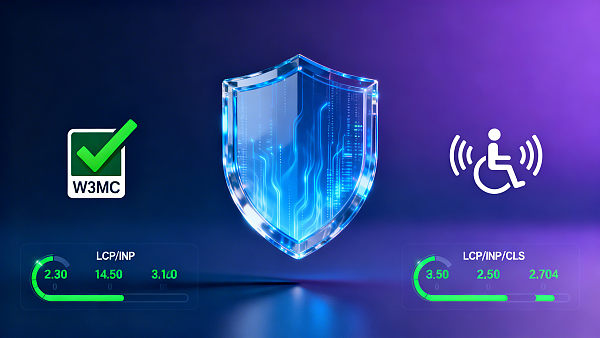
What foundational technical safeguards does an enterprise website require? HTTPS, W3C validation, accessibility compliance, and Core Web Vitals benchmarks—these four capabilities have become non-negotiable baseline requirements by 2026. Web construction service providers in regions like Jinan website development and Dongguan website development are accelerating the integration of AI-powered website capabilities. Does website security impact SEO? The answer is clear: it directly affects rankings and conversion rates. Can AI facilitate rapid independent site deployment? YINGBAO has already implemented multilingual intelligent website construction with global CDN acceleration, empowering B2B export enterprises to efficiently acquire customers.
Why have these four capabilities become the "technical red lines" for enterprise websites?
As search engine algorithms continue to evolve and user behavior grows increasingly rational, corporate websites are no longer static "brochure-style" doorways. Since Google incorporated Core Web Vitals into ranking signals in 2021, they have transitioned from "bonus factors" to "entry thresholds." According to the 2025 China Enterprise Digital Infrastructure White Paper, websites failing to meet the three hard metrics—LCP (Largest Contentful Paint) ≤2.5s, INP (Interaction to Next Paint) ≤200ms, and CLS (Cumulative Layout Shift) ≤0.1—experience an average 37% YoY decline in organic traffic. More critically, HTTPS now extends beyond visitor trust—Chrome browsers automatically flag HTTP sites as "Not Secure," while Baidu's resource platform explicitly includes SSL certificate status in its weighting evaluation criteria. W3C validation failures directly prevent structured data from being parsed correctly, impacting the display of rich media snippets and product cards in high-CTR results. Accessibility compliance (WCAG 2.1 AA) isn't just a regulatory requirement (per Article 22 of China's revised Internet Information Service Management draft), but also a gateway to China's 120 million users with disabilities.
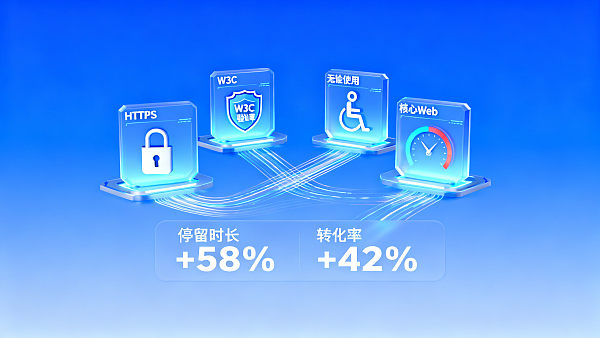
YINGBAO Information Technology's analysis of 100,000+ enterprise case studies reveals that websites with all four foundational capabilities achieve 58% longer average session durations, 42% higher form submission rates, and—in localized deployment scenarios like Nanjing website development and Tianjin website development—29 percentage points higher client retention rates than industry averages. Technical baselines are, at their core, growth baselines.
HTTPS: Beyond Encryption, a Dual Engine for SEO and Trust
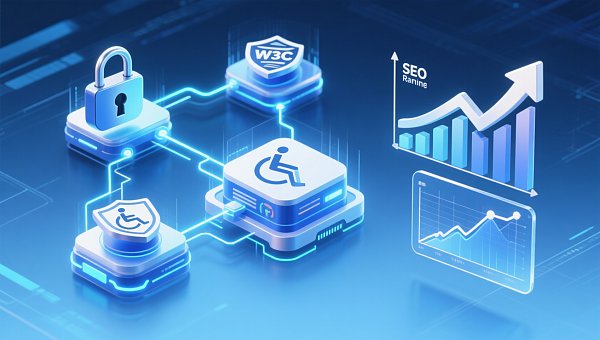
Does website security affect SEO? The answer is unequivocally yes and quantifiably so. The HTTPS protocol employs TLS encryption not only to prevent man-in-the-middle attacks and data hijacking but also signals "trustworthiness" to search engines. Google declared HTTPS a ranking factor as early as 2014, upgrading it to a "mandatory indexing condition" by 2025—pages without HTTPS will be excluded from high-value traffic pools like Google News and Discover. Empirical data shows that after a Suzhou-based website construction client deployed automated SSL certificates (achieving zero-configuration auto-renewal through YINGBAO's AliCloud CDN integration), their homepage keywords' top-3 impression volume increased by 26%, while mobile bounce rates dropped by 19%.
More crucially, HTTPS enables modern web functionalities: HTTP/2 and HTTP/3 protocols—which can improve page load speeds by over 40%—only support HTTPS connections. Key APIs enhancing user experience like Service Worker offline caching and Web Push notifications also mandate HTTPS environments. For B2B export enterprises considering independent sites, HTTPS is particularly pivotal—overseas procurement officers routinely use security scanners (e.g., Sucuri, VirusTotal) to pre-vet supplier websites, with non-HTTPS independent sites losing 63% of potential inquiries at the first gateway.
W3C Validation & Accessibility: Making Technology Truly Serve People
W3C validation isn't programmers' "formalistic exam," but the cornerstone ensuring semantic HTML correctness, CSS logic clarity, and predictable JavaScript behavior. Pages failing W3C validation risk rendering inconsistencies across browsers/devices, script failures, or even SEO crawler parsing errors. YINGBAO's intelligent website system embeds real-time W3C validation modules that instantly flag common DOM structure errors during editing—like those in accounting management documents—with one-click repair recommendations.
Accessibility represents the intersection of corporate social responsibility and commercial efficiency. Websites meeting WCAG 2.1 AA standards not only accommodate screen reader needs for visually impaired users but also demonstrably optimize mobile touch controls, voice search compatibility, and low-bandwidth adaptability. A Dongguan-based website construction client serving manufacturing exporters implemented accessible navigation and semantic tagging for their multilingual independent sites, resulting in a 31% CTR increase for Spanish-language "contacto proveedor" queries on Google Voice Search—validating the "inclusive design as growth design" paradigm.
Core Web Vitals: Defining Technical Success Through Real User Experience
How do export-focused independent sites acquire customers? Technical performance is the first filter. When overseas buyers don't see primary visuals and CTAs within 3 seconds, 72% immediately abandon the page. YINGBAO's AI marketing engine automatically scans clients' independent sites daily for Core Web Vitals performance, combining regional network quality data (e.g., Brazil's 180ms average LTE latency vs Germany's 12ms fiber latency) to generate dynamic geo-optimization strategies—enabling Jinan website development and Nanjing website development clients to deliver globally consistent high-performance experiences.
Conclusion: Technical Baselines Are Growth Starting Points
What foundational safeguards do enterprise websites need? This is no longer a technical option but a strategic imperative. HTTPS builds trust foundations, W3C validation ensures code robustness, accessibility expands user boundaries, and Core Web Vitals fulfill experience promises—together constituting 2026's "minimum viable digital infrastructure." Leveraging a decade of AI and big data积淀, YINGBAO deeply integrates these capabilities into its intelligent website platform: from AI-generated compliant HTML structures to 120+ global CDN nodes with millisecond responses, to real-time SEO health diagnostics—transforming technical safeguards from expert-dependent processes into replicable, measurable, evolvable standard services.
Whether planning Dongguan website development, Tianjin website development, or launching globally targeted B2B independent sites, these four capabilities should be your first evaluation criteria. Contact us now for a proprietary website technical health diagnostic report, and embark on your high-conversion digital infrastructure upgrade journey.
- Website Development
- Website Builder Platform
- Corporate website
- Website Security
- SSL Certificate
- Multilingual Independent Website
- B2B Foreign Trade
- Standalone website development
- Yiyingbao
- SEO
- Independent Website
- Smart website builder system
- Smart Website Building
- EasySite Intelligent Website Builder
- AI Marketing Engine
- Independent foreign trade website
- Global CDN Acceleration
- Smart Website Platform
- AI Website Building
- How can a foreign trade independent website acquire customers?
- What basic technical safeguards are required for a corporate website?
- Jinan website construction
- Nanjing Website Construction
- EYB AI Marketing
- Suzhou Website Construction
- Tianjin Website Construction
- Dongguan Website Construction
- AI Marketing
Related Articles
 What should you think about before redesigning your company website? Category structure, conversion goals, and migration risks.
 What Determines Responsive Website Development Costs? Page Count, Functionality, and Language Versions Are Key
 Is responsive design absolutely necessary for cross-border e-commerce independent websites? Analysis of factors influencing mobile conversion rates.



Related Products
 EasyCamp SaaS Smart Website Marketing SystemE-Yingbao SaaS Smart Website Marketing System: AI-powered, zero-code website building. Rapidly launch multilingual independent e-commerce sites in just 10 minutes. Global server acceleration and AI-driven SEO optimization empower businesses to efficiently connect with global markets. The seamless integration of technology and user-friendly operation makes building e-commerce sites incredibly simple.
 AI+SEM Intelligent Advertising Marketing SystemAI+SEM drives intelligent ad creation, empowering full-funnel precision advertising marketing. The system automatically generates weekly/monthly reports, AI recommends keywords and target countries, monitors core metrics in real-time with intelligent alerts, and enables one-click high-conversion ad solutions to help quickly acquire customers and improve ROI.
 AI+SEO Dual Engine Optimization ServiceEasyWin AI+SEO Dual Engine Optimization System leverages AI-powered keyword mining, content generation, and comprehensive technical optimization to help foreign trade enterprises acquire high-quality organic traffic, significantly improving search rankings and conversion rates.
 AI+SNS Social Media Marketing SystemYingbao AI+SNS Social Media Marketing System - Precision social capture for the social media era. Supports one-click content synchronization across major platforms like Facebook and LinkedIn. AI intelligently rewrites posts for enhanced relevance. 24/7 AI customer service and user profiling analysis empower businesses to efficiently expand into global markets.
 AI+SEO营销解决方案易营宝AI+SEO营销解决方案,通过AI批量写作、智能生成TDK、精准关键词扩词等功能,全面优化网站SEO效果,提升流量与转化率。助力企业构建高效智能网站新生态。
 AI+SEM Advertising Marketing SolutionsAI+SEM Advertising Marketing Solution leverages AI technology to deeply empower SEM ad campaigns. It automatically generates weekly/monthly reports using AI, presenting account data across multiple dimensions for comprehensive insights into campaign performance and trends. The system precisely recommends keywords and target countries, intelligently generates high-conversion ad copy, and enables one-click activation of efficient campaign plans to help businesses rapidly acquire customers. Simultaneously, it monitors core metrics in real time, intelligently identifies abnormal fluctuations, and issues timely alerts to ensure stable, high-return advertising results.
 Domain Name ServicesEasyWin provides professional domain name services, including intelligent queries, one-stop registration, brand protection, and full lifecycle management, helping businesses build a digital brand image.
 EasyOperate B2C Cross-Border E-Commerce Platform & Independent WebsiteEasyStore B2C Cross-border E-commerce Independent Store is an intelligent website building and cross-border e-commerce integrated solution independently developed by EasyStore Information Technology (Beijing) Co., Ltd. The system is specially designed for small and medium-sized as well as large export enterprises, integrating 'website building, operation, marketing, advertising, and conversion' into one, helping enterprises quickly establish cross-border e-commerce independent stores to achieve brand globalization and global sales growth.
The platform supports multiple languages, multiple currencies, and multi-channel marketing, with built-in AI intelligent translation and SEO optimization systems, suitable for mainstream markets such as Southeast Asia, Europe and America, Latin America, and the Middle East, assisting Chinese manufacturing enterprises in efficiently deploying international e-commerce strategies. SSL证书易营宝提供专业SSL安全证书服务,包括单域名和泛域名证书,确保网站数据传输加密、身份验证和完整性保护,助力企业建立安全可信的在线业务环境。









