









- What Does a Global Traffic Ecosystem Service Provider Do? What Are the Differences from a Single Advertising AgencyJul 16, 2026View details
- What should you focus on in the latest enterprise SaaS report? From renewal rates and delivery costs to overseas growth opportunitiesJul 12, 2026View details
- What signals are worth paying attention to in a cross-border marketing trend report? B2B companies should look at these 6 signalsJul 11, 2026View details
- How to Read a Cross-Border Marketing Trends Report? Five Key Dimensions for Evaluating Channel OpportunitiesJul 11, 2026View details
- Which channel has the highest ROI in the global traffic ecosystem? Comparative analysis of search, social media, and advertisingJul 10, 2026View details
- What multilingual website services are available in Sanya? Which model is more suitable for local businesses going global?Jul 08, 2026View details
- How to view the complete list of China SaaS companies in the top 100? Practical methods for screening website-building and marketing service providersJul 08, 2026View details
- How to view pricing in the global traffic ecosystem? Cost comparison of search, social media, and content channel advertisingJul 06, 2026View details
Does a corporate website redesign require SEO to be redone?
Does a corporate website redesign require SEO to be redone? The answer is usually yes. Once the page structure, URLs, content, and tags are adjusted, search rankings and traffic may fluctuate. Only by planning ahead and optimizing simultaneously can you avoid declines in indexing and customer loss.
Why SEO usually needs to be redone after a corporate website redesign
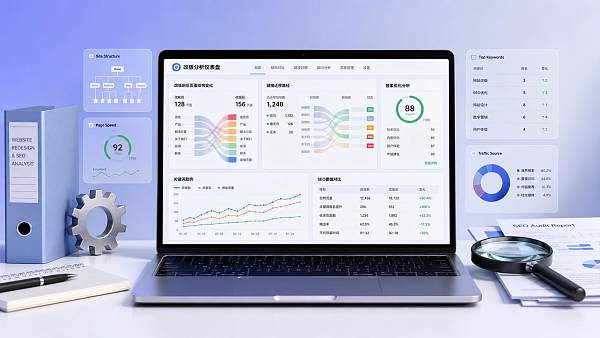
Many companies understand a website redesign as a visual upgrade, focusing on page aesthetics, user interaction, and backend management while overlooking how search engines interpret existing pages. As long as the redesign involves URLs, category hierarchy, content layout, title tags, or internal linking logic, the SEO foundation will be reshuffled.
Therefore, when discussing whether SEO needs to be redone after a corporate website redesign, the key question is not “whether,” but “to what extent.” Some projects only require localized fixes, while others need a comprehensive rebuild covering indexing, keywords, redirect rules, and content strategy.
- If the URL structure of the old site changes, existing ranking pages may lose the transfer of authority, causing significant fluctuations in search traffic.
- If page content is extensively deleted or revised, the industry terms, product terms, and long-tail keywords originally covered may be lost at the same time.
- If the redesign focuses only on design and neglects technical SEO, common issues include duplicate pages, broken links, missing titles, declining indexing, and confusing conversion paths.
For foreign trade companies, manufacturing factories, cross-border brands, and multilingual websites, the SEO impact of a redesign is even greater, because websites for different countries, language versions, and customer-acquisition pages inherently rely on more rigorous technical structures and content planning.
Which redesign actions are most likely to cause ranking and traffic declines
Not every redesign causes serious losses, but the following actions are often high-risk areas. If a company does not prepare an SEO plan before launch, it will usually see significant changes in indexing, keyword rankings, and the number of inquiries within two to eight weeks after the redesign.
Checklist of high-risk redesign actions
- Changing the domain name or directory structure without establishing a complete 301 redirect mapping.
- Reclassifying product or service categories, resulting in the deletion or consolidation of old pages.
- After adopting a new website-building system, failing to configure titles, descriptions, canonical tags, and sitemaps accordingly.
- Failing to address language-version relationships and regional targeting logic when redesigning a multilingual website.
- Removing large amounts of body content in pursuit of a minimalist design, resulting in lower topical relevance.
From the perspective of integrated website and marketing services, a corporate website is not merely a presentation tool but also a long-term customer-acquisition asset. If a website redesign focuses only on delivery time and page appearance while ignoring search visibility, the company will need to spend more on advertising to make up for the traffic gap, resulting in higher overall costs.
Does a corporate website redesign require SEO to be redone? Use this table for a quick assessment
If you are still deciding whether SEO needs to be redone after a corporate website redesign, you can first compare the redesign type with the recommended approach below. Different redesign depths require completely different scopes of SEO work.
Simply put, the deeper the redesign, the less you can rely on “retaining the original content” to maintain rankings. Search engines evaluate page paths, structural relationships, topical signals, and crawl efficiency—not merely whether the page text is similar.
What should be done before, during, and after a redesign to minimize SEO losses
SEO work for a website redesign should not begin only on launch day. The truly effective approach is to distribute optimization tasks across the pre-redesign, development, and post-launch stages. This makes it possible to balance design, technology, indexing, and conversion, instead of waiting for traffic to decline before taking corrective action.
Before the redesign: Take inventory of your assets first
- Export key pages that currently receive traffic, rank in search results, or have backlinks to avoid accidentally deleting high-value pages.
- Organize core keywords, product terms, regional terms, and inquiry-related keywords, and clarify which pages are responsible for customer acquisition.
- Create a mapping table between old and new URLs to prepare for subsequent 301 redirects and monitoring.
During development: Include SEO requirements in the delivery checklist
- Ensure that titles, descriptions, H tags, image ALT attributes, and canonical tags can be customized.
- Control loading speed, mobile responsiveness, redundant code, and the logic for generating duplicate pages.
- For multilingual websites, plan the directory, subdomain, or independent-site strategy in advance and maintain one-to-one correspondence between language versions.
After launch: Monitor continuously for four to eight weeks
- Check whether 301 redirects are working, focusing on whether old pages correctly point to new pages.
- Submit the sitemap and continuously monitor changes in crawling, indexing, rankings, and conversion paths.
- Perform secondary optimization on declining pages, including content enhancement, internal-link repair, and landing-page adjustments.
Why using separate suppliers for website development and marketing makes SEO loss after a redesign more likely
Many companies assign website development to a technology company and promotion to a marketing team. As a result, the two parties may have different objectives when the redesigned website goes live. The former focuses on whether the pages have been delivered, while the latter focuses on traffic and inquiries, but there is no unified data framework or execution standard between them.
The most common problem with this fragmented approach is that SEO is added temporarily only after the design has been finalized. This can result in URLs that cannot be retained, insufficient content areas, categories that are unsuitable for search positioning, and even multilingual pages without a sustainable expansion structure.
Yeeplab provides foreign trade companies, manufacturing factories, cross-border e-commerce sellers, and brands expanding overseas with coordinated solutions covering AI-powered website building, multilingual website development, Google SEO optimization, advertising, and GEO. Its advantage lies in planning website development, indexing, promotion, and conversion within the same growth framework, rather than passively fixing gaps after launch.
What capabilities should companies focus on when choosing a redesign service provider
If your question is not simply whether SEO needs to be redone after a corporate website redesign, but also “who can truly handle the redesign and customer acquisition together,” then you should not evaluate providers solely on pricing and page examples. You should also assess their understanding of the search and marketing journey.
The table below is suitable for quick use when comparing service providers. Companies planning to build multilingual corporate websites, overseas independent sites, B2B inquiry websites, and cross-border e-commerce stores should pay particular attention to including SEO capabilities in the delivery assessment.
For buyers, what truly deserves attention is not “whether a website can be built,” but “whether the redesigned website can continue to generate stable traffic, qualified inquiries, and measurable growth.” This is also why integrated services are more valuable than single-point outsourcing.
Common misconceptions and FAQ: Does a corporate website redesign require SEO to be redone?
If the original content is retained after the redesign, does SEO no longer need to be redone?
Not necessarily. Even if the body text remains unchanged, search engines will still reevaluate the page if the URL, page hierarchy, template structure, title tags, or internal linking relationships have changed. Content is only one part of SEO; technical structure is equally important.
After a corporate website redesign, is a ranking decline normal fluctuation or a serious problem?
Minor fluctuations are common in the short term. However, if indexing continues to decline two to four weeks later, core keyword rankings are noticeably lost, and form inquiries decrease, this indicates more than normal volatility. Problems may have occurred with redirects, page authority transfer, or content layout during the redesign.
Why does a multilingual website redesign require SEO to be redone more often?
A multilingual corporate website involves not only page content but also target countries, language versions, directory structures, and different search habits. If the relationships between language sites become disorganized after the redesign, indexing may become fragmented, topics may be duplicated, and alignment with target markets may become unclear.
When the budget is limited, which parts of SEO should be prioritized after a redesign?
The usual priorities are: 301 redirects, retaining core pages, fixing title tags and descriptions, submitting the sitemap, checking speed and mobile compatibility, and strengthening the content of key product pages. Protect existing traffic first, then gradually expand into new content and keywords for new markets.
Why choose us: Plan website redesign, SEO, and overseas customer acquisition together
For companies evaluating whether SEO needs to be redone after a corporate website redesign, the more practical question is how to reduce traffic losses during the redesign and make the new website more suitable for long-term promotion. Relying on its self-developed cloud intelligent website-building system, AI+SEO/GEO optimization system, and overseas marketing capabilities, Yeeplab can coordinate website development, search optimization, advertising, and conversion paths within a unified plan.
If you are preparing to upgrade your corporate website, rebuild a multilingual independent site, or improve Google SEO and the quality of overseas inquiries after a redesign, you may wish to consult us about the following: SEO risk diagnosis for the existing website, URL migration and 301 solutions, category and keyword planning, delivery timeline assessment, multilingual site structure recommendations, coordinated advertising landing-page solutions, and post-redesign ongoing operations and pricing.
In an integrated website and marketing service scenario, a redesign should not merely “change the look.” It should serve as the starting point for improving indexing, conversions, and visibility in global markets. The earlier SEO is incorporated into the redesign process, the lower the subsequent repair costs and the more stable the foundation for growth.
Related Articles

Related Products
 EasyCamp SaaS Smart Website Marketing SystemE-Yingbao SaaS Smart Website Marketing System: AI-powered, zero-code website building. Rapidly launch multilingual independent e-commerce sites in just 10 minutes. Global server acceleration and AI-driven SEO optimization empower businesses to efficiently connect with global markets. The seamless integration of technology and user-friendly operation makes building e-commerce sites incredibly simple.
 AI+SEM Intelligent Advertising Marketing SystemAI+SEM drives intelligent ad creation, empowering full-funnel precision advertising marketing. The system automatically generates weekly/monthly reports, AI recommends keywords and target countries, monitors core metrics in real-time with intelligent alerts, and enables one-click high-conversion ad solutions to help quickly acquire customers and improve ROI.
 AI+SEO Dual Engine Optimization ServiceEasyWin AI+SEO Dual Engine Optimization System leverages AI-powered keyword mining, content generation, and comprehensive technical optimization to help foreign trade enterprises acquire high-quality organic traffic, significantly improving search rankings and conversion rates.
 AI+SNS Social Media Marketing SystemYingbao AI+SNS Social Media Marketing System - Precision social capture for the social media era. Supports one-click content synchronization across major platforms like Facebook and LinkedIn. AI intelligently rewrites posts for enhanced relevance. 24/7 AI customer service and user profiling analysis empower businesses to efficiently expand into global markets.
 AI+SEO营销解决方案易营宝AI+SEO营销解决方案,通过AI批量写作、智能生成TDK、精准关键词扩词等功能,全面优化网站SEO效果,提升流量与转化率。助力企业构建高效智能网站新生态。
 AI+SEM Advertising Marketing SolutionsAI+SEM Advertising Marketing Solution leverages AI technology to deeply empower SEM ad campaigns. It automatically generates weekly/monthly reports using AI, presenting account data across multiple dimensions for comprehensive insights into campaign performance and trends. The system precisely recommends keywords and target countries, intelligently generates high-conversion ad copy, and enables one-click activation of efficient campaign plans to help businesses rapidly acquire customers. Simultaneously, it monitors core metrics in real time, intelligently identifies abnormal fluctuations, and issues timely alerts to ensure stable, high-return advertising results.
 Domain Name ServicesEasyWin provides professional domain name services, including intelligent queries, one-stop registration, brand protection, and full lifecycle management, helping businesses build a digital brand image.
 EasyOperate B2C Cross-Border E-Commerce Platform & Independent WebsiteEasyStore B2C Cross-border E-commerce Independent Store is an intelligent website building and cross-border e-commerce integrated solution independently developed by EasyStore Information Technology (Beijing) Co., Ltd. The system is specially designed for small and medium-sized as well as large export enterprises, integrating 'website building, operation, marketing, advertising, and conversion' into one, helping enterprises quickly establish cross-border e-commerce independent stores to achieve brand globalization and global sales growth.
The platform supports multiple languages, multiple currencies, and multi-channel marketing, with built-in AI intelligent translation and SEO optimization systems, suitable for mainstream markets such as Southeast Asia, Europe and America, Latin America, and the Middle East, assisting Chinese manufacturing enterprises in efficiently deploying international e-commerce strategies. SSL证书易营宝提供专业SSL安全证书服务,包括单域名和泛域名证书,确保网站数据传输加密、身份验证和完整性保护,助力企业建立安全可信的在线业务环境。









