









- What Does a Global Traffic Ecosystem Service Provider Do? What Are the Differences from a Single Advertising AgencyJul 16, 2026View details
- What should you focus on in the latest enterprise SaaS report? From renewal rates and delivery costs to overseas growth opportunitiesJul 12, 2026View details
- What signals are worth paying attention to in a cross-border marketing trend report? B2B companies should look at these 6 signalsJul 11, 2026View details
- How to Read a Cross-Border Marketing Trends Report? Five Key Dimensions for Evaluating Channel OpportunitiesJul 11, 2026View details
- Which channel has the highest ROI in the global traffic ecosystem? Comparative analysis of search, social media, and advertisingJul 10, 2026View details
- What multilingual website services are available in Sanya? Which model is more suitable for local businesses going global?Jul 08, 2026View details
Which Is More Cost-Effective: SaaS Website Building or Custom-Coded Development?
Which is more cost-effective: a SaaS website-building platform or custom-built code? This is not only about the initial budget; it also affects launch speed, SEO performance, maintenance costs, and future growth. For most companies focused on lead generation and overseas marketing, the answer is often not “which one is cheaper,” but which option can deliver business results faster with a controllable investment.
If a company currently prioritizes rapid launch, stable operation, ongoing promotion, and global market validation, SaaS website building is usually more cost-effective. If business processes are highly complex, system integration requirements are extremely demanding, and the company has a mature technical team, custom-built code may offer long-term advantages. The real criteria are total cost, growth efficiency, and management risk—not simply the development quote.
The conclusion first: what companies are really comparing is not website-building methods, but growth efficiency
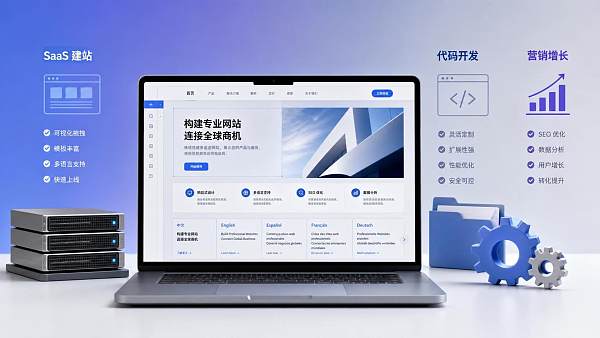
Readers searching for “Which is more cost-effective: a SaaS website-building platform or custom-built code?” are usually not looking for technical definitions. They want to quickly determine where to allocate their budget so they can launch faster, generate leads more reliably, and avoid rising costs over time.
These readers are generally most concerned about four things: first, how much the initial investment differs; second, whether SEO and Google indexing will be affected; third, whether ongoing maintenance will continue to consume money; and fourth, whether the website can keep up with future business growth.
Therefore, determining which option is “more cost-effective” cannot be based solely on the initial payment. A website that is inexpensive but slow to launch, difficult to modify, and built on a weak SEO foundation may slow down promotional efforts. By contrast, a platform that appears to have a higher annual fee but supports rapid publishing, comprehensive multilingual capabilities, and ready-to-use marketing functions may deliver better overall return on investment.
Why many companies underestimate the true cost of custom-built code
When evaluating website development for the first time, many companies tend to view custom-built code as “develop once and own it forever.” This is only half true. The code does belong to the company, but it is never a one-time asset. It also entails long-term technical maintenance, version upgrades, security fixes, and dependence on personnel.
The cost of custom-built code generally includes product design, front-end and back-end development, testing, server deployment, domain and CDN services, content management backends, data backups, vulnerability fixes, performance optimization, and labor costs for every subsequent minor change. These costs are often not fully included when the project is initiated.
For foreign trade companies, manufacturing factories, and brands expanding overseas in particular, a website is not finished once it is built. Companies need to continuously add language versions, create landing pages, support advertising campaigns, integrate form tracking, and carry out SEO optimization. As long as the business changes, custom-built code will continue to generate secondary development costs.
There is also a more practical issue: personnel risk. Many companies’ websites are not held back by technical problems, but by the departure of the original developer, slow response from an outsourcing provider, or incomplete documentation. Once subsequent iterations fail to keep up, the website can become a sunk cost that the company appears to own but cannot use efficiently.
Why SaaS website building is often better suited to marketing websites and overseas-facing corporate websites
The advantage of SaaS website building is not only that it is fast to set up, but also that it standardizes the capabilities companies use most often. For example, template systems, visual editing, multilingual management, form collection, page SEO settings, mobile responsiveness, security updates, and server operations do not need to be developed from scratch.
For companies targeting overseas customer acquisition, what truly matters is whether the website can go live quickly and enter the promotion cycle as soon as possible. SaaS platforms can usually shorten the launch period from several months to several weeks or even less. Time itself is a cost: the earlier a website goes live, the sooner it can accumulate indexing, inquiries, and advertising conversion data.
At the SEO level, many companies worry that SaaS is unfavorable for optimization. However, the key issue is not whether the solution is SaaS, but whether the platform’s underlying architecture supports SEO-friendly structures. As long as it supports customizable TDK, URL rules, sitemaps, structured layouts, page speed optimization, and multilingual indexing, SaaS can also deliver effective Google optimization.
For marketing teams, SaaS also offers an underestimated benefit: a low barrier to making changes. Adding product pages, adjusting copy, publishing industry content, and creating campaign pages do not require waiting for developers to schedule every task. Content and pages can respond quickly to market changes, which is critical to both SEO and advertising efficiency.
How can you determine which option is more cost-effective? Look at these four core dimensions
First, consider launch speed. If a company is expanding into overseas markets, timing is important. SaaS is generally better suited to teams that need to validate the market quickly, launch advertising campaigns early, and capture traffic as soon as possible. Custom-built code is more suitable for projects whose requirements are already clearly defined and that are not under pressure to launch in the short term.
Second, consider team capabilities. If a company lacks stable product, technical, and operations resources, the ongoing cost of custom-built code will increase significantly. Conversely, if the company already has a mature R&D team and the website needs deep integration with an ERP, CRM, membership system, or complex transaction logic, custom-built code offers greater flexibility.
Third, consider marketing requirements. If the website mainly serves functions such as brand presentation, SEO lead generation, multilingual content delivery, and advertising landing-page conversion, a marketing-friendly SaaS platform is often more cost-effective. Companies are competing not on the originality of their code, but on page production efficiency and customer acquisition and conversion efficiency.
Fourth, consider the total cost of ownership over the next three years. Do not calculate only the first-year investment. Include development fees, maintenance fees, redesign costs, failure risks, communication costs, and time costs. Many companies ultimately find that although custom-built code appears manageable in the first year, its total cost over three years is often higher than that of a mature SaaS solution.
Which companies are better suited to SaaS, and which are better suited to custom-built code?
If you are a foreign trade company, factory, cross-border seller, or brand expanding overseas, and your core goals are to quickly launch an independent website, capture Google SEO traffic, and increase overseas inquiries, SaaS is usually the more practical choice. These companies generally need a stable, user-friendly website that can be promoted quickly, rather than a heavy development project.
If your business model is highly standardized and focuses on product presentation, multilingual expansion, content marketing, and advertising conversion, the standardized capabilities of SaaS can cover most of your needs. It allows companies to focus their efforts on content, traffic, and conversion instead of remaining tied up in long-term technical coordination.
However, if the company’s website is itself part of a business system—for example, if it involves complex quotation logic, advanced permission management, specialized interaction processes, non-standard database structures, or the need to establish two-way connections with multiple internal systems—the controllability of custom-built code may be more valuable.
Simply put, marketing-oriented websites are better suited to SaaS, while system-oriented platforms are better suited to custom-built code. When making a decision, a company should first determine the website’s primary responsibility: “lead generation and conversion” or “supporting complex business logic.” Different responsibilities lead to different answers about which option is most cost-effective.
From the perspective of actual operations, the truly cost-effective solution is the one that can continuously deliver results
Whether a website is cost-effective ultimately comes down to business results. For most companies, a website is not a technical work of art, but a sales channel, brand gateway, and content asset. If a website can be indexed by search engines faster, reliably handle advertising traffic, and continuously generate inquiries, it is the more cost-effective solution.
This is why more and more companies are choosing integrated services that combine website building, SEO, advertising, and multilingual capabilities. Simply building a website does not mean it will generate growth. What truly creates value is considering promotion, indexing, conversion, and global market adaptation from the very beginning of website development.
In overseas expansion scenarios, a SaaS website-building platform designed for global marketing can significantly reduce a company’s trial-and-error costs and shorten the cycle from website development to customer acquisition if it also provides AI content support, multilingual management, an SEO foundation, advertising landing-page capabilities, and ongoing operations support.
Therefore, there is no absolute answer to which is more cost-effective: a SaaS website-building platform or custom-built code. For most companies seeking to quickly gain overseas traffic and business opportunities, SaaS generally offers higher overall cost-effectiveness. For a small number of complex, system-oriented projects, custom-built code still has its own justification.
Summary: do not compare prices alone; compare total cost, speed, and growth potential
Returning to the original question, which is more cost-effective: a SaaS website-building platform or custom-built code? If a company’s goal is to launch quickly, operate stably, continuously carry out SEO and advertising promotion, and control long-term investment, SaaS is highly likely to be the more cost-effective choice. It is better suited to most marketing-oriented, overseas-focused, and lead-generation websites.
If a company has clearly defined complex business requirements, a mature technical team, and expectations for a relatively long development cycle, custom-built code can also provide greater freedom for customization. The prerequisite, however, is that the company is prepared to bear the long-term costs of development, maintenance, and management, rather than judging the solution solely by its initial development quote.
The truly rational way to choose is to work backward from business goals when selecting a website-building solution: do you need a website that can quickly generate traffic and inquiries, or a highly customized business system? Once this question is clear, the answer to “which is more cost-effective” will usually no longer be ambiguous.
Related Articles


Related Products
 EasyCamp SaaS Smart Website Marketing SystemE-Yingbao SaaS Smart Website Marketing System: AI-powered, zero-code website building. Rapidly launch multilingual independent e-commerce sites in just 10 minutes. Global server acceleration and AI-driven SEO optimization empower businesses to efficiently connect with global markets. The seamless integration of technology and user-friendly operation makes building e-commerce sites incredibly simple.
 AI+SEM Intelligent Advertising Marketing SystemAI+SEM drives intelligent ad creation, empowering full-funnel precision advertising marketing. The system automatically generates weekly/monthly reports, AI recommends keywords and target countries, monitors core metrics in real-time with intelligent alerts, and enables one-click high-conversion ad solutions to help quickly acquire customers and improve ROI.
 AI+SEO Dual Engine Optimization ServiceEasyWin AI+SEO Dual Engine Optimization System leverages AI-powered keyword mining, content generation, and comprehensive technical optimization to help foreign trade enterprises acquire high-quality organic traffic, significantly improving search rankings and conversion rates.
 AI+SNS Social Media Marketing SystemYingbao AI+SNS Social Media Marketing System - Precision social capture for the social media era. Supports one-click content synchronization across major platforms like Facebook and LinkedIn. AI intelligently rewrites posts for enhanced relevance. 24/7 AI customer service and user profiling analysis empower businesses to efficiently expand into global markets.
 AI+SEO营销解决方案易营宝AI+SEO营销解决方案,通过AI批量写作、智能生成TDK、精准关键词扩词等功能,全面优化网站SEO效果,提升流量与转化率。助力企业构建高效智能网站新生态。
 AI+SEM Advertising Marketing SolutionsAI+SEM Advertising Marketing Solution leverages AI technology to deeply empower SEM ad campaigns. It automatically generates weekly/monthly reports using AI, presenting account data across multiple dimensions for comprehensive insights into campaign performance and trends. The system precisely recommends keywords and target countries, intelligently generates high-conversion ad copy, and enables one-click activation of efficient campaign plans to help businesses rapidly acquire customers. Simultaneously, it monitors core metrics in real time, intelligently identifies abnormal fluctuations, and issues timely alerts to ensure stable, high-return advertising results.
 Domain Name ServicesEasyWin provides professional domain name services, including intelligent queries, one-stop registration, brand protection, and full lifecycle management, helping businesses build a digital brand image.
 EasyOperate B2C Cross-Border E-Commerce Platform & Independent WebsiteEasyStore B2C Cross-border E-commerce Independent Store is an intelligent website building and cross-border e-commerce integrated solution independently developed by EasyStore Information Technology (Beijing) Co., Ltd. The system is specially designed for small and medium-sized as well as large export enterprises, integrating 'website building, operation, marketing, advertising, and conversion' into one, helping enterprises quickly establish cross-border e-commerce independent stores to achieve brand globalization and global sales growth.
The platform supports multiple languages, multiple currencies, and multi-channel marketing, with built-in AI intelligent translation and SEO optimization systems, suitable for mainstream markets such as Southeast Asia, Europe and America, Latin America, and the Middle East, assisting Chinese manufacturing enterprises in efficiently deploying international e-commerce strategies. SSL证书易营宝提供专业SSL安全证书服务,包括单域名和泛域名证书,确保网站数据传输加密、身份验证和完整性保护,助力企业建立安全可信的在线业务环境。









