









- Is Brand Globalization Marketing Consulting Worth Buying? At What Stage Should Companies Bring It InJul 01, 2026View details
- Cross-Border Marketing Trend Research: Why More and More Companies Are Starting to Deploy AI Search and GEO OptimizationJun 30, 2026View details
- Cross-Border Marketing Trend Research: How Independent Sites, AI Content, and Short-Video Customer Acquisition Are ChangingJun 30, 2026View details
- How Can a Brand Updates Page Be Made More SEO-Friendly? Analysis of Update Frequency, Content Structure, and Internal Linking StrategyJun 28, 2026View details
- What stages does the cross-border services ecosystem include? How do website building, promotion, payment, and compliance work togetherJun 22, 2026View details
- How will email marketing costs change in 2026Jun 22, 2026View details
- The China-US tariff arrangement has reached a preliminary consensus, and the trade association will be establishedJun 15, 2026View details
- Should overseas brand marketing start with ads or contentJun 21, 2026View details
Are the maintenance costs for multilingual SEO on an overseas independent website high?
When many companies expand into global markets, one of their biggest concerns is whether the maintenance cost of multilingual SEO for an overseas independent website will be too high. In fact, the cost level depends on the technology framework, content strategy, and operational efficiency. With the right approach, companies can still achieve efficient customer acquisition and long-term growth.
For foreign trade factories, cross-border sellers, and brands expanding overseas, a multilingual website is not simply about adding pages in several languages. It is a systematic project involving site architecture, translation quality, keyword research, content updates, technical optimization, and continuous operations. What truly drives up the maintenance cost of multilingual SEO for an overseas independent website is often not the number of languages itself, but whether the underlying solution is replicable, manageable, and scalable.
If a company plans multilingual SEO rules, content production workflows, and conversion paths together from the website development stage, subsequent maintenance pressure can usually be reduced by 30% to 50%. Conversely, if SEO is added only after launch, or localization is handled only after translation, costs will not only be higher, but indexing and inquiry results will also often be unstable.
High multilingual SEO maintenance costs usually come from these four areas
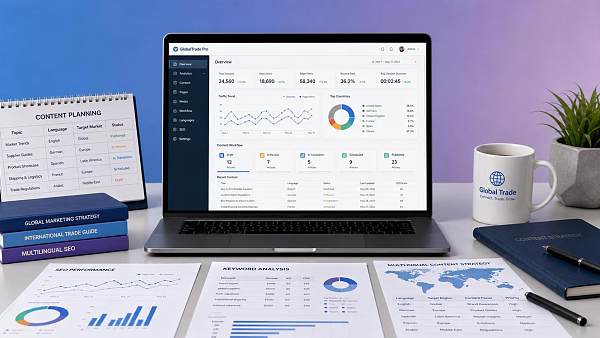
When companies discuss the maintenance cost of multilingual SEO for overseas independent websites, they often focus only on translation expenses while overlooking the continuous optimization investment required over the following 3 to 6 months. In reality, common costs are mainly distributed across four areas: content, technology, operations, and data review. Each area directly affects ranking stability and customer acquisition efficiency.
1. Content localization is not mechanical translation
If multilingual pages simply translate Chinese sentence by sentence into English, French, or Spanish, it is usually difficult to obtain organic traffic in the target market. This is because search term habits, purchasing expressions, and page reading logic vary significantly across countries. For the same product, search intent in North America and the Middle East may differ by 2 to 3 levels.
For example, on B2B manufacturing pages, English-speaking markets tend to pay more attention to specifications, certifications, application scenarios, and delivery cycles; Latin American markets may care more about MOQ, payment methods, and after-sales response. If the content is not locally rewritten and only literal translation is used, repeated rework will be required later. This is the real reason why many companies feel maintenance is expensive.
2. Technical architecture determines later maintenance efficiency
There are three common structures for multilingual websites: subdirectory, subdomain, and separate domain. For most small and medium-sized companies expanding overseas, the subdirectory structure offers a better balance in early launch speed, authority inheritance, and unified management, making it suitable for operating 2 to 8 languages simultaneously.
If the CMS, URL rules, hreflang tags, sitemap, and template system are not configured properly from the start, every additional language may add dozens to hundreds of technical checkpoints. As a result, the maintenance cost of multilingual SEO for an overseas independent website will increase exponentially with page scale, rather than growing linearly.
3. Content update frequency affects long-term costs
Many companies understand multilingual SEO as “build the website and wait for traffic,” which is a typical misconception. A clearly targeted overseas independent website usually needs to publish 4 to 12 pieces of industry content every month, review core product pages every 60 to 90 days, and track conversion data for key landing pages every 30 days.
If updates rely entirely on manual coordination among marketing, translation, design, and technical teams, the more multilingual sites there are, the higher the internal communication cost will be. Conversely, if AI-assisted content production, a unified asset library, and a templated publishing mechanism are adopted, maintenance investment becomes more controllable and the launch cycle can be significantly shortened.
4. Inadequate data analysis leads to hidden waste
Many companies invest in website development, translation, and optimization budgets within 6 months, but fail to establish analysis mechanisms for keywords, indexing, bounce rate, inquiry sources, and page conversion paths. As a result, low-conversion pages continue to be maintained, while high-potential languages do not receive additional resources, causing costs to keep rising while results remain scattered.
The table below can help companies quickly identify where multilingual SEO maintenance investment is mainly concentrated, as well as the work priorities at different stages.
As shown in the table, the maintenance cost of multilingual SEO for an overseas independent website is not a single procurement item, but a set of ongoing operating costs. If companies can unify the technical foundation, content standards, and data dashboard at the early stage of website development, the marginal cost of adding languages and pages later will decrease significantly.
What determines whether multilingual SEO is “high cost” or “high efficiency”
For the same overseas independent website with 3 languages and 300 pages, some teams face heavy monthly maintenance pressure, while others can steadily produce content and continuously increase inquiries. The difference usually lies not in the total budget, but in whether the team has three capabilities: standardization, automation, and localization.
Whether the website foundation supports scalable expansion
For integrated website + marketing service projects, the website building system is not a display tool, but the infrastructure for traffic assets. A system suitable for long-term SEO operations should at least support independent management of multilingual URLs, batch template replication, custom page Meta settings, 301 redirects, structured data configuration, and mobile performance optimization.
If the platform requires templates to be redeveloped every time a language is added, or if publishing content depends on technical staff handling pages one by one, maintenance costs will naturally be higher. By contrast, a SaaS-based, modular website system can often shorten the deployment time for a new language to 3 to 7 days instead of 2 to 4 weeks.
Whether the keyword strategy is executed by market
Do not use one keyword set to cover all countries
Many companies directly copy keywords from the English website to other language sites, which is a common cause of wasted costs. Search term length, industry terminology, and purchasing stages vary greatly across markets. A truly effective approach is to build keyword layouts separately based on a three-layer structure of “core product keywords + application scenario keywords + purchasing intent keywords.”
- Core product keywords: suitable for the homepage, category pages, and core product pages, usually controlled at 20 to 50 groups.
- Application scenario keywords: suitable for solution pages and case pages. It is recommended to arrange 10 to 30 groups for each key market.
- Purchasing intent keywords: such as supplier, manufacturer, wholesale, customization, etc., suitable for inquiry-oriented pages and FAQ pages.
This structured strategy can reduce ineffective content production and allow teams to prioritize maintaining pages that truly generate inquiries, thereby reducing ineffective spending in the maintenance cost of multilingual SEO for overseas independent websites.
Whether content works together with advertising and social media
If multilingual SEO operates in isolation, the content team often needs to plan, translate, and test separately, resulting in relatively high duplicate investment. If it is connected with Google Ads, Facebook promotion, social media content, and landing page systems, the same set of product assets can be split into search pages, ad pages, short copy, and Q&A content, increasing the reuse rate by more than 2 times.
This is also why more and more companies choose integrated website and marketing service solutions. A unified data, asset, and page system not only lowers maintenance costs, but also allows SEO traffic and advertising traffic to jointly drive inquiry conversions.
How companies can control the maintenance cost of multilingual SEO for overseas independent websites
The key to controlling costs is not simply cutting the budget, but allocating every investment to areas with greater compounding value. For website projects preparing to deploy 2 to 10 languages, it is recommended to start with three aspects: implementation sequence, page priority, and service collaboration mechanism.
Start with “deep operations in fewer languages,” then expand gradually
At the early stage, it is not recommended to launch more than 8 languages at once. A more stable approach is to first select 1 to 3 key markets and complete full optimization of the homepage, core product pages, solution pages, FAQ pages, and inquiry pages. Generally, keeping the first batch of pages within 30 to 80 pages is more conducive to testing results.
After indexing, rankings, and inquiry paths are validated, replicating the model to the second batch of languages can effectively reduce trial-and-error costs. This phased expansion method is more suitable for B2B companies with limited budgets but long-term growth goals than launching at full scale all at once.
Establish a standardized maintenance mechanism
Standardization is the core of lowering the maintenance cost of multilingual SEO for overseas independent websites. Companies are advised to establish at least 5 types of basic assets: a keyword library, terminology database, page templates, asset library, and data dashboard. In this way, whether adding languages, launching new products, or adjusting pages, work can move forward quickly within the existing framework.
The table below is suitable for evaluating efficiency differences among different maintenance methods, helping managers determine whether to continue relying on scattered outsourcing or shift to a more complete integrated service model.
From a management perspective, the value of integrated maintenance is not only saving time, but also keeping technology, content, advertising, and conversion goals aligned. For multilingual websites, consistent direction is more important than point-by-point optimization, and this is also the key to controlling long-term costs.
Choose a service provider with global marketing collaboration capabilities
When evaluating service providers, companies should not look only at website development prices or per-article content quotations. More attention should be paid to whether the provider has capabilities in multilingual website development, Google SEO optimization, advertising, social media operations, and AI-assisted content. This is because the ultimate goal of an independent website is not the number of pages, but sustainable customer acquisition.
Integrated service platforms represented by 易营宝 are more suitable for companies that need to operate overseas independent websites over the long term. Its self-developed cloud intelligent website building system, AI advertising marketing system, and AI+SEO/GEO optimization capabilities can help companies form a closed loop among website development, content, advertising, and search visibility, reducing cost fluctuations caused by repeated development and repeated outsourcing.
Common misconceptions and procurement advice in multilingual independent website maintenance
In many projects, the issue is not that the budget is too small, but that it is spent in the wrong places. Especially for inquiry-oriented B2B websites, page indexing, search matching, and conversion design must move forward together. If any one of these is missing, multilingual SEO maintenance will appear to become “more and more expensive.”
Common misconceptions
- Focusing only on translation without keyword restructuring, resulting in pages that are readable but difficult to rank.
- Looking only at the number of indexed pages instead of effective inquiry pages, making the maintenance direction easy to deviate.
- Creating a large number of pages first and adding technical standards later, which often makes later repair costs higher.
- SEO, advertising, and social media operate independently, preventing content assets from being reused.
Four key questions to clarify during procurement
Look at the solution, not just the quotation
- Whether it supports unified management and batch publishing for 2 to 10 languages.
- Whether it includes keyword research, content localization, and technical SEO maintenance.
- Whether it can connect with advertising and social media traffic generation to form an on-site conversion closed loop.
- Whether it provides monthly reviews, including changes in indexing, rankings, traffic, and inquiry leads.
If a service provider can only deliver a website but cannot continuously solve traffic and conversion issues, the company will still need to find SEO, advertising, and content teams later to fill the gaps. In that case, the overall maintenance cost of multilingual SEO for the overseas independent website will usually be higher.
For companies hoping to operate overseas markets over the long term, multilingual SEO is not an additional burden, but a foundational project within the global customer acquisition system. Whether the cost is high depends on whether the company adopts the right technical architecture, phased content strategy, and an integrated website and marketing service operating model.
易营宝 has been deeply engaged in overseas digital marketing for many years. Centered on AI intelligent website building, multilingual website development, Google SEO optimization, advertising, and GEO search visibility improvement, it helps companies build overseas independent websites that are easier to promote, index, and convert. If you are evaluating investment in a multilingual independent website, or hope to reduce long-term maintenance costs and improve global inquiry quality, feel free to contact us now to obtain a customized solution and learn more about our solutions.
Related Articles
Related Products
 EasyCamp SaaS Smart Website Marketing SystemE-Yingbao SaaS Smart Website Marketing System: AI-powered, zero-code website building. Rapidly launch multilingual independent e-commerce sites in just 10 minutes. Global server acceleration and AI-driven SEO optimization empower businesses to efficiently connect with global markets. The seamless integration of technology and user-friendly operation makes building e-commerce sites incredibly simple.
 AI+SEM Intelligent Advertising Marketing SystemAI+SEM drives intelligent ad creation, empowering full-funnel precision advertising marketing. The system automatically generates weekly/monthly reports, AI recommends keywords and target countries, monitors core metrics in real-time with intelligent alerts, and enables one-click high-conversion ad solutions to help quickly acquire customers and improve ROI.
 AI+SEO Dual Engine Optimization ServiceEasyWin AI+SEO Dual Engine Optimization System leverages AI-powered keyword mining, content generation, and comprehensive technical optimization to help foreign trade enterprises acquire high-quality organic traffic, significantly improving search rankings and conversion rates.
 AI+SNS Social Media Marketing SystemYingbao AI+SNS Social Media Marketing System - Precision social capture for the social media era. Supports one-click content synchronization across major platforms like Facebook and LinkedIn. AI intelligently rewrites posts for enhanced relevance. 24/7 AI customer service and user profiling analysis empower businesses to efficiently expand into global markets.
 AI+SEO营销解决方案易营宝AI+SEO营销解决方案,通过AI批量写作、智能生成TDK、精准关键词扩词等功能,全面优化网站SEO效果,提升流量与转化率。助力企业构建高效智能网站新生态。
 AI+SEM Advertising Marketing SolutionsAI+SEM Advertising Marketing Solution leverages AI technology to deeply empower SEM ad campaigns. It automatically generates weekly/monthly reports using AI, presenting account data across multiple dimensions for comprehensive insights into campaign performance and trends. The system precisely recommends keywords and target countries, intelligently generates high-conversion ad copy, and enables one-click activation of efficient campaign plans to help businesses rapidly acquire customers. Simultaneously, it monitors core metrics in real time, intelligently identifies abnormal fluctuations, and issues timely alerts to ensure stable, high-return advertising results.
 Domain Name ServicesEasyWin provides professional domain name services, including intelligent queries, one-stop registration, brand protection, and full lifecycle management, helping businesses build a digital brand image.
 EasyOperate B2C Cross-Border E-Commerce Platform & Independent WebsiteEasyStore B2C Cross-border E-commerce Independent Store is an intelligent website building and cross-border e-commerce integrated solution independently developed by EasyStore Information Technology (Beijing) Co., Ltd. The system is specially designed for small and medium-sized as well as large export enterprises, integrating 'website building, operation, marketing, advertising, and conversion' into one, helping enterprises quickly establish cross-border e-commerce independent stores to achieve brand globalization and global sales growth.
The platform supports multiple languages, multiple currencies, and multi-channel marketing, with built-in AI intelligent translation and SEO optimization systems, suitable for mainstream markets such as Southeast Asia, Europe and America, Latin America, and the Middle East, assisting Chinese manufacturing enterprises in efficiently deploying international e-commerce strategies. SSL证书易营宝提供专业SSL安全证书服务,包括单域名和泛域名证书,确保网站数据传输加密、身份验证和完整性保护,助力企业建立安全可信的在线业务环境。









