









- What Does a Global Traffic Ecosystem Service Provider Do? What Are the Differences from a Single Advertising AgencyJul 16, 2026View details
- What should you focus on in the latest enterprise SaaS report? From renewal rates and delivery costs to overseas growth opportunitiesJul 12, 2026View details
- What signals are worth paying attention to in a cross-border marketing trend report? B2B companies should look at these 6 signalsJul 11, 2026View details
- How to Read a Cross-Border Marketing Trends Report? Five Key Dimensions for Evaluating Channel OpportunitiesJul 11, 2026View details
- Which channel has the highest ROI in the global traffic ecosystem? Comparative analysis of search, social media, and advertisingJul 10, 2026View details
- What multilingual website services are available in Sanya? Which model is more suitable for local businesses going global?Jul 08, 2026View details
- How to view the complete list of China SaaS companies in the top 100? Practical methods for screening website-building and marketing service providersJul 08, 2026View details
- How to view pricing in the global traffic ecosystem? Cost comparison of search, social media, and content channel advertisingJul 06, 2026View details
Is Google Mobile-Friendly Test accurate for determining mobile responsiveness?
Is Google’s Mobile-Friendly Test accurate for mobile compatibility? Many businesses find that although they pass the test, their actual conversion performance is still unsatisfactory. This article examines the issue from the perspectives of SEO, user experience, and real business scenarios to help you understand the boundaries of its assessment.
For foreign trade companies, brands expanding overseas, and cross-border independent website operators, mobile compatibility is no longer an advantage but a basic requirement that affects indexing, inquiries, and advertising performance. The problem is that many teams treat a passing result from Google’s tool as the final conclusion that their mobile experience is qualified.
In real business scenarios, this is often not enough. Even if a page passes the test, it may still have problems such as weak above-the-fold information, a high rate of accidental button taps, overly long forms, and complicated loading processes. These issues can ultimately lead to a high bounce rate, insufficient time on page, and increased conversion costs. Especially in integrated B2B website development and overseas marketing scenarios, mobile performance directly affects SEO growth and advertising returns.
What can Google’s Mobile-Friendly Test determine, and what can it not determine?
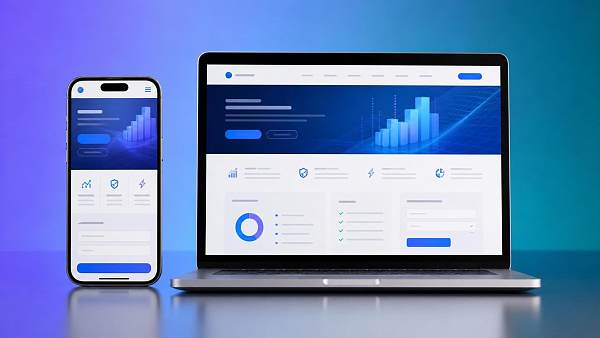
Let’s first answer the key question: Is Google’s Mobile-Friendly Test accurate for mobile compatibility? The answer is that it is useful for assessing basic compatibility, but it does not provide a comprehensive assessment of actual business performance. It is more like a preliminary screening tool than a complete acceptance standard.
It mainly checks basic accessibility
It usually checks whether the page has a viewport configured, whether the text is too small, whether clickable elements are too close together, whether content extends beyond the screen, and whether resources can be crawled properly on mobile devices. These are first-level checks, suitable for quick troubleshooting during the early stages of website development or before a page goes live. A single page can usually be evaluated within a few minutes.
If a website cannot even pass these basic checks, it naturally has obvious mobile risks, such as abnormal text scaling, horizontal scrolling, or navigation elements that are difficult to tap. In such cases, the test results are generally useful and straightforward.
It does not directly evaluate conversion or commercial usability
Many businesses mistakenly believe that “passing the test means good user experience, which means good SEO performance.” This is a common misconception. In reality, Google’s Mobile-Friendly Test will not determine whether the above-the-fold content conveys value within 3 seconds, whether the inquiry button is sufficiently prominent, or whether multilingual switching, product filtering, and form processes are suitable for overseas visitors.
For B2B foreign trade websites, mobile conversion usually depends on four types of factors: page speed, information structure, trust elements, and the inquiry path. Testing tools can cover only part of these factors. At most, they can answer the question “Can users view the page?” but it is difficult for them to answer “Can users be converted into customers?”
The four blind spots businesses most often overlook
- The above-the-fold information lacks focus, so visitors cannot tell within 5 seconds what you sell or whom you serve.
- The CTA button is positioned too low, requiring mobile users to scroll through more than two screens before seeing the key action入口.
- The form contains more than 6 fields, resulting in a significant decline in inquiry submission rates.
- Too many images, scripts, and tracking codes extend loading time to more than 4 seconds on mobile networks.
The table below can help businesses understand more clearly the difference between “passing the tool” and “being usable for business.”
The key conclusion is that Google’s Mobile-Friendly Test is suitable for a “minimum-standard check,” but it should not be used alone as the acceptance standard for mobile compatibility. Websites targeting multiple regions, such as North America, Europe, and Southeast Asia, should also include at least three types of validation: speed validation, conversion validation, and real-device validation.
Why is mobile conversion still unsatisfactory after passing the test?
What many businesses really care about is not “whether the page can be displayed,” but “why mobile traffic has increased while inquiries have not grown accordingly.” This is often not a single technical problem, but a lack of coordination among website development, content, and the marketing journey.
Meeting mobile SEO requirements does not mean smooth mobile conversion
Search engine crawling places greater emphasis on accessibility and basic page quality, but whether users are willing to leave their contact information depends on whether the information structure is clear. For example, common problems on manufacturing B2B websites include having extensive product specifications but a deeply buried purchasing入口; strong certifications and delivery capabilities placed after the third screen; and mobile menus with four levels, making it difficult for users to quickly find key pages.
If the page cannot explain “who you are, what you can do, and why users should contact you” within the first 8 seconds, conversion may still be low even when the traffic is highly relevant. This issue is especially apparent on advertising landing pages and often directly increases the cost per lead.
Five common gaps in real business scenarios
- The page passes the test, but the above-the-fold image is too large, affecting LCP performance.
- The layout adapts responsively, but the multilingual switching button is not prominent.
- The button is clickable, but the inquiry form requires users to fill in more than 7 fields.
- The page structure is normal, but the product page lacks key purchasing information such as PDF files, MOQ, and lead time.
- The website can be browsed, but the mobile customer service入口 is located at the bottom, causing visitors to leave after their first browsing session.
B2B websites should pay particular attention to “decision-support information”
Unlike B2C purchasing, B2B procurement is usually not completed with a single click. It generally involves 2 to 4 rounds of information confirmation. A mobile page should display core products, application scenarios, delivery scope, qualifications and capabilities, and contact入口 within at least one or two screens. Otherwise, visitors will often leave first and never return.
To facilitate troubleshooting, businesses can evaluate mobile performance separately across three levels: “viewable, usable, and convertible.”
If your website has completed only the first level, Google’s Mobile-Friendly Test may appear to be “very accurate.” However, if the goal is to improve SEO inquiries and overseas advertising conversions, you must continue to achieve the second and third levels.
How should businesses properly evaluate mobile compatibility?
Rather than simply asking “Is Google’s Mobile-Friendly Test accurate for mobile compatibility?”, a more effective approach is to establish an actionable inspection process. For integrated website and marketing service projects, it is recommended to divide the process into at least three stages and six inspection items.
Stage 1: Tool testing
First, use Google’s Mobile-Friendly Test for an initial compatibility check, and then combine it with PageSpeed Insights to observe mobile performance signals. The focus should not be limited to whether the page “passes or fails”; you should also check whether images, fonts, scripts, and above-the-fold rendering slow down loading. For marketing websites, the mobile above-the-fold area should ideally be limited to 2 to 3 core information blocks.
Stage 2: Real-device validation
Test on at least three types of devices: standard Android models, mainstream iPhone screen sizes, and small-screen or older devices. For multilingual websites, also check whether longer texts in German, French, Russian, and other languages cause abnormal line wrapping. Many layout problems cannot be identified in tools but become apparent on real devices.
Stage 3: Marketing conversion validation
Use data to analyze the mobile bounce rate, form submission rate, average time on page, and key button click-through rate. If mobile traffic accounts for more than 60% of visits from a particular channel but less than 30% of inquiries, this indicates that the compatibility is likely only a “technical pass” and does not truly match user behavior.
Six items businesses are advised to check closely
- Does the above-the-fold area clearly communicate the product and its advantages within 5 to 8 seconds?
- Is the contact information visible within one screen, with click-to-contact functionality?
- Has the form been simplified to 3 to 5 core fields?
- Does the product page display MOQ, lead time, applications, certifications, or customization scope?
- Do multilingual pages maintain a consistent structure without misalignment or untranslated content?
- Does the mobile loading process avoid interference from large images, pop-ups, and redundant scripts?
For an AI-driven enterprise SaaS intelligent website development and overseas marketing service platform such as 易营宝, mobile compatibility issues are better addressed from an integrated perspective that includes the website development system, SEO structure, advertising landing pages, and data tracking. For businesses, a page does not exist in isolation; it ultimately needs to support indexing, advertising, inquiries, and repeat purchases.
In actual projects, if the mobile navigation structure, content block order, form strategy, conversion components, and search engine crawling logic are considered simultaneously during the website development stage, the subsequent optimization cost is usually much lower than that of making changes after launch. The implementation cycle is also more controllable, and a typical round of effective optimization can be completed within 2 to 4 weeks.
Practical recommendations for foreign trade and overseas expansion businesses
If your core goals are Google SEO, advertising, or overseas social media traffic acquisition, mobile compatibility should not be evaluated based on a single test result. Instead, you should assess whether it supports the complete customer acquisition journey. A truly effective mobile page should meet four conditions simultaneously: be friendly to indexing, load reliably, present information clearly, and enable smooth conversion.
For manufacturing factories, cross-border sellers, and brands expanding overseas, it is recommended to prioritize the optimization of four types of key pages: the homepage, product listing pages, product detail pages, and advertising landing pages. These pages usually contribute most of the mobile entry traffic and are also where inquiry conversions are most concentrated.
Returning to the original question, is Google’s Mobile-Friendly Test accurate for mobile compatibility? If you only want to determine whether a page has obvious technical compatibility errors, it is accurate. If you want to determine whether the website can truly support SEO growth and overseas customer acquisition, it is far from sufficient.
易营宝 has long served foreign trade companies, manufacturing factories, cross-border e-commerce sellers, and brands expanding overseas. Through AI intelligent website development, multilingual website construction, Google SEO optimization, advertising, and GEO generative engine optimization, it helps businesses build overseas independent websites that can be promoted, indexed, and converted. If you are evaluating mobile user experience, website redevelopment, or overseas marketing performance, please contact us immediately to obtain customized solutions and optimization recommendations that better match your business scenario.
Related Articles


Related Products
 EasyCamp SaaS Smart Website Marketing SystemE-Yingbao SaaS Smart Website Marketing System: AI-powered, zero-code website building. Rapidly launch multilingual independent e-commerce sites in just 10 minutes. Global server acceleration and AI-driven SEO optimization empower businesses to efficiently connect with global markets. The seamless integration of technology and user-friendly operation makes building e-commerce sites incredibly simple.
 AI+SEM Intelligent Advertising Marketing SystemAI+SEM drives intelligent ad creation, empowering full-funnel precision advertising marketing. The system automatically generates weekly/monthly reports, AI recommends keywords and target countries, monitors core metrics in real-time with intelligent alerts, and enables one-click high-conversion ad solutions to help quickly acquire customers and improve ROI.
 AI+SEO Dual Engine Optimization ServiceEasyWin AI+SEO Dual Engine Optimization System leverages AI-powered keyword mining, content generation, and comprehensive technical optimization to help foreign trade enterprises acquire high-quality organic traffic, significantly improving search rankings and conversion rates.
 AI+SNS Social Media Marketing SystemYingbao AI+SNS Social Media Marketing System - Precision social capture for the social media era. Supports one-click content synchronization across major platforms like Facebook and LinkedIn. AI intelligently rewrites posts for enhanced relevance. 24/7 AI customer service and user profiling analysis empower businesses to efficiently expand into global markets.
 AI+SEO营销解决方案易营宝AI+SEO营销解决方案,通过AI批量写作、智能生成TDK、精准关键词扩词等功能,全面优化网站SEO效果,提升流量与转化率。助力企业构建高效智能网站新生态。
 AI+SEM Advertising Marketing SolutionsAI+SEM Advertising Marketing Solution leverages AI technology to deeply empower SEM ad campaigns. It automatically generates weekly/monthly reports using AI, presenting account data across multiple dimensions for comprehensive insights into campaign performance and trends. The system precisely recommends keywords and target countries, intelligently generates high-conversion ad copy, and enables one-click activation of efficient campaign plans to help businesses rapidly acquire customers. Simultaneously, it monitors core metrics in real time, intelligently identifies abnormal fluctuations, and issues timely alerts to ensure stable, high-return advertising results.
 Domain Name ServicesEasyWin provides professional domain name services, including intelligent queries, one-stop registration, brand protection, and full lifecycle management, helping businesses build a digital brand image.
 EasyOperate B2C Cross-Border E-Commerce Platform & Independent WebsiteEasyStore B2C Cross-border E-commerce Independent Store is an intelligent website building and cross-border e-commerce integrated solution independently developed by EasyStore Information Technology (Beijing) Co., Ltd. The system is specially designed for small and medium-sized as well as large export enterprises, integrating 'website building, operation, marketing, advertising, and conversion' into one, helping enterprises quickly establish cross-border e-commerce independent stores to achieve brand globalization and global sales growth.
The platform supports multiple languages, multiple currencies, and multi-channel marketing, with built-in AI intelligent translation and SEO optimization systems, suitable for mainstream markets such as Southeast Asia, Europe and America, Latin America, and the Middle East, assisting Chinese manufacturing enterprises in efficiently deploying international e-commerce strategies. SSL证书易营宝提供专业SSL安全证书服务,包括单域名和泛域名证书,确保网站数据传输加密、身份验证和完整性保护,助力企业建立安全可信的在线业务环境。









