









- What Does a Global Traffic Ecosystem Service Provider Do? What Are the Differences from a Single Advertising AgencyJul 16, 2026View details
- What should you focus on in the latest enterprise SaaS report? From renewal rates and delivery costs to overseas growth opportunitiesJul 12, 2026View details
- What signals are worth paying attention to in a cross-border marketing trend report? B2B companies should look at these 6 signalsJul 11, 2026View details
- How to Read a Cross-Border Marketing Trends Report? Five Key Dimensions for Evaluating Channel OpportunitiesJul 11, 2026View details
- Which channel has the highest ROI in the global traffic ecosystem? Comparative analysis of search, social media, and advertisingJul 10, 2026View details
- What multilingual website services are available in Sanya? Which model is more suitable for local businesses going global?Jul 08, 2026View details
- How to view the complete list of China SaaS companies in the top 100? Practical methods for screening website-building and marketing service providersJul 08, 2026View details
- How to view pricing in the global traffic ecosystem? Cost comparison of search, social media, and content channel advertisingJul 06, 2026View details
For website speed optimization, should images use WebP or AVIF?
Website speed optimization: should images be compressed using WebP or AVIF? This is not simply a debate over formats, but a key choice that affects loading speed, SEO performance, and conversion efficiency. This article combines practical experience in website development and marketing to help you quickly determine which option to choose.
For B2B websites, cross-border e-commerce stores, advertising landing pages, and multilingual independent websites, images often account for 50%—80% of the page size. If the format is selected incorrectly, even when the server, code, and CDN have all been optimized, above-the-fold loading may still take 2 to 5 seconds, directly affecting bounce rates, inquiry volume, and advertising conversions.
Especially in integrated website and marketing service scenarios, images are not merely visual assets. They also affect Google indexing, mobile experience, overseas access speed, and ad quality scores. For companies seeking to balance website development efficiency with long-term growth, understanding the differences between WebP and AVIF is more important than simply pursuing a “smaller file size.”
What Is the Difference Between WebP and AVIF?
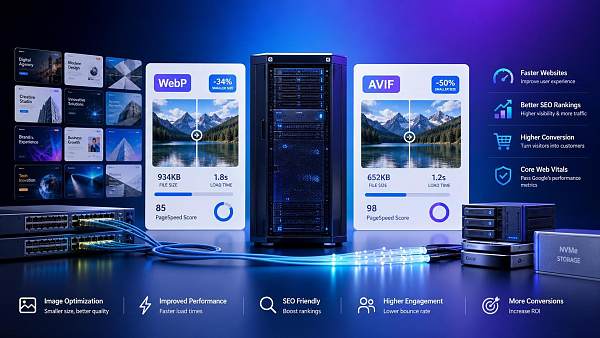
Here is the conclusion first: WebP offers a better balance, while AVIF provides a higher compression rate. However, actual use should not be based on file size alone. When choosing WebP or AVIF for image compression and website speed optimization, the key factors are page type, device compatibility, generation efficiency, and marketing objectives—not a single format.
Compression efficiency: AVIF usually requires less storage
At a similar image quality, AVIF is usually 40%—60% smaller than JPEG and another 15%—30% smaller than WebP. For assets such as homepage banners, large product detail images, and case study images that exceed 200KB per image, AVIF does offer greater advantages in reducing transmission size, especially for mobile networks and cross-regional access.
Compatibility: WebP remains more reliable
After years of adoption, WebP has more mature support across mainstream browsers, CMS plugins, website-building systems, and image-processing tools. Although AVIF is now supported by most modern browsers, compatibility gaps may still occur on some older devices, legacy systems, and certain third-party environments. For websites focused on lead generation, stability is often more important than achieving the highest possible compression.
Generation cost: AVIF requires greater system capabilities
AVIF encoding is more complex and consumes more CPU resources and processing time during batch conversion. For a B2C independent website with 3,000 product images, if every new product release requires multiple sizes and multilingual versions to be generated simultaneously, AVIF will place higher demands on the website platform and content management workflow. WebP is more suitable for high-frequency update scenarios in this regard.
The table below can be used to quickly assess the practical differences between the two formats in website speed optimization. It is especially suitable for website managers, operations teams, and marketing decision-makers when selecting an initial solution.
If a company is still using JPEG or PNG as its primary format, switching to WebP first will usually complete the first stage of optimization. If the website already has responsive images, caching, and fallback mechanisms, introducing AVIF as a further step will produce more noticeable benefits. This is also a common optimization path for many overseas marketing websites, moving from Stage 1 to Stage 2.
Why Do Image Formats Directly Affect SEO and Conversions?
When discussing whether to use WebP or AVIF for image compression and website speed optimization, many companies tend to view it as a “file-processing choice made by technical staff.” In reality, image formats are directly connected to SEO, advertising, and inquiry conversions, especially on websites that combine Google organic traffic with overseas advertising.
Loading speed affects the above-the-fold experience
For B2B websites, the above-the-fold area often includes one banner, a group of product images, and several icons, so image assets can easily exceed 1MB. If above-the-fold loading time increases from 1.8 seconds to 4 seconds, users’ patience on mobile devices will decline noticeably, and the loss of visitors after entering from an ad click will also increase.
Page performance affects organic visibility
Search engines will not improve your rankings simply because you use AVIF, but lighter images can help improve page loading performance, crawling efficiency, and mobile usability. For websites with 100, 500, or even more than 3,000 pages of content, image optimization can amplify differences in overall indexing efficiency and page quality.
The conversion journey depends on stable image display
If a format is too new but the fallback solution is insufficient, users’ devices may not display product images, certificate images, or case study images correctly, directly affecting inquiry quality. For manufacturing websites, cross-border e-commerce stores, and advertising landing pages, images do more than showcase products—they also help build trust. Compatibility therefore cannot be overlooked.
Marketing websites are more concerned with three metrics
- Whether the time to display the above-the-fold content is controlled within 2–3 seconds
- Whether the total resource size of key product pages is controlled within 1.5MB
- Whether core images can be displayed reliably on both mobile and desktop devices
For companies targeting overseas lead generation, image optimization is not an isolated task. It is a foundational efficiency project involving website development, content, SEO, and advertising. Platforms such as Yingyingbao, which integrate AI-powered website building, Google SEO optimization, advertising, and multilingual independent website operations, typically incorporate image processing into the overall site performance strategy rather than compressing images only once before launch.
For Different Website Scenarios, Should You Prioritize WebP or AVIF?
There is no universal answer to whether WebP or AVIF should be used for image compression and website speed optimization. Different business models and content structures require different optimal strategies. The most practical approach for a company is to make tiered decisions based on page type, update frequency, and marketing objectives rather than applying a one-size-fits-all solution across the entire website.
Scenarios where WebP should be prioritized
If your website is a B2B marketing website, multilingual corporate website, information website, or catalog website with a large number of products, WebP is usually the more reliable starting point. There are three main reasons: more mature compatibility, faster batch conversion, and easier integration with CMS and SaaS website-building systems, which can reduce launch and maintenance costs.
Scenarios where AVIF should be prioritized
If the homepage contains large visual images, there are many brand showcase images, and the target visitors mainly use modern browsers and mobile devices, AVIF may be more suitable. In particular, when the original image size is between 500KB and 2MB and high visual quality needs to be maintained, AVIF can deliver a more significant reduction in file size.
To avoid making an overly subjective choice, the table below can be used directly as a basis for procurement evaluation or website implementation. It is suitable for communication among product managers, operations teams, and service providers.
Most companies ultimately do not use “only one format,” but adopt a hybrid strategy: use WebP first for listing pages, thumbnails, and content images, while testing AVIF for large homepage images, campaign images, and key product showcase images. This approach usually achieves a more practical balance between compatibility, compression rate, and operational efficiency.
A Truly Practical Implementation Method: Do More Than Change the Format—Develop a Complete Image Strategy
If PNG images are simply converted in batches to WebP or AVIF without addressing image dimensions, lazy loading, caching, and fallback mechanisms, the website speed improvement will often be limited. An effective approach generally includes at least four steps, with the first round of validation completed within 7–15 days.
Step 1: Classify images by page value
It is recommended that website images be divided into three categories: core above-the-fold images, product/content showcase images, and decorative small images. Above-the-fold images should prioritize file-size control, with each image ideally compressed to 150KB–300KB. Product images can be controlled at 80KB–250KB depending on clarity requirements, while icons and decorative images should be kept as lightweight as possible.
Step 2: Implement responsive image sizes at the same time
Many websites become slow not because the format is wrong, but because large 1920-pixel images are loaded directly on mobile devices. It is recommended to prepare at least three sizes, such as 480px, 960px, and 1440px, and deliver them according to the device being used. The resulting benefits are often comparable to switching from WebP to AVIF.
Step 3: Establish fallback and caching mechanisms
If you choose AVIF, it is recommended to retain WebP or JPEG fallback versions at the same time to prevent a small number of devices from being unable to recognize the images. For cross-border business websites, CDN caching strategies should also be used so that users in North America, Europe, Southeast Asia, and other regions can obtain image resources with low latency.
Step 4: Test conversion pages first
There is no need to modify the entire website at once. You can begin with three types of core pages: the homepage, product detail pages, and inquiry landing pages. Observe their performance continuously for 2–4 weeks before deciding whether to switch the entire website. This approach helps control risk and provides a clearer view of the actual impact on bounce rate, time on page, and the conversion path.
Four common mistakes in enterprise implementation
- Compressing images without changing their dimensions, leaving them too large on mobile devices.
- Forcing AVIF across the entire website without a fallback format, affecting compatibility and display.
- Pursuing the smallest possible file size at the expense of excessive image-quality loss and reduced product trust.
- Looking only at technical scores without considering the conversion results of inquiry pages and advertising pages.
In actual projects, the advantage of an integrated platform such as Yingyingbao does not lie in providing only one particular image format. Its value lies in centrally managing AI-powered website building, page performance, SEO deployment, advertising landing page optimization, and multilingual delivery. For companies seeking stable lead generation in North America, Europe, Japan and South Korea, or the Middle East, this coordinated approach across the entire website is generally more effective than isolated technical adjustments.
What Questions Should Companies Ask Service Providers When Making Procurement or Website-Building Decisions?
If you are choosing a website development company, SaaS platform, or overseas marketing service provider, when discussing whether to use WebP or AVIF for image compression and website speed optimization, do not ask only, “Do you support AVIF?” More importantly, confirm whether the provider has complete delivery capabilities, especially in automated processing, performance testing, and marketing coordination.
Five key questions to confirm
- Does it support output in both WebP and AVIF, with automatic fallback?
- Does it support outputting different image sizes for different devices to prevent mobile devices from loading large desktop images?
- Can it develop separate compression strategies for the homepage, product pages, and landing pages?
- Can it be planned together with SEO, advertising, and multilingual pages rather than handled as an isolated task?
- Can it continuously review performance and conversion results 7, 14, and 30 days after launch?
For companies focused on inquiry generation, global brand expansion, and independent website growth, the real investment is not “the format itself,” but whether a continuous optimization mechanism can be established. Especially when a website simultaneously supports Google SEO, Google Ads, Facebook advertising, and overseas social media traffic acquisition, the image strategy must serve the final business results.
If your website content is updated frequently and you have a large number of product images, using WebP first is more practical. If you need to compress large homepage images, campaign pages, and key conversion pages, AVIF is worth testing. If you want to balance compatibility and performance, a hybrid strategy is usually the more suitable answer for long-term enterprise operations. If you would like to further evaluate how to configure image formats, page speed, and overseas marketing solutions for your website, please contact us now to obtain a customized solution and learn more about our solutions.
Related Articles
Related Products
 EasyCamp SaaS Smart Website Marketing SystemE-Yingbao SaaS Smart Website Marketing System: AI-powered, zero-code website building. Rapidly launch multilingual independent e-commerce sites in just 10 minutes. Global server acceleration and AI-driven SEO optimization empower businesses to efficiently connect with global markets. The seamless integration of technology and user-friendly operation makes building e-commerce sites incredibly simple.
 AI+SEM Intelligent Advertising Marketing SystemAI+SEM drives intelligent ad creation, empowering full-funnel precision advertising marketing. The system automatically generates weekly/monthly reports, AI recommends keywords and target countries, monitors core metrics in real-time with intelligent alerts, and enables one-click high-conversion ad solutions to help quickly acquire customers and improve ROI.
 AI+SEO Dual Engine Optimization ServiceEasyWin AI+SEO Dual Engine Optimization System leverages AI-powered keyword mining, content generation, and comprehensive technical optimization to help foreign trade enterprises acquire high-quality organic traffic, significantly improving search rankings and conversion rates.
 AI+SNS Social Media Marketing SystemYingbao AI+SNS Social Media Marketing System - Precision social capture for the social media era. Supports one-click content synchronization across major platforms like Facebook and LinkedIn. AI intelligently rewrites posts for enhanced relevance. 24/7 AI customer service and user profiling analysis empower businesses to efficiently expand into global markets.
 AI+SEO营销解决方案易营宝AI+SEO营销解决方案,通过AI批量写作、智能生成TDK、精准关键词扩词等功能,全面优化网站SEO效果,提升流量与转化率。助力企业构建高效智能网站新生态。
 AI+SEM Advertising Marketing SolutionsAI+SEM Advertising Marketing Solution leverages AI technology to deeply empower SEM ad campaigns. It automatically generates weekly/monthly reports using AI, presenting account data across multiple dimensions for comprehensive insights into campaign performance and trends. The system precisely recommends keywords and target countries, intelligently generates high-conversion ad copy, and enables one-click activation of efficient campaign plans to help businesses rapidly acquire customers. Simultaneously, it monitors core metrics in real time, intelligently identifies abnormal fluctuations, and issues timely alerts to ensure stable, high-return advertising results.
 Domain Name ServicesEasyWin provides professional domain name services, including intelligent queries, one-stop registration, brand protection, and full lifecycle management, helping businesses build a digital brand image.
 EasyOperate B2C Cross-Border E-Commerce Platform & Independent WebsiteEasyStore B2C Cross-border E-commerce Independent Store is an intelligent website building and cross-border e-commerce integrated solution independently developed by EasyStore Information Technology (Beijing) Co., Ltd. The system is specially designed for small and medium-sized as well as large export enterprises, integrating 'website building, operation, marketing, advertising, and conversion' into one, helping enterprises quickly establish cross-border e-commerce independent stores to achieve brand globalization and global sales growth.
The platform supports multiple languages, multiple currencies, and multi-channel marketing, with built-in AI intelligent translation and SEO optimization systems, suitable for mainstream markets such as Southeast Asia, Europe and America, Latin America, and the Middle East, assisting Chinese manufacturing enterprises in efficiently deploying international e-commerce strategies. SSL证书易营宝提供专业SSL安全证书服务,包括单域名和泛域名证书,确保网站数据传输加密、身份验证和完整性保护,助力企业建立安全可信的在线业务环境。









