









- The China-US tariff arrangement has reached a preliminary consensus, and the trade association will be establishedJun 15, 2026View details
- What determines B2C cross-border e-commerce website development costs? A breakdown of features, interfaces, and deployment methodsJun 17, 2026View details
- China-Morocco zero-tariff access, a breakthrough in the cost of Moroccan goods exports to ChinaJun 11, 2026View details
- What signal should be released for the suspension of exports to JapanJun 10, 2026View details
- China's May LNG imports rebounded, with increased volumes from Russia and Canada filling the Middle East supply gapJun 10, 2026View details
- Will GEO change its SEO strategy?Jun 04, 2026View details
- What types of businesses are end-to-end solutions suitable for?Jun 03, 2026View details
- 2026 Global Growth Channel TrendsJun 02, 2026View details
How to do SEO content optimization so rankings can rise more easily
To do SEO content optimization well, it is not just about stuffing keywords, but also about balancing user needs and search rules. This article will combine website SEO optimization tutorials, Google SEO ranking improvement, and search engine optimization service strategies to help you drive ranking growth more efficiently.
For companies integrating website + marketing services, content is not only a traffic entry point, but also a key part of customer acquisition, conversion, inquiries, and brand awareness. Whether they are users, operators, business decision-makers, after-sales maintenance personnel, or channel agents, they all care more about one practical question: after investing in content, how long will it take to see ranking changes, and how can it be done more steadily and sustainably.
Since its establishment in 2013, Yiyingbao Information Technology (Beijing) Co., Ltd. has built full-chain service capabilities from website building to promotion, and from content to conversion, centered on intelligent website building, SEO optimization, social media marketing, and advertising placement. For companies that want to improve Google SEO rankings, enhance website indexing efficiency, and reduce customer acquisition costs, content optimization must advance in sync with website structure, keyword strategy, page experience, and conversion paths.
First clarify the goal: SEO content optimization is not about writing articles, but about building a rankable content system
Many companies understand SEO content optimization as “publishing news regularly” or “writing more industry articles,” but after updating for 3 months to 6 months, indexing remains unstable, keywords fail to rise, and inquiries do not increase significantly. The root cause is that the content was not designed around search intent, page structure, and business conversion, but was only doing superficial updates.
A truly effective SEO content layout usually needs to cover 3 types of pages: core business pages, scenario solution pages, and problem-based content pages. Core business pages are responsible for capturing traffic with high commercial intent, scenario pages help segmented industry users match their needs, and problem-based content is responsible for expanding long-tail keywords and improving the overall topical relevance of the site.
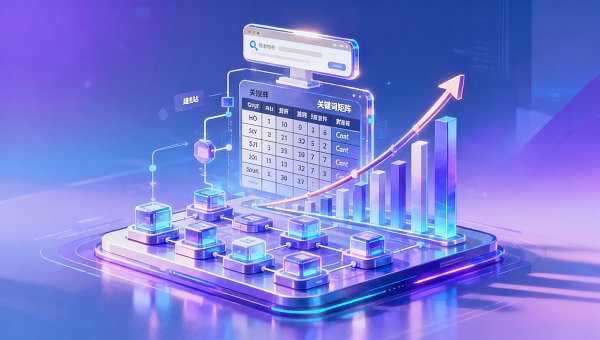
Taking the website + marketing service integration industry as an example, if a company simultaneously provides website building, search engine optimization services, content operations, and advertising placement, then it should at least plan 4 primary topics, 8 to 20 secondary topics, and 6 to 12 supporting content pieces per month centered on buyer questions, thereby forming a stable content matrix.
4 basic modules of the content system
- Business pages: such as corporate website building, Google SEO optimization, overseas social media marketing, and managed advertising placement, focusing on capturing high-conversion terms.
- Case or scenario pages: focusing on segmented industries such as manufacturing, education, software services, and cross-border business to improve relevance.
- Tutorial pages: covering search needs such as website SEO optimization tutorials, content optimization steps, and keyword layout methods.
- Q&A pages: solving high-frequency questions such as “How long does it take to see results,” “How should the budget be allocated,” and “Will a redesign cause ranking drops.”
If a company does not define the hierarchy of target keywords before content planning, duplicate categories, internal page competition, and wasted crawling resources are likely to occur. It is usually recommended that each core page be tied to 1 primary keyword, 2 to 4 related keywords, and more than 5 scenario keywords, which is more conducive to helping search engines identify the page topic.
How to arrange keywords so rankings can improve more steadily
The key to keyword layout is not repetition, but hierarchy. The homepage, category pages, detail pages, and article pages undertake different tasks. If all pages compete for the same keyword, for example “SEO optimization,” not only will it be difficult to improve, but it may also make it impossible for search engines to determine which page deserves to rank more.
A more practical approach is to first divide keywords into 3 levels by commercial intent: high-intent keywords, mid-intent keywords, and informational long-tail keywords. High-intent keywords are suitable for service pages, mid-intent keywords are suitable for solution pages, and informational long-tail keywords are suitable for tutorials, FAQ, and topical content. In this way, within 8 to 12 weeks, it is usually easier to see simultaneous growth in indexing volume and the number of ranking keywords.
Keyword layout example table
The table below is suitable for integrated website + marketing service companies as a reference when planning content, and can help teams avoid the common problem of “one keyword spread across the entire site.”
From the perspective of execution results, informational content can often bring indexing faster, while high-intent pages require stronger internal site authority and external signal support. Therefore, within the first 30 days, the content team can prioritize completing more than 10 long-tail content pieces first, and then gradually strengthen the depth of core service pages and internal linking support.
3 details that are easily overlooked
- In the first 30 characters of the title, explain the topic as clearly as possible, and do not only write a brand slogan.
- Within the first 100 characters of the opening paragraph, state the problem and the direction of the solution, which is more helpful for search understanding.
- On the same page, naturally include the primary keyword, synonyms, and scenario keywords to avoid single-point repetition.
If the company itself is also involved in internal knowledge management or industry vertical content development, it can also insert more professional management topics into topical pages to improve the breadth of the site. For example, around digital management scenarios, introducing professional resource pages such as Analysis of application strategies of business-finance integration in the transformation practice of financial management in public institutions can help strengthen content depth and reach specific audiences, but the premise is that it must maintain a reasonable relevance to the site theme and visitor needs.
Professional content alone is not enough; page experience and conversion design also determine ranking performance
Many pages clearly have a lot of content, yet still fail to rank. The common problem is not “writing too little,” but “poor readability, chaotic structure, slow loading, and high bounce rate.” For search engines, content quality and page experience are judged together. Whether users stay on a page for 30 seconds or 3 minutes often depends on whether the structure is clear and whether information can be located quickly.
For B2B service websites, it is recommended that each core page be controlled within 4 to 6 information sections, including value explanation, target audience, service process, delivery cycle, frequently asked questions, and inquiry entry points. This can ensure information density while also making it easier for users, decision-makers, and channel partners to quickly judge whether it is worth continuing the conversation.
Comparison table of page elements affecting SEO performance
The following set of elements is usually the most easily overlooked part in website SEO optimization projects, yet it directly affects the speed of ranking growth.
In actual execution, website building and SEO cannot be disconnected. The advantage of service providers like Yiyingbao, which simultaneously possess intelligent website building and marketing optimization capabilities, lies in being able to consider URL structure, category planning, content templates, internal link design, and conversion components together, reducing the cost of repeated later modifications. For new websites, the structural design of the first 60 days is often more critical than later remedial work.
4 suggestions for page conversion design
- Place clear inquiry entry points on service pages, and it is recommended that they appear at least 1 time on each screen.
- Use lists or tables as much as possible for key explanations to reduce large blocks of text.
- Add delivery processes, timelines, or checklists in the middle section to enhance decision-making confidence.
- Add FAQ at the bottom of the page to address the final questions of hesitant users.
If a page only considers indexing and does not consider inquiry conversion, even if some keywords enter the top 20, it may not necessarily bring business growth. Rankings are only the process; conversion is the result.
From execution to maintenance: an SEO content optimization process more suitable for enterprise implementation
SEO content optimization is not a one-time delivery, but a process of weekly and monthly iteration. For most companies, a more executable method is not to pursue “short-term explosion,” but to establish a 90-day process that can be tracked, adjusted, and reviewed. This is friendlier to operators, after-sales maintenance teams, and management alike.
Recommended 5-step implementation process
- Step 1: Site audit, checking indexing, structure, dead links, loading speed, and mobile adaptation, usually completed in 3 to 7 days.
- Step 2: Keyword hierarchy, determining core pages and topical pages, and producing a list containing at least 30 to 80 keywords.
- Step 3: Content production, prioritizing the launch of core service pages, then supplementing tutorial pages, FAQ pages, and scenario pages.
- Step 4: On-site linkage, improving internal links, anchor text, related recommendations, and conversion buttons to form on-site paths.
- Step 5: Monthly review, checking indexing, number of ranking keywords, bounce rate, and inquiry changes every 30 days to decide whether to retain, rewrite, or expand.
In this process, the value of maintenance personnel is equally important. For example, if after a page redesign the title is lost, category paths change, images are not compressed, or forms cannot be submitted, these problems may all cause fluctuations in existing rankings. For many companies, ranking declines are not due to content deterioration, but because of problems in maintenance details.
Common misconceptions and correction methods
The first misconception is focusing only on homepage rankings and not looking at overall site keyword coverage. In fact, a healthy corporate website should usually first expand 50 to 200 long-tail keywords, and then gradually drive the competitiveness of core keywords. The second misconception is changing titles too frequently; changing them once every 7 days will interfere with the search engine's reassessment of the page topic. The third misconception is not updating content after publishing, resulting in outdated information and reduced conversion power.
If a company wants to improve the professionalism of content management, it can also turn its internal knowledge base and topical resources into independent sections. For example, for visitors interested in organizational management, process optimization, and digital operations, it can appropriately extend to related content pages such as Analysis of application strategies of business-finance integration in the transformation practice of financial management in public institutions, forming a more complete knowledge reach path, but attention should still be paid to topic boundaries and page hierarchy design.
For distributors, resellers, and agents, unified content standards are also very important. If the headquarters can provide standardized page templates, industry term libraries, and monthly update recommendations, channel websites can more easily maintain a consistent optimization direction and reduce authority dilution caused by fragmented efforts.
When enterprises choose search engine optimization services, focus on these dimensions
For business decision-makers, choosing an SEO service provider cannot depend only on pricing; it is also necessary to see whether the methodology is systematic, whether delivery is transparent, and whether website building and content work together. Especially in integrated website + marketing service scenarios, doing content alone, technology alone, or advertising alone often leads to information fragmentation, resulting in increased costs and reduced efficiency.
A more reliable evaluation method is to judge from 4 levels: whether it has website building capabilities, whether it has content planning methods, whether it can conduct data reviews, and whether it understands localized expression in different markets. For companies with global promotion needs, language versions, landing page structure, and regional search habits will all affect the final results.
Service provider evaluation checklist
- Whether it can provide a site diagnostic report, instead of only promising a number of published articles.
- Whether it provides keyword hierarchy and page mapping, instead of broadly bundling keywords.
- Whether it takes into account website building, content, data analysis, and conversion path design.
- Whether it has a monthly review mechanism and provides adjustment recommendations at least every 30 days.
Yiyingbao has been deeply engaged in digital marketing services for more than 10 years, coordinating intelligent website building, SEO optimization, social media marketing, and advertising placement, making it more suitable for enterprises that want to plan a unified content growth path. For teams with clear annual growth goals and the need to balance brand exposure and inquiry conversion, this integrated model can usually reduce communication loss and shorten the cycle from launch to optimization.
FAQ: 3 common questions from enterprises
First, how long does SEO content optimization take to show results? Generally, a new site needs 8 to 16 weeks to observe indexing and long-tail keyword changes, while a mature site with a good foundation may see some pages recover in 4 to 8 weeks. Second, is high-frequency updating necessary? Not necessarily. The key is topic completeness and continuous iteration. Updating 4 high-quality pieces per month is usually more effective than updating 10 low-quality pieces per week. Third, do content and advertising conflict? They do not conflict. SEO is more of a mid- to long-term asset, while advertising is more suitable for short-term customer acquisition. The synergy of the two can instead improve overall lead efficiency.
If you are advancing a corporate website upgrade, overseas market expansion, or procurement of search engine optimization services, content optimization should shift from “single-article thinking” to “whole-site content asset thinking.” By planning keywords, page structure, user experience, conversion design, and subsequent maintenance in a unified manner, rankings can rise more steadily, and traffic can more easily convert into real business opportunities. If you want to further understand an integrated website building and SEO solution suitable for your own industry, we recommend contacting us immediately to obtain a customized solution or consult for more solution ideas.
Related Articles



Related Products
 EasyCamp SaaS Smart Website Marketing SystemE-Yingbao SaaS Smart Website Marketing System: AI-powered, zero-code website building. Rapidly launch multilingual independent e-commerce sites in just 10 minutes. Global server acceleration and AI-driven SEO optimization empower businesses to efficiently connect with global markets. The seamless integration of technology and user-friendly operation makes building e-commerce sites incredibly simple.
 AI+SEM Intelligent Advertising Marketing SystemAI+SEM drives intelligent ad creation, empowering full-funnel precision advertising marketing. The system automatically generates weekly/monthly reports, AI recommends keywords and target countries, monitors core metrics in real-time with intelligent alerts, and enables one-click high-conversion ad solutions to help quickly acquire customers and improve ROI.
 AI+SEO Dual Engine Optimization ServiceEasyWin AI+SEO Dual Engine Optimization System leverages AI-powered keyword mining, content generation, and comprehensive technical optimization to help foreign trade enterprises acquire high-quality organic traffic, significantly improving search rankings and conversion rates.
 AI+SNS Social Media Marketing SystemYingbao AI+SNS Social Media Marketing System - Precision social capture for the social media era. Supports one-click content synchronization across major platforms like Facebook and LinkedIn. AI intelligently rewrites posts for enhanced relevance. 24/7 AI customer service and user profiling analysis empower businesses to efficiently expand into global markets.
 AI+SEO营销解决方案易营宝AI+SEO营销解决方案,通过AI批量写作、智能生成TDK、精准关键词扩词等功能,全面优化网站SEO效果,提升流量与转化率。助力企业构建高效智能网站新生态。
 AI+SEM Advertising Marketing SolutionsAI+SEM Advertising Marketing Solution leverages AI technology to deeply empower SEM ad campaigns. It automatically generates weekly/monthly reports using AI, presenting account data across multiple dimensions for comprehensive insights into campaign performance and trends. The system precisely recommends keywords and target countries, intelligently generates high-conversion ad copy, and enables one-click activation of efficient campaign plans to help businesses rapidly acquire customers. Simultaneously, it monitors core metrics in real time, intelligently identifies abnormal fluctuations, and issues timely alerts to ensure stable, high-return advertising results.
 Domain Name ServicesEasyWin provides professional domain name services, including intelligent queries, one-stop registration, brand protection, and full lifecycle management, helping businesses build a digital brand image.
 EasyOperate B2C Cross-Border E-Commerce Platform & Independent WebsiteEasyStore B2C Cross-border E-commerce Independent Store is an intelligent website building and cross-border e-commerce integrated solution independently developed by EasyStore Information Technology (Beijing) Co., Ltd. The system is specially designed for small and medium-sized as well as large export enterprises, integrating 'website building, operation, marketing, advertising, and conversion' into one, helping enterprises quickly establish cross-border e-commerce independent stores to achieve brand globalization and global sales growth.
The platform supports multiple languages, multiple currencies, and multi-channel marketing, with built-in AI intelligent translation and SEO optimization systems, suitable for mainstream markets such as Southeast Asia, Europe and America, Latin America, and the Middle East, assisting Chinese manufacturing enterprises in efficiently deploying international e-commerce strategies. SSL证书易营宝提供专业SSL安全证书服务,包括单域名和泛域名证书,确保网站数据传输加密、身份验证和完整性保护,助力企业建立安全可信的在线业务环境。









