









- The China-US tariff arrangement has reached a preliminary consensus, and the trade association will be establishedJun 15, 2026View details
- What determines B2C cross-border e-commerce website development costs? A breakdown of features, interfaces, and deployment methodsJun 17, 2026View details
- China-Morocco zero-tariff access, a breakthrough in the cost of Moroccan goods exports to ChinaJun 11, 2026View details
- What signal should be released for the suspension of exports to JapanJun 10, 2026View details
- China's May LNG imports rebounded, with increased volumes from Russia and Canada filling the Middle East supply gapJun 10, 2026View details
- Will GEO change its SEO strategy?Jun 04, 2026View details
- What types of businesses are end-to-end solutions suitable for?Jun 03, 2026View details
- 2026 Global Growth Channel TrendsJun 02, 2026View details
How Can YouTube Video Marketing Generate Inquiries
If you want YouTube video marketing to truly generate inquiries, the key is not just producing videos, but also integrating social media marketing strategies, search engine optimization services, and data-driven ad optimization tools to connect the full chain of exposure, conversion, and sustained growth.
Why do many companies invest in YouTube video marketing, gain views, yet receive no inquiries?
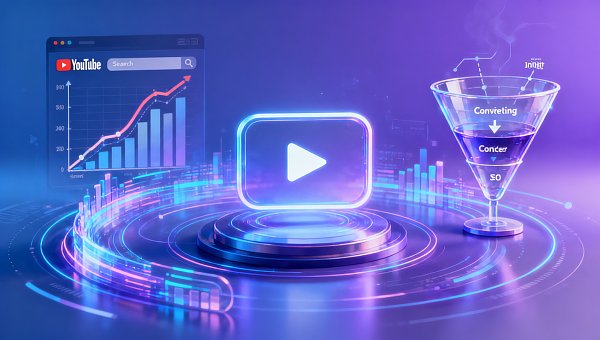
In the integrated website + marketing services industry, the goal of YouTube video marketing should not stop at exposure, but should point to trackable business conversions. After investing continuously for 2–3 months, many companies find that their videos have views and their channels have subscribers, but website forms, WhatsApp inquiries, or email inquiries do not increase at the same pace. The problem is usually not “too few videos,” but a “broken conversion chain.”
For users and operators, common pain points include choosing topics based on intuition, failing to optimize titles and descriptions with keyword placement, and having landing pages that do not align with the video content. For business decision-makers, the bigger concern is the input-output cycle, and they usually observe within 4–12 weeks whether qualified leads are increasing. If there is no unified data attribution mechanism, it becomes difficult for the team to determine whether the issue lies in the content, the campaign, or the website handoff.
Project managers and channel partners also face another practical issue: customers in different countries and across different product lines do not follow the same decision-making path. Some watch case-study videos first, some search for solutions first, and some click directly on ads and enter the quotation page. If YouTube video marketing is not coordinated with smart website building, SEO optimization, and remarketing ads, inquiries will naturally be lost across multiple touchpoints.
When there are no inquiries, the issue is usually stuck at these 4 key stages
- Content positioning leans too much toward showcasing, lacking a clear explanation of “what problem is solved, who it is for, and how to get in touch.”
- Video keyword placement is incomplete, focusing only on the title while ignoring the description, chapters, tags, and subtitle text.
- The landing page has weak conversion support, with unreasonable page load speed, form length, case proof, and call-to-action button setup.
- Data tracking is disconnected, with no distinction between organic traffic, ad traffic, channel recommendation traffic, and branded keyword traffic.
Yiyingbao Information Technology (Beijing) Co., Ltd. has long served global growth scenarios. Relying on artificial intelligence and big data capabilities, it integrates smart website building, SEO optimization, social media marketing, and advertising into a unified solution. For YouTube video marketing, this means not operating the channel in isolation, but advancing simultaneously across 4 dimensions: keyword research, page conversion support, remarketing reach, and lead attribution.
If you want to turn YouTube video marketing into an inquiry engine, first build a solid conversion funnel
Truly effective YouTube video marketing usually follows a 5-step funnel: “exposure—interest—visit—conversion—follow-up.” If a company only looks at play volume, it is easy to overestimate content performance. A more practical approach is to place each video into a clear business scenario, such as new product introductions, process explanations, project case studies, FAQ answers, or channel recruitment explanations, and then match them with different landing pages and conversion actions.
For B2B companies, common effective conversion actions include: submitting a form, booking a demo, downloading materials, sending an email inquiry, clicking a phone number, or entering an instant messaging channel. Operationally, it is recommended to divide conversions into 3 levels: the first level is visiting the landing page, the second level is staying or downloading, and the third level is a valid inquiry. This way, issues can be identified within the first 2–4 weeks, instead of waiting until the sales side sees no deals for a long time before reviewing the problem.
What elements should a video that can generate inquiries include at a minimum?
It is recommended to control the content structure in 3 stages: clearly state the pain point in the first 15 seconds, explain the solution in the middle 60–180 seconds, and give a call to action in the final 20 seconds. If the video is relatively long, chapter navigation can be added so that project leaders and procurement decision-makers can quickly jump to key information sections such as specifications, processes, delivery, and cost.
Recommended execution checklist
- Choose topics around high-intent search terms, such as “how to choose,” “how much does it cost,” “which scenarios is it suitable for,” and “how to deploy.”
- Make titles highlight scenario terms and result terms, and avoid using only a brand name or a vague product name.
- In the first 100–150 words of the description, clearly explain the solution value and include a supporting link to the official website.
- Keep subtitles, thumbnails, end cards, and landing page information consistent to reduce bounce.
If a company’s services involve network infrastructure, global access speed, or overseas business capacity, the video can also naturally mention the impact of the technical foundation on marketing conversion. For example, if a company website is unstable for overseas access or loads slowly on mobile devices, it will directly affect the form submission rate after traffic is driven from videos. For such needs, explanations can be combined with enterprise network upgrade directions such as Internet Protocol Version 6 (IPV6), so that technical solutions and marketing performance form a closed loop.
How should different roles judge whether a YouTube video marketing plan is worth the investment?
YouTube video marketing is not a standalone content project, but a cross-department collaborative effort. Users care about execution difficulty, business decision-makers care about return on investment, project managers care about timelines, distributors and agents care about asset reuse, and end consumers care more about whether the information is clear and credible. Therefore, the evaluation criteria must be broken down instead of focusing on only one metric.
The table below is suitable for early-stage plan evaluation. It aligns common roles, key metrics, and recommended actions, making it easier for companies to complete directional judgment in one internal meeting and reduce communication friction such as “the content team wants to do it, the sales team does not approve, and management does not understand.”
From execution experience, if YouTube video marketing is to achieve more stable inquiries, it must at least meet 3 conditions simultaneously: the content can be searched, the page can be understood, and the leads can be followed up. Yiyingbao’s advantage lies in not only handling front-end content and channel layout, but also integrating back-end website structure, keyword architecture, ad remarketing, and data dashboards to help teams reduce the trial-and-error cycle.
Before investing, it is recommended to check these 5 basic conditions
- Whether there is already a clear target market and target language version, instead of making all videos for everyone.
- Whether the official website has 2–3 core landing pages corresponding to the solution page, case-study page, and contact page.
- Whether the form is limited to 3–5 necessary fields to avoid loss caused by excessive length.
- Whether basic tracking has been deployed, such as source channels, page dwell time, form submissions, and download behavior.
- Whether the sales team can follow up new leads within 24–48 hours to avoid wasting video traffic.
How should content, website, and advertising work together to turn traffic into inquiries?
For YouTube video marketing to generate inquiries, it cannot rely on the channel alone. The truly efficient approach is for videos to build trust, the website to capture demand, SEO to continuously acquire search traffic, and advertising to amplify high-intent audiences. Especially in industrial, manufacturing, and technical service businesses, customers often need multiple touches, and on average they submit requests only after 3–5 content interactions.
The table below is suitable for judging “which link is most likely to break.” If a company has already been consistently updating videos but still has no stable leads, the bottleneck can usually be found in these 4 stages. This kind of review is more effective than vaguely saying “the content is not good,” and it is also more convenient for management to allocate budgets.
From the perspective of integrated website + marketing services, the most important thing to focus on is a “unified information architecture.” The selling points presented in videos, the solutions written on the official website, and the benefit points promised in ads must maintain the same semantic system; otherwise, users will experience a cognitive gap after clicking through. For companies that require overseas access support, upgrades to the website’s underlying network and access protocols will also affect conversion support efficiency. For example, in enterprise network upgrade scenarios, a 128-bit address system and more stable transmission capabilities help support a global access experience.
When implementing at the enterprise level, how can you arrange timelines, budgets, and collaboration processes more reliably?
If a company is preparing to officially launch YouTube video marketing, it is recommended to first run an 8–12 week pilot cycle instead of making a heavy full-year investment from the start. Use the first 2 weeks to complete keyword research, script planning, and landing page preparation; continue publishing and testing data in weeks 3–6; then carry out secondary optimization in weeks 7–12 based on viewing behavior and inquiry quality. This approach both controls the budget and gives management visible phased results.
A 4-step implementation process more suitable for B2B teams
- Diagnosis phase: review the current website status, content assets, market goals, and competitive semantics to form a priority list.
- Build phase: improve the channel, landing pages, tracking system, remarketing audiences, and conversion paths.
- Execution phase: steadily produce 2–4 types of video content each month, combined with organic traffic and ad testing.
- Optimization phase: iterate based on lead quality, page conversion rate, channel cost, and sales feedback.
Budget judgment should also be layered. For early-stage teams, it is best to first focus on 1 core market, 2 main product categories, and 3 types of high-intent content. It is not recommended to spread efforts across too many country sites and content themes at the same time. This makes it easier to validate the model within one quarter. After the foundational content, website support, and ad audiences have accumulated, then expand into multilingual and multi-channel collaboration.
Common pitfalls reminder
- Only pursuing visual quality in shooting while ignoring keywords and conversion entry points, resulting in content that “looks good but does not convert.”
- Only building the YouTube channel without optimizing the official website at the same time, causing traffic to fail to accumulate into follow-up-ready leads.
- Only looking at total play volume without checking completion rate, link click-through rate, and form conversion rate, making judgments easy to distort.
- Sales follow-up is too slow, especially for customers across time zones; contacting them again after 48 hours often means the opportunity window has already been missed.
If a company’s business is related to overseas infrastructure, enterprise network performance, or secure delivery, more professional explanations can also be added to technical content, such as information about 128-bit address length, multicast support, built-in IPSec protocol, and end-to-end encryption. This type of content is not meant to pile up technical jargon, but to help project leaders and technical procurement teams understand solution value more quickly and form credible support for the marketing narrative.
FAQ: What are the most common questions when using YouTube video marketing to generate inquiries?
How long does it take to see inquiry results?
If a company already has a foundational website and a clear product line, changes in traffic generation and conversion data can usually be seen within 4–8 weeks; if landing pages still need to be built, tracking deployed, and multilingual content created, the common ramp-up cycle will extend to 8–12 weeks. B2B projects naturally have a long deal cycle, so it is recommended to first look at valid visits and high-intent actions, and then at final transactions.
Is a longer video always better?
Not necessarily. For YouTube video marketing used for lead generation, what matters more is complete information and a clear rhythm. Solution videos are commonly 2–6 minutes, case-study breakdowns can be 5–8 minutes, and complex technical explanations can be longer, but chapters and clear guidance must be added. If the user benefit is not made clear in the first 30 seconds, even a longer video will be hard to convert.
Is advertising a must in order to get inquiries?
Not necessarily, but relying only on organic growth is usually slower. A more reliable approach is to first use SEO and content to build foundational traffic, and then do remarketing to people who have watched the videos or visited the website. In this way, advertising does not need broad, heavy spending, but instead focuses on precise reach around high-intent audiences, making cost control easier.
Is it suitable for foreign trade, manufacturing, and technical service companies?
Very suitable, but the premise is that the content must shift from “talking about ourselves” to “talking about customer problems.” Equipment demonstrations, project processes, delivery standards, after-sales support, common troubleshooting, and regional agency policies are all video topics suitable for conversion. For distributors and agents, YouTube video marketing can also be reused as recruitment and training material, improving channel communication efficiency.
Why choose us: from video lead generation to website conversion, we provide an actionable full-funnel solution
If you are evaluating whether YouTube video marketing is worth doing, or you have already been doing it for some time but still have no inquiries, the core issue is not producing more videos, but identifying the breakpoints in the funnel as quickly as possible. Since its establishment in 2013, Yiyingbao Information Technology (Beijing) Co., Ltd. has continued to focus deeply on integrated services covering smart website building, SEO optimization, social media marketing, and advertising, and can drive collaboration across 4 dimensions: technology, content, channels, and data.
For business decision-makers, we can help determine budget ranges, phased goals, and priority markets; for operations teams, we can organize keywords, content planning, page conversion support, and data tracking; for project leaders, we can define implementation cycles, cross-department coordination milestones, and delivery acceptance items; and for channel partners, we can also provide content architecture recommendations better suited for recruitment, training, and end-customer conversion.
You can prioritize consulting on the following topics
- Whether YouTube video marketing and official website revamping should be carried out simultaneously, and how to arrange the sequence.
- How to group keywords for different markets and different product lines, and which ones are more suitable for initial promotion.
- Which specifications, case studies, FAQs, and form fields should be retained on the landing page for more reasonable conversion.
- How the pilot cycle is generally arranged, and how to evaluate phased results within 8–12 weeks.
- If enterprise network upgrades, overseas access, and technical capacity requirements are involved, how to coordinate them with the marketing plan.
If you want to have a more specific discussion around parameter confirmation, product selection, delivery cycles, customized solutions, or quotation communication, you can now carry out a systematic diagnosis based on your existing website, video content, and target market. First straighten out the conversion path, and then advance YouTube video marketing, so inquiry growth will be much more achievable.
Related Articles


Related Products
 EasyCamp SaaS Smart Website Marketing SystemE-Yingbao SaaS Smart Website Marketing System: AI-powered, zero-code website building. Rapidly launch multilingual independent e-commerce sites in just 10 minutes. Global server acceleration and AI-driven SEO optimization empower businesses to efficiently connect with global markets. The seamless integration of technology and user-friendly operation makes building e-commerce sites incredibly simple.
 AI+SEM Intelligent Advertising Marketing SystemAI+SEM drives intelligent ad creation, empowering full-funnel precision advertising marketing. The system automatically generates weekly/monthly reports, AI recommends keywords and target countries, monitors core metrics in real-time with intelligent alerts, and enables one-click high-conversion ad solutions to help quickly acquire customers and improve ROI.
 AI+SEO Dual Engine Optimization ServiceEasyWin AI+SEO Dual Engine Optimization System leverages AI-powered keyword mining, content generation, and comprehensive technical optimization to help foreign trade enterprises acquire high-quality organic traffic, significantly improving search rankings and conversion rates.
 AI+SNS Social Media Marketing SystemYingbao AI+SNS Social Media Marketing System - Precision social capture for the social media era. Supports one-click content synchronization across major platforms like Facebook and LinkedIn. AI intelligently rewrites posts for enhanced relevance. 24/7 AI customer service and user profiling analysis empower businesses to efficiently expand into global markets.
 AI+SEO营销解决方案易营宝AI+SEO营销解决方案,通过AI批量写作、智能生成TDK、精准关键词扩词等功能,全面优化网站SEO效果,提升流量与转化率。助力企业构建高效智能网站新生态。
 AI+SEM Advertising Marketing SolutionsAI+SEM Advertising Marketing Solution leverages AI technology to deeply empower SEM ad campaigns. It automatically generates weekly/monthly reports using AI, presenting account data across multiple dimensions for comprehensive insights into campaign performance and trends. The system precisely recommends keywords and target countries, intelligently generates high-conversion ad copy, and enables one-click activation of efficient campaign plans to help businesses rapidly acquire customers. Simultaneously, it monitors core metrics in real time, intelligently identifies abnormal fluctuations, and issues timely alerts to ensure stable, high-return advertising results.
 Domain Name ServicesEasyWin provides professional domain name services, including intelligent queries, one-stop registration, brand protection, and full lifecycle management, helping businesses build a digital brand image.
 EasyOperate B2C Cross-Border E-Commerce Platform & Independent WebsiteEasyStore B2C Cross-border E-commerce Independent Store is an intelligent website building and cross-border e-commerce integrated solution independently developed by EasyStore Information Technology (Beijing) Co., Ltd. The system is specially designed for small and medium-sized as well as large export enterprises, integrating 'website building, operation, marketing, advertising, and conversion' into one, helping enterprises quickly establish cross-border e-commerce independent stores to achieve brand globalization and global sales growth.
The platform supports multiple languages, multiple currencies, and multi-channel marketing, with built-in AI intelligent translation and SEO optimization systems, suitable for mainstream markets such as Southeast Asia, Europe and America, Latin America, and the Middle East, assisting Chinese manufacturing enterprises in efficiently deploying international e-commerce strategies. SSL证书易营宝提供专业SSL安全证书服务,包括单域名和泛域名证书,确保网站数据传输加密、身份验证和完整性保护,助力企业建立安全可信的在线业务环境。









