









- The China-US tariff arrangement has reached a preliminary consensus, and the trade association will be establishedJun 15, 2026View details
- What determines B2C cross-border e-commerce website development costs? A breakdown of features, interfaces, and deployment methodsJun 17, 2026View details
- China-Morocco zero-tariff access, a breakthrough in the cost of Moroccan goods exports to ChinaJun 11, 2026View details
- What signal should be released for the suspension of exports to JapanJun 10, 2026View details
- China's May LNG imports rebounded, with increased volumes from Russia and Canada filling the Middle East supply gapJun 10, 2026View details
- Will GEO change its SEO strategy?Jun 04, 2026View details
Which stage of business is smart advertising suitable for? How should in-house and outsourced operations be chosen
Which stage is intelligent ad campaigns suitable for? How should companies choose between an in-house team and an outsourced operation model?
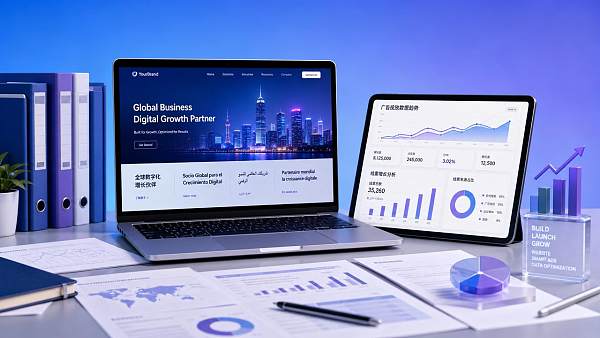
Once a company enters a growth phase for customer acquisition, intelligent ad campaigns are often no longer an optional choice, but a lever for improving efficiency. The question is not whether to do it, but when to do it, who should do it, and how to invest the budget where it is more likely to deliver results.
Many companies get stuck at the very beginning, wondering whether in-house execution is more cost-effective and whether outsourcing is more省心. In fact, neither approach is absolutely better or worse. The key depends on the company’s stage, team maturity, lead quality requirements, and expectations for growth pace.
Looking at recent changes, traffic is becoming increasingly fragmented, and platform algorithms are placing more and more emphasis on data feedback. The value of intelligent ad campaigns has also shifted from “buying traffic” to “using data to find the right customers, using content to improve conversion, and using systems to continuously optimize ROI.”
This also means that when a company is making a choice, it should not look only at surface-level service fees, but also at whether the overall lead-generation path runs smoothly and whether it can truly create stable growth.
Which stage is suitable for intelligent ad campaigns
Not every company is suited to the same level of investment in intelligent ad campaigns. Different stages have different goals. To determine whether it is time to increase investment, you can first look at three signals.
- Organic traffic growth is slowing, and existing channels can no longer support new leads.
- The sales team has follow-up capability, but the front end is clearly not generating enough leads.
- Product positioning and target market are already relatively clear, and results need to be scaled and validated.
If a company is still in the product refinement stage, with unclear website messaging and an incomplete conversion path, increasing intelligent ad spending too early will usually only magnify the problems. Traffic may come in, but inquiries will be few, bounce rates high, costs expensive, and the market may ultimately be misjudged.
On the contrary, when the official website, landing pages, form mechanisms, and customer service response are already in place, intelligent ad campaigns can more easily play a leverage role. They can help companies quickly test countries, keywords, audience segments, and creative directions, shortening the trial-and-error cycle.
For foreign trade companies, manufacturers, cross-border sellers, and brand-going-global teams, this stage often appears when there are already preliminary deals and the next step is to scale lead volume.
Which companies are more suitable for in-house operations
In-house execution is not just about “opening an account yourself and running ads yourself.” Truly effective in-house operations require strategy, materials, data analysis, and landing page coordination. Missing even one link can cause ad campaigns to run off course.
Generally speaking, the following types of companies are better suited for in-house operations:
- There is already a mature internal marketing lead who understands channel logic and investment evaluation.
- The product line is stable, the selling points are clear, and historical data is relatively complete.
- The budget has strong continuity and can absorb early-stage testing costs.
- The sales, content, design, and website teams can collaborate quickly.
The biggest advantage of in-house execution is a shorter feedback loop. When the market changes, the team can promptly adjust keywords, audience segments, creative content, and bidding strategies. For companies that value data accumulation, this sense of control is very important.
But the risk is also more obvious. Many teams assume that simply having an ad account means they know how to run intelligent ad campaigns, and as a result they overlook landing page structure, tracking setup, conversion attribution, and sales follow-up quality. In the end, the clicks may look good, but the actual conversions are not ideal.
So, in-house operations are suitable for companies with “methodology, talent, and an execution system,” not simply for companies that want to save service fees.
Which companies are more suitable for outsourced operations
If there is no complete in-house ad team, but the company wants to quickly get through the customer acquisition model, outsourced operations are usually the more realistic choice. Especially during the new market expansion phase, an external team can often fill the experience gap more quickly.
Outsourced operations are more suitable for the following situations:
- The company wants to launch intelligent ad campaigns quickly, but internal manpower is limited.
- Cross-platform deployment is needed, such as search, social media, and short video coordination.
- The company hopes to leverage mature methods and reduce the early-stage trial-and-error loss.
- The website, SEO, and ad landing pages need integrated optimization.
Good outsourced operations are not just about helping a company set up accounts and bid. They involve optimizing the entire chain, from website building, content, and advertising to data feedback and lead screening, forming a closed loop. For overseas customer acquisition, this integrated capability is especially critical, because traffic quality often depends on whether the front-end messaging and back-end follow-up are aligned.
Taking Yiyingbao as an example, relying on AI intelligent website building, AI ad marketing systems, and SEO/GEO optimization capabilities, it can unify and optimize website construction, multilingual content, ad landing pages, and intelligent ad campaigns within the same growth framework, avoiding separate channel battles.
The key to this model is not outsourcing execution, but enabling the company to establish a replicable growth mechanism more quickly.
Compare in-house and outsourced operations across these four core dimensions
If you are still hesitating, you can narrow the judgment down to four dimensions. This is much closer to real decision-making than simply comparing quotations.
In actual business, there is another easily overlooked point: collaboration efficiency. Intelligent ad campaigns are never isolated actions. They involve website structure, form design, page content, customer service scripts, and sales follow-up cadence.
If internal collaboration is slow, even if you choose in-house execution, ad spend can still be wasted due to delayed responses. Conversely, if outsourced operations have weak communication mechanisms, information silos will also occur.
Before making a decision, first check these three common misconceptions
The first misconception is treating intelligent ad campaigns as simply buying traffic. In fact, the more intelligent the platform becomes, the more sensitive it is to material quality, data feedback, and conversion goal settings. If the front-end preparation is insufficient, even the algorithm cannot help you find truly high-value customers.
The second misconception is looking only at click cost and ignoring final conversions. Cheap clicks do not mean effectiveness, and more inquiries do not necessarily mean higher quality. What really matters is effective lead cost, business conversion rate, and overall ROI.
The third misconception is ignoring content and website fundamentals. For example, slow page loading, poor mobile experience, overly long forms, and insufficient trust signals will all directly affect intelligent ad performance.
By the way, many management-oriented content pieces also emphasize the importance of process and structural optimization, such asDiscussion on New Era Enterprise Human Resource Management Optimization Strategies. In essence, this also shows that system efficiency often comes from mechanism design, not just individual effort.
The same is true for enterprises. To do intelligent ad campaigns well, first sort out the foundational chain; budget is more important than blind spending.
A more stable choice: verify on a small scale first, then decide on the long-term model
If a company is still uncertain at present, a more stable approach is not to choose one of the two immediately, but to first conduct a small-scale test and validate. This makes it easier to see your own weaknesses and to judge which model is more suitable for long-term development.
- First clarify the goal: is it brand exposure, inquiry growth, or order conversion?
- Then prepare the basic assets, including the official website, landing pages, tracking system, and content materials.
- Use one market, one product line, or one audience segment to conduct a first-round test.
- Continuously observe two to three optimization cycles, then evaluate whether to scale up.
If during the testing stage it is found that the internal team can steadily analyze data, continuously optimize pages, and respond quickly to leads, then in-house execution can be gradually pursued. If the bottleneck is mainly in experience, systems, and collaboration, then it is more suitable to choose professional outsourced operations.
For companies that want overseas growth, integrated services often offer greater advantages. If website building, SEO, advertising, social media, and AI search optimization can be advanced simultaneously, the results of intelligent ad campaigns are usually more stable and can more easily accumulate long-term assets.
In the end, in-house and outsourced operations are not a matter of right versus wrong, but a matter of stage selection. The one that fits the current business rhythm is the better solution.
When a company already has clear positioning, a basic conversion path, and definite growth goals, intelligent ad campaigns are worth deploying as early as possible. First look at the foundation, then the resources, and finally the execution efficiency; decision-making will be more stable and results will be easier to achieve.
If you want to take fewer detours, a more practical approach is to first complete one small-scale validation, then decide whether to build the capability in-house or use a mature service provider to drive growth. This choice is often more reliable than making a decision based on intuition.
Related Articles
 Southeast Asia's five countries launch DTSC certification, Chinese enterprise website service providers enter the first batch of evaluation partners
 Southeast Asia’s five nations launch DTSC certification; foreign trade independent sites welcome a new threshold
 Why should mechanical foreign trade websites emphasize application scenarios? Demonstrating scenarios is more persuasive to buyers than listing parameters.

Related Products
 EasyCamp SaaS Smart Website Marketing SystemE-Yingbao SaaS Smart Website Marketing System: AI-powered, zero-code website building. Rapidly launch multilingual independent e-commerce sites in just 10 minutes. Global server acceleration and AI-driven SEO optimization empower businesses to efficiently connect with global markets. The seamless integration of technology and user-friendly operation makes building e-commerce sites incredibly simple.
 AI+SEM Intelligent Advertising Marketing SystemAI+SEM drives intelligent ad creation, empowering full-funnel precision advertising marketing. The system automatically generates weekly/monthly reports, AI recommends keywords and target countries, monitors core metrics in real-time with intelligent alerts, and enables one-click high-conversion ad solutions to help quickly acquire customers and improve ROI.
 AI+SEO Dual Engine Optimization ServiceEasyWin AI+SEO Dual Engine Optimization System leverages AI-powered keyword mining, content generation, and comprehensive technical optimization to help foreign trade enterprises acquire high-quality organic traffic, significantly improving search rankings and conversion rates.
 AI+SNS Social Media Marketing SystemYingbao AI+SNS Social Media Marketing System - Precision social capture for the social media era. Supports one-click content synchronization across major platforms like Facebook and LinkedIn. AI intelligently rewrites posts for enhanced relevance. 24/7 AI customer service and user profiling analysis empower businesses to efficiently expand into global markets.
 AI+SEO营销解决方案易营宝AI+SEO营销解决方案,通过AI批量写作、智能生成TDK、精准关键词扩词等功能,全面优化网站SEO效果,提升流量与转化率。助力企业构建高效智能网站新生态。
 AI+SEM Advertising Marketing SolutionsAI+SEM Advertising Marketing Solution leverages AI technology to deeply empower SEM ad campaigns. It automatically generates weekly/monthly reports using AI, presenting account data across multiple dimensions for comprehensive insights into campaign performance and trends. The system precisely recommends keywords and target countries, intelligently generates high-conversion ad copy, and enables one-click activation of efficient campaign plans to help businesses rapidly acquire customers. Simultaneously, it monitors core metrics in real time, intelligently identifies abnormal fluctuations, and issues timely alerts to ensure stable, high-return advertising results.
 Domain Name ServicesEasyWin provides professional domain name services, including intelligent queries, one-stop registration, brand protection, and full lifecycle management, helping businesses build a digital brand image.
 EasyOperate B2C Cross-Border E-Commerce Platform & Independent WebsiteEasyStore B2C Cross-border E-commerce Independent Store is an intelligent website building and cross-border e-commerce integrated solution independently developed by EasyStore Information Technology (Beijing) Co., Ltd. The system is specially designed for small and medium-sized as well as large export enterprises, integrating 'website building, operation, marketing, advertising, and conversion' into one, helping enterprises quickly establish cross-border e-commerce independent stores to achieve brand globalization and global sales growth.
The platform supports multiple languages, multiple currencies, and multi-channel marketing, with built-in AI intelligent translation and SEO optimization systems, suitable for mainstream markets such as Southeast Asia, Europe and America, Latin America, and the Middle East, assisting Chinese manufacturing enterprises in efficiently deploying international e-commerce strategies. SSL证书易营宝提供专业SSL安全证书服务,包括单域名和泛域名证书,确保网站数据传输加密、身份验证和完整性保护,助力企业建立安全可信的在线业务环境。









