









- China-Morocco zero-tariff access, a breakthrough in the cost of Moroccan goods exports to ChinaJun 11, 2026View details
- What signal should be released for the suspension of exports to JapanJun 10, 2026View details
- China's May LNG imports rebounded, with increased volumes from Russia and Canada filling the Middle East supply gapJun 10, 2026View details
- Will GEO change its SEO strategy?Jun 04, 2026View details
- What types of businesses are end-to-end solutions suitable for?Jun 03, 2026View details
- 2026 Global Growth Channel TrendsJun 02, 2026View details
How to choose a foreign trade marketing solution? A framework from lead generation channels to inquiry conversion
How to choose a foreign trade marketing solution is not really about judging which tool stack is more complete, but about whether it can form a stable closed loop of attracting customers, handling inquiries, following up, and closing deals. For many overseas businesses, the issue is often not whether they “do promotion,” but whether they can handle the traffic after it comes in and whether they can convert leads into customers after they are captured.
Especially under the trend of integrated website and marketing services, enterprises are paying more and more attention to the synergy between independent websites, search visibility, ad placement, social media touchpoints, and data analysis. An effective foreign trade marketing solution should not only solve short-term inquiry generation, but also take into account long-term brand building and global market expansion capabilities.
First, make it clear: foreign trade marketing is not a single ad placement action
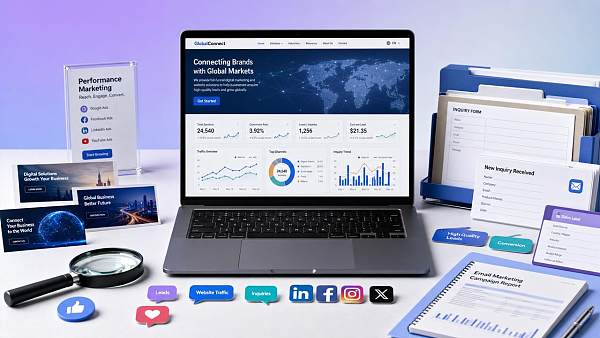
When choosing a foreign trade marketing solution, many teams are used to first asking about the platform, budget, and traffic cost. This line of thinking is incomplete. Because the foreign trade business chain is longer, customer decision-making is slower, the procurement process is more complex, and it is difficult for a single channel alone to continuously scale results.
Simply put, a foreign trade marketing solution should cover four levels: finding customers, making customers understand, making customers willing to inquire, and driving inquiries into the transaction process. Focusing only on front-end traffic can easily lead to high clicks but low conversions; focusing only on website display can result in complete content but no visits.
Therefore, when evaluating the pros and cons of a solution, the core is not whether it “has the most functions,” but whether each link is coordinated around business objectives and whether it is suitable for the target region, product characteristics, and sales rhythm.
From channels to websites, the underlying structure of a foreign trade marketing solution
A mature foreign trade marketing solution is usually composed of the channel layer, content layer, site layer, conversion layer, and data layer. It is not a matter of piecing several services together, but of designing around the overseas customer journey.
The channel layer determines whether the target market can be reached
Search engines are suitable for capturing explicit demand, ad placement is suitable for quickly testing the market, social media platforms are more suitable for continuously influencing decisions, and short videos and content distribution help improve awareness and trust. Different regions and different products require very different channel combinations.
The site layer determines whether traffic can be retained
An independent website is not an electronic catalog. It needs to take into account loading speed, mobile experience, multilingual presentation, search-friendly structure, and inquiry path design. Especially in B2B scenarios, after entering the page, customers care more about professional credibility, delivery capability, and product fit.
The conversion layer determines inquiry quality
Forms, buttons, case studies, quotation logic, FAQ, downloadable materials, and instant communication entry points all directly affect lead quality. Getting an email address does not mean obtaining a valid business opportunity; leaving an inquiry does not mean entering a real procurement process.
The industry now focuses more on integration, not single-point capability
In recent years, more and more companies have re-evaluated foreign trade marketing solutions, because external traffic costs have risen, platform rules change faster, and the customer decision process has shifted from “search—inquiry” to “multi-channel verification—then contact.”
This means that website construction, search optimization, ad placement, social media operations, and data tracking can no longer operate independently. What truly delivers stable growth is often an integrated website and marketing service setup.
For platform-based service providers represented by YiYingBao, the long-term approach is to view intelligent website building, SEO optimization, social media marketing, and ad placement within the same growth chain. Its advantage lies not only in tool integration, but also in connecting website building, content, advertising, and search visibility through AI and big data, shortening testing cycles and improving lead acquisition efficiency.
For businesses covering regions such as North America, Europe, Southeast Asia, Japan and South Korea, the Middle East, Russian-speaking regions, and Latin America, multilingual websites, localized content, search rule adaptation, and differentiated channel operations have already become foundational capabilities in foreign trade marketing solutions, not add-ons.
When choosing, what to focus on is more important than “what it has”
In actual evaluation, attention can be placed on several dimensions that are closer to results.
If a foreign trade marketing solution can connect these dimensions, it usually means subsequent growth will be more controllable. Conversely, if the solution only emphasizes rankings, clicks, or website speed, but cannot answer inquiry quality and transaction path issues, its actual value needs to be judged carefully.
Different business scenarios require different build-out ideas
There is no one-size-fits-all template for foreign trade marketing solutions. Different business forms have different requirements for channels and websites.
- Manufacturing companies place more emphasis on professional content, factory capability presentation, case evidence, and stable inquiry sources.
- Cross-border e-commerce stores place greater emphasis on page conversion, shopping process, ad efficiency, and repurchase pathways.
- Brand global expansion projects usually focus on content asset accumulation, social media synergy, and long-term search visibility.
- Early-stage market testing is more suitable for using a lightweight site plus ad verification, and then gradually expanding SEO and content layout.
In other words, when choosing a foreign trade marketing solution, first clarifying the business objectives is more important than comparing the service list. Different goals should lead to different budget allocation, channel sequencing, and evaluation standards.
Some teams also reference cross-industry research materials when comparing internal plans to improve budget and execution mechanisms, such asResearch on measures to improve the budget execution rate of public institutions, whose value does not lie in direct industry mapping, but in helping establish a clearer thinking framework for resource allocation and execution evaluation.
Why more and more companies value AI-driven integration capabilities
The foreign trade marketing chain is long and variable. It is difficult for manual experience alone to continuously balance efficiency and precision. Especially in multilingual website building, keyword layout, ad creative testing, and inquiry source analysis, AI capabilities are becoming an important factor affecting execution speed.
The logic of platforms like YiYingBao is to integrate the cloud intelligent website building system, cross-border store system, AI advertising marketing system, and AI+SEO/GEO optimization system into the same growth framework. The significance of this approach is that a website is not only launched, but can also be indexed, seen, clicked, and ultimately convert effectively.
From a long-term perspective, competition in foreign trade marketing solutions is shifting from “who can do more channels” to “who can more quickly generate data feedback and continuously optimize.” This is also why more and more companies, when choosing a service provider, simultaneously evaluate technical foundations, localized services, and cross-regional execution experience.
When building a closed loop, common misconceptions are more worth being alert to than methods
Many projects fail to meet expectations, and it is not necessarily because the direction is wrong, but because key links were ignored.
- Only looking at traffic, not inquiry quality, leads to budget burn rate rising fast, but sales follow-up efficiency is not high.
- Redesigning the website to be lightweight and visually appealing, but lacking a clear action entry and trust proof.
- Separating SEO, ads, and social media execution, resulting in disjointed data and fragmented optimization directions.
- Ignoring search habits and content preferences in different countries, causing translated content that is not truly understood.
These issues all show that foreign trade marketing solutions cannot just look at front-end exposure; they must also examine whether each step can lead to a transaction opportunity. Only by connecting traffic, content, pages, forms, follow-up, and repurchase can the solution truly have business value.
The next step in judgment can start from three things
If you are evaluating a foreign trade marketing solution, you may first sort out the existing channel structure, identify which traffic sources bring real business opportunities; then check whether the independent website has the three basic conditions of search friendliness, content credibility, and clear conversion; and finally break down the path from inquiry to deal to find the links that truly affect efficiency.
When the judging criteria shift from “whether it exists” to “whether it can form a closed loop,” the choice of solution becomes clearer. For foreign trade businesses, a good foreign trade marketing solution is not a one-time combination of investments, but a growth system that can continuously verify, continuously optimize, and continuously scale results.
Related Articles



Related Products
 EasyCamp SaaS Smart Website Marketing SystemE-Yingbao SaaS Smart Website Marketing System: AI-powered, zero-code website building. Rapidly launch multilingual independent e-commerce sites in just 10 minutes. Global server acceleration and AI-driven SEO optimization empower businesses to efficiently connect with global markets. The seamless integration of technology and user-friendly operation makes building e-commerce sites incredibly simple.
 AI+SEM Intelligent Advertising Marketing SystemAI+SEM drives intelligent ad creation, empowering full-funnel precision advertising marketing. The system automatically generates weekly/monthly reports, AI recommends keywords and target countries, monitors core metrics in real-time with intelligent alerts, and enables one-click high-conversion ad solutions to help quickly acquire customers and improve ROI.
 AI+SEO Dual Engine Optimization ServiceEasyWin AI+SEO Dual Engine Optimization System leverages AI-powered keyword mining, content generation, and comprehensive technical optimization to help foreign trade enterprises acquire high-quality organic traffic, significantly improving search rankings and conversion rates.
 AI+SNS Social Media Marketing SystemYingbao AI+SNS Social Media Marketing System - Precision social capture for the social media era. Supports one-click content synchronization across major platforms like Facebook and LinkedIn. AI intelligently rewrites posts for enhanced relevance. 24/7 AI customer service and user profiling analysis empower businesses to efficiently expand into global markets.
 AI+SEO营销解决方案易营宝AI+SEO营销解决方案,通过AI批量写作、智能生成TDK、精准关键词扩词等功能,全面优化网站SEO效果,提升流量与转化率。助力企业构建高效智能网站新生态。
 AI+SEM Advertising Marketing SolutionsAI+SEM Advertising Marketing Solution leverages AI technology to deeply empower SEM ad campaigns. It automatically generates weekly/monthly reports using AI, presenting account data across multiple dimensions for comprehensive insights into campaign performance and trends. The system precisely recommends keywords and target countries, intelligently generates high-conversion ad copy, and enables one-click activation of efficient campaign plans to help businesses rapidly acquire customers. Simultaneously, it monitors core metrics in real time, intelligently identifies abnormal fluctuations, and issues timely alerts to ensure stable, high-return advertising results.
 Domain Name ServicesEasyWin provides professional domain name services, including intelligent queries, one-stop registration, brand protection, and full lifecycle management, helping businesses build a digital brand image.
 EasyOperate B2C Cross-Border E-Commerce Platform & Independent WebsiteEasyStore B2C Cross-border E-commerce Independent Store is an intelligent website building and cross-border e-commerce integrated solution independently developed by EasyStore Information Technology (Beijing) Co., Ltd. The system is specially designed for small and medium-sized as well as large export enterprises, integrating 'website building, operation, marketing, advertising, and conversion' into one, helping enterprises quickly establish cross-border e-commerce independent stores to achieve brand globalization and global sales growth.
The platform supports multiple languages, multiple currencies, and multi-channel marketing, with built-in AI intelligent translation and SEO optimization systems, suitable for mainstream markets such as Southeast Asia, Europe and America, Latin America, and the Middle East, assisting Chinese manufacturing enterprises in efficiently deploying international e-commerce strategies. SSL证书易营宝提供专业SSL安全证书服务,包括单域名和泛域名证书,确保网站数据传输加密、身份验证和完整性保护,助力企业建立安全可信的在线业务环境。









