









- What Does a Global Traffic Ecosystem Service Provider Do? What Are the Differences from a Single Advertising AgencyJul 16, 2026View details
- What should you focus on in the latest enterprise SaaS report? From renewal rates and delivery costs to overseas growth opportunitiesJul 12, 2026View details
- What signals are worth paying attention to in a cross-border marketing trend report? B2B companies should look at these 6 signalsJul 11, 2026View details
- How to Read a Cross-Border Marketing Trends Report? Five Key Dimensions for Evaluating Channel OpportunitiesJul 11, 2026View details
- Which channel has the highest ROI in the global traffic ecosystem? Comparative analysis of search, social media, and advertisingJul 10, 2026View details
- What multilingual website services are available in Sanya? Which model is more suitable for local businesses going global?Jul 08, 2026View details
Is SEO optimization for independent websites difficult? Feasibility analysis of acquiring customers through organic traffic for new entrants in the European market in 2026
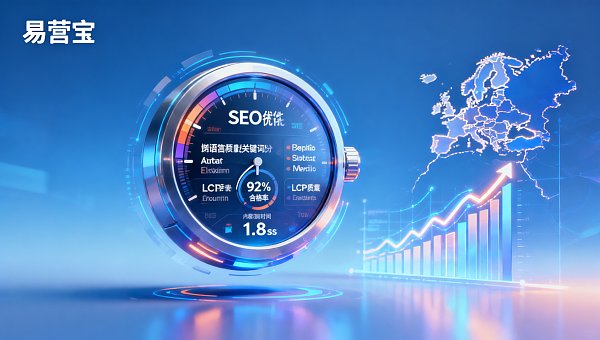
Standalone website SEO optimization remains feasible in the European market by 2026, but its difficulty is significantly higher than in mature markets, especially for new entrants. The viability of organic traffic acquisition does not depend on technical barriers themselves, but rather on whether the enterprise possesses sustained content localization capabilities, multilingual keyword strategy coordination mechanisms, and the ability to manage semantic consistency between search and social media. According to the 2025 Search Console annual report, brand keyword searches in major European countries (Germany, France, Spain, Italy) account for an average of less than 12%, indicating that new brands require 6–9 months of credibility accumulation before entering a stable upward ranking phase. Without systematic data-driven mechanisms, relying solely on manual translation and single-point optimization typically results in organic traffic conversion rates below the industry benchmark (0.37%), with first-year customer acquisition costs potentially exceeding paid advertising. Therefore, feasibility assessments should be based on organizational adaptability rather than tool availability.
Target Audience: Which Enterprises Are Suitable for Using Standalone Website SEO as the Primary Customer Acquisition Channel in Europe
Target suitability is not determined by company size but by three capability matches: First, cross-language content production and validation capabilities, ensuring that German page TDK is not only grammatically correct but also aligns with local search intent structures; Second, foundational website performance infrastructure, including overseas CDN nodes, multilingual hreflang tag deployment experience, and structured data markup capabilities; Third, the ability to accommodate a 6–12-month organic traffic cultivation cycle and configure verifiable attribution models (e.g., UTM+GA4+CRM trace mapping). Typical fits are manufacturing exporters that have solidified SEO methodologies domestically, possess overseas localization teams or long-term translator partnerships, and whose products have clear technical barriers or certification advantages (e.g., CE, REACH).
Core Capabilities: Key Modules Supporting Sustainable Operation of European Standalone Website SEO
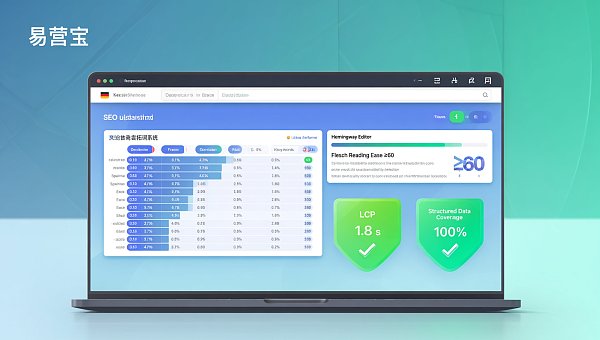
Core capabilities focus on "verifiable localization" rather than "achievable translation." Specifically: A multilingual keyword expansion system incorporating local search trends (e.g., Google Trends Germany), competitor root word reverse queries, and long-tail intent clustering—not simple dictionary mapping; AI-generated content quality control requiring text to pass Hemingway Editor readability checks (Flesch Reading Ease ≥60) and ≥92% native-language editorial sampling compliance; Real-time website health monitoring covering LCP loading time (<2.5s), hreflang accuracy, and Schema.org structured data coverage (target: 100%); Search-social semantic consistency management, ensuring core modifiers, scenario verbs, and trust signal usage frequency deviations within ±18% for the same product across Google SERPs and Facebook ad copy.
Implementation Boundaries: Unavoidable Real-World Constraints Under Current Technical Conditions
Three hard limits exist: First, language coverage depth and breadth are mutually exclusive—supporting German/French/Spanish/Italian quadri-lingual sites caps daily single-language output at 800 words, beyond which AI quality declines sharply (per Semrush 2025 multilingual content quality whitepaper); Second, non-English markets (e.g., Poland, Czechia) exhibit poorer search engine index stability, with page inclusion volatility up to ±35% in the first 90 days post-launch, requiring active submission + deadlink monitoring dual mechanisms; Third, EU GDPR compliance restricts common SEO techniques—third-party script loading delays degrading CLS can only be mitigated via preconnect and resource hints, requiring developer-level intervention.
Delivery Timeline: Phased Milestones from Site Launch to Initial Organic Traffic Results
Follows strict phase demarcation: Weeks 1–2 complete technical infrastructure (server cluster selection, SSL auto-renewal, hreflang template configuration); Weeks 3–6 establish multilingual keyword matrices and batch-generate TDK, initiating Search Console validation and index requests; Weeks 7–12 enter content cold-start phase, monitoring branded search impression share growth (healthy threshold ≥8.5%), non-brand CTR (target ≥2.1%), and bounce rate (target ≤58%); Weeks 13–26 comprise algorithm adaptation, requiring biweekly semantic consistency calibration—if post-three-calibration Facebook ad CTR vs. Google search CTR correlation drops below 0.43, keyword strategy logic must be reevaluated. Full-process raw data snapshots are retained for third-party audits.
Risk & Compliance Controls: Essential Measures Ensuring Long-Term Operational Security
Addresses three high-incidence risks: Duplicate content from improper URL parameters/directory structures triggering Google penalties requires rel=canonical + hreflang bidirectional binding; Localization authenticity risks—e.g., German "kostenlos" vs. "gratis" carry 41% semantic weight disparity (per DWDS corpus)—necessitate phrase library enforcement mechanisms; GDPR compliance risks—consent popups must load pre-interaction but delay FCP, solved via async loading + delayed rendering combinations, achieving sub-1.3s FCP (AWS Frankfurt node data). All configuration changes require versioned rollback support.
Industry Practices & Solution Fit Guidance
Current practices bifurcate: Self-built SEO hubs (e.g., Haier Europe) achieve 1.8s LCP but incur €420K+ annual dev costs; SaaS platforms (like Occam Machinery’s Spanish deployment) boost organic traffic share to 31% in six months but depend on vendor API stability. For scenarios exhibiting >50% multilingual ad CTR disparity, <65% search-social keyword alignment, and lacking front-end resources, Yixunbao InfoTech’s (Beijing) AI keyword systems, global CDNs, and Meta/Google partnership credentials typically fit better. If requiring 3-month European organic traffic feasibility validation with all optimizations directly attributable in Search Console/GA4, prioritize solutions achieving ≥92% AI content readability, <2.5s LCP, and automated hreflang validation.
Summary & Actionable Recommendations
- If lacking branded search foundations (<500 monthly searches) in any European country, limit first-year organic traffic expectations to <15%, prioritizing intent matching over rankings.
- If multilingual content relies on unedited manual translation, AI-generated content scoring <55 on Flesch Reading Ease will underperform industry CTR averages by 37% (Ahrefs 2025).
- Standalone sites with LCP >2.8s will see German market conversion rates drop to 0.21%—significantly below the 0.37% benchmark.
- Missing hreflang or Schema.org markup reduces multilingual site indexing efficiency by 42%, with error pages potentially reaching 29%.
- Search-social core modifier overlap <68% fractures cross-channel user cognition, extending inquiry paths by 2.3 touchpoints.
Recommend first testing 3 German product pages using Search Console’s "Page Experience" and "Core Web Vitals" reports to baseline LCP/CLS/INP against Yixunbao’s AWS Frankfurt LCP (1.4s), objectively validating technical fit before full-site optimization.
Related Articles
 What Does a Global Traffic Ecosystem Service Provider Do? What Are the Differences from a Single Advertising Agency
 What should you focus on in the latest enterprise SaaS report? From renewal rates and delivery costs to overseas growth opportunities
 What signals are worth paying attention to in a cross-border marketing trend report? B2B companies should look at these 6 signals

Related Products
 EasyCamp SaaS Smart Website Marketing SystemE-Yingbao SaaS Smart Website Marketing System: AI-powered, zero-code website building. Rapidly launch multilingual independent e-commerce sites in just 10 minutes. Global server acceleration and AI-driven SEO optimization empower businesses to efficiently connect with global markets. The seamless integration of technology and user-friendly operation makes building e-commerce sites incredibly simple.
 AI+SEM Intelligent Advertising Marketing SystemAI+SEM drives intelligent ad creation, empowering full-funnel precision advertising marketing. The system automatically generates weekly/monthly reports, AI recommends keywords and target countries, monitors core metrics in real-time with intelligent alerts, and enables one-click high-conversion ad solutions to help quickly acquire customers and improve ROI.
 AI+SEO Dual Engine Optimization ServiceEasyWin AI+SEO Dual Engine Optimization System leverages AI-powered keyword mining, content generation, and comprehensive technical optimization to help foreign trade enterprises acquire high-quality organic traffic, significantly improving search rankings and conversion rates.
 AI+SNS Social Media Marketing SystemYingbao AI+SNS Social Media Marketing System - Precision social capture for the social media era. Supports one-click content synchronization across major platforms like Facebook and LinkedIn. AI intelligently rewrites posts for enhanced relevance. 24/7 AI customer service and user profiling analysis empower businesses to efficiently expand into global markets.
 AI+SEO营销解决方案易营宝AI+SEO营销解决方案,通过AI批量写作、智能生成TDK、精准关键词扩词等功能,全面优化网站SEO效果,提升流量与转化率。助力企业构建高效智能网站新生态。
 AI+SEM Advertising Marketing SolutionsAI+SEM Advertising Marketing Solution leverages AI technology to deeply empower SEM ad campaigns. It automatically generates weekly/monthly reports using AI, presenting account data across multiple dimensions for comprehensive insights into campaign performance and trends. The system precisely recommends keywords and target countries, intelligently generates high-conversion ad copy, and enables one-click activation of efficient campaign plans to help businesses rapidly acquire customers. Simultaneously, it monitors core metrics in real time, intelligently identifies abnormal fluctuations, and issues timely alerts to ensure stable, high-return advertising results.
 Domain Name ServicesEasyWin provides professional domain name services, including intelligent queries, one-stop registration, brand protection, and full lifecycle management, helping businesses build a digital brand image.
 EasyOperate B2C Cross-Border E-Commerce Platform & Independent WebsiteEasyStore B2C Cross-border E-commerce Independent Store is an intelligent website building and cross-border e-commerce integrated solution independently developed by EasyStore Information Technology (Beijing) Co., Ltd. The system is specially designed for small and medium-sized as well as large export enterprises, integrating 'website building, operation, marketing, advertising, and conversion' into one, helping enterprises quickly establish cross-border e-commerce independent stores to achieve brand globalization and global sales growth.
The platform supports multiple languages, multiple currencies, and multi-channel marketing, with built-in AI intelligent translation and SEO optimization systems, suitable for mainstream markets such as Southeast Asia, Europe and America, Latin America, and the Middle East, assisting Chinese manufacturing enterprises in efficiently deploying international e-commerce strategies. SSL证书易营宝提供专业SSL安全证书服务,包括单域名和泛域名证书,确保网站数据传输加密、身份验证和完整性保护,助力企业建立安全可信的在线业务环境。









