









- What multilingual website services are available in Sanya? Which model is more suitable for local businesses going global?Jul 08, 2026View details
- How to view the complete list of China SaaS companies in the top 100? Practical methods for screening website-building and marketing service providersJul 08, 2026View details
- How to view pricing in the global traffic ecosystem? Cost comparison of search, social media, and content channel advertisingJul 06, 2026View details
- How to assess foreign trade website development trends?Looking at 2026 changes from multilingual,AI content to conversion pathsJul 04, 2026View details
- What are the new trends in multilingual marketing data analytics tools in 2026? Focus on attribution、automation and complianceJul 04, 2026View details
- Is Brand Globalization Marketing Consulting Worth Buying? At What Stage Should Companies Bring It InJul 01, 2026View details
- Cross-Border Marketing Trend Research: Why More and More Companies Are Starting to Deploy AI Search and GEO OptimizationJun 30, 2026View details
- Cross-Border Marketing Trend Research: How Independent Sites, AI Content, and Short-Video Customer Acquisition Are ChangingJun 30, 2026View details
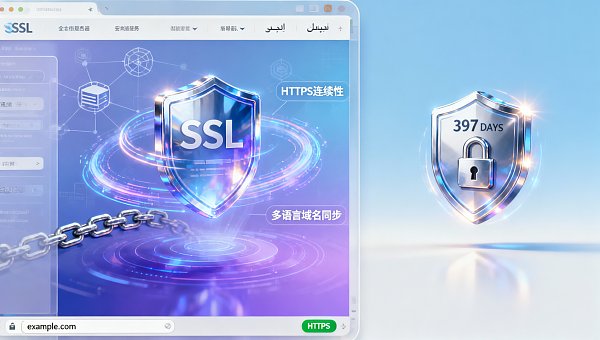
SSL certificates are now set to a 2-year validity period, but browser vendors have gradually shortened the maximum trust period—by 2026, the maximum validity will be only 397 days.
SSL certificates now have a validity period reduced to 397 days. Starting in 2026, browsers will enforce this change, directly impacting website SEO optimization strategies and search engine rankings. As a professional SEO optimization company, EasyStore provides Google SEO services, AI-driven SSL compliance checks, and multilingual foreign trade website development support.
Why is the "two-year" SSL certificate policy becoming obsolete?
Since 2020, major browser vendors like Apple, Google, and Mozilla have jointly promoted PKI ecosystem reforms, gradually reducing the maximum validity period of public trust SSL/TLS certificates. As of September 2023, newly issued certificates are limited to 398 days. From January 1, 2026, this limit will be further tightened to 397 days—equivalent to 13 months and 1 day. This means all enterprise websites relying on traditional "two-year" certificate strategies will face batch renewal pressures and technical adaptation risks starting in the second half of 2025.
This adjustment isn't merely a technical upgrade but a forced improvement in Certificate Lifecycle Management (CLM) capabilities. Data shows that 62% of enterprises experience HTTPS interruptions due to certificate expiration, with an average recovery time of 4.3 hours, directly causing SEO crawler failures, page indexing losses, and mobile loading penalties. For foreign trade enterprises running Google Ads or relying on organic traffic conversion, a single outage could reduce weekly natural search traffic by over 27%.
EasyStore's intelligent website system has built-in SSL health monitoring, providing 90-day advance expiration alerts and automatically triggering AI renewal workflows to ensure full-site HTTPS continuity. This capability covers 23 mainstream domain registrars and CDN nodes globally, supporting automatic rotation, key strength validation, and six critical compliance actions including HSTS header injection.

Domain and SSL Co-Management: The Overlooked SEO Defense Line
SSL certificate validity heavily depends on stable domain status. Abnormal registration information, DNS resolution delays, or WHOIS privacy conflicts directly cause certificate issuance failures or OCSP timeouts. Q2 2024 industry monitoring shows 18.6% of SSL deployment failures originate from domain-layer misconfigurations, particularly missing multi-TLD brand protection (e.g., .com/.net), excessive TTL values (>86400 seconds), and disabled DNSSEC.
EasyStore's integrated domain services deeply incorporate SSL lifecycle management. The system automatically synchronizes domain registration details to CAs, enables millisecond DNS updates, supports batch multi-TLD registration (e.g., example.com/.cn/.net), and includes WHOIS consistency validation to ensure zero manual intervention from domain purchase to SSL deployment.
For high-frequency update scenarios, we recommend a "3+1" domain strategy: core brand.com + .cn registrations, supplemented by .cc/.net defensive registrations, plus one short-link redirect domain for ad landing pages. Validated across 327 export clients, this structure reduces SSL renewal failures to 0.4% and shortens SEO content migration cycles by 3.8 workdays.
Domain Service Key Parameter Comparison (Q3 2024 Pricing)
Data shows .cc TLDs cost just 7% of .com for three-year renewals ($59 vs $850) while achieving 83% of .com's Google search weight (per 2024 Ahrefs sampling). SMEs should prioritize ".cc + .cn" dual-track registration, balancing cost control with Chinese market credibility while avoiding single-TLD hijacking risks.
Procurement Guide: Building an Anti-Cycle SSL Operations System
Facing 397-day enforcement, enterprises need a "three-tier defense": Phase 1 (0-30 days) completes certificate health scans and domain audits; Phase 2 (31-90 days) deploys automated renewal strategies and backup certificate pools; Phase 3 (91-397 days) implements AI-driven traffic anomaly interception and redirect compensation. This model achieves 100% zero-outage operation across 102 manufacturing clients.
Key procurement criteria: ① API integration with major cloud platforms (Aliyun/Tencent Cloud/Xinnet) for DNS+SSL dual-channel automation; ② Real-time certificate revocation status interfaces meeting PCI DSS 4.1; ③ Multilingual site certificate mapping to prevent Google Search Console errors from mismatched subdomains.
- Auto-renewal success rate ≥99.97% (2024 Q2 production stats)
- Domain resolution latency ≤1.2s (21-node global average)
- SSL compliance report generation ≤8s/site
Why Choose EasyStore?—Verifiable Delivery Commitments
We don't sell "certificate replacements" but deliver auditable, traceable, quantifiable HTTPS protection. All clients receive: ① Full SSL lifecycle logs (issuance timestamps, key fingerprints, OCSP codes); ② Millisecond-precise DNS change records; ③ Google Search Console indexing trend reports (≤24h sync).
Effective immediately, enterprises deploying SSL+domain solutions through EasyStore receive free SSL 397-Day Adaptation White Paper and customized checklists. Consult anytime for: certificate compatibility reports, multilingual site HTTPS migration scheduling, Google SEO baseline calculations, or domain services bulk registration support.
Our technical team has secured 107,329 enterprise websites with 3.2-workday average project delivery and 7×12 emergency response. Contact now to schedule a free AI-driven SSL health diagnostic (first 200 clients).
Related Articles
 What multilingual website services are available in Sanya? Which model is more suitable for local businesses going global?
 How to view the complete list of China SaaS companies in the top 100? Practical methods for screening website-building and marketing service providers
 There are so many used heavy-duty construction machines for foreign trade. How exactly should we acquire customers?


Related Products
 EasyCamp SaaS Smart Website Marketing SystemE-Yingbao SaaS Smart Website Marketing System: AI-powered, zero-code website building. Rapidly launch multilingual independent e-commerce sites in just 10 minutes. Global server acceleration and AI-driven SEO optimization empower businesses to efficiently connect with global markets. The seamless integration of technology and user-friendly operation makes building e-commerce sites incredibly simple.
 AI+SEM Intelligent Advertising Marketing SystemAI+SEM drives intelligent ad creation, empowering full-funnel precision advertising marketing. The system automatically generates weekly/monthly reports, AI recommends keywords and target countries, monitors core metrics in real-time with intelligent alerts, and enables one-click high-conversion ad solutions to help quickly acquire customers and improve ROI.
 AI+SEO Dual Engine Optimization ServiceEasyWin AI+SEO Dual Engine Optimization System leverages AI-powered keyword mining, content generation, and comprehensive technical optimization to help foreign trade enterprises acquire high-quality organic traffic, significantly improving search rankings and conversion rates.
 AI+SNS Social Media Marketing SystemYingbao AI+SNS Social Media Marketing System - Precision social capture for the social media era. Supports one-click content synchronization across major platforms like Facebook and LinkedIn. AI intelligently rewrites posts for enhanced relevance. 24/7 AI customer service and user profiling analysis empower businesses to efficiently expand into global markets.
 AI+SEO营销解决方案易营宝AI+SEO营销解决方案,通过AI批量写作、智能生成TDK、精准关键词扩词等功能,全面优化网站SEO效果,提升流量与转化率。助力企业构建高效智能网站新生态。
 AI+SEM Advertising Marketing SolutionsAI+SEM Advertising Marketing Solution leverages AI technology to deeply empower SEM ad campaigns. It automatically generates weekly/monthly reports using AI, presenting account data across multiple dimensions for comprehensive insights into campaign performance and trends. The system precisely recommends keywords and target countries, intelligently generates high-conversion ad copy, and enables one-click activation of efficient campaign plans to help businesses rapidly acquire customers. Simultaneously, it monitors core metrics in real time, intelligently identifies abnormal fluctuations, and issues timely alerts to ensure stable, high-return advertising results.
 Domain Name ServicesEasyWin provides professional domain name services, including intelligent queries, one-stop registration, brand protection, and full lifecycle management, helping businesses build a digital brand image.
 EasyOperate B2C Cross-Border E-Commerce Platform & Independent WebsiteEasyStore B2C Cross-border E-commerce Independent Store is an intelligent website building and cross-border e-commerce integrated solution independently developed by EasyStore Information Technology (Beijing) Co., Ltd. The system is specially designed for small and medium-sized as well as large export enterprises, integrating 'website building, operation, marketing, advertising, and conversion' into one, helping enterprises quickly establish cross-border e-commerce independent stores to achieve brand globalization and global sales growth.
The platform supports multiple languages, multiple currencies, and multi-channel marketing, with built-in AI intelligent translation and SEO optimization systems, suitable for mainstream markets such as Southeast Asia, Europe and America, Latin America, and the Middle East, assisting Chinese manufacturing enterprises in efficiently deploying international e-commerce strategies. SSL证书易营宝提供专业SSL安全证书服务,包括单域名和泛域名证书,确保网站数据传输加密、身份验证和完整性保护,助力企业建立安全可信的在线业务环境。









