









- EU Plans to Raise Tax on Incoming Small Parcels to €5Oct 31, 2026View details
- Maersk Adjusts Middle East Emergency Operating Cost Recovery Surcharge to USD 2,000 per ContainerOct 30, 2026View details
- Ministry of Commerce: Online retail sales grew 4.4% in the first three quarters, while cross-border e-commerce maintained relatively rapid growthOct 29, 2026View details
- CCTV reports: AI-powered smart hardware is expanding overseas at a faster pace, with orders for some best-selling products booked through next yearOct 29, 2026View details
- Alphabet Q3 Earnings: Google Search Advertising Revenue Rises 10.5% to $82 BillionOct 29, 2026View details
- AliExpress Announces New Service Rules for Russia, Linked to Wildberries Product IntegrationOct 28, 2026View details
When targeting the Middle East market, should you invest in search or social media first?
See How Customers Make Decisions Before Deciding Whether to Prioritize Search or Social Media in the Middle East
When planning overseas marketing channels for the Middle East, the easiest mistake to make is not having a small budget or choosing the wrong channel once. It is applying the advertising habits used in European and American markets directly to the Middle East. Many companies start by asking: Should we do Google Search first, or social media? On the surface, this is a channel selection question, but in reality, it is about determining the customer decision-making path. There is no single conversion logic in the Middle East. B2B industrial products, engineering supplies, consumer brands, and cross-border retail businesses differ significantly in how inquiries are generated. The order in which channels are deployed should follow the type of business, not the popularity of the platform.
If the product itself has clear purchasing intent, such as machinery, building materials, components, commercial systems, or industrial consumables—typical products in foreign trade projects—search channels are usually more suitable for an initial launch. The reason is straightforward: the customer’s need has already formed, and they may even be comparing suppliers, but have not yet decided who to work with. At this stage, search brings more than traffic; it captures demand that is closer to the inquiry and pre-order stage. By contrast, if the product is highly brand-oriented and visually driven, and customers need to “get to know you” first, such as home furnishings, beauty products, fashion accessories, or consumer electronics accessories, social media is often more suitable for initial outreach. Users do not search for the brand first; they are initially persuaded by content and usage scenarios.
This is also why advertising performance varies so significantly among companies in the Middle East. It is not that search is ineffective or social media has no impact; the two channels simply serve different purposes. Search is more like reaching people who are already looking for answers, while social media is more like bringing your brand into the view of potential customers.
For B2B Project-Based Businesses, Search Usually Generates Qualified Inquiries Earlier Than Social Media
For B2B marketing in the Middle East, especially for companies targeting factories, contractors, distributors, and procurement buyers, prioritizing search is generally more reliable. “Reliable” does not mean it is always cheaper; it means that lead intent is clearer. Customers directly search for product terms, solution terms, and regional terms, and may even include specifications, application scenarios, or purchasing purposes. As long as the website can effectively receive this traffic and the landing page clearly presents technical information, delivery capabilities, multilingual content, and contact methods, search traffic is more likely to turn into qualified inquiries.
A common problem is not that the advertisements receive no clicks, but that the website itself is not ready. In their initial assessment of a supplier, Middle Eastern customers usually look at several highly practical factors: whether the website appears legitimate, whether the language reads smoothly, whether the case studies are credible, whether it is convenient to submit an inquiry, and whether the website loads reliably on mobile devices. If a company invests its budget in search first while the website is still monolingual, the page structure is confusing, form submission is inconvenient, and page loading is slow, high-intent traffic from search will be wasted. This is precisely why website development and marketing services cannot be viewed separately. Before investing in search, the independent website should at least have a solid foundation for indexing, a clear conversion path, and an acceptable mobile experience.
Solutions such as Yiyingbao’s approach, which integrates AI-powered website building, SEO optimization, and advertising within one system, are suitable for these businesses for exactly this reason: they do not only solve the question of “where traffic comes from,” but also address whether “customers will leave a lead after clicking through.” In the Middle East, particular attention should be paid to multilingual pages and inquiry entry-point design. English pages are the foundation, and some industries may also consider developing Arabic landing page content. However, the extent to which this should be pursued depends on the target customer profile, internal operational capabilities, and after-sales support capabilities. Businesses should not expand blindly merely to appear more localized.
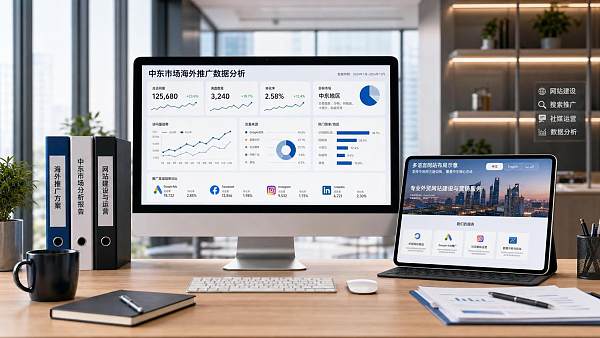
For Brand-Oriented and Retail Businesses, Starting with Social Media Often Better Matches How Middle Eastern Users Discover Products
If you sell products directly to consumers, or if your cross-border sales depend heavily on brand impressions, content-driven interest, and visual trust before conversion, social media should generally not be placed second. Social communication in the Middle East is not simply about “posting content”; it is more of a combination of brand reach, user education, and building an audience for remarketing. Many users do not initially enter a brand name into a search engine. Instead, they first see the product, how it is used, and user feedback in a social media environment, and then turn to the website or search engines for further confirmation.
When these businesses place heavy emphasis on search from the outset, they often encounter a practical problem: search volume is limited, while competition for non-branded terms is not low. As a result, click costs are not necessarily low, but conversion may still be unstable. This is because users have not yet formed a clear understanding of the product; they are merely passing by and are not in a hurry to buy. In contrast, social media content, short-form video materials, and remarketing ads are more likely to turn unfamiliar interest into convertible intent.
However, starting with social media does not simply mean creating accounts and generating exposure. It places higher demands on content quality, update frequency, comment management, and the website’s landing pages. Many companies assume that social media is suitable for an initial launch because the barrier to entry is low, only to find that although traffic is substantial, actual conversions are limited. The problem is usually not the platform, but a broken journey: the advertising materials attract a broad-interest audience, while the landing page still resembles a factory-style corporate website; social media content discusses lifestyle scenarios, while the website only presents a company introduction; after clicking, users must go through multiple redirects, and payment or lead submission is inconvenient. Users in the Middle East do not automatically become more patient simply because the channel is social media.
When the Budget Is Limited, the Priority Should Depend on Whether You Can Support a Complete Conversion Loop
For companies with limited budgets, the biggest fear is trying to do both while doing neither deeply enough. When starting promotion in the Middle East, the real question should not be “Which channel is more popular?” but “Which channel can form a complete conversion loop at this stage?”
If a company currently has only a simple corporate website, lacks multilingual content, and has no systematic content assets, establishing the website and basic advertising system should take priority over rushing to allocate the budget. The value of an integrated website-and-marketing solution such as Yiyingbao is often reflected at this stage: website development, SEO, advertising, and social media operations are not isolated individual actions, but coordinated efforts centered on one conversion objective. For companies just starting out with a limited budget, this coordination is more practical than attempting to achieve a breakthrough through a single point of focus.
Do Not Treat “the Middle East Market” as a Single Market
Another common misjudgment is treating the Middle East as a homogeneous region. In reality, the distribution of target customers, language preferences, payment methods, device usage habits, and content preferences in different industries all affect channel priorities. Even when using search, some companies may be better suited to launching an English website and Google Ads first, while others may need to establish organic search content first. Similarly, for social media, some companies are better suited to direct-response advertising, while others should first focus on building a content base and remarketing audience.
The Middle Eastern user experience is particularly sensitive to mobile access, the sense of trust conveyed by a page, and communication convenience. If a company promotes high-value products, it should not provide only an email address as a contact method. If it operates a cross-border e-commerce store, the checkout process, currency display, product categorization, and logistics information must all be clear. If it operates a B2B lead-generation website, its case studies, production capacity, delivery process, and certification information should be presented clearly without being piled up like a manual. Customers are not there to complete a reading comprehension exercise; they are there to decide whether the company is worth contacting.
The Truly Mature Approach Is Usually Not an Either-Or Choice, but a Phased Rollout
Based on project experience, a practical approach for the Middle East is often not to commit permanently to one channel, but to first establish the channel closest to conversion and then add the other. For example, a B2B company can use search to test core product terms and landing page conversions, confirm which product categories can generate high-quality inquiries, and then use social media and content to supplement the brand, re-engage users, and conduct remarketing. Conversely, a consumer brand can first use social media to build awareness and an audience pool, and then use search to capture branded terms, product terms, and high-intent users. This is also a common approach.
The most important factor here is not the channel combination itself, but whether the data is viewed from the same business management perspective. Which terms generate inquiries? Which creative assets generate add-to-cart actions? Which pages have high bounce rates? Which regions convert more consistently? If this information is scattered across different suppliers and systems, it is difficult for a company to make the next decision. This is also why more and more companies expanding overseas choose an integrated service system that can handle independent website development as well as SEO, advertising, and social media operations. This does not necessarily mean deploying all channels at once, but it can at least ensure that each step is not an isolated action.
Returning to the original question: When marketing in the Middle East, should overseas promotion begin with search or social media? If your product is intended for a clear purchasing need and your website is capable of receiving and converting traffic, search should most likely come first. If your product relies more on content-driven interest and brand trust, social media is often more suitable as the starting point. Looking one step further, the real priority should be building a website foundation that can be promoted, indexed, and converted, together with an operational framework that connects search, social media, advertising, and long-term SEO growth. Channels are only the entry point. Whether that entry point can become business depends on whether the system behind it is ready.
Related Articles
 Amazon Launches a Refund Without Return Program for FBA Sellers Across Five European Marketplaces
 From November 1, the EU will require identification codes to be declared for each low-value item
 How Can You Evaluate Lead Generation Effectiveness for B2B Export Marketing Solutions with Long Sales Cycles?


Related Products
 Yiyingbao SaaS Intelligent Website Building and Marketing SystemYiyingbao SaaS Intelligent Website Building and Marketing System, AI-powered no-code website building, rapid creation of multilingual B2B international websites in 10 minutes, global server acceleration, AI-powered SEO optimization, helping businesses connect efficiently with global markets. The perfect integration of technology and operation makes building an international trade website remarkably simple
 AI+SEM Intelligent Advertising Marketing SystemAI+SEM drives intelligent ad creation, empowering full-funnel precision advertising marketing. The system automatically generates weekly/monthly reports, AI recommends keywords and target countries, monitors core metrics in real-time with intelligent alerts, and enables one-click high-conversion ad solutions to help quickly acquire customers and improve ROI.
 AI+SEO Dual-Engine System Optimization ServicesYiyingbao’s AI+SEO dual-engine optimization system helps foreign trade enterprises acquire high-quality organic traffic through AI-powered keyword research, content generation, and comprehensive technical optimization, significantly improving search rankings and conversion rates.
 AI+SNS Social Media Marketing SystemYingbao AI+SNS Social Media Marketing System - Precision social capture for the social media era. Supports one-click content synchronization across major platforms like Facebook and LinkedIn. AI intelligently rewrites posts for enhanced relevance. 24/7 AI customer service and user profiling analysis empower businesses to efficiently expand into global markets.
 AI+SEO营销解决方案易营宝AI+SEO营销解决方案,通过AI批量写作、智能生成TDK、精准关键词扩词等功能,全面优化网站SEO效果,提升流量与转化率。助力企业构建高效智能网站新生态。
 AI+SEM Advertising Marketing SolutionsAI+SEM Advertising Marketing Solution leverages AI technology to deeply empower SEM ad campaigns. It automatically generates weekly/monthly reports using AI, presenting account data across multiple dimensions for comprehensive insights into campaign performance and trends. The system precisely recommends keywords and target countries, intelligently generates high-conversion ad copy, and enables one-click activation of efficient campaign plans to help businesses rapidly acquire customers. Simultaneously, it monitors core metrics in real time, intelligently identifies abnormal fluctuations, and issues timely alerts to ensure stable, high-return advertising results.
 Domain Name ServicesEasyWin provides professional domain name services, including intelligent queries, one-stop registration, brand protection, and full lifecycle management, helping businesses build a digital brand image.
 EasyOperate B2C Cross-Border E-Commerce Platform & Independent WebsiteEasyStore B2C Cross-border E-commerce Independent Store is an intelligent website building and cross-border e-commerce integrated solution independently developed by EasyStore Information Technology (Beijing) Co., Ltd. The system is specially designed for small and medium-sized as well as large export enterprises, integrating 'website building, operation, marketing, advertising, and conversion' into one, helping enterprises quickly establish cross-border e-commerce independent stores to achieve brand globalization and global sales growth.
The platform supports multiple languages, multiple currencies, and multi-channel marketing, with built-in AI intelligent translation and SEO optimization systems, suitable for mainstream markets such as Southeast Asia, Europe and America, Latin America, and the Middle East, assisting Chinese manufacturing enterprises in efficiently deploying international e-commerce strategies. SSL证书易营宝提供专业SSL安全证书服务,包括单域名和泛域名证书,确保网站数据传输加密、身份验证和完整性保护,助力企业建立安全可信的在线业务环境。









