









- Can the average annual growth rate reflect real opportunities in overseas markets?Oct 07, 2026View details
- Which customer acquisition channels will be affected by cross-border marketing trends in 2026?Sep 06, 2026View details
- Which homogenization risks should be considered in an analysis of the AI-powered website building industry?Aug 30, 2026View details
- How Will AI Marketing Trends 2026 Change Advertising Budget AllocationAug 28, 2026View details
- Is the EV SSL certificate market shrinking or upgrading? How should companies assess certificate procurement?Aug 11, 2026View details
- Why the old AMP SEO 2020 practices no longer work and what has changed in current optimization prioritiesAug 02, 2026View details
How can manufacturers generate qualified inquiries from technical content in overseas customer acquisition?
When many manufacturing companies build overseas websites, their most common expectation is: “Translate the product materials into English, and customers will come naturally.” But once they enter the actual procurement process, they find that overseas buyers do not lack supplier lists; what they lack is information that helps them assess risks, shorten selection time, and solve application challenges. Overseas customer acquisition for manufacturers should not stop at displaying specifications and production capacity. Only by transforming professional technical content into information that is visible in search, easy for customers to understand, and capable of addressing procurement pain points can companies continuously generate qualified inquiries that are closer to conversion.
For business decision-makers, the value of technical content does not lie in making a website “more substantial,” but in establishing a sustainable trust mechanism: when customers look for solutions through Google, industry searches, or AI Q&A tools, they can find the company; when they compare multiple suppliers, they can understand the company’s capability boundaries; and when they are ready to submit an inquiry, they know what information to provide and are willing to leave genuine requirements.
Overseas customer acquisition for manufacturers is held back when “technical language is not understood by customers”
The language used internally by factories often consists of material grades, equipment models, tolerance ranges, testing standards, and the number of production lines. This information is certainly important, but it is not necessarily the language overseas buyers use when searching. A procurement manager may search for “high temperature sealing solution for chemical equipment” rather than a specific seal part number; an engineer is more concerned with “how to reduce component failure caused by vibration” than with how many machining centers a company owns.
This does not mean that professionalism should be downplayed. On the contrary, technical content needs to shift from “self-introduction” to “customer tasks.” When customers arrive on a page, they are usually trying to solve several practical problems: Is the product suitable for my operating conditions? Does it comply with the standards of the target market? How is consistency between samples and mass production ensured? If problems arise, does the supplier have analysis and response capabilities?
If a website contains only a product catalog and a string of specifications, visitors will find it difficult to obtain answers quickly. The inquiries left may be low-information requests such as “Please quote,” or even merely price-comparison leads. In contrast, providing selection criteria, technical explanations, and validation paths for specific scenarios often results in inquiries with greater completeness and relevance.
First, break down technical assets: which content can truly generate search traffic and inquiries
Manufacturing companies do not lack content; what they lack is a way of organizing content that can be understood and searched by overseas markets. R&D materials, quality inspection records, after-sales issues, business communication emails, and trade show Q&A are all content assets that can be accumulated. It is recommended to reclassify them according to the procurement journey rather than building pages only by product model.
- Needs identification stage: Create explanatory content around industry applications, failure causes, process challenges, and material selection. For example, “material selection logic for different corrosive environments” helps potential customers confirm whether they are looking in the right direction.
- Solution comparison stage: Provide specification comparisons, selection tables, standards explanations, process differences, and application limitations. There is no need to avoid limitations here; clearly explaining boundaries can instead build more trust.
- Supplier evaluation stage: Present quality control checkpoints, sampling processes, delivery coordination, testing capabilities, and common issue-handling mechanisms, allowing procurement personnel to see the feasibility of cooperation.
- Conversion decision stage: Set inquiry entry points that match application scenarios, such as “Get Selection Advice,” “Submit Drawings for Evaluation,” and “Consult an Alternative Solution,” rather than placing only a generic Contact Us on every page.
Content granularity should be appropriate. A page that only states “We manufacture a certain type of product” will usually struggle to cover complex search intent; an article filled with experimental data but lacking conclusions and reading guidance will also discourage non-technical decision-makers. A better approach is to provide the conclusion first, then explain the decision criteria, and finally retain parameters, drawings, or downloadable materials for engineers who need further details.
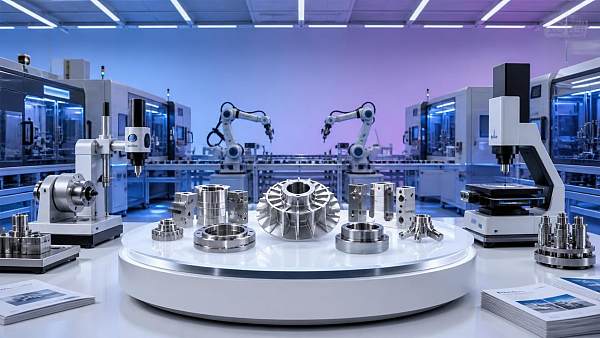
Move technical content from “readable” to “findable”
The accumulation of overseas organic traffic requires coordinated efforts in content topics, page structure, and multilingual expression. Keyword research should not focus only on broad product terms. For B2B manufacturing, more valuable terms are often long-tail searches such as “product + application,” “product + material,” “problem + solution,” and “standard + industry.” These terms may not have high search volumes, but visitor needs are clearer and closer to a purchasing decision.
For example, product pages carry basic information such as models, specifications, and lead-time communication; application pages answer “in what environments does this product perform effectively?”; technical articles explain “why a particular type of failure occurs and how to evaluate a solution”; and case study or project pages present the process from requirement confirmation to validation and delivery. When pages are connected through natural internal links, search engines can more easily understand the company’s areas of expertise, and customers will not lose their way while reading.
Multilingual content cannot stop at literal translation. Purchasing habits, measurement systems, regulatory concerns, and modes of expression differ across English-, German-, Spanish-, and Arabic-speaking markets. Accuracy and local readability should be prioritized, especially for technical terminology, units, standard names, and calls to action. Translating Chinese promotional copy sentence by sentence into foreign languages often results in content that is “grammatically correct but does not sound like it was written by an industry professional.”
In this process, AI can be used to extract information from materials, generate initial content drafts, identify keyword gaps, and support multilingual operations, but it cannot replace technical review. Content involving performance commitments, compliance requirements, material suitability, and safety boundaries must be confirmed by personnel familiar with the products. Companies may refer to the ideas on coordination between technology application and management in Practical Challenges and Countermeasures for Fintech in Promoting Enterprise Innovation and Development: the purpose of tools is not to make judgments for people, but to enable organizations to direct their limited professional judgment toward more critical areas.
Effective inquiries are not simply about making forms shorter
Many companies worry that too many form fields will reduce submission rates, so they require customers to provide only their name, email address, and message. As a result, sales teams receive a large amount of information whose value cannot be assessed, and after several rounds of communication, product requirements still remain unclear. For customized, project-based, or high-value manufacturing businesses, inquiry design should serve “lead prequalification.”
Fields can be dynamically configured according to page type: ask for model, quantity, and destination country on standard product pages; add drawing uploads, material requirements, target operating conditions, and estimated purchasing time on customized pages; and guide customers on technical solution pages to describe existing problems, application equipment, and key constraints. Fields should not be overloaded all at once, but customers should understand “why this information is needed,” for example, by noting “Used to confirm material compatibility and recommend specifications.”
Follow-up after submission is equally important. Automated reply emails can inform customers that the materials have been received, outline the expected communication, and indicate what additional information can be provided; CRM or lead management systems should record the source page, search terms, country or region, and browsing behavior. This enables marketing teams to identify which types of technical content generate not only traffic, but genuine opportunities worth following up by sales.
Use data to determine whether content is creating business opportunities
When measuring content for overseas customer acquisition in manufacturing, companies cannot look only at the number of articles published or keyword rankings. More important metrics include: whether organic traffic from target countries is increasing; whether application and technical pages generate longer dwell times and more page views; whether inquiry rates differ across content topics; whether inquiries include key fields such as drawings, project cycles, and purchase quantities; and where the leads that ultimately enter quotation, sampling, and closing stages come from.
A practical review method is to collect the “shared characteristics of high-quality inquiries” from the sales team each month. What types of pages did they visit first? Which technical issues did their questions focus on? Which materials frequently need to be sent repeatedly? These answers will in turn guide the next round of content development. Content teams will no longer select topics based on intuition, and sales personnel will not need to view the website as a promotional window unrelated to closing deals.
For manufacturing companies seeking to establish a long-term presence in overseas markets, a website is not a one-time online brochure, but a digital showroom that continuously accumulates trust. With integrated capabilities covering AI website building, multilingual websites, Google SEO, advertising, overseas social media operations, and GEO generative engine optimization, Yiyingbao can help companies connect fragmented technical materials, customer acquisition channels, and lead follow-up. Truly valuable overseas customer acquisition for manufacturers always begins with understanding customer problems and ultimately rests on a clear, credible, and actionable inquiry path.
Related Articles

Related Products
 Yiyingbao SaaS Intelligent Website Building and Marketing SystemYiyingbao SaaS Intelligent Website Building and Marketing System, AI-powered no-code website building, rapid creation of multilingual B2B international websites in 10 minutes, global server acceleration, AI-powered SEO optimization, helping businesses connect efficiently with global markets. The perfect integration of technology and operation makes building an international trade website remarkably simple
 AI+SEM Intelligent Advertising Marketing SystemAI+SEM drives intelligent ad creation, empowering full-funnel precision advertising marketing. The system automatically generates weekly/monthly reports, AI recommends keywords and target countries, monitors core metrics in real-time with intelligent alerts, and enables one-click high-conversion ad solutions to help quickly acquire customers and improve ROI.
 AI+SEO Dual-Engine System Optimization ServicesYiyingbao’s AI+SEO dual-engine optimization system helps foreign trade enterprises acquire high-quality organic traffic through AI-powered keyword research, content generation, and comprehensive technical optimization, significantly improving search rankings and conversion rates.
 AI+SNS Social Media Marketing SystemYingbao AI+SNS Social Media Marketing System - Precision social capture for the social media era. Supports one-click content synchronization across major platforms like Facebook and LinkedIn. AI intelligently rewrites posts for enhanced relevance. 24/7 AI customer service and user profiling analysis empower businesses to efficiently expand into global markets.
 AI+SEO营销解决方案易营宝AI+SEO营销解决方案,通过AI批量写作、智能生成TDK、精准关键词扩词等功能,全面优化网站SEO效果,提升流量与转化率。助力企业构建高效智能网站新生态。
 AI+SEM Advertising Marketing SolutionsAI+SEM Advertising Marketing Solution leverages AI technology to deeply empower SEM ad campaigns. It automatically generates weekly/monthly reports using AI, presenting account data across multiple dimensions for comprehensive insights into campaign performance and trends. The system precisely recommends keywords and target countries, intelligently generates high-conversion ad copy, and enables one-click activation of efficient campaign plans to help businesses rapidly acquire customers. Simultaneously, it monitors core metrics in real time, intelligently identifies abnormal fluctuations, and issues timely alerts to ensure stable, high-return advertising results.
 Domain Name ServicesEasyWin provides professional domain name services, including intelligent queries, one-stop registration, brand protection, and full lifecycle management, helping businesses build a digital brand image.
 EasyOperate B2C Cross-Border E-Commerce Platform & Independent WebsiteEasyStore B2C Cross-border E-commerce Independent Store is an intelligent website building and cross-border e-commerce integrated solution independently developed by EasyStore Information Technology (Beijing) Co., Ltd. The system is specially designed for small and medium-sized as well as large export enterprises, integrating 'website building, operation, marketing, advertising, and conversion' into one, helping enterprises quickly establish cross-border e-commerce independent stores to achieve brand globalization and global sales growth.
The platform supports multiple languages, multiple currencies, and multi-channel marketing, with built-in AI intelligent translation and SEO optimization systems, suitable for mainstream markets such as Southeast Asia, Europe and America, Latin America, and the Middle East, assisting Chinese manufacturing enterprises in efficiently deploying international e-commerce strategies. SSL证书易营宝提供专业SSL安全证书服务,包括单域名和泛域名证书,确保网站数据传输加密、身份验证和完整性保护,助力企业建立安全可信的在线业务环境。









