









- Can the average annual growth rate reflect real opportunities in overseas markets?Oct 07, 2026View details
- Which customer acquisition channels will be affected by cross-border marketing trends in 2026?Sep 06, 2026View details
- Which homogenization risks should be considered in an analysis of the AI-powered website building industry?Aug 30, 2026View details
- How Will AI Marketing Trends 2026 Change Advertising Budget AllocationAug 28, 2026View details
- Is the EV SSL certificate market shrinking or upgrading? How should companies assess certificate procurement?Aug 11, 2026View details
- Why the old AMP SEO 2020 practices no longer work and what has changed in current optimization prioritiesAug 02, 2026View details
How Can a New Website Be Promoted Quickly? A Traffic Growth Strategy Mix for the First 90 Days
The first 90 days after a new website goes live often determine whether its subsequent customer acquisition curve rises steadily or remains stuck in a state of “having a website but no traffic.” Many business decision-makers search for “como promocionar rapidamente una pagina web,” but what they really want to solve is not simply “how to get more people to see the website,” but rather: how to quickly gain targeted traffic that can be assessed, optimized, and generate inquiries or orders when budgets are limited, markets are unfamiliar, and product competition is intense.
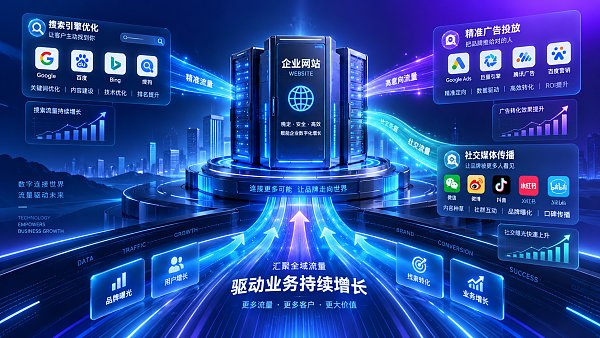
For foreign trade companies, manufacturing plants, and cross-border brands, promoting a new website should not rely on a single channel. SEO takes time to deliver results, advertising requires creative assets and data calibration, and social media depends on consistent content and accumulated trust. A more reasonable approach for the first 90 days is to launch website infrastructure, search optimization, paid testing, and social media outreach simultaneously, while retaining reviewable data at every stage.
Do Not Rush Into Traffic Acquisition: A New Website Must First Be Able to “Handle Traffic”
Traffic arriving at a website is only the beginning. If visitors cannot understand what the company sells, who its products are for, or how to get in touch next, advertising budgets and content investments will be wasted. This is especially true for B2B businesses, where overseas buyers typically assess a supplier’s credibility in a very short time; B2C consumers, on the other hand, are more concerned with whether pricing, specifications, shipping, payment, and reviews are clear.
Therefore, a basic check should be completed before the website goes live: whether core product pages have independent links and clear titles; whether multilingual content has been localized rather than mechanically translated; whether mobile loading is smooth; whether conversion entry points such as forms, WhatsApp, email, and online inquiries are available; and whether the privacy policy, company profile, qualification information, and shipping instructions are complete. For search engines, a clear website structure and crawlable pages are prerequisites for indexing; for real customers, these details determine whether they are willing to leave their contact information.
If a company serves both wholesalers and end consumers, the website architecture requires even more advance planning. A single display-oriented corporate website can hardly meet both inquiry and ordering needs. Consider using a B2B2C dual-mode standalone website solution to incorporate pathways such as multi-specification products, price displays, shopping carts, and bulk quotation requests into the same site logic, preventing customer loss due to mismatched purchasing methods.
Days 1–30: Replace Blind Waiting with “Discoverability”
A new domain lacks historical authority, and the last thing you should do is publish a few generic articles and wait for organic rankings. The goal of the first stage is to help search engines understand the website’s topic while quickly identifying initial market feedback.
For SEO, pages can be built around three types of keywords: product terms, application terms, and industry problem terms. For example, in addition to targeting product models, manufacturers should also cover pre-purchase questions such as “what scenarios is a certain material suitable for,” “how to choose a supplier,” and “considerations for bulk purchasing.” Keywords do not need to focus solely on high-search-volume terms; they should also be combined with the target country, language, product use, and purchasing intent to create pages that answer specific questions.
On the technical side, submit a sitemap and check robots rules, page indexing status, 404 pages, and duplicate title issues. The value of tools such as Google Search Console is not in watching rankings every day, but in identifying which pages have been crawled and which search terms are beginning to generate impressions. The earlier problems are discovered, the less likely you are to find two months later that important product pages have not been indexed at all.
At the same time, it is recommended to launch small-budget search advertising tests. Advertising is not merely about “buying traffic”; it is also the fastest market research tool for a new website: which keywords have high click-through rates, which countries generate higher-quality inquiries, and whether customers are more willing to click “Get a Quote” or “Download Catalog.” All of this data can in turn improve SEO pages and website copy.
Days 31–60: Turn Advertising Data into Content and Conversion Assets
After entering the second month, the focus of promotion should shift from “whether there is traffic” to “whether the traffic is close to the target customers.” At this stage, high-intent terms from earlier advertising can be selected and expanded into product landing pages, case studies, FAQs, or regional pages. For terms with many clicks but high bounce rates, reassess whether search intent aligns with the page content.
For example, if users search for “industrial supplier” but land on a brand story page, drop-off is almost inevitable; if users search for “bulk order” but the page only has retail purchase buttons, buyers will also hesitate. A website is not better simply because it contains more information; it should enable every type of visitor to quickly reach the path that suits them.
At this stage, social media does not necessarily need to pursue a large number of followers. LinkedIn is suitable for presenting factory capabilities, industry insights, and application solutions, while Facebook, Instagram, or TikTok are better suited for product demonstrations, usage scenarios, and short-form video distribution. Content can focus on “a question customers frequently ask,” “one step in product manufacturing,” or “a real specification comparison,” allowing unfamiliar visitors to build basic trust through the content before returning to the website to make an inquiry or purchase.
For companies with advertising needs across multiple regions, ad groups and landing pages should be divided by market. Customers in North America, Europe, the Middle East, and Latin America have different preferences regarding price presentation, delivery cycles, communication tools, and language content. Putting all countries into one advertising campaign may seem convenient, but it will dilute the budget with low-quality clicks.
Days 61–90: Moving from “Having Traffic” to “Sustainable Customer Acquisition”
The third month is suitable for conducting a growth review. Do not look only at total visits; also examine effective behaviors generated by each channel: whether organic search has begun to generate stable impressions; which advertising keywords genuinely bring inquiries; whether social media visitors browse core pages; and whether there are significant differences in form submission rates, shopping cart behavior, or quotation-request conversions across countries.
At this point, resources can be concentrated on two types of assets: one is high-conversion pages that have already been proven effective, with content, backlinks, and internal links continuously added; the other is reusable marketing material, such as product short videos, industry Q&As, downloadable catalogs, advertising creatives, and email follow-up content. These do not become ineffective when a single campaign ends; instead, they continuously reduce uncertainty in customer acquisition as data accumulates.
Yiyingbao provides services such as AI-powered website building, multilingual website development, Google SEO, advertising placement, overseas social media operations, and GEO generative engine optimization for foreign trade and cross-border businesses. For companies just beginning overseas promotion, what matters more is not launching every channel at once, but gradually identifying the growth combination that suits their products, markets, and sales models through the coordination of website building, data analysis, and marketing execution.
Three Most Common Misconceptions About Rapid Promotion
Misconception 1: Equating promotion with running ads. Advertising can quickly bring visits, but it cannot replace landing pages, content, and conversion mechanisms. Without clear traffic handling, the larger the budget, the greater the potential waste.
Misconception 2: SEO is only about keyword stuffing. Search engines increasingly emphasize whether content genuinely solves users’ problems. Rather than repeating keywords on a page, it is better to provide purchasing decision information such as specifications, applications, certifications, delivery, and usage methods.
Misconception 3: Looking only at rankings, not business results. Some terms may rank well but may not necessarily bring target customers. Companies should include inquiry quality, sales follow-up rate, order cycle, and customer region in their evaluation instead of pursuing surface-level traffic alone.
Returning to the question of “como promocionar rapidamente una pagina web,” being fast does not mean surging in the short term and then quickly declining. The most valuable outcome in the first 90 days of a new website is to establish a verifiable customer acquisition mechanism: the website can handle traffic, SEO is accumulating, advertising is being tested, social media is building touchpoints, and data tells the company where to allocate its next budget. Only then does the traffic acquired have a better chance of becoming sustainable business opportunities.
Related Articles



Related Products
 Yiyingbao SaaS Intelligent Website Building and Marketing SystemYiyingbao SaaS Intelligent Website Building and Marketing System, AI-powered no-code website building, rapid creation of multilingual B2B international websites in 10 minutes, global server acceleration, AI-powered SEO optimization, helping businesses connect efficiently with global markets. The perfect integration of technology and operation makes building an international trade website remarkably simple
 AI+SEM Intelligent Advertising Marketing SystemAI+SEM drives intelligent ad creation, empowering full-funnel precision advertising marketing. The system automatically generates weekly/monthly reports, AI recommends keywords and target countries, monitors core metrics in real-time with intelligent alerts, and enables one-click high-conversion ad solutions to help quickly acquire customers and improve ROI.
 AI+SEO Dual-Engine System Optimization ServicesYiyingbao’s AI+SEO dual-engine optimization system helps foreign trade enterprises acquire high-quality organic traffic through AI-powered keyword research, content generation, and comprehensive technical optimization, significantly improving search rankings and conversion rates.
 AI+SNS Social Media Marketing SystemYingbao AI+SNS Social Media Marketing System - Precision social capture for the social media era. Supports one-click content synchronization across major platforms like Facebook and LinkedIn. AI intelligently rewrites posts for enhanced relevance. 24/7 AI customer service and user profiling analysis empower businesses to efficiently expand into global markets.
 AI+SEO营销解决方案易营宝AI+SEO营销解决方案,通过AI批量写作、智能生成TDK、精准关键词扩词等功能,全面优化网站SEO效果,提升流量与转化率。助力企业构建高效智能网站新生态。
 AI+SEM Advertising Marketing SolutionsAI+SEM Advertising Marketing Solution leverages AI technology to deeply empower SEM ad campaigns. It automatically generates weekly/monthly reports using AI, presenting account data across multiple dimensions for comprehensive insights into campaign performance and trends. The system precisely recommends keywords and target countries, intelligently generates high-conversion ad copy, and enables one-click activation of efficient campaign plans to help businesses rapidly acquire customers. Simultaneously, it monitors core metrics in real time, intelligently identifies abnormal fluctuations, and issues timely alerts to ensure stable, high-return advertising results.
 Domain Name ServicesEasyWin provides professional domain name services, including intelligent queries, one-stop registration, brand protection, and full lifecycle management, helping businesses build a digital brand image.
 EasyOperate B2C Cross-Border E-Commerce Platform & Independent WebsiteEasyStore B2C Cross-border E-commerce Independent Store is an intelligent website building and cross-border e-commerce integrated solution independently developed by EasyStore Information Technology (Beijing) Co., Ltd. The system is specially designed for small and medium-sized as well as large export enterprises, integrating 'website building, operation, marketing, advertising, and conversion' into one, helping enterprises quickly establish cross-border e-commerce independent stores to achieve brand globalization and global sales growth.
The platform supports multiple languages, multiple currencies, and multi-channel marketing, with built-in AI intelligent translation and SEO optimization systems, suitable for mainstream markets such as Southeast Asia, Europe and America, Latin America, and the Middle East, assisting Chinese manufacturing enterprises in efficiently deploying international e-commerce strategies. SSL证书易营宝提供专业SSL安全证书服务,包括单域名和泛域名证书,确保网站数据传输加密、身份验证和完整性保护,助力企业建立安全可信的在线业务环境。









