









- 21st Century Business Herald: AI and CTV Become Core Growth Engines for Digital Marketing in Overseas MarketsNov 18, 2026View details
- China Presents 25 Cooperation Outcomes in Areas Including Cross-Border E-Commerce During APECNov 18, 2026View details
- AI Products Drive Hong Kong Exports Up 64.9% in September, Fastest Growth in Over 40 YearsNov 17, 2026View details
- National Bureau of Statistics: Foreign trade grew rapidly in October, providing stable support for global tradeNov 17, 2026View details
- The U.S. has ended the $800 de minimis exemption for non-postal shipments; express courier packages must be formally declared.Nov 16, 2026View details
- ASEAN Signs Digital Economy Framework Agreement, Moving Toward Harmonized Cross-Border E-Commerce RulesNov 15, 2026View details
How to build an export marketing website solution that balances customer acquisition, conversion, and brand presentation
A Foreign Trade Marketing Website Solution Should Address More Than Website Building First
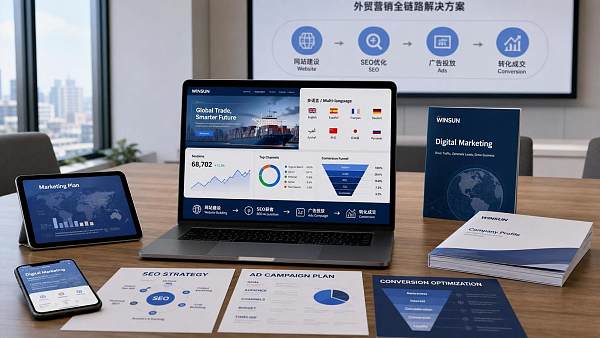
Whether a foreign trade marketing website solution is effective often does not depend on how attractive the pages look, but on whether the website can simultaneously serve as a customer acquisition entry point, a conversion tool, and a brand carrier. Many projects experience slow indexing, few inquiries, and high bounce rates after launch. In essence, the issue is not insufficient traffic, but that the solution was not designed around real business scenarios from the very beginning.
In practical applications, companies building overseas official websites vary greatly in type. Some rely more on Google SEO to continuously generate inquiries, some first use advertising to test the market, and others use the website as a multilingual brand hub to receive traffic from social media, short videos, and offline exhibitions. Different scenarios naturally lead to different evaluation priorities for foreign trade marketing website solutions.
This is also why the integration of website and marketing services has become increasingly important in recent years. Service platforms such as 易营宝, which have long focused on overseas marketing, view intelligent website building, SEO optimization, advertising, social media operations, and AI search visibility within one unified growth logic, rather than treating the website as a standalone deliverable. The value of this approach lies in enabling the site to enter the promotion, indexing, and conversion cycle more quickly after launch.
Start by Identifying the Business Stage, So the Website Structure Does Not Go Off Track
Even when building the same type of foreign trade marketing website solution, new market expansion and mature business upgrades have completely different starting points. The former focuses more on quickly validating channels and inquiry quality, while the latter cares more about content depth, brand trust, and the ability to replicate across multiple regions. If the same page structure is used for both, resource mismatches often occur.
A more common way to evaluate the solution is to first confirm which stage the website mainly serves. Is it designed to help unfamiliar users quickly understand product capabilities, or to enable visitors with clear needs to submit a form as soon as possible? Is the priority to achieve a breakthrough in a single language first, or to directly plan multilingual, multi-region, and multi-channel promotion at the same time? Only when this layer is clarified can the sections, content, and technical configuration of a foreign trade marketing website solution have a solid basis.
When SEO Lead Generation Is the Priority, the Focus Is Content Crawling and Topic Architecture
If the core mission of the website is to obtain long-term organic traffic, then a foreign trade marketing website solution cannot remain only at the homepage and product page level. Category logic, the number of landing pages, keyword mapping, internal links, and multilingual indexing will all directly affect subsequent indexing efficiency.
In this type of scenario, the problem with many sites is not a lack of content, but that the content structure is not suitable for search engines to understand. Duplicate titles, thin product pages, missing application pages, and FAQs without extended questions all make it difficult for a website to form stable topical coverage. Using a website building system with AI+SEO capabilities usually makes it easier to balance content production efficiency and page standardization.
When Advertising Is the Priority, the Focus Is Landing Pages and Lead Qualification
When traffic mainly comes from Google ads or social media ads, a foreign trade marketing website solution needs to shorten the information path. After visitors enter the page, the first things they judge are whether the product matches their needs, whether delivery is trustworthy, and whether the contact action is clear, rather than whether the company profile is written comprehensively.
At this point, the website is more like a conversion system. Pages need to organize information around a single goal, such as highlighting core models, delivery capabilities, certification materials, case evidence, and form field settings. If traditional official website-style navigation is still used, traffic will be dispersed, and advertising costs will be harder to recover.
When Brand Globalization Is the Priority, Multilingual Consistency Matters More Than Simply Adding Pages
There is another scenario where short-term inquiries are not the only goal. Instead, the website is expected to become the brand’s official expression window overseas. In this case, a foreign trade marketing website solution should pay more attention to brand narrative, visual consistency, regional version management, and a unified experience after users enter the website from different channels.
Especially when targeting multiple regions such as North America, Europe, and Southeast Asia, multilingual support is not just about translating pages. It also involves content priorities, differences in wording, trust signals, and localized conversion actions. The value of platforms such as 易营宝, which cover multi-region marketing scenarios, lies in their ability to handle website building, promotion, and localization adaptation within one implementation framework.
In Different Scenarios, the Evaluation Priorities for Foreign Trade Marketing Website Solutions Are Not the Same
If all websites are built around “show the company, show the products, and leave contact information,” the subsequent results are usually relatively average. The following differences often determine whether a solution truly fits the business.
From this perspective, a foreign trade marketing website solution is not simply about choosing a template, but about choosing an implementation path that is closer to the current growth goals. If the website, SEO, advertising, and social media are disconnected from one another, it is often difficult to create effective synergy.
What Really Affects Conversion Is Often These Easily Overlooked Details
Many project misjudgments occur at the level of “everything seems to have been done.” For example, there may be multilingual versions, but they are only direct machine translations; there may be a product center, but it is not broken down by industry applications; there may be inquiry forms, but there are too many fields, resulting in a poor mobile submission experience. On the surface, it looks like a complete website, but in reality, it lacks conversion logic.
Another common situation is focusing only on website building costs while ignoring subsequent promotion costs. If the website architecture in the early stage is not SEO-friendly, the later stage can only continuously rely on advertising to supplement traffic. If tracking points and data feedback are incomplete, ad optimization will also lose its basis. Whether a foreign trade marketing website solution is mature depends on whether long-term operating costs have been taken into account in advance.
- Treating an official display website as a marketing website, resulting in pages with a lot of information but weak action guidance.
- Focusing only on design aesthetics while neglecting loading speed, mobile adaptation, and technical SEO.
- Treating different regional markets as having the same needs, while ignoring differences in language, trust points, and content preferences.
- Building only the website without subsequent coordination of content, advertising, and social media, causing the website to quickly become a static asset.
A More Reliable Implementation Approach Is to Place the Website Within the Complete Growth Chain
A more effective foreign trade marketing website solution usually does not treat the website as an isolated project. Instead, it places the website within the chain of “traffic entry—content reception—conversion trigger—data feedback—continuous optimization.” The benefit of this approach is that every page knows what task it carries, rather than being left with only a display function.
At the implementation level, three things can be sorted out first: first, what is the current main customer acquisition channel; second, what evidence visitors most need to see after entering the website; third, whether the website needs to support multilingual expansion, advertising landing page expansion, and improved AI search visibility in the future. Once these three questions are answered clearly, the solution becomes much more specific.
For projects that need to operate in overseas markets over the long term, it is more suitable to choose an integrated platform with capabilities in intelligent website building, SEO optimization, advertising marketing, and multi-region operations. For service systems such as 易营宝, which are driven by AI and big data, the advantage is not having many isolated functions, but being able to connect website building, content, promotion, and data analytics, so that the website truly becomes infrastructure for overseas growth.
How to Judge Next Whether Your Foreign Trade Marketing Website Solution Is Suitable
If you are planning or upgrading an overseas official website, you can first use several questions for internal alignment: Does the website mainly support SEO, advertising, or brand communication? Is the core market a single region or multiple regions at the same time? What is currently most lacking: traffic, conversion, or trust building? Different answers correspond to completely different foreign trade marketing website solutions.
A more practical approach is to first review whether the page structure, content types, language versions, conversion actions, and data tracking match the current goals, and then evaluate the subsequent promotion cycle, maintenance costs, and expansion difficulty. The solution obtained in this way is often closer to real growth results than simply pursuing a “good-looking website.”
When a foreign trade marketing website solution is well designed, the result is usually not about how complete it looks at the moment of launch, but whether it can be found, understood, and trusted after launch, while continuously bringing in qualified leads. This is the true focus that balances customer acquisition, conversion, and brand presentation.
Related Articles
 How Can You Identify Effective Traffic Sources When Reviewing Growth in Inquiries from Your Independent Website?
 How to Choose a Target Market for Your Cross-Border Ecommerce Store
 Overseas Marketing Data Analysis: How to Evaluate Channel Performance by Lead Quality


Related Products
 Yiyingbao SaaS Intelligent Website Building and Marketing SystemYiyingbao SaaS Intelligent Website Building and Marketing System, AI-powered no-code website building, rapid creation of multilingual B2B international websites in 10 minutes, global server acceleration, AI-powered SEO optimization, helping businesses connect efficiently with global markets. The perfect integration of technology and operation makes building an international trade website remarkably simple
 AI+SEM Intelligent Advertising Marketing SystemAI+SEM drives intelligent ad creation, empowering full-funnel precision advertising marketing. The system automatically generates weekly/monthly reports, AI recommends keywords and target countries, monitors core metrics in real-time with intelligent alerts, and enables one-click high-conversion ad solutions to help quickly acquire customers and improve ROI.
 AI+SEO Dual-Engine System Optimization ServicesYiyingbao’s AI+SEO dual-engine optimization system helps foreign trade enterprises acquire high-quality organic traffic through AI-powered keyword research, content generation, and comprehensive technical optimization, significantly improving search rankings and conversion rates.
 AI+SNS Social Media Marketing SystemYingbao AI+SNS Social Media Marketing System - Precision social capture for the social media era. Supports one-click content synchronization across major platforms like Facebook and LinkedIn. AI intelligently rewrites posts for enhanced relevance. 24/7 AI customer service and user profiling analysis empower businesses to efficiently expand into global markets.
 AI+SEO营销解决方案易营宝AI+SEO营销解决方案,通过AI批量写作、智能生成TDK、精准关键词扩词等功能,全面优化网站SEO效果,提升流量与转化率。助力企业构建高效智能网站新生态。
 AI+SEM Advertising Marketing SolutionsAI+SEM Advertising Marketing Solution leverages AI technology to deeply empower SEM ad campaigns. It automatically generates weekly/monthly reports using AI, presenting account data across multiple dimensions for comprehensive insights into campaign performance and trends. The system precisely recommends keywords and target countries, intelligently generates high-conversion ad copy, and enables one-click activation of efficient campaign plans to help businesses rapidly acquire customers. Simultaneously, it monitors core metrics in real time, intelligently identifies abnormal fluctuations, and issues timely alerts to ensure stable, high-return advertising results.
 Domain Name ServicesEasyWin provides professional domain name services, including intelligent queries, one-stop registration, brand protection, and full lifecycle management, helping businesses build a digital brand image.
 EasyOperate B2C Cross-Border E-Commerce Platform & Independent WebsiteEasyStore B2C Cross-border E-commerce Independent Store is an intelligent website building and cross-border e-commerce integrated solution independently developed by EasyStore Information Technology (Beijing) Co., Ltd. The system is specially designed for small and medium-sized as well as large export enterprises, integrating 'website building, operation, marketing, advertising, and conversion' into one, helping enterprises quickly establish cross-border e-commerce independent stores to achieve brand globalization and global sales growth.
The platform supports multiple languages, multiple currencies, and multi-channel marketing, with built-in AI intelligent translation and SEO optimization systems, suitable for mainstream markets such as Southeast Asia, Europe and America, Latin America, and the Middle East, assisting Chinese manufacturing enterprises in efficiently deploying international e-commerce strategies. SSL证书易营宝提供专业SSL安全证书服务,包括单域名和泛域名证书,确保网站数据传输加密、身份验证和完整性保护,助力企业建立安全可信的在线业务环境。









