









- 21st Century Business Herald: AI and CTV Become Core Growth Engines for Digital Marketing in Overseas MarketsNov 18, 2026View details
- China Presents 25 Cooperation Outcomes in Areas Including Cross-Border E-Commerce During APECNov 18, 2026View details
- AI Products Drive Hong Kong Exports Up 64.9% in September, Fastest Growth in Over 40 YearsNov 17, 2026View details
- National Bureau of Statistics: Foreign trade grew rapidly in October, providing stable support for global tradeNov 17, 2026View details
- The U.S. has ended the $800 de minimis exemption for non-postal shipments; express courier packages must be formally declared.Nov 16, 2026View details
- ASEAN Signs Digital Economy Framework Agreement, Moving Toward Harmonized Cross-Border E-Commerce RulesNov 15, 2026View details
Overseas Marketing Data Analysis: How to Evaluate Channel Performance by Lead Quality
In overseas marketing, one channel may generate a large number of form submissions but very few purchasing inquiries that fit your business scope, while another may bring in fewer inquiries that are easier for sales to advance. Comparing only inquiry volume or cost per inquiry can lead you to allocate budget to traffic that looks inexpensive but delivers little value.
To evaluate channel performance, first use a consistent definition of an inquiry, then assess customer fit, purchase intent, and sales progress to calculate the cost per qualified inquiry. The goal of overseas marketing data analysis is not to identify the channel with the most inquiries, but to determine which channels generate opportunities that meet your objectives at an acceptable cost.
First, distinguish between “inquiries received” and “qualified inquiries”
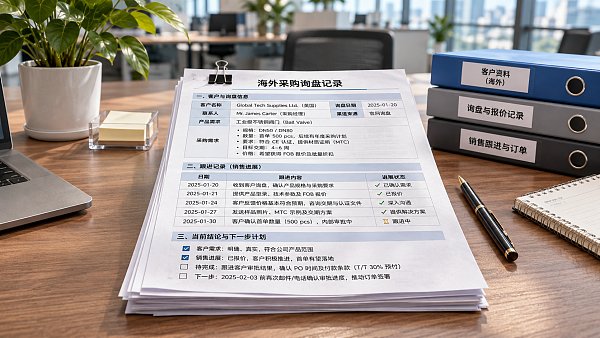
A form submission, email, or chat message only indicates that a user has made contact; it does not necessarily represent a purchasing opportunity. Internal tests, duplicate submissions, spam, and requests clearly outside your business scope should be excluded from qualified inquiries. Leads with incomplete information that may still be a fit should be marked as pending confirmation rather than immediately classified as invalid.
Marketing and sales should agree on the qualification criteria and establish reusable rules for recording inquiries. For example, if your company primarily serves overseas bulk-buying customers, target market, product requirements, and contactability can serve as basic criteria. A retail inquiry may still have value, but if it does not align with current business objectives, it should not be counted in the same category of qualified inquiries.
When the same customer contacts you multiple times through forms and email, retain records of all interactions, but deduplicate customer counts using the company, email address, or other reliable information. When comparing channels, distinguish between “number of inquiries” and “number of unique customers” to avoid duplicate submissions inflating a channel’s performance.
Set practical criteria for assessing inquiry quality
Start with a simple lead classification rather than building a complex model right away. The key is to help different team members reach broadly consistent conclusions when assessing the same lead and to record the reasons for their decisions.
- Customer fit: Check whether the market, company type, product requirements, and purchase volume align with your business scope. Do not reject a customer based solely on a free email address or job title.
- Clarity of requirements: Has the customer specified the intended use, specifications, quantity, or delivery requirements? You can follow up to obtain more details when an inquiry contains limited information; do not automatically treat it as low quality.
- Purchase intent: Has the customer asked specific questions about pricing, samples, lead times, or similar details? These behaviors can indicate intent, but they do not mean the customer has decided to make a purchase.
- Sales readiness: Is the contact information valid? Has the customer replied, and can sales confirm the next step? Record no response separately from invalid contact information.
You can classify leads as “qualified with clear requirements,” “qualified but pending confirmation,” “not a fit,” or “invalid,” and add further categories as needed. Update the status as follow-up progresses: a customer whose initial message was unclear may become a qualified opportunity after providing specifications; a lead that clearly indicates no relevant purchasing needs should also be reclassified promptly.
Connect inquiries to their actual sources
Before comparing channels, confirm that data can be traced from the visit through to the form submission or inquiry record. At a minimum, record the submission time, landing page, source channel, advertising campaign, and lead ID, and carry that ID into the sales follow-up sheet or customer management system. Also record the source of leads generated by email and instant messaging whenever possible; if the source cannot be confirmed, mark it as “unknown” rather than assigning one based on memory.
Campaign links with tracking parameters help distinguish advertising, social media, and other activities, but parameters may be lost when users move between pages, use third-party forms, or switch devices. After launch, submit a test inquiry yourself to check whether landing-page parameters are retained, form fields are captured, and the sales record can be matched to the submission. Organic search and direct visits may also be misidentified, so the source shown in a system should not be treated as a complete record of the purchase journey.
Agree on attribution rules in advance. For example, you might record the acquisition source as the first touchpoint, or record the conversion source as the last identifiable visit before submission. These approaches answer different questions, so label the rule used in each report and do not add together data based on different attribution methods. When personal information is involved, collect only the fields needed for business purposes and handle and store them in accordance with applicable requirements.
Compare channels using the same set of metrics
First, use the same reporting period, target market, and business type, then examine how inquiries progress to opportunities across channels. Basic metrics can be calculated as follows:
- Qualified inquiry rate = number of qualified inquiries ÷ total number of deduplicated inquiries. This indicates how well the traffic aligns with business objectives.
- Cost per qualified inquiry = channel-related spend ÷ number of qualified inquiries. This compares the investment required to generate one qualified lead. Use a consistent definition of costs and specify whether production and operating expenses are included.
- Opportunity conversion rate = number of inquiries that reach the agreed opportunity stage ÷ number of qualified inquiries. This helps assess sales progress. Define the opportunity stage consistently, for example, as completing requirements confirmation and beginning pricing discussions.
If a channel has a low qualified inquiry rate, first check whether search terms, audience targeting, or landing-page promises are attracting people who are not a fit. If the qualification rate is acceptable but the opportunity conversion rate is low, review sales response times, contact information, and records of requirements confirmation. Do not judge a channel as ineffective based on just one metric.
Allow time for sales follow-up as well. Recent inquiries may not have received a response yet. Comparing them directly with older leads that have completed follow-up can make recent channel performance look worse than it is. Review inquiries in cohorts by month of submission and note the report’s cutoff date and the number pending confirmation. When sample sizes are small, continue monitoring rather than making major budget changes based on a handful of results.
Address where the problem occurs instead of simply increasing or cutting the budget
Start troubleshooting by checking data completeness: confirm that channel attribution and deduplication are reasonably accurate, then assess whether the traffic is a fit, and finally use sales feedback to identify barriers to conversion. If forms frequently receive inquiries about products you do not offer, check whether your ad copy and page descriptions are too broad. If customers fit your target but their requirements are unclear, consider adding fields about intended use or purchasing needs while avoiding too many fields that could discourage submissions.
Some content pages attract readers seeking information rather than people ready to purchase. For example, if an inquiry follows a visit to investment research on environmental industry funds in the energy conservation and environmental protection sector, verify the specific requirements first, then determine whether it qualifies as an inquiry for your current business. A page visit or form submission alone does not indicate purchase intent.
Record the date and details of each change, along with the original data definitions, and compare results only after an adequate observation period. If qualified inquiries decrease while the number of leads pending confirmation rises noticeably, first check follow-up progress. If the cost per qualified inquiry continues to rise and customer fit declines, consider narrowing your targeting or reallocating budget to channels with more consistent performance.
Related Articles
 How Can You Identify Effective Traffic Sources When Reviewing Growth in Inquiries from Your Independent Website?
 How to Choose a Target Market for Your Cross-Border Ecommerce Store
 Overseas Marketing Data Analysis: How to Evaluate Channel Performance by Lead Quality

Related Products
 Yiyingbao SaaS Intelligent Website Building and Marketing SystemYiyingbao SaaS Intelligent Website Building and Marketing System, AI-powered no-code website building, rapid creation of multilingual B2B international websites in 10 minutes, global server acceleration, AI-powered SEO optimization, helping businesses connect efficiently with global markets. The perfect integration of technology and operation makes building an international trade website remarkably simple
 AI+SEM Intelligent Advertising Marketing SystemAI+SEM drives intelligent ad creation, empowering full-funnel precision advertising marketing. The system automatically generates weekly/monthly reports, AI recommends keywords and target countries, monitors core metrics in real-time with intelligent alerts, and enables one-click high-conversion ad solutions to help quickly acquire customers and improve ROI.
 AI+SEO Dual-Engine System Optimization ServicesYiyingbao’s AI+SEO dual-engine optimization system helps foreign trade enterprises acquire high-quality organic traffic through AI-powered keyword research, content generation, and comprehensive technical optimization, significantly improving search rankings and conversion rates.
 AI+SNS Social Media Marketing SystemYingbao AI+SNS Social Media Marketing System - Precision social capture for the social media era. Supports one-click content synchronization across major platforms like Facebook and LinkedIn. AI intelligently rewrites posts for enhanced relevance. 24/7 AI customer service and user profiling analysis empower businesses to efficiently expand into global markets.
 AI+SEO营销解决方案易营宝AI+SEO营销解决方案,通过AI批量写作、智能生成TDK、精准关键词扩词等功能,全面优化网站SEO效果,提升流量与转化率。助力企业构建高效智能网站新生态。
 AI+SEM Advertising Marketing SolutionsAI+SEM Advertising Marketing Solution leverages AI technology to deeply empower SEM ad campaigns. It automatically generates weekly/monthly reports using AI, presenting account data across multiple dimensions for comprehensive insights into campaign performance and trends. The system precisely recommends keywords and target countries, intelligently generates high-conversion ad copy, and enables one-click activation of efficient campaign plans to help businesses rapidly acquire customers. Simultaneously, it monitors core metrics in real time, intelligently identifies abnormal fluctuations, and issues timely alerts to ensure stable, high-return advertising results.
 Domain Name ServicesEasyWin provides professional domain name services, including intelligent queries, one-stop registration, brand protection, and full lifecycle management, helping businesses build a digital brand image.
 EasyOperate B2C Cross-Border E-Commerce Platform & Independent WebsiteEasyStore B2C Cross-border E-commerce Independent Store is an intelligent website building and cross-border e-commerce integrated solution independently developed by EasyStore Information Technology (Beijing) Co., Ltd. The system is specially designed for small and medium-sized as well as large export enterprises, integrating 'website building, operation, marketing, advertising, and conversion' into one, helping enterprises quickly establish cross-border e-commerce independent stores to achieve brand globalization and global sales growth.
The platform supports multiple languages, multiple currencies, and multi-channel marketing, with built-in AI intelligent translation and SEO optimization systems, suitable for mainstream markets such as Southeast Asia, Europe and America, Latin America, and the Middle East, assisting Chinese manufacturing enterprises in efficiently deploying international e-commerce strategies. SSL证书易营宝提供专业SSL安全证书服务,包括单域名和泛域名证书,确保网站数据传输加密、身份验证和完整性保护,助力企业建立安全可信的在线业务环境。









