









- 21st Century Business Herald: AI and CTV Become Core Growth Engines for Digital Marketing in Overseas MarketsNov 18, 2026View details
- China Presents 25 Cooperation Outcomes in Areas Including Cross-Border E-Commerce During APECNov 18, 2026View details
- AI Products Drive Hong Kong Exports Up 64.9% in September, Fastest Growth in Over 40 YearsNov 17, 2026View details
- National Bureau of Statistics: Foreign trade grew rapidly in October, providing stable support for global tradeNov 17, 2026View details
- The U.S. has ended the $800 de minimis exemption for non-postal shipments; express courier packages must be formally declared.Nov 16, 2026View details
- ASEAN Signs Digital Economy Framework Agreement, Moving Toward Harmonized Cross-Border E-Commerce RulesNov 15, 2026View details
How Can You Identify Effective Traffic Sources When Reviewing Growth in Inquiries from Your Independent Website?
Traffic to your independent website is growing, but the number of inquiries has barely changed. Or form submissions have increased, but sales follow-up reveals that most are not from target customers. In this situation, increasing the budget further may not be the answer. The key to reviewing inquiry growth for an independent website is to connect traffic sources with lead quality and sales progress, and identify the channels that are truly worth continued investment.
First, align on what counts as effective traffic
Effective traffic is not simply a matter of long visit durations or many pages viewed. Visitors must match the business’s target customer profile and take a valuable next step. For an export-oriented B2B website, this might mean submitting a product inquiry, providing a business email address, or describing a purchasing requirement. For a cross-border e-commerce store, it could mean adding an item to the cart, starting checkout, or completing an order.
Before reviewing performance, it is a good idea for the marketing and sales teams to agree on how inquiries will be classified. For example, exclude spam, job applications, and duplicate submissions. Classify leads as valid inquiries when their product requirements are clear, their purchasing region falls within the business’s service area, and their contact details are usable. Separately mark leads as high-intent if they indicate a purchasing timeline or quantity, or show interest in further discussion. The criteria do not need to be complex, but they should be applied consistently throughout the same reporting period.
In particular, remember that more inquiries do not necessarily mean more valid inquiries. One channel may generate a large number of low-barrier messages, while another may bring fewer inquiries that are more likely to come from target buyers. Channel comparisons are meaningful only when lead quality is included in the analysis.
Connect source data along the customer journey
Before reviewing channel reports, first confirm that data can be linked from the initial visit through to the inquiry. For day-to-day operations, check the following in order:
- Check tracking coverage: Confirm that analytics tools are installed on the website’s main pages, advertising landing pages, and multilingual pages. Set up key actions such as form submissions, email clicks, and instant messaging clicks as events, then verify them with real tests.
- Standardize channel tagging: Use UTM parameters consistently for external links in ads, social media posts, emails, and other channels to distinguish the source, medium, and campaign. Keep naming consistent to avoid splitting the same channel into multiple groups because of differences in capitalization or spelling.
- Record inquiry sources: Where permitted, record details such as the source, landing page, and submission time with the form data, or pass them to the customer management system. Also retain sales labels for lead validity and follow-up status.
- Check for duplicates and omissions: Compare records from the website backend, advertising platforms, and customer management system to identify duplicate submissions, test data, and phone or email inquiries that were not tracked.
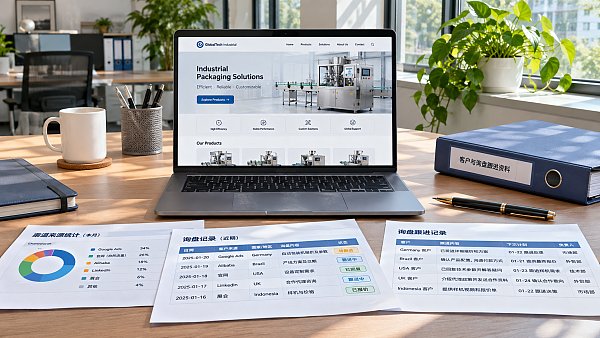
If your forms do not record the source, you can start by using conversion reports in your analytics tool to make an initial assessment. However, do not treat the report figures as the actual number of valid customers. Cross-device visits, privacy settings, browser restrictions, and untagged links can all cause source data to be missing. If needed, add an optional “How did you hear about us?” question to the form as a supplementary reference.
Use a review table to see each channel’s actual contribution
Organize data by channel, such as organic search, paid advertising, social media, direct traffic, and referral traffic, and break it down by major countries or regions and landing pages. At a minimum, track the following metrics:
- Visits and inquiries: Understand the scale of each channel and how many visitors complete the desired action.
- Inquiry conversion rate: Number of inquiries ÷ corresponding number of visits. Use the same reporting period and consistent traffic definitions when comparing results; do not mix users with sessions.
- Valid inquiry rate: Number of valid inquiries ÷ total number of inquiries. This helps assess lead quality rather than just the number of form submissions.
- Cost per valid inquiry: Channel spend ÷ number of valid inquiries. For advertising channels, you can start with ad spend. When comparing long-term channels such as SEO and social media, try to include content production, personnel, or service costs according to consistent criteria.
- Sales progress: Record statuses such as contacted, requirements confirmed, and quoted. If possible, continue tracking deal value and sales cycle length.
For example, if advertising generates many inquiries but the valid inquiry rate is low, review the search terms, targeting locations, and whether the landing page’s promises are accurate. If organic search brings fewer visits but continues to generate clear product inquiries, investigate which keywords and product pages led to them. Do not overlook sample size when assessing results: for a page with only a handful of inquiries, a small change in conversion rate can alter its ranking, so avoid making major budget changes based on that alone.
Sales cycles can also vary by channel. Manufacturing purchases often involve repeated comparisons and internal approvals, so leads that have not yet received a quote this month do not necessarily indicate an ineffective channel. Review leads in cohorts based on when they were generated, and give the sales team a reasonable follow-up window.
When you find a problem, investigate traffic and pages separately
When a channel has high traffic but a low inquiry conversion rate, first check whether the visitors are the target audience. Are ad search terms skewed toward free tutorials or recruitment? Is social media content attracting people who are not involved in purchasing? Do the country and language settings include markets you do not serve? If the traffic is clearly misaligned, adjusting targeting and content is more important than repeatedly changing button colors.
If the audience is generally a good match, check whether the landing page answers customers’ key questions. Are product specifications, application scenarios, delivery regions, certification details, and contact information easy to find? Is the mobile form too long, and does it provide clear feedback after submission? For multilingual websites, also check that language switching, form fields, and inquiry notifications are working properly.
A common situation is that inquiry volume falls without any obvious page malfunction. In this case, compare the channel mix across different periods: Have brand keyword ads been reduced, or has the ranking of an organic search page changed? Also consider holidays, campaign schedules, and changes in demand in target markets. Avoid attributing every fluctuation to a website redesign.
Attribution is not about picking a single “winning channel”
A customer may first discover a brand through social media, then search for the company name, and later return to the website through an email link to submit an inquiry. If you look only at the last visit, branded search or email may get all the credit. If you look only at the first visit, you may underestimate the impact of subsequent touchpoints.
In practice, you can record both the first source and the source before submission, then assess the results by cross-checking advertising platforms, website analytics, and sales feedback. Interpret direct traffic and branded keywords in organic search with particular care: they may reflect awareness built through other channels. Different platforms use different conversion attribution rules and reporting windows. If the figures do not match, check that the definitions are consistent before attempting to add them together.
Turn review findings into actions for the next cycle
You do not need to change every part of the process in each review. Choose one or two significant issues that can be tested, and define an owner and an observation period. For example, refine ad search terms, add specification details for high-intent products, or shorten the mobile inquiry form. Record traffic, valid inquiries, and lead quality before and after the changes. Where possible, avoid making too many major changes at the same time so you can assess their impact.
For teams managing multilingual websites, SEO, advertising, and overseas social media at the same time, data fragmentation can make reviews more difficult. Yi Ying Bao provides services including intelligent website building, SEO optimization, advertising, and overseas social media. These can be considered alongside a company’s existing customer acquisition processes to clarify coordination needs from website conversion through to channel operations. Specific approaches to data collection, lead transfer, and attribution still need to be confirmed based on the tools in use, privacy compliance requirements, and actual configuration.
Ultimately, the answer to what constitutes effective traffic is not found in a single report, but in comparing operational data with sales feedback. Ongoing tracking and regular validation provide a sound basis for every adjustment to your investment.
Related Articles
 How Can You Identify Effective Traffic Sources When Reviewing Growth in Inquiries from Your Independent Website?
 How to Choose a Target Market for Your Cross-Border Ecommerce Store
 Overseas Marketing Data Analysis: How to Evaluate Channel Performance by Lead Quality

Related Products
 Yiyingbao SaaS Intelligent Website Building and Marketing SystemYiyingbao SaaS Intelligent Website Building and Marketing System, AI-powered no-code website building, rapid creation of multilingual B2B international websites in 10 minutes, global server acceleration, AI-powered SEO optimization, helping businesses connect efficiently with global markets. The perfect integration of technology and operation makes building an international trade website remarkably simple
 AI+SEM Intelligent Advertising Marketing SystemAI+SEM drives intelligent ad creation, empowering full-funnel precision advertising marketing. The system automatically generates weekly/monthly reports, AI recommends keywords and target countries, monitors core metrics in real-time with intelligent alerts, and enables one-click high-conversion ad solutions to help quickly acquire customers and improve ROI.
 AI+SEO Dual-Engine System Optimization ServicesYiyingbao’s AI+SEO dual-engine optimization system helps foreign trade enterprises acquire high-quality organic traffic through AI-powered keyword research, content generation, and comprehensive technical optimization, significantly improving search rankings and conversion rates.
 AI+SNS Social Media Marketing SystemYingbao AI+SNS Social Media Marketing System - Precision social capture for the social media era. Supports one-click content synchronization across major platforms like Facebook and LinkedIn. AI intelligently rewrites posts for enhanced relevance. 24/7 AI customer service and user profiling analysis empower businesses to efficiently expand into global markets.
 AI+SEO营销解决方案易营宝AI+SEO营销解决方案,通过AI批量写作、智能生成TDK、精准关键词扩词等功能,全面优化网站SEO效果,提升流量与转化率。助力企业构建高效智能网站新生态。
 AI+SEM Advertising Marketing SolutionsAI+SEM Advertising Marketing Solution leverages AI technology to deeply empower SEM ad campaigns. It automatically generates weekly/monthly reports using AI, presenting account data across multiple dimensions for comprehensive insights into campaign performance and trends. The system precisely recommends keywords and target countries, intelligently generates high-conversion ad copy, and enables one-click activation of efficient campaign plans to help businesses rapidly acquire customers. Simultaneously, it monitors core metrics in real time, intelligently identifies abnormal fluctuations, and issues timely alerts to ensure stable, high-return advertising results.
 Domain Name ServicesEasyWin provides professional domain name services, including intelligent queries, one-stop registration, brand protection, and full lifecycle management, helping businesses build a digital brand image.
 EasyOperate B2C Cross-Border E-Commerce Platform & Independent WebsiteEasyStore B2C Cross-border E-commerce Independent Store is an intelligent website building and cross-border e-commerce integrated solution independently developed by EasyStore Information Technology (Beijing) Co., Ltd. The system is specially designed for small and medium-sized as well as large export enterprises, integrating 'website building, operation, marketing, advertising, and conversion' into one, helping enterprises quickly establish cross-border e-commerce independent stores to achieve brand globalization and global sales growth.
The platform supports multiple languages, multiple currencies, and multi-channel marketing, with built-in AI intelligent translation and SEO optimization systems, suitable for mainstream markets such as Southeast Asia, Europe and America, Latin America, and the Middle East, assisting Chinese manufacturing enterprises in efficiently deploying international e-commerce strategies. SSL证书易营宝提供专业SSL安全证书服务,包括单域名和泛域名证书,确保网站数据传输加密、身份验证和完整性保护,助力企业建立安全可信的在线业务环境。









