









- Which customer acquisition channels will be affected by cross-border marketing trends in 2026?Sep 06, 2026View details
- Which homogenization risks should be considered in an analysis of the AI-powered website building industry?Aug 30, 2026View details
- How Will AI Marketing Trends 2026 Change Advertising Budget AllocationAug 28, 2026View details
- Is the EV SSL certificate market shrinking or upgrading? How should companies assess certificate procurement?Aug 11, 2026View details
- Why the old AMP SEO 2020 practices no longer work and what has changed in current optimization prioritiesAug 02, 2026View details
- How to Choose Topics for an Industry News Section to Attract More Organic Search TrafficJul 29, 2026View details
- Digital Marketing Shenzhen Market Insights: Why Are Companies Expanding Overseas Looking for Growth Teams in Shenzhen?Jul 31, 2026View details
- Can Zhejiang foreign trade independent websites still be developed today? Look at changes in traffic and lead generationJul 28, 2026View details
How are the costs of foreign trade marketing solutions calculated? Breakdown of website building, SEO, advertising, and content investment.
Don't just look at the quotation when considering the cost of foreign trade marketing solutions.
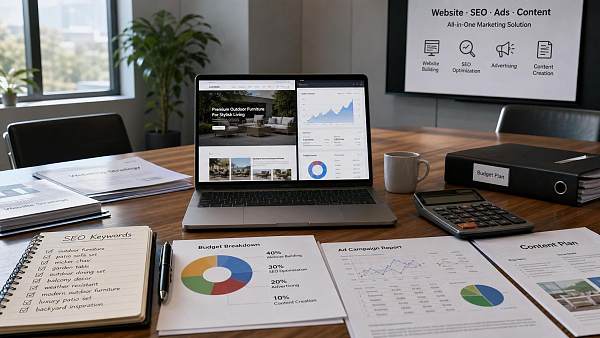
How are the costs of foreign trade marketing solutions calculated? Many companies initially only ask about the total price, but what truly influences the approval decision is often not the price level, but whether the budget structure is reasonable.
For companies going global, website building, SEO, advertising, and content creation are not four isolated expenses, but rather a continuous investment. No matter how much money is spent on front-end advertising, if the website performs poorly, it's usually difficult to reduce inquiry costs.
This is why when evaluating the cost of foreign trade marketing solutions, one should not only look at the initial contract amount, but also at the subsequent maintenance, optimization pace, channel synergy, and replicable growth capabilities.
Recent changes indicate that more and more companies are breaking down their expenses into two main categories: "infrastructure investment" and "customer acquisition and growth investment." This makes it easier to budget and track the return on investment.
In a typical service plan, the cost is usually broken down into several parts.
Common international trade marketing solutions typically consist of four parts: website setup costs, SEO costs, advertising costs, and content creation costs. Some service providers also include data analysis, overseas social media management, and multilingual support.
If your business covers multiple countries, the budget also needs to consider language version expansion, the creation of landing pages for different regions, and the cost of integrating with the lead management system. This part is often underestimated in the early stages.
- Website building: system, design, page creation, and technology deployment.
- SEO: Keyword layout, technical optimization, page optimization, backlinks and content.
- Advertising: Account setup, creative testing, campaign execution, and continuous optimization.
- Content: Product copywriting, case studies, blog posts, short videos, landing pages.
Therefore, when discussing the cost of foreign trade marketing solutions, the core question is not "how much does it cost?", but rather "where is the budget allocated, and can a stable customer acquisition chain be established?"
How are website building costs calculated, and why is there such a large difference?
Website building is usually the first investment in an international trade marketing solution. The reason for the large price difference is not the number of pages themselves, but the system capabilities, SEO fundamentals, conversion logic, and future scalability.
If it's just a showcase website, the cost is relatively low. However, if the goal is to acquire customers through inquiries, you need to consider multilingual support, mobile speed, form design, page indexing capabilities, and the efficiency of subsequent content expansion.
In actual business operations, website building costs are more suitable for evaluation based on "platform capabilities + page depth + business scenarios" rather than simply calculating based on the price per page.
Choosing a website and marketing integrated platform like YiYingBao offers the advantage that website building is not an isolated project, but directly serves subsequent SEO, advertising, and content growth, reducing redundant development and multi-party collaboration costs.
How to determine SEO costs, and why you can't just look at the monthly service fee?
SEO is often seen as a long-term investment, making it the easiest part of foreign trade marketing solutions to negotiate a lower price. However, what truly determines the effectiveness is not just the monthly fee, but the depth of service and the content of the execution.
A proper SEO plan typically includes keyword strategy, on-site structure optimization, content updates, technical diagnostics, data tracking, and search demand analysis for different markets.
A more obvious sign is that many companies are experiencing a lack of organic traffic after their websites are completed. This is not because there is no demand in the industry, but because website building and SEO are carried out separately, resulting in page structures that are not suitable for indexing and ranking.
Therefore, when evaluating the cost of foreign trade marketing solutions, SEO should focus on three key aspects: whether there is a clear keyword database, whether there is a continuous content plan, and whether traffic can be converted into inquiries, rather than just looking at the exposure numbers on the reports.
Advertising costs are the easiest to get out of control; this is how to break down your budget.
Advertising is the fastest-changing item in foreign trade marketing solutions. This is because it includes not only advertising expenditure but also the human resources costs associated with account setup, creative content creation, landing page design, and continuous optimization.
Many companies only include media spending in their budgets, neglecting to optimize costs. As a result, they get clicks, but inquiries are unstable, and they ultimately feel that the advertising campaigns are "too expensive."
A more prudent approach is to divide the advertising budget into three parts.
- Test budget: Validate country, keyword pack, creative materials, and landing page.
- Expansion budget: Continuously expand the effective combination.
- Optimize the budget: allocate funds for remarketing, data analysis, and conversion improvement.
If the solution covers Google Ads, Facebook Ads, and the remarketing chain, the cost of the foreign trade marketing solution may seem higher, but the overall customer acquisition cost may not be higher, because channel synergy usually improves conversion rates.
Content investment is often underestimated, but it determines conversion quality.
Content is not an "additional item," but rather the part of the foreign trade marketing solution fee that most easily affects conversion quality. Especially in B2B inquiry scenarios, customers will repeatedly review product pages, case study pages, qualification pages, and industry solution pages.
If the content is thin, the translation is awkward, and the page information is incomplete, even if ads bring in traffic, it will be difficult to generate high-quality leads. Back-end sales follow-up time will increase, and the hidden costs will actually be higher.
This also means that content budgets should not be calculated solely based on the number of articles, but also on whether the product, industry, and target market are understood. The ability to clearly explain complex products directly impacts the final conversion rate.
When approving a budget, focus on these four outcome indicators.
To determine whether the cost of an international trade marketing solution is reasonable, it's advisable not to focus solely on the total investment, but also to keep an eye on the results metrics. This is how you transform "costs" into "business decisions."
- Is the cost per valid inquiry acceptable?
- Does the website conversion rate continue to improve?
- Do organic traffic and advertising traffic work together?
- Whether the content assets can be reused in the future.
If a solution can simultaneously improve indexing, reduce bounce rate, stabilize customer acquisition, and make subsequent budget increases more controllable, then the cost of such a foreign trade marketing solution is usually more worthwhile to approve.
How to choose a more suitable service model
From a procurement perspective, the biggest concern isn't high prices, but rather that projects are broken down too into smaller parts. One company handles website development, another handles SEO, and yet another outsources advertising to a third party, ultimately blurring the lines of responsibility and increasing collaboration costs.
Integrated service models like EasyCreation are more suitable for companies that want to control cost structure, shorten launch cycle, and unify data standards. The value of integration is even more apparent when multilingual websites and overseas promotions are running in parallel.
Ultimately, the cost of foreign trade marketing solutions is not a fixed number. Instead, it requires a reverse calculation of the budget based on the target market, channel mix, sales cycle, and expected inquiry volume.
First, break down the cost structure, and then examine whether each item directly contributes to customer acquisition and conversion. This approach is usually more valuable than simply lowering prices. A clear understanding of budget allocation leads to better control over future growth.
Related Articles


Related Products
 Yiyingbao SaaS Intelligent Website Building and Marketing SystemYiyingbao SaaS Intelligent Website Building and Marketing System, AI-powered no-code website building, rapid creation of multilingual B2B international websites in 10 minutes, global server acceleration, AI-powered SEO optimization, helping businesses connect efficiently with global markets. The perfect integration of technology and operation makes building an international trade website remarkably simple
 AI+SEM Intelligent Advertising Marketing SystemAI+SEM drives intelligent ad creation, empowering full-funnel precision advertising marketing. The system automatically generates weekly/monthly reports, AI recommends keywords and target countries, monitors core metrics in real-time with intelligent alerts, and enables one-click high-conversion ad solutions to help quickly acquire customers and improve ROI.
 AI+SEO Dual-Engine System Optimization ServicesYiyingbao’s AI+SEO dual-engine optimization system helps foreign trade enterprises acquire high-quality organic traffic through AI-powered keyword research, content generation, and comprehensive technical optimization, significantly improving search rankings and conversion rates.
 AI+SNS Social Media Marketing SystemYingbao AI+SNS Social Media Marketing System - Precision social capture for the social media era. Supports one-click content synchronization across major platforms like Facebook and LinkedIn. AI intelligently rewrites posts for enhanced relevance. 24/7 AI customer service and user profiling analysis empower businesses to efficiently expand into global markets.
 AI+SEO营销解决方案易营宝AI+SEO营销解决方案,通过AI批量写作、智能生成TDK、精准关键词扩词等功能,全面优化网站SEO效果,提升流量与转化率。助力企业构建高效智能网站新生态。
 AI+SEM Advertising Marketing SolutionsAI+SEM Advertising Marketing Solution leverages AI technology to deeply empower SEM ad campaigns. It automatically generates weekly/monthly reports using AI, presenting account data across multiple dimensions for comprehensive insights into campaign performance and trends. The system precisely recommends keywords and target countries, intelligently generates high-conversion ad copy, and enables one-click activation of efficient campaign plans to help businesses rapidly acquire customers. Simultaneously, it monitors core metrics in real time, intelligently identifies abnormal fluctuations, and issues timely alerts to ensure stable, high-return advertising results.
 Domain Name ServicesEasyWin provides professional domain name services, including intelligent queries, one-stop registration, brand protection, and full lifecycle management, helping businesses build a digital brand image.
 EasyOperate B2C Cross-Border E-Commerce Platform & Independent WebsiteEasyStore B2C Cross-border E-commerce Independent Store is an intelligent website building and cross-border e-commerce integrated solution independently developed by EasyStore Information Technology (Beijing) Co., Ltd. The system is specially designed for small and medium-sized as well as large export enterprises, integrating 'website building, operation, marketing, advertising, and conversion' into one, helping enterprises quickly establish cross-border e-commerce independent stores to achieve brand globalization and global sales growth.
The platform supports multiple languages, multiple currencies, and multi-channel marketing, with built-in AI intelligent translation and SEO optimization systems, suitable for mainstream markets such as Southeast Asia, Europe and America, Latin America, and the Middle East, assisting Chinese manufacturing enterprises in efficiently deploying international e-commerce strategies. SSL证书易营宝提供专业SSL安全证书服务,包括单域名和泛域名证书,确保网站数据传输加密、身份验证和完整性保护,助力企业建立安全可信的在线业务环境。









