









- Which customer acquisition channels will be affected by cross-border marketing trends in 2026?Sep 06, 2026View details
- Which homogenization risks should be considered in an analysis of the AI-powered website building industry?Aug 30, 2026View details
- How Will AI Marketing Trends 2026 Change Advertising Budget AllocationAug 28, 2026View details
- Is the EV SSL certificate market shrinking or upgrading? How should companies assess certificate procurement?Aug 11, 2026View details
- Why the old AMP SEO 2020 practices no longer work and what has changed in current optimization prioritiesAug 02, 2026View details
- How to Choose Topics for an Industry News Section to Attract More Organic Search TrafficJul 29, 2026View details
Which market boundaries should be used to define exclusive agency territories in international trade?
The territorial division of exclusive foreign trade agencies should not be based solely on national borders. Customer sources, channel coverage, and market potential should also be considered to reduce the risk of parallel imports and disputes over rights and responsibilities. For agents, whether a territory is reasonably defined directly determines whether their initial investment can achieve stable returns.
Readers searching for "territorial division of exclusive foreign trade agencies" usually do not lack contract templates. Instead, they want clarity on whether exclusivity should be defined by country, city, customer type, or sales channel, and how ownership should be determined when online inquiries flow across territories.
First, clarify: territorial boundaries should not be defined solely by administrative maps
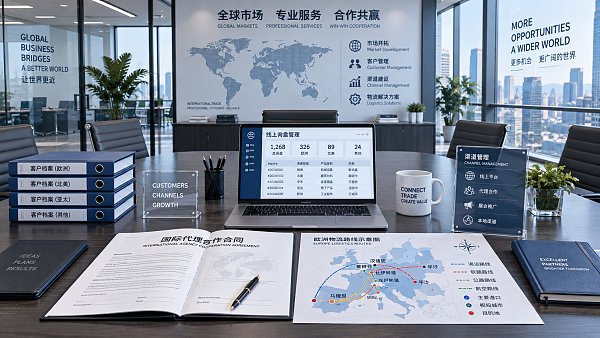
The most common approach to defining exclusive foreign trade agency territories is to directly specify one country or several countries. However, for overseas business involving different levels of market maturity and complex purchasing processes, this approach is often too broad and can easily lead to disagreements during actual implementation.
For example, an agent is responsible for the German market, but the customer's headquarters are in Germany, its purchasing center is in the Netherlands, its delivery location is in Poland, and the final order is submitted through an English-language website. If the contract only states "exclusive agent for Germany," it is difficult to determine whether the order belongs to the German agent based solely on national borders.
A more prudent approach is to view a territory as an "operable market unit." Administrative boundaries can serve as a basis, but the priority for determining customer registration location, project location, final delivery location, contracting entity, and paying entity should also be clearly defined.
For dealers and distributors, a territory is not an abstract term but a business asset. Only when boundaries are identifiable, traceable, and enforceable will agents be willing to invest in local warehousing, sales teams, trade show promotion, and digital marketing budgets.
Four types of market boundaries determine whether exclusivity can truly be implemented
The first type is geographic boundaries, namely countries, states or provinces, cities, or economic zones. This approach is suitable for products with a high proportion of offline channels and clear customer transaction locations, such as industrial equipment, building materials, components, and machinery products requiring on-site service.
The second type is customer boundaries, which are defined according to the end customer's industry, group, project type, or account list. When dealing with procurement by multinational groups, management based on customer lists is usually more effective than division by country and can also prevent multiple agents from repeatedly following up on the same group.
The third type is channel boundaries, which distinguish between offline distribution, online retail, e-commerce platforms, project bidding, OEM customers, and brand direct-sales customers. Many parallel import disputes occur not between two countries, but between different sales channels.
The fourth type is digital traffic boundaries. When companies obtain inquiries through multilingual websites, Google SEO, Google Ads, or overseas social media, the visitor's location, form country code, advertising account, and landing page language may all affect lead ownership, so rules need to be agreed upon in advance.
Therefore, a reasonable territorial division for exclusive foreign trade agencies is usually not based on a single dimension, but rather a combination of "country or region + customer scope + sales channel + lead ownership rules." The more complex the boundaries are, the more specifically the decision criteria need to be written, rather than broadly using terms such as "local market."
Before signing with an agent, focus on assessing market potential and the fit with investment capacity
Exclusive agency does not mean that the larger the territory, the better. If the coverage area is too large, the agent may lack sufficient capital, personnel, and channel capabilities to develop the market; the brand owner may also reopen the market due to lower-than-expected growth, undermining the stability of the partnership.
Agents should first assess the number of customers in the target territory, purchasing frequency, competing brands, certification requirements, logistics costs, and after-sales service requirements. For markets that have not yet been validated, it may be preferable to seek exclusivity in key countries first rather than undertaking an entire continent at once.
Customer acquisition costs should also be calculated. If customers primarily come through search engines and website inquiries, agents need to confirm whether the brand owner provides support such as multilingual websites, SEO content, advertising leads, or localized landing pages; otherwise, exclusivity may have only nominal value.
Brand owners should, in turn, focus on the agent's actual coverage capabilities, including existing customer resources, industry sales experience, inventory capacity, after-sales personnel, and annual promotional budget. Exclusive qualification should match market development responsibilities and should not be determined solely by the amount of the initial order.
When online inquiries cross territories, ownership rules must be included in the contract
More and more foreign trade customers now submit requirements through independent websites, search ads, social media direct messages, and trade show pages. Online customer acquisition has broken traditional geographic boundaries and shifted agents' main concern from "who can sell" to "who can follow up on the lead."
The contract should clearly specify that online inquiries are allocated primarily according to the customer's company registration location, project delivery location, or final place of use, and should establish an enforceable order of priority. Determining ownership solely by IP address, language version, or traffic source is generally insufficient as a final basis.
For leads obtained directly through the brand's official website, a response time limit should be established. For example, after confirming that a customer belongs to the agent's territory, the brand owner should transfer the lead to the agent within the agreed number of working days; if the agent fails to follow up in a timely manner or makes no progress for an extended period, the brand owner may reclaim and reassign the lead.
If a company also operates Google SEO, advertising campaigns, and social media accounts, agents should also understand the scope of traffic placement. Using distinguishable landing pages, form fields, and CRM tags can preserve evidence of lead sources and reduce subsequent verbal disputes.
Integrated marketing services such as 易营宝, which cover intelligent website building, multilingual content, SEO, and advertising, can help brand owners configure website languages, form rules, and lead tags by market. For agents, a transparent digital allocation mechanism offers greater assurance than vague commitments.
To prevent parallel imports and conflicts, exception scenarios and exit mechanisms must also be established
No matter how clearly territories are divided, special circumstances such as cross-border customer purchases, centralized tendering by headquarters, or e-commerce resale cannot be completely avoided. Therefore, the agreement should list principles for handling exceptional orders, including multinational groups, existing customers, major direct-sales customers of the brand, and emergency replenishment orders.
For transactions completed across territories, both parties may agree on commission sharing, differences in supply prices, or priority rights for project registration. The key is not that every order belongs to one party, but that there is a clear basis when disputes arise, preventing agents from being bypassed without compensation after making investments.
Exclusivity should also be linked to minimum purchase volumes, market development plans, the number of registered customers, and service capability indicators. Brand owners need to retain reasonable assessment rights, while agents should also require transparent assessment criteria so that undisclosed targets cannot be used as grounds for revoking exclusivity.
It is advisable to establish a phased evaluation mechanism, such as reviewing sales revenue, progress with key customers, online lead conversion, and market promotion activities every six months. If market performance does not meet expectations, the territory can first be adjusted or the cooperation changed to non-exclusive, rather than immediately terminating the entire partnership.
Conclusion: Define territories based on operability, verifiability, and traceability
The territorial division of exclusive foreign trade agencies should focus on actual market operations rather than simply applying administrative national borders. The country scope provides a foundation; customer, channel, and digital lead rules determine execution results; and market capacity and investment capability determine whether exclusive cooperation can be sustained over the long term.
During negotiations, agents should focus on confirming the territory definition, ownership of online inquiries, key customer lists, channel restrictions, performance assessments, and exit arrangements. Only by clarifying these issues before signing the agreement can exclusive agency rights be transformed into genuinely sustainable market opportunities.
Related Articles


Related Products
 Yiyingbao SaaS Intelligent Website Building and Marketing SystemYiyingbao SaaS Intelligent Website Building and Marketing System, AI-powered no-code website building, rapid creation of multilingual B2B international websites in 10 minutes, global server acceleration, AI-powered SEO optimization, helping businesses connect efficiently with global markets. The perfect integration of technology and operation makes building an international trade website remarkably simple
 AI+SEM Intelligent Advertising Marketing SystemAI+SEM drives intelligent ad creation, empowering full-funnel precision advertising marketing. The system automatically generates weekly/monthly reports, AI recommends keywords and target countries, monitors core metrics in real-time with intelligent alerts, and enables one-click high-conversion ad solutions to help quickly acquire customers and improve ROI.
 AI+SEO Dual-Engine System Optimization ServicesYiyingbao’s AI+SEO dual-engine optimization system helps foreign trade enterprises acquire high-quality organic traffic through AI-powered keyword research, content generation, and comprehensive technical optimization, significantly improving search rankings and conversion rates.
 AI+SNS Social Media Marketing SystemYingbao AI+SNS Social Media Marketing System - Precision social capture for the social media era. Supports one-click content synchronization across major platforms like Facebook and LinkedIn. AI intelligently rewrites posts for enhanced relevance. 24/7 AI customer service and user profiling analysis empower businesses to efficiently expand into global markets.
 AI+SEO营销解决方案易营宝AI+SEO营销解决方案,通过AI批量写作、智能生成TDK、精准关键词扩词等功能,全面优化网站SEO效果,提升流量与转化率。助力企业构建高效智能网站新生态。
 AI+SEM Advertising Marketing SolutionsAI+SEM Advertising Marketing Solution leverages AI technology to deeply empower SEM ad campaigns. It automatically generates weekly/monthly reports using AI, presenting account data across multiple dimensions for comprehensive insights into campaign performance and trends. The system precisely recommends keywords and target countries, intelligently generates high-conversion ad copy, and enables one-click activation of efficient campaign plans to help businesses rapidly acquire customers. Simultaneously, it monitors core metrics in real time, intelligently identifies abnormal fluctuations, and issues timely alerts to ensure stable, high-return advertising results.
 Domain Name ServicesEasyWin provides professional domain name services, including intelligent queries, one-stop registration, brand protection, and full lifecycle management, helping businesses build a digital brand image.
 EasyOperate B2C Cross-Border E-Commerce Platform & Independent WebsiteEasyStore B2C Cross-border E-commerce Independent Store is an intelligent website building and cross-border e-commerce integrated solution independently developed by EasyStore Information Technology (Beijing) Co., Ltd. The system is specially designed for small and medium-sized as well as large export enterprises, integrating 'website building, operation, marketing, advertising, and conversion' into one, helping enterprises quickly establish cross-border e-commerce independent stores to achieve brand globalization and global sales growth.
The platform supports multiple languages, multiple currencies, and multi-channel marketing, with built-in AI intelligent translation and SEO optimization systems, suitable for mainstream markets such as Southeast Asia, Europe and America, Latin America, and the Middle East, assisting Chinese manufacturing enterprises in efficiently deploying international e-commerce strategies. SSL证书易营宝提供专业SSL安全证书服务,包括单域名和泛域名证书,确保网站数据传输加密、身份验证和完整性保护,助力企业建立安全可信的在线业务环境。









