









- 21st Century Business Herald: AI and CTV Become Core Growth Engines for Digital Marketing in Overseas MarketsNov 18, 2026View details
- China Presents 25 Cooperation Outcomes in Areas Including Cross-Border E-Commerce During APECNov 18, 2026View details
- AI Products Drive Hong Kong Exports Up 64.9% in September, Fastest Growth in Over 40 YearsNov 17, 2026View details
- National Bureau of Statistics: Foreign trade grew rapidly in October, providing stable support for global tradeNov 17, 2026View details
- The U.S. has ended the $800 de minimis exemption for non-postal shipments; express courier packages must be formally declared.Nov 16, 2026View details
- ASEAN Signs Digital Economy Framework Agreement, Moving Toward Harmonized Cross-Border E-Commerce RulesNov 15, 2026View details
Practical Video Marketing for Export Products: From Product Demonstrations to Inquiry Conversion
Product videos may be clear and well-shot yet generate views but no inquiries. The problem often lies not with the footage itself: after watching, overseas customers may still not know whether the product meets their needs or where to go next to get in touch. Video marketing for export products should connect “understanding the product” with “making it easy to inquire”: first, design demonstrations around buyers’ questions; then place the videos on relevant product pages and clearly guide customers to submit their requirements.
Before filming, decide what customers need to verify
Don’t rush to cram the workshop, equipment, and every product angle into a single video. First, review existing inquiries, sales communications, and product materials to identify the information customers repeatedly ask about: what applications the product is suitable for, its key specifications, how to install or operate it, and whether it can be customized to their requirements. Prioritize answering one main question in each video. If there is too much information, split it into multiple videos so they can be placed on the relevant pages.
For example, when demonstrating equipment, organize the footage in the following order: “workpiece—operation—operating status—finished result.” When showing components, make sure customers can clearly see their dimensions and positions, connection methods, and actual assembled state. Ensure that specifications match the product documentation. Statements about performance and applications should be based on verifiable information; don’t use adjectives such as “efficient” or “durable” in place of evidence.
Before filming, prepare a brief shot list: what question each shot answers, what props are needed, what text should appear on screen, and what action you want customers to take at the end. This helps avoid discovering during editing that a key operation or product detail is missing.
Use the demonstration footage to explain the product
Show the product and its application as early as possible in the video, avoiding a lengthy opening sequence. Then use close-ups to highlight key components and continuous shots to show the operating process. Add wider shots when necessary to help customers understand how the equipment relates to the operator and workpiece. Don’t use rapid cuts to gloss over operating steps, especially steps such as installation, adjustment, and product handling that may affect purchasing decisions.
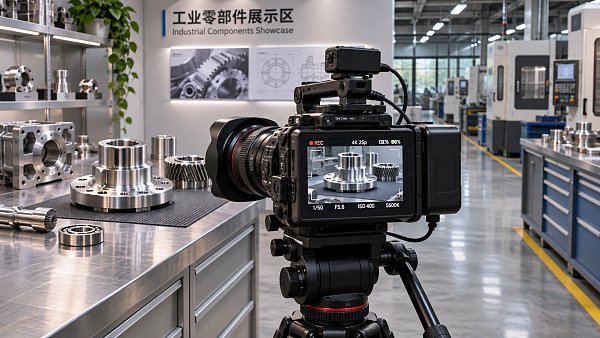
Keep the lighting as consistent as possible and the product clearly in focus. When recording narration, avoid obvious machine noise. For precision structures, add close-up shots of specific areas. Dimensions can be explained with labels or reference objects, but a reference object should not replace accurate specifications. For operations involving safety protection, show the protective measures actually required during use to avoid creating a misleading impression.
When to use subtitles and voice-over
Many customers browse with the sound off, so they should be able to understand key information from the visuals and subtitles. Subtitles do not need to repeat the narration word for word; instead, they should highlight information such as operation names, specifications, and applicable conditions. Keep each shot on screen long enough for viewers to read. When creating language versions for different markets, standardize product terminology, units of measurement, and model numbers first, then check that subtitles do not obscure operational details.
Machine translation can be used as a first draft, but product names, technical specifications, and industry terminology should be reviewed by someone familiar with both the target language and the product. Include information about customization capabilities, lead times, or certifications only after confirming the applicable conditions, so that the video does not make claims inconsistent with actual supply terms.
Guide viewers from the video to the product page
End the video with a clear call to action, such as “View specifications and submit your requirements” or “Send us your drawings to discuss product selection,” rather than displaying only a vague company name. Match the contact route to the viewing channel: on your website, place the inquiry button near the video; for social media content, use the profile or landing page links supported by that platform, and check that the links work before publishing.
The landing page should correspond directly to the product shown in the video, rather than directing everyone to the homepage. At a minimum, customers should be able to see the product model, key specifications, applications, relevant images, and contact options. If the video demonstrates a particular feature, the page should provide corresponding information to reduce the time customers spend looking for details.
The inquiry form should not simply ask customers to “leave a message.” Prompt them to provide information such as the intended application, required specifications, quantity, or target market, while also leaving space for a free-form description. For custom products, you can prompt customers to mention drawing or sample requirements, but don’t make information that is not yet necessary mandatory. After submission, display a clear confirmation message and check that the notification reaches the staff responsible for follow-up.
How to adapt the same video assets for different channels
Product detail pages are suitable for more complete demonstrations that let customers comparing solutions review the details. Videos in social media feeds, however, need to show the product’s application and most compelling visuals sooner. You can use the same footage for both, but don’t simply shorten it by cutting time: the short version should answer one specific question, while the full version can provide more details about the operating process and specifications.
Before publishing, check the aspect ratio, subtitle readability on mobile devices, and whether the video thumbnail accurately represents the content. If the thumbnail or title promises to show a particular feature, the video should include the corresponding demonstration. Otherwise, even if it attracts clicks, it may cause customers with genuine needs to leave.
For the Middle Eastern market, also check that the video subtitles, product page, and inquiry route use consistent Arabic wording, and that the page’s right-to-left layout displays correctly. If you need to build pages in local languages, learn more about Arabic Industry Website Development and Marketing Solutions. Its features include Arabic website development, right-to-left layouts, AI-powered translation and localization, consultation on Middle Eastern social media marketing strategies, and Arabic keyword optimization solutions. The specific configuration should match your actual advertising and page requirements.
Use data to identify bottlenecks, not just track views
After publishing, assess three stages separately: whether people watch the video, whether viewers visit the product page, and whether visitors submit an inquiry. Use distinct links or tracking tags for different channels, and record the video version, advertising channel, and corresponding page to ensure that subsequent comparisons are based on identifiable data from the same time period. When collecting data, check applicable privacy requirements and user consent settings.
- Many views, but viewers drop off quickly: Check whether the opening is too long, whether the thumbnail matches the content, and whether the subtitles are easy to read on mobile devices.
- People watch the video, but few visit the page: Check whether the call to action is clear, whether the link is easy to find, and whether it opens correctly.
- Page visits but few inquiries: Review the specifications, page loading speed, mobile form, and submission confirmation. Also assess whether the video is attracting viewers with relevant purchasing needs.
- Many inquiries, but few are a good fit: Explain the applications, models, or customization requirements in the video and on the page so customers can make an initial assessment before submitting an inquiry.
When making changes, prioritize changing one main factor at a time. For example, replace the opening shot first and then observe viewing behavior. When modifying the form, keep other key conditions unchanged so you can identify what caused the change. When data volumes are low or audiences vary significantly across channels, avoid drawing conclusions from short-term fluctuations alone; continue reviewing the actual inquiry content.
Related Articles
 How Can You Identify Effective Traffic Sources When Reviewing Growth in Inquiries from Your Independent Website?
 How to Choose a Target Market for Your Cross-Border Ecommerce Store
 Overseas Marketing Data Analysis: How to Evaluate Channel Performance by Lead Quality

Related Products
 Yiyingbao SaaS Intelligent Website Building and Marketing SystemYiyingbao SaaS Intelligent Website Building and Marketing System, AI-powered no-code website building, rapid creation of multilingual B2B international websites in 10 minutes, global server acceleration, AI-powered SEO optimization, helping businesses connect efficiently with global markets. The perfect integration of technology and operation makes building an international trade website remarkably simple
 AI+SEM Intelligent Advertising Marketing SystemAI+SEM drives intelligent ad creation, empowering full-funnel precision advertising marketing. The system automatically generates weekly/monthly reports, AI recommends keywords and target countries, monitors core metrics in real-time with intelligent alerts, and enables one-click high-conversion ad solutions to help quickly acquire customers and improve ROI.
 AI+SEO Dual-Engine System Optimization ServicesYiyingbao’s AI+SEO dual-engine optimization system helps foreign trade enterprises acquire high-quality organic traffic through AI-powered keyword research, content generation, and comprehensive technical optimization, significantly improving search rankings and conversion rates.
 AI+SNS Social Media Marketing SystemYingbao AI+SNS Social Media Marketing System - Precision social capture for the social media era. Supports one-click content synchronization across major platforms like Facebook and LinkedIn. AI intelligently rewrites posts for enhanced relevance. 24/7 AI customer service and user profiling analysis empower businesses to efficiently expand into global markets.
 AI+SEO营销解决方案易营宝AI+SEO营销解决方案,通过AI批量写作、智能生成TDK、精准关键词扩词等功能,全面优化网站SEO效果,提升流量与转化率。助力企业构建高效智能网站新生态。
 AI+SEM Advertising Marketing SolutionsAI+SEM Advertising Marketing Solution leverages AI technology to deeply empower SEM ad campaigns. It automatically generates weekly/monthly reports using AI, presenting account data across multiple dimensions for comprehensive insights into campaign performance and trends. The system precisely recommends keywords and target countries, intelligently generates high-conversion ad copy, and enables one-click activation of efficient campaign plans to help businesses rapidly acquire customers. Simultaneously, it monitors core metrics in real time, intelligently identifies abnormal fluctuations, and issues timely alerts to ensure stable, high-return advertising results.
 Domain Name ServicesEasyWin provides professional domain name services, including intelligent queries, one-stop registration, brand protection, and full lifecycle management, helping businesses build a digital brand image.
 EasyOperate B2C Cross-Border E-Commerce Platform & Independent WebsiteEasyStore B2C Cross-border E-commerce Independent Store is an intelligent website building and cross-border e-commerce integrated solution independently developed by EasyStore Information Technology (Beijing) Co., Ltd. The system is specially designed for small and medium-sized as well as large export enterprises, integrating 'website building, operation, marketing, advertising, and conversion' into one, helping enterprises quickly establish cross-border e-commerce independent stores to achieve brand globalization and global sales growth.
The platform supports multiple languages, multiple currencies, and multi-channel marketing, with built-in AI intelligent translation and SEO optimization systems, suitable for mainstream markets such as Southeast Asia, Europe and America, Latin America, and the Middle East, assisting Chinese manufacturing enterprises in efficiently deploying international e-commerce strategies. SSL证书易营宝提供专业SSL安全证书服务,包括单域名和泛域名证书,确保网站数据传输加密、身份验证和完整性保护,助力企业建立安全可信的在线业务环境。









