









- Can the average annual growth rate reflect real opportunities in overseas markets?Oct 07, 2026View details
- Which customer acquisition channels will be affected by cross-border marketing trends in 2026?Sep 06, 2026View details
- Which homogenization risks should be considered in an analysis of the AI-powered website building industry?Aug 30, 2026View details
- How Will AI Marketing Trends 2026 Change Advertising Budget AllocationAug 28, 2026View details
- Is the EV SSL certificate market shrinking or upgrading? How should companies assess certificate procurement?Aug 11, 2026View details
- Why the old AMP SEO 2020 practices no longer work and what has changed in current optimization prioritiesAug 02, 2026View details
Why Do Shenzhen Foreign Trade Websites Place More Emphasis on Google Organic Traffic?
For those engaged in foreign trade in Shenzhen, the term “independent website” is nothing unfamiliar. What truly creates a gap is often not whether a website has been built, but whether its traffic structure is stable. Over the past few years, many companies initially focused on advertising because it delivers fast results and direct feedback. However, over time, they discovered a very practical issue: advertising can amplify demand, but it is difficult for it to replace the accumulation of trust. Especially in B2B scenarios, purchasing decisions take time, inquiry quality varies, and relying solely on short-term paid traffic makes costs and uncertainty increasingly difficult to control. This is why a growing number of Shenzhen foreign trade independent websites are placing greater emphasis on organic traffic from Google.
Here, “placing greater emphasis” does not mean that advertising is unimportant. Rather, many companies have shifted from “traffic is enough as long as we have it” to “we need sustainable customer acquisition.” For foreign trade companies, manufacturing factories, and brands expanding overseas, the value of Google organic traffic lies not only in saving on click fees, but also in gradually turning a website into a long-term customer acquisition asset instead of a landing page used for a single advertising campaign.
Why Shenzhen Foreign Trade Companies Feel the Pressure of Traffic Structure Earlier
Shenzhen’s foreign trade ecosystem has several distinctive characteristics: rapid response, intense competition, and a wide range of product categories. From consumer electronics and smart hardware to home furnishings, accessories, and machinery, businesses across different sectors are competing for overseas orders. Once competition becomes concentrated, the advertising side is the first to feel fluctuations in cost per click, repeated exposure to high-quality audiences, and rising lead costs. For products with high order values and complex decision-making chains, it is difficult for companies to accept a customer acquisition model in which “there is traffic today, but everything stops tomorrow when there is no budget.”
Google organic traffic is more consistent with the actual purchasing journey of foreign buyers. Overseas buyers may not submit an inquiry after their first search. They often compare suppliers repeatedly: whether the website looks professional, whether the content is complete, whether product pages are sufficiently specific, whether company information is credible, and whether they can find technical content relevant to their needs. A company is more likely to receive high-intent inquiries only when it continues to appear at these search touchpoints.
In other words, the emphasis that Shenzhen foreign trade independent websites place on organic traffic is essentially an adaptation to the search behavior of overseas buyers, rather than a simple pursuit of “free traffic.”
The Real Value of Organic Traffic Goes Beyond Low Cost
When many people talk about SEO, their first reaction is that it is “cheaper than advertising.” This is not wrong, but it is incomplete. For Shenzhen foreign trade independent websites, the more important value of organic traffic includes at least three aspects.
The first is stability. When advertising stops, traffic often drops immediately. Organic rankings take longer to build, but as long as the website structure, content quality, page indexing, and keyword layout are solid, traffic can remain sustainable. In particular, once long-tail search terms achieve sufficient coverage, they are often more durable than simply competing for core keywords.
The second is lead quality. People searching for terms such as “supplier,” “manufacturer,” “custom,” and “wholesale” usually enter the comparison stage with a clear need. Compared with users reached through interruptive advertising, these users who actively search are more likely to generate valid inquiries. Of course, keyword intent must also be assessed in combination with the industry; search volume alone is not enough.
The third is brand trust. A website that continues to appear for product terms, solution terms, problem-related terms, and location-based terms will naturally create the perception that “this company has been operating in this industry for the long term.” This is particularly important in B2B procurement. Customers may not remember which advertisements you ran, but they will remember whether your website consistently appeared in key searches.
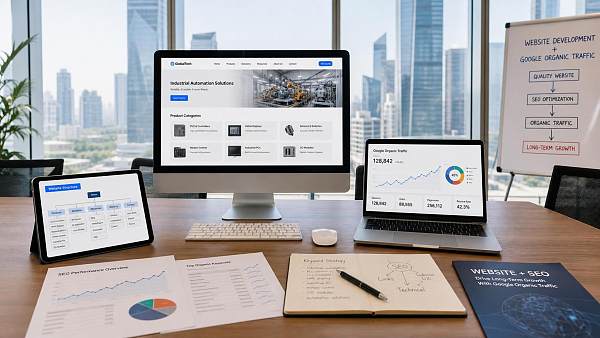
Why Website Building and Marketing Can No Longer Be Viewed Separately
Many Shenzhen companies do not avoid SEO; rather, they build their independent websites from the outset in ways that are unsuitable for SEO. Common problems include disorganized page structures, product categories that do not support keyword expansion, improper multilingual implementation, slow on-site loading, poor mobile experiences, content systems that cannot be updated continuously, and even difficulty managing basic page titles and URL rules.
At this point, discussing organic traffic becomes significantly more difficult. Google organic rankings cannot be solved simply by “adding an optimization package” later; they are influenced by the underlying website architecture from the very beginning. This is why integrated website and marketing services have attracted increasing attention in recent years. It is not only because service providers want to expand their delivery scope, but also because companies genuinely need to consider promotion logic during the website-building stage.
In the foreign trade context, a website that can genuinely support organic traffic should answer at least several questions: Can its pages be expanded by market and language? Can products and application scenarios be developed into independent content entry points? Will it support Google SEO, advertising landing pages, and social media traffic acquisition in the future? If the company plans to target North America, Europe, the Middle East, or Japan and South Korea, can its content management and site structure continue to support those markets? Addressing these issues after launch is not necessarily the most efficient solution.
This is also why platforms such as Yiyingbao, which integrate smart website building, SEO optimization, advertising, and social media operations into a unified growth framework, are more aligned with the current needs of foreign trade companies. Their value does not lie in having “more features,” but in reducing the disconnect between website building, content, and promotion. For companies planning to develop overseas markets over the long term, whether a website can be promoted, indexed, and converted is often more important than whether it merely “looks good” visually.
For Shenzhen Foreign Trade Independent Websites, Common Misconceptions About Organic Traffic Deserve More Attention Than Tactics
One misconception is that organic traffic means “writing a few articles in English.” In reality, Google evaluates the overall quality of a website, including its information architecture, the clarity of page topics, the match between content and search intent, internal links, crawlability, and whether useful information can be updated continuously. Scattered content alone is unlikely to support stable rankings.
Another misconception is the rush to pursue high-volume keywords. Many companies immediately try to compete for the most important keywords in their industry. However, for foreign trade websites, a more practical approach is usually to accumulate results gradually through long-tail keywords, product terms, application terms, and location-specific demand terms. Build up high-intent search entry points first, then expand toward broader industry terms. This generally delivers a much higher success rate.
Another common situation is that a website receives traffic but generates no inquiries. The problem may not lie in SEO itself, but in the conversion path. For example, a page may discuss only product specifications without explaining application scenarios, or display only company information without addressing procurement concerns such as lead times, customization, certification compatibility, packaging, and minimum order quantities. Organic traffic brings visits, but whether those visits can be converted into inquiries still depends on page content and trust-building design.
The Value of Google Organic Traffic Continues to Rise
The overseas customer acquisition environment has undergone a clear change: it is increasingly difficult for a single channel to support growth. Platform traffic is subject to platform rules, advertising traffic is affected by price fluctuations, and social media traffic is heavily influenced by content publishing cycles. By comparison, search traffic remains one of the few channels that can continuously capture clearly defined demand. Especially in B2B foreign trade, where procurement cycles are long and decision-making processes are complex, search has never been merely a supporting channel.
Looking further ahead, companies cannot focus only on traditional search engine results pages. As AI search and generative results increasingly influence how users obtain information, it will become more important for website content to be structured, topics to be clear, and brands to maintain stable visibility in specific fields. In recent years, Yiyingbao has incorporated AI+SEO/GEO into the same service framework, which is also, to some extent, a response to this change: an independent website should not be built only for indexing today, but should also leave room for future forms of search presentation.
Of course, this does not mean that every company should immediately shift a large portion of its budget to SEO. A more reasonable approach is usually to use advertising to validate markets and keywords, use organic traffic to build long-term assets, and use social media and content to complement the brand. These channels are not substitutes for one another; the key lies in their sequence and allocation.
If You Need to Decide Whether to Increase SEO Investment, Look at These Signals First
If a company already has a stable overseas expansion direction, its product line is not a one-time business, and its target customers repeatedly use Google to search for suppliers, solutions, and answers to their questions, organic traffic is usually worth developing at an early stage. Conversely, if products are updated extremely quickly, market validation is not yet complete, or sales depend primarily on intensive direct selling, the pace of SEO investment should be more cautious. In such cases, it is better to establish a solid website foundation first and avoid misaligning investment with the current stage of the business.
For Shenzhen foreign trade independent websites, the issue truly worth investing in is not the abstract question of “whether to do SEO,” but whether the website has long-term operational value. Whether it can continuously expand content, cover multiple languages, connect with different markets, support advertising and organic traffic, and adapt to future search formats is more important than a single ranking.
If a company is preparing to rebuild its independent website, or finds that advertising costs for its existing website are rising while organic traffic remains stagnant, the next step may be to conduct a comprehensive review from four perspectives: site structure, keyword layout, content assets, and conversion paths. Many problems do not lie in “whether promotion is being carried out,” but in “whether the website was built for growth from the very beginning.” This is the fundamental reason why Shenzhen foreign trade independent websites are increasingly emphasizing Google organic traffic.
Related Articles

Related Products
 Yiyingbao SaaS Intelligent Website Building and Marketing SystemYiyingbao SaaS Intelligent Website Building and Marketing System, AI-powered no-code website building, rapid creation of multilingual B2B international websites in 10 minutes, global server acceleration, AI-powered SEO optimization, helping businesses connect efficiently with global markets. The perfect integration of technology and operation makes building an international trade website remarkably simple
 AI+SEM Intelligent Advertising Marketing SystemAI+SEM drives intelligent ad creation, empowering full-funnel precision advertising marketing. The system automatically generates weekly/monthly reports, AI recommends keywords and target countries, monitors core metrics in real-time with intelligent alerts, and enables one-click high-conversion ad solutions to help quickly acquire customers and improve ROI.
 AI+SEO Dual-Engine System Optimization ServicesYiyingbao’s AI+SEO dual-engine optimization system helps foreign trade enterprises acquire high-quality organic traffic through AI-powered keyword research, content generation, and comprehensive technical optimization, significantly improving search rankings and conversion rates.
 AI+SNS Social Media Marketing SystemYingbao AI+SNS Social Media Marketing System - Precision social capture for the social media era. Supports one-click content synchronization across major platforms like Facebook and LinkedIn. AI intelligently rewrites posts for enhanced relevance. 24/7 AI customer service and user profiling analysis empower businesses to efficiently expand into global markets.
 AI+SEO营销解决方案易营宝AI+SEO营销解决方案,通过AI批量写作、智能生成TDK、精准关键词扩词等功能,全面优化网站SEO效果,提升流量与转化率。助力企业构建高效智能网站新生态。
 AI+SEM Advertising Marketing SolutionsAI+SEM Advertising Marketing Solution leverages AI technology to deeply empower SEM ad campaigns. It automatically generates weekly/monthly reports using AI, presenting account data across multiple dimensions for comprehensive insights into campaign performance and trends. The system precisely recommends keywords and target countries, intelligently generates high-conversion ad copy, and enables one-click activation of efficient campaign plans to help businesses rapidly acquire customers. Simultaneously, it monitors core metrics in real time, intelligently identifies abnormal fluctuations, and issues timely alerts to ensure stable, high-return advertising results.
 Domain Name ServicesEasyWin provides professional domain name services, including intelligent queries, one-stop registration, brand protection, and full lifecycle management, helping businesses build a digital brand image.
 EasyOperate B2C Cross-Border E-Commerce Platform & Independent WebsiteEasyStore B2C Cross-border E-commerce Independent Store is an intelligent website building and cross-border e-commerce integrated solution independently developed by EasyStore Information Technology (Beijing) Co., Ltd. The system is specially designed for small and medium-sized as well as large export enterprises, integrating 'website building, operation, marketing, advertising, and conversion' into one, helping enterprises quickly establish cross-border e-commerce independent stores to achieve brand globalization and global sales growth.
The platform supports multiple languages, multiple currencies, and multi-channel marketing, with built-in AI intelligent translation and SEO optimization systems, suitable for mainstream markets such as Southeast Asia, Europe and America, Latin America, and the Middle East, assisting Chinese manufacturing enterprises in efficiently deploying international e-commerce strategies. SSL证书易营宝提供专业SSL安全证书服务,包括单域名和泛域名证书,确保网站数据传输加密、身份验证和完整性保护,助力企业建立安全可信的在线业务环境。









