









- EU Customs Code reform to take effect on November 1, with new handling fees for direct-mail small parcelsNov 01, 2026View details
- EU Plans to Raise Tax on Incoming Small Parcels to €5Oct 31, 2026View details
- Maersk Adjusts Middle East Emergency Operating Cost Recovery Surcharge to USD 2,000 per ContainerOct 30, 2026View details
- Ministry of Commerce: Online retail sales grew 4.4% in the first three quarters, while cross-border e-commerce maintained relatively rapid growthOct 29, 2026View details
- CCTV reports: AI-powered smart hardware is expanding overseas at a faster pace, with orders for some best-selling products booked through next yearOct 29, 2026View details
- Alphabet Q3 Earnings: Google Search Advertising Revenue Rises 10.5% to $82 BillionOct 29, 2026View details
How to Assess the Quality of LinkedIn Sales Leads
How to Determine the Quality of LinkedIn Sales Leads
When developing sales leads on LinkedIn, the easiest trap to fall into is not failing to find people, but mistaking “people who appear active” for “leads worth pursuing.” Many teams add numerous contacts in the early stages, and the message response rate is not necessarily low, yet the proportion that actually progresses to inquiries, meetings, quotations, or even the sample stage remains limited. The problem is usually not LinkedIn itself, but a deviation in the logic used to assess leads. Lead volume does not equal sales opportunities. A complete profile photo, a large company, or an impressive job title does not automatically indicate high quality.
If LinkedIn is treated as a front-end touchpoint for acquiring overseas trade customers or expanding brands globally, lead quality should be assessed from at least four perspectives: whether the need is genuine, whether the contact has the authority to advance the project, whether interactions show clear intent, and whether the cost of subsequent conversion is controllable. This approach applies to manufacturing companies developing B2B inquiries, service providers attracting traffic through multilingual websites, and brands converting customers through overseas independent websites, although the specific focus may differ.
Let us start with one of the most common misjudgments: treating seniority as the only criterion. Many people habitually prioritize founders, general managers, and purchasing directors, assuming that the higher the title, the greater the chance of closing a deal. During actual follow-up, however, they discover that these contacts may not personally handle specific purchasing or partnership evaluations. Especially in medium-sized and large overseas companies, the people who truly drive projects are often business leaders, category managers, supply chain managers, marketing managers, or even operations personnel responsible for implementing digital projects. In other words, assessing lead quality requires looking not only at whether someone can make the final decision, but also at whether they will become involved. Someone with a budget but no participation in the selection process may not be more valuable than someone directly responsible for vendor selection and communication.
Assess Need Fit First—Do Not Rush to Judge Response Speed
The first layer of a high-quality lead is not a willingness to chat, but whether the need genuinely matches the offering. This is particularly important for website development and overseas marketing services. For example, if a company is indeed expanding into the North American or European markets, while its website clearly suffers from insufficient multilingual support, poor mobile experience, weak indexing fundamentals, or unclear inquiry paths, then the lead has a clear fit with services such as intelligent website development, SEO optimization, advertising, and social media operations. By contrast, if the contact only makes a general comment about wanting to “do promotion” without clarifying its main regions, product structure, average order value, or channel strategy, the lead may be active but is likely to involve repeated discussions later.
Many experienced teams first examine a prospect’s online infrastructure before deciding whether to investigate further. Whether the website has not been updated for a long time, whether multilingual versions are available, whether the pages have clear conversion entry points, whether brand information is consistent, and whether social media accounts are operated continuously can all reflect the maturity of the need. For companies developing global markets, LinkedIn leads should not be assessed in isolation. Their website status, search visibility, and ability to support advertising landing pages should be considered together. Truly convertible customers usually do not merely lack a contact; they have reached the stage where their digital marketing chain needs to be completed.
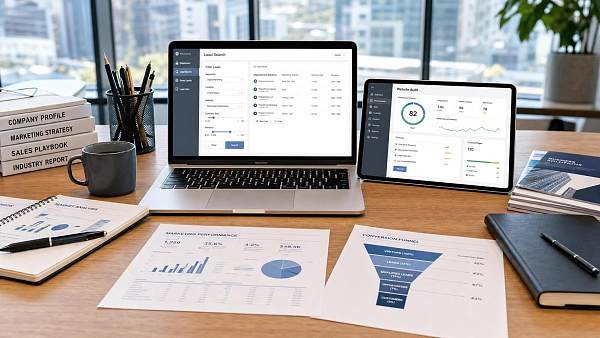
One detail is often overlooked: need fit is not limited to industry fit; it also includes stage fit. The way a startup brand’s LinkedIn leads are assessed can differ significantly from that of a mature manufacturer. The former may focus more on quickly building an independent website, launching advertising, and establishing basic content, while the latter may care more about multilingual websites, long-term SEO indexing, regional market sites, lead distribution, and CRM integration. If a service provider cannot identify the stage the prospect is in, it is easy to mistake a low-maturity need for a high-potential project.
The Right Role Matters More Than the Company’s Size
The second key consideration in LinkedIn sales lead development is the contact’s position within the company. Not everyone at a target company deserves the same follow-up investment. Contacts can generally be divided into three categories: decision-makers, influencers, and information gatherers. A high-quality lead does not necessarily have to belong to the first category, but it should at least fall into one of the first two.
If the contact is a marketing leader, they may not sign the contract, but they are highly likely to lead website redesigns, outsourced SEO, or advertising agency evaluations. If the contact works in purchasing or supply chain, they may not lead brand promotion, but they may determine which suppliers are shortlisted. If the contact is an owner’s assistant, an ordinary salesperson, or a general administrative employee, even an enthusiastic response may merely indicate that they are passing information along, resulting in significantly lower advancement efficiency. Many teams waste considerable time here: they appear to be following up continuously, but in reality they never reach the person who can truly assess the project’s value.
When assessing a role, do not focus only on the job title. A more reliable approach is to combine the person’s public activity, previous experience, department, and published content. Someone with “Business Development” in their title may be responsible for channel development or may simply be carrying out sales activities. A “Marketing Manager” may manage social media content or oversee the entire overseas customer acquisition budget. LinkedIn provides sufficient background clues; the issue is whether adequate preliminary screening is performed.
Truly Valuable Interactions Often Include Specific Questions
When assessing lead quality, engagement intent is more important than a simple reply. Someone who politely responds, “We do not have any plans at the moment,” is not a high-quality lead. Someone who continues by asking, “Do you support multilingual SEO architecture?”, “Can advertising landing pages be deployed independently?”, or “Would it be suitable to start with organic traffic in the European market?” is usually a higher-quality lead, even if the discussion has not yet reached the quotation stage. This is because the person has begun evaluating feasibility rather than remaining at the level of social pleasantries.
In integrated website and marketing services, quality leads often show several signals: they are willing to explain their target markets, disclose the current status of their advertising or website, clearly express their pain points, arrange further communication, or directly ask about the scope of a proposal. These signals indicate that the prospect is not merely making casual inquiries but is advancing an internal evaluation.
Conversely, some contacts appear highly engaged but remain for several rounds at “send me the materials to review” or “we will contact you if there is an opportunity.” Such leads should receive cautious investment. This does not mean they have no value at all, but their current conversion probability is relatively low. They should be placed in long-term nurturing rather than occupy core sales and operations resources.
Do Not Ignore Conversion Costs—Even Good Leads Require ROI Analysis
Some leads appear ideal on the surface: the industry is a good fit, the role is appropriate, and the contact is willing to communicate. Once execution begins, however, hidden costs may prove too high. For example, the prospect may need to cover multiple languages and regions while having disorganized internal materials, inconsistent brand messaging, and severe gaps in historical website data. Alternatively, they may want to develop an independent website, SEO, advertising, and social media simultaneously without a clear budget range or an internal point of contact. Such projects are not impossible to handle, but the costs of early-stage coordination, proposal communication, and delivery collaboration will all increase significantly.
Therefore, in addition to evaluating whether a lead can convert, high-quality lead assessment should consider whether reasonable conversion conditions exist. In cross-border markets in particular, compliance requirements, language adaptation, advertising review, and content localization difficulty vary by region. The landing-page logic that works in North America may not apply directly to the Middle East or Latin America. The website structure for B2B manufacturing inquiries also differs from the conversion path of a B2C cross-border e-commerce store. If these operating conditions are not clarified early, even a successfully closed deal may become a project that is difficult to execute smoothly.
The Assessment Priorities Differ by Business Scenario
For an international trade factory developing B2B inquiries, it is more important to assess whether the prospect has ongoing purchasing needs, a clearly defined product category, and the potential for medium- or long-term cooperation. In this context, a high-quality lead is often not the person who replies the fastest, but the one with a strong product-line fit, a stable purchasing process, and detailed questions about delivery times and customization capabilities.
If a brand expanding globally is using LinkedIn to find channels, partners, or service resources, the assessment priorities are different. Greater attention should be paid to whether the prospect understands the complete brand growth process and whether they care about independent-website conversion, advertising returns, content localization, and search visibility rather than discussing only a single channel. Focusing solely on isolated execution often leads to misaligned objectives in subsequent cooperation.
For service providers offering integrated solutions covering website development, SEO optimization, advertising, and social media operations, high-quality leads usually share one characteristic: their questions are not fragmented but systematic. For example, they may ask how to build a multilingual site while also caring about search indexing, advertising landing pages, form conversion, and subsequent data accumulation. Such customers are more likely to establish long-term cooperation because they are not facing an isolated pain point, but an overseas marketing chain that has not yet been fully connected.
Do Not Just Score Leads—Assign a Priority Level to the Next Action
Lead assessment is not intended to create an attractive table; it is intended to determine the next action. High-quality leads should quickly enter in-depth communication, needs confirmation, and discussions about the scope of a proposal. Medium-quality leads are suitable for continued nurturing through content outreach, case-study discussions, and website diagnostics. Low-maturity leads should not receive heavy investment; the connection can be maintained while waiting for a suitable demand window.
In LinkedIn sales lead development, the real difference lies not in how many people are added or how many rounds of messages are sent, but in whether you can identify early on who is worth pursuing deeply. Assess need fit, the contact’s role, the true intent reflected in interactions, and whether the project has executable conversion conditions. Once these layers are understood, it is usually possible to judge lead quality with reasonable accuracy. When further confirmation is needed, the most effective questions are often direct: Which market are you mainly serving at present? At which stage are your current website and customer acquisition channels encountering obstacles? Who will participate in the final evaluation? The true quality of many leads becomes essentially clear once these questions have been answered.
Related Articles
 Liu Meng: Chinese Companies Expanding Overseas Need to Upgrade to Sustainable Competitiveness
 How Can B2B Websites Improve Conversion Rates Through Inquiry Forms?
 Amazon Launches a Refund Without Return Program for FBA Sellers Across Five European Marketplaces



Related Products
 Yiyingbao SaaS Intelligent Website Building and Marketing SystemYiyingbao SaaS Intelligent Website Building and Marketing System, AI-powered no-code website building, rapid creation of multilingual B2B international websites in 10 minutes, global server acceleration, AI-powered SEO optimization, helping businesses connect efficiently with global markets. The perfect integration of technology and operation makes building an international trade website remarkably simple
 AI+SEM Intelligent Advertising Marketing SystemAI+SEM drives intelligent ad creation, empowering full-funnel precision advertising marketing. The system automatically generates weekly/monthly reports, AI recommends keywords and target countries, monitors core metrics in real-time with intelligent alerts, and enables one-click high-conversion ad solutions to help quickly acquire customers and improve ROI.
 AI+SEO Dual-Engine System Optimization ServicesYiyingbao’s AI+SEO dual-engine optimization system helps foreign trade enterprises acquire high-quality organic traffic through AI-powered keyword research, content generation, and comprehensive technical optimization, significantly improving search rankings and conversion rates.
 AI+SNS Social Media Marketing SystemYingbao AI+SNS Social Media Marketing System - Precision social capture for the social media era. Supports one-click content synchronization across major platforms like Facebook and LinkedIn. AI intelligently rewrites posts for enhanced relevance. 24/7 AI customer service and user profiling analysis empower businesses to efficiently expand into global markets.
 AI+SEO营销解决方案易营宝AI+SEO营销解决方案,通过AI批量写作、智能生成TDK、精准关键词扩词等功能,全面优化网站SEO效果,提升流量与转化率。助力企业构建高效智能网站新生态。
 AI+SEM Advertising Marketing SolutionsAI+SEM Advertising Marketing Solution leverages AI technology to deeply empower SEM ad campaigns. It automatically generates weekly/monthly reports using AI, presenting account data across multiple dimensions for comprehensive insights into campaign performance and trends. The system precisely recommends keywords and target countries, intelligently generates high-conversion ad copy, and enables one-click activation of efficient campaign plans to help businesses rapidly acquire customers. Simultaneously, it monitors core metrics in real time, intelligently identifies abnormal fluctuations, and issues timely alerts to ensure stable, high-return advertising results.
 Domain Name ServicesEasyWin provides professional domain name services, including intelligent queries, one-stop registration, brand protection, and full lifecycle management, helping businesses build a digital brand image.
 EasyOperate B2C Cross-Border E-Commerce Platform & Independent WebsiteEasyStore B2C Cross-border E-commerce Independent Store is an intelligent website building and cross-border e-commerce integrated solution independently developed by EasyStore Information Technology (Beijing) Co., Ltd. The system is specially designed for small and medium-sized as well as large export enterprises, integrating 'website building, operation, marketing, advertising, and conversion' into one, helping enterprises quickly establish cross-border e-commerce independent stores to achieve brand globalization and global sales growth.
The platform supports multiple languages, multiple currencies, and multi-channel marketing, with built-in AI intelligent translation and SEO optimization systems, suitable for mainstream markets such as Southeast Asia, Europe and America, Latin America, and the Middle East, assisting Chinese manufacturing enterprises in efficiently deploying international e-commerce strategies. SSL证书易营宝提供专业SSL安全证书服务,包括单域名和泛域名证书,确保网站数据传输加密、身份验证和完整性保护,助力企业建立安全可信的在线业务环境。









