









- Which customer acquisition channels will be affected by cross-border marketing trends in 2026?Sep 06, 2026View details
- Which homogenization risks should be considered in an analysis of the AI-powered website building industry?Aug 30, 2026View details
- How Will AI Marketing Trends 2026 Change Advertising Budget AllocationAug 28, 2026View details
- Is the EV SSL certificate market shrinking or upgrading? How should companies assess certificate procurement?Aug 11, 2026View details
- Why the old AMP SEO 2020 practices no longer work and what has changed in current optimization prioritiesAug 02, 2026View details
- How to Choose Topics for an Industry News Section to Attract More Organic Search TrafficJul 29, 2026View details
Guide to Acquiring Customers for Foreign Trade Independent Websites: 5 Key Judgments to Consider Before Choosing a Platform

First, clarify the goal: A website isn't 'built'—it's 'grown'
Many independent sites fail not because their pages look bad, but because they focus solely on 'display' from the start, without forming a complete loop of 'lead acquisition → conversion → optimization.'
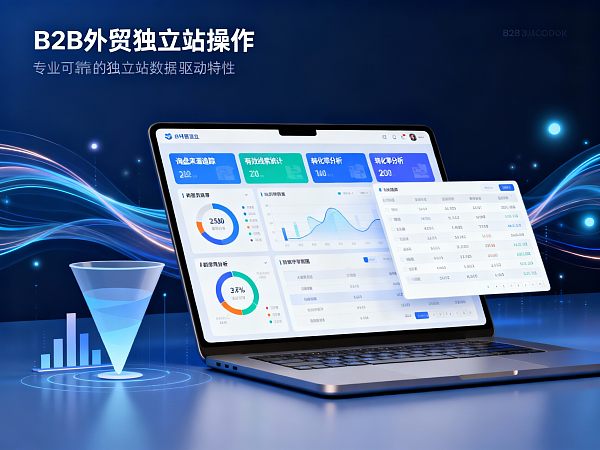
A truly worthwhile independent site should consistently generate inquiries (leads) and clearly track where they come from, which efforts are effective, and how to optimize further.
If a platform can only build pages but fails to establish clear metrics around inquiries (what counts as a valid lead?), reliable delivery (lead notifications), source attribution (traceability), and periodic optimization (weekly/monthly rhythms), it risks becoming a 'display-only' site with visits but no growth.
5 key criteria to filter platforms—more reliable than demos
1) Can it treat 'inquiries' as core results, not just an add-on feature?
Inquiries don't happen just because 'there's a form.' They require clear entry points (forms/live chat/IM), reliable delivery (notifications to responsible parties), and trackable metrics (filtering junk leads, distinguishing valid ones).
If a vendor can't clarify these details, expect pitfalls like lead leakage, poor lead quality, or mismatched data later.
- How are inquiries defined? What counts as a valid vs. invalid lead?
- How are leads notified? Does it support multiple recipients and notification methods?
- Can leads be segmented by source, page, language, or site?
2) Can inquiries be tied to their source? Otherwise, ROI remains a mystery
The biggest waste isn't spending money—it's not knowing which spending works: SEO? Content? Ads? Or a specific landing page?
If a platform only shows visit counts but not 'which channel/page drove inquiries,' optimization becomes guesswork, and reviews turn into lip service.
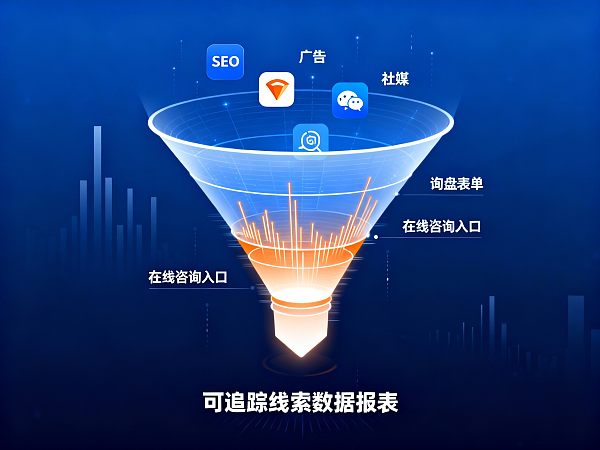
- Does it attribute inquiries to channels (SEO/content/ads/social)?
- Can it identify high-performing pages/keyword themes/product pages?
- Can review results be distilled into actionable optimization lists?
3) Does it support 'continuous iteration'? Otherwise, ads pour money into a leaky bucket
Independent sites grow through iteration: landing pages, copy, product displays, FAQs, form fields, and inquiry entry points all need constant tweaking.
If every change requires dev queues, outsourcing, or workflows, iteration slows, and conversions stall.
- Can landing pages be quickly duplicated, revised, and launched? Does it support module reuse?
- Are product displays B2B-friendly (parameters, models, specs, attachments, downloads)?
- Can content and topic pages be continuously produced and managed (for search/long-tail demand)?
4) Is it 'cheap the first year' but starts charging for tools and labor in year two?
Don’t just compare quotes. Ask: Will you need extra tools, integrations, repeated data transfers, content re-entry, or reworked structures later?
Many 'seemingly cheap' solutions just shift costs to manpower, outsourcing, and collaboration.
- Which capabilities are native (site building, content, SEO, ads, data)? Which require patching?
- Are reports and data live-viewable, or just screenshots?
- With multi-channel, multi-language setups, can data metrics stay consistent?
5) Are permissions, data, and recovery baseline capabilities?
Independent sites host client leads and business assets. With team collaboration, unclear permissions, no audit logs, or backup/recovery mechanisms, risks explode during staff changes, errors, or shared accounts.
- Does it support role-based permissions (edit/review/lead access)?
- Are there activity logs for issue tracing?
- Does it allow data export, backup, and recovery?
30-minute screening checklist: Answer these 6 questions to eliminate half the options
- How do you define inquiries? How are invalid leads filtered?
- How are leads notified to responsible parties? Does it support multiple recipients and notification methods?
- Can inquiries be mapped to source channels and tagged by page performance?
- Can landing pages/content be quickly iterated and reused? Do changes require dev queues?
- With multi-language, multi-market, multi-channel setups, how are data metrics unified?
- How are permissions, activity logs, backups, and exports handled? How are errors recovered?
Why many teams choose 'site + lead gen + reviews' as one package
When the goal shifts from 'building a site' to 'treating the site as long-term lead assets,' the bottleneck isn’t build speed—it’s coordination and reviews:
How content/topics connect to search, how ad landing pages iterate quickly, how inquiries are tracked and followed up, and how data is unified for reviews.
Splitting these into separate tools often creates data silos, bloated workflows, and reconciliation hassles.
Example: Which goals is YY-Suite best suited for?
YY-Suite is an all-in-one smart site-building and marketing platform, integrating 'site building, content hosting, lead acquisition, and inquiry reviews' into one system.
It focuses on establishing metrics, notifications, and attribution reviews around leads (inquiries), putting independent sites into an iterative, verifiable operational state from day one.
If your goals include: multi-language expansion, SEO/content沉淀, or ad投放 with ROI tracking, such all-in-one systems deliver long-term efficiency.
When is 'all-in-one' unnecessary?
If you only need a short-term display page without content or ad coordination, or long-term reviews, lightweight solutions may suffice.
For高度私有化,深度定制化需求 with dedicated tech团队长期维护,定制开发路线更合适.
Final advice: Don’t rush for 'the strongest-looking'—first choose what 'clearly explains results'
The most practical platform criterion is whether it builds an executable, reviewable, iterative闭环 around inquiries.
Solutions that clarify inquiry definitions, notification mechanisms, source attribution, and review cadences—backed by actual backend data—are usually more stable.
Related Articles



Related Products
 Yiyingbao SaaS Intelligent Website Building and Marketing SystemYiyingbao SaaS Intelligent Website Building and Marketing System, AI-powered no-code website building, rapid creation of multilingual B2B international websites in 10 minutes, global server acceleration, AI-powered SEO optimization, helping businesses connect efficiently with global markets. The perfect integration of technology and operation makes building an international trade website remarkably simple
 AI+SEM Intelligent Advertising Marketing SystemAI+SEM drives intelligent ad creation, empowering full-funnel precision advertising marketing. The system automatically generates weekly/monthly reports, AI recommends keywords and target countries, monitors core metrics in real-time with intelligent alerts, and enables one-click high-conversion ad solutions to help quickly acquire customers and improve ROI.
 AI+SEO Dual-Engine System Optimization ServicesYiyingbao’s AI+SEO dual-engine optimization system helps foreign trade enterprises acquire high-quality organic traffic through AI-powered keyword research, content generation, and comprehensive technical optimization, significantly improving search rankings and conversion rates.
 AI+SNS Social Media Marketing SystemYingbao AI+SNS Social Media Marketing System - Precision social capture for the social media era. Supports one-click content synchronization across major platforms like Facebook and LinkedIn. AI intelligently rewrites posts for enhanced relevance. 24/7 AI customer service and user profiling analysis empower businesses to efficiently expand into global markets.
 AI+SEO营销解决方案易营宝AI+SEO营销解决方案,通过AI批量写作、智能生成TDK、精准关键词扩词等功能,全面优化网站SEO效果,提升流量与转化率。助力企业构建高效智能网站新生态。
 AI+SEM Advertising Marketing SolutionsAI+SEM Advertising Marketing Solution leverages AI technology to deeply empower SEM ad campaigns. It automatically generates weekly/monthly reports using AI, presenting account data across multiple dimensions for comprehensive insights into campaign performance and trends. The system precisely recommends keywords and target countries, intelligently generates high-conversion ad copy, and enables one-click activation of efficient campaign plans to help businesses rapidly acquire customers. Simultaneously, it monitors core metrics in real time, intelligently identifies abnormal fluctuations, and issues timely alerts to ensure stable, high-return advertising results.
 Domain Name ServicesEasyWin provides professional domain name services, including intelligent queries, one-stop registration, brand protection, and full lifecycle management, helping businesses build a digital brand image.
 EasyOperate B2C Cross-Border E-Commerce Platform & Independent WebsiteEasyStore B2C Cross-border E-commerce Independent Store is an intelligent website building and cross-border e-commerce integrated solution independently developed by EasyStore Information Technology (Beijing) Co., Ltd. The system is specially designed for small and medium-sized as well as large export enterprises, integrating 'website building, operation, marketing, advertising, and conversion' into one, helping enterprises quickly establish cross-border e-commerce independent stores to achieve brand globalization and global sales growth.
The platform supports multiple languages, multiple currencies, and multi-channel marketing, with built-in AI intelligent translation and SEO optimization systems, suitable for mainstream markets such as Southeast Asia, Europe and America, Latin America, and the Middle East, assisting Chinese manufacturing enterprises in efficiently deploying international e-commerce strategies. SSL证书易营宝提供专业SSL安全证书服务,包括单域名和泛域名证书,确保网站数据传输加密、身份验证和完整性保护,助力企业建立安全可信的在线业务环境。









