









- 21st Century Business Herald: AI and CTV Become Core Growth Engines for Digital Marketing in Overseas MarketsNov 18, 2026View details
- China Presents 25 Cooperation Outcomes in Areas Including Cross-Border E-Commerce During APECNov 18, 2026View details
- AI Products Drive Hong Kong Exports Up 64.9% in September, Fastest Growth in Over 40 YearsNov 17, 2026View details
- National Bureau of Statistics: Foreign trade grew rapidly in October, providing stable support for global tradeNov 17, 2026View details
- The U.S. has ended the $800 de minimis exemption for non-postal shipments; express courier packages must be formally declared.Nov 16, 2026View details
- ASEAN Signs Digital Economy Framework Agreement, Moving Toward Harmonized Cross-Border E-Commerce RulesNov 15, 2026View details
How Can You Prevent Traffic Drops During an International Trade Website Redesign? A URL Migration and Indexing Checklist
Even a minor oversight during an international trade website redesign can lead to a drop in traffic and inquiries. The risk often lies not in whether the new pages look attractive, but in whether old URLs, search engine index records, and existing promotion entry points transition smoothly. This article outlines key points for URL migration and indexation checks to help project managers control risks before launch.
Before the redesign, identify which pages must not be lost
At the start of a project, design mockups are usually the first focus, but auditing the old site is more urgent. Product pages, industry solution pages, technical articles, and multilingual pages may each support organic search, ad landing pages, or visits from existing customers. Reviewing pages only against the new navigation can cause you to miss old links that are not in the menu but continue to attract visitors.
We recommend compiling the old URLs using a site crawl, Google Search Console, website analytics tools, and the existing sitemap. Record each page’s topic, language, organic search performance, external links, advertising purpose, and contribution to inquiries. Do not dismiss pages simply because they have no analytics data: customers may still have bookmarked them, or they may appear in old emails and product catalogs.
After the audit, label each page “keep the original URL,” “move to a new URL,” “merge,” or “delete,” and assign an owner. For pages that generate inquiries or showcase core products, first confirm that the corresponding content and calls to action will be retained in the new site, then decide on the page structure. If the original URL can be kept, there is no need to make extensive changes just to tidy up the directory structure.
A mapping table determines whether the migration can be implemented
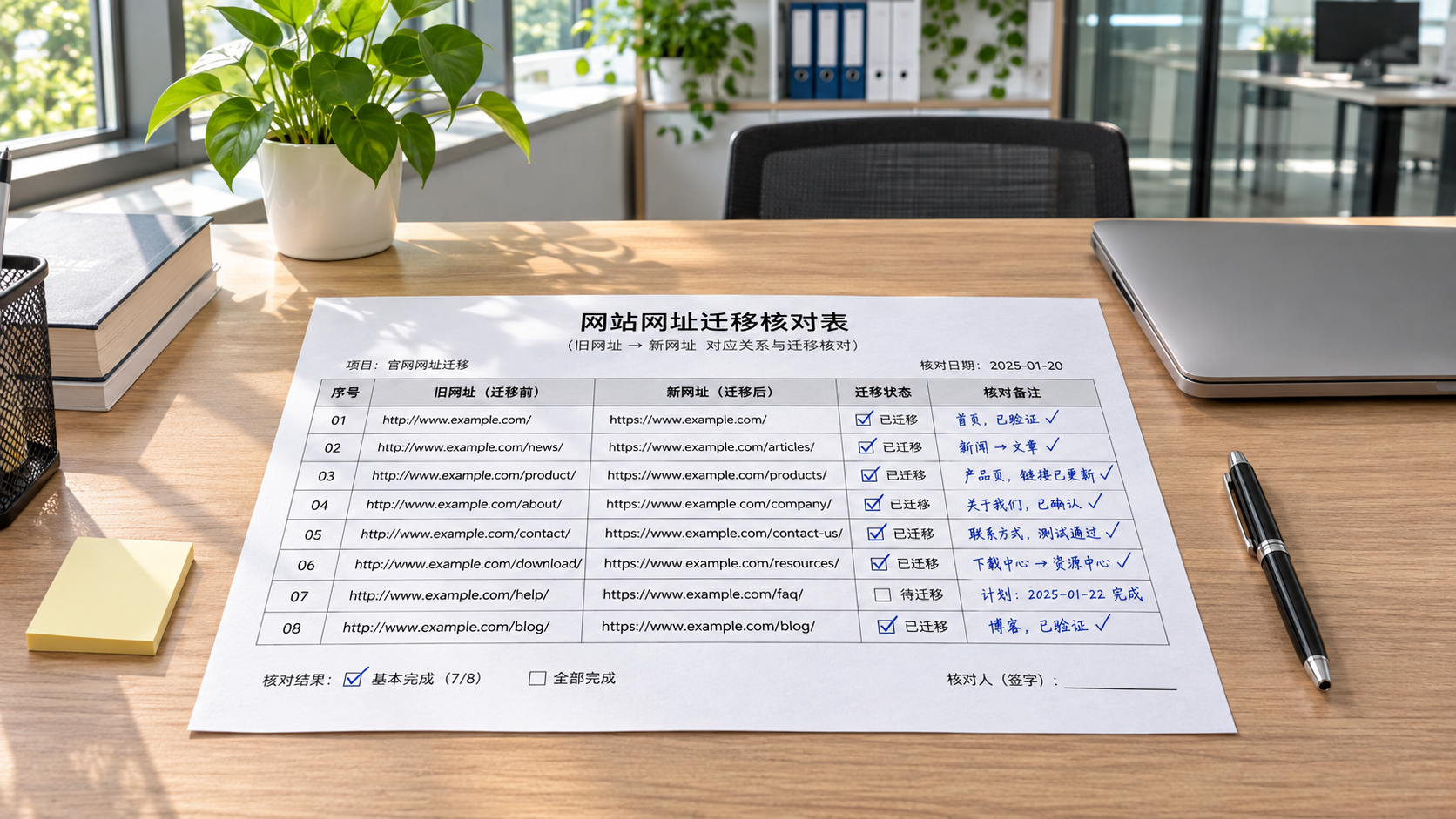
At a minimum, the URL mapping table should include the old URL, new URL, handling method, page language, owner, and verification result. An old product page should ideally map to the new product page with the closest matching topic. Pages that are genuinely merged should point to a page that addresses the original needs, rather than all being redirected to the homepage. Redirecting everything to the homepage can make it difficult for users to find the original content and may be treated by search engines as a soft 404.

Permanent migrations usually use server-side 301 redirects. When testing, do not just check what ultimately opens in the browser; also check the response status code, destination URL, and number of redirects to avoid old URLs passing through multiple intermediate URLs before reaching the new page. Internal links, the sitemap, and canonical URLs on the new site should also point directly to the final URLs to reduce reliance on redirects.
Pages that are no longer available and have no suitable replacement can return a standard 404 or 410, with clear on-site navigation provided. Do not redirect discontinued products to unrelated categories just to eliminate errors. If the domain is changing, also make sure the old domain remains under your control and that redirects stay active long term. When the conditions are met, use the Change of Address tool in Search Console.
Pre-launch checks: being accessible does not mean being indexed
Test environments are often password-protected or set to block indexing to prevent unfinished pages from appearing in search results. When switching to the live site, remove any restrictions that are no longer needed, and check robots.txt as well as indexing directives in pages and response headers to ensure that live pages are not blocked by mistake. Do not rely on robots.txt to hide test pages; access controls are more reliable.
When spot-checking key pages, verify not only the status code but also the title, main content, image alt text, and canonical URL. The canonical URL should point to the corresponding page you want indexed; it should not point all language versions to the homepage or to the same language version. For product information loaded by scripts, check that search engines can access the actual content, rather than just seeing a blank page.
For multilingual sites, also verify the language and region annotations: each version should point to a corresponding page that exists and is accessible, and the pages should confirm their relationship to each other. The other language versions corresponding to an English product page should, where possible, cover the same product topic. If there is no corresponding translation, there is no need to create an incorrect relationship. Use caution with automatic redirects based on visitors’ locations to avoid preventing search engines and international customers from accessing other language versions.
The new XML sitemap should list the final URLs you want indexed, and exclude redirected URLs, unavailable pages, and pages blocked from indexing. Submitting a sitemap helps search engines discover pages but does not guarantee indexation. Before launch, also check mobile display, page loading, inquiry forms, email delivery, and analytics events to avoid a situation where traffic is normal but leads cannot be recorded or received.
After launch, check traffic and inquiries together
On launch day, first spot-check high-value old URLs: do they return the expected status code, lead to the correct new pages, and allow a real form submission to be tested successfully? The advertising and social media teams should also update landing page links, especially for product ads that are currently running. Do not rely solely on redirects, and never send paid traffic to unrelated pages.
Then continue monitoring page indexation, crawling, and search performance in Search Console, and compare them with the pre-redesign baseline. Break down the data by page type, language, country, or region: flat overall traffic does not rule out a loss of organic traffic to a core product catalog. Also check inquiry events in your analytics tools against the emails actually received or records in your customer management system to distinguish a drop in search traffic from a failure in form tracking.
Search performance may fluctuate after migration, but do not assume a fixed recovery period. If important pages continue to decline, check redirects, indexing restrictions, canonical URLs, content changes, and internal links in that order, then assess the changes in search results. For newly discovered broken links, create an issue list that identifies affected pages, the person responsible for fixes, and retest status. This is more useful than repeatedly submitting indexing requests.
Clarify project responsibilities before the redesign
An international trade website redesign involves coordination among the website development, search optimization, advertising, and sales teams. Project managers should confirm in advance who will provide the old URL data, who will create and implement the mapping table, who will verify redirects and multilingual pages, and who will track indexation and inquiries after launch. Backups of the old site, rollback conditions, and domain access permissions should also be included in the delivery plan to avoid discovering only after a failure that recovery is not possible.
These acceptance checks should not be skipped when using an integrated website and marketing service. 易营宝 provides smart website development, multilingual websites, search optimization, and advertising services, making it suitable for coordinating page migration and promotional entry points within the same project. The specific scope of implementation still needs to be determined according to the size of the existing site, system permissions, and target markets. Before signing off on acceptance, it is best to obtain a reviewable URL mapping table, test records, and a post-launch monitoring plan.
Related Articles
 How to Set Up 301 Redirects During a Website Migration?
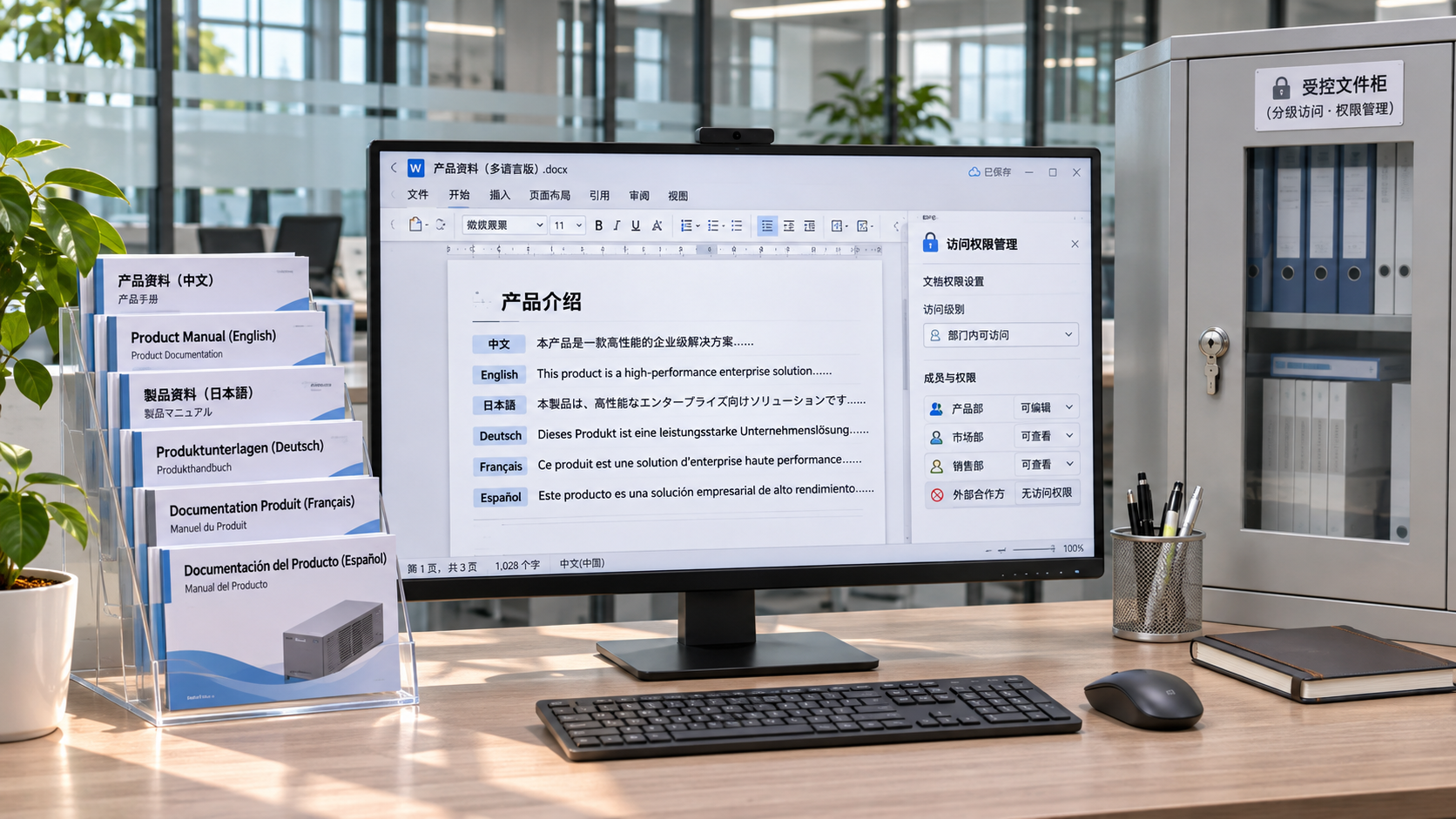
 Is an enterprise multilingual CMS secure? How to assess access control
 How Can You Prevent Traffic Drops During an International Trade Website Redesign? A URL Migration and Indexing Checklist

Related Products
 Yiyingbao SaaS Intelligent Website Building and Marketing SystemYiyingbao SaaS Intelligent Website Building and Marketing System, AI-powered no-code website building, rapid creation of multilingual B2B international websites in 10 minutes, global server acceleration, AI-powered SEO optimization, helping businesses connect efficiently with global markets. The perfect integration of technology and operation makes building an international trade website remarkably simple
 AI+SEM Intelligent Advertising Marketing SystemAI+SEM drives intelligent ad creation, empowering full-funnel precision advertising marketing. The system automatically generates weekly/monthly reports, AI recommends keywords and target countries, monitors core metrics in real-time with intelligent alerts, and enables one-click high-conversion ad solutions to help quickly acquire customers and improve ROI.
 AI+SEO Dual-Engine System Optimization ServicesYiyingbao’s AI+SEO dual-engine optimization system helps foreign trade enterprises acquire high-quality organic traffic through AI-powered keyword research, content generation, and comprehensive technical optimization, significantly improving search rankings and conversion rates.
 AI+SNS Social Media Marketing SystemYingbao AI+SNS Social Media Marketing System - Precision social capture for the social media era. Supports one-click content synchronization across major platforms like Facebook and LinkedIn. AI intelligently rewrites posts for enhanced relevance. 24/7 AI customer service and user profiling analysis empower businesses to efficiently expand into global markets.
 AI+SEO营销解决方案易营宝AI+SEO营销解决方案,通过AI批量写作、智能生成TDK、精准关键词扩词等功能,全面优化网站SEO效果,提升流量与转化率。助力企业构建高效智能网站新生态。
 AI+SEM Advertising Marketing SolutionsAI+SEM Advertising Marketing Solution leverages AI technology to deeply empower SEM ad campaigns. It automatically generates weekly/monthly reports using AI, presenting account data across multiple dimensions for comprehensive insights into campaign performance and trends. The system precisely recommends keywords and target countries, intelligently generates high-conversion ad copy, and enables one-click activation of efficient campaign plans to help businesses rapidly acquire customers. Simultaneously, it monitors core metrics in real time, intelligently identifies abnormal fluctuations, and issues timely alerts to ensure stable, high-return advertising results.
 Domain Name ServicesEasyWin provides professional domain name services, including intelligent queries, one-stop registration, brand protection, and full lifecycle management, helping businesses build a digital brand image.
 EasyOperate B2C Cross-Border E-Commerce Platform & Independent WebsiteEasyStore B2C Cross-border E-commerce Independent Store is an intelligent website building and cross-border e-commerce integrated solution independently developed by EasyStore Information Technology (Beijing) Co., Ltd. The system is specially designed for small and medium-sized as well as large export enterprises, integrating 'website building, operation, marketing, advertising, and conversion' into one, helping enterprises quickly establish cross-border e-commerce independent stores to achieve brand globalization and global sales growth.
The platform supports multiple languages, multiple currencies, and multi-channel marketing, with built-in AI intelligent translation and SEO optimization systems, suitable for mainstream markets such as Southeast Asia, Europe and America, Latin America, and the Middle East, assisting Chinese manufacturing enterprises in efficiently deploying international e-commerce strategies. SSL证书易营宝提供专业SSL安全证书服务,包括单域名和泛域名证书,确保网站数据传输加密、身份验证和完整性保护,助力企业建立安全可信的在线业务环境。









