









- 21st Century Business Herald: AI and CTV Become Core Growth Engines for Digital Marketing in Overseas MarketsNov 18, 2026View details
- China Presents 25 Cooperation Outcomes in Areas Including Cross-Border E-Commerce During APECNov 18, 2026View details
- AI Products Drive Hong Kong Exports Up 64.9% in September, Fastest Growth in Over 40 YearsNov 17, 2026View details
- National Bureau of Statistics: Foreign trade grew rapidly in October, providing stable support for global tradeNov 17, 2026View details
- The U.S. has ended the $800 de minimis exemption for non-postal shipments; express courier packages must be formally declared.Nov 16, 2026View details
- ASEAN Signs Digital Economy Framework Agreement, Moving Toward Harmonized Cross-Border E-Commerce RulesNov 15, 2026View details
How Should You Allocate Your Overseas Brand Video Marketing Budget? From Production Costs to Campaign Returns
The budget for overseas brand video marketing should not be determined first by the quote for a single brand film. Instead, work backward from the business objective: does the company want to build awareness, drive website visits, generate inquiries, or close sales directly? If production consumes the entire budget, even a high-quality video may lack sufficient resources for promotion and testing. Conversely, buying traffic without investing in content and landing pages makes it difficult to determine whether the spend is effective.
There is no fixed budget allocation that works for every company. A more reliable approach is to calculate the full costs of production, promotion, channel adaptation, and performance measurement, then adjust spending based on the sales cycle and measurable results.
Define the video’s purpose before deciding on production specifications
A video designed to build brand awareness needs to help the target market understand who the company is and what problem its product solves. A video designed to generate inquiries should focus more on demonstrating use cases and key capabilities, while providing a clear next step. These objectives call for different production specifications and should not be evaluated using the same metrics.
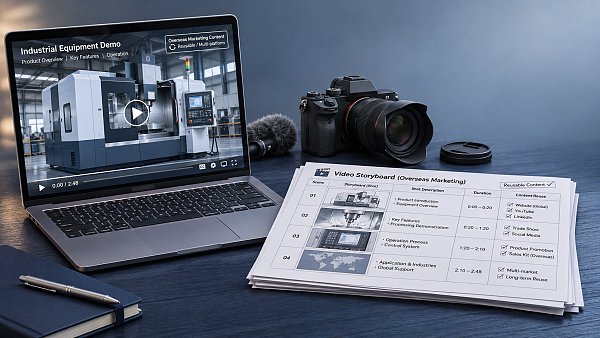
For example, an industrial equipment company preparing to enter a new market could use footage of its factory and equipment demonstrations to build credibility, then edit the footage into short videos tailored to different use cases and direct potential customers to product pages. When purchasing decisions involve several roles, one high-spec brand film may not explain every technical and commercial consideration as effectively as a series of clearly focused videos that can be reused.
When the budget is limited, prioritize accurate information, clear visuals and sound, natural communication in the target language, and consistency between the video and landing page. Whether aerial footage, complex animation, or on-location filming overseas adds value depends on whether it directly helps customers understand and trust the offering—not simply on how impressive it looks.
What costs should you budget for beyond the production quote?
Video production costs involve more than filming and editing. When comparing vendor quotes, calculate one-time deliverables and ongoing usage costs together:
- Planning and production: Scriptwriting, filming crew, location, equipment, post-production editing, animation, voice-over, and subtitles. Confirm the number of filming days, finished videos, and revision rounds included in the quote.
- Adaptation for overseas markets: Translation, review by native speakers, localization for different regions, and edits in landscape and portrait formats and at different lengths. Translating subtitles directly may not accurately convey product applications or industry terminology.
- Asset licensing: Music, fonts, images, actor likenesses, and third-party footage. Clarify the authorized territories, term, channels, and whether paid promotion is permitted. If the license is too limited, expanding campaigns or using assets in additional markets may incur extra costs.
- Promotion and conversion support: Ad platform spend, account management, creative testing, landing page updates, and data tracking. Completing video production does not mean the customer acquisition process is ready.
The contract should also specify whether source files will be delivered, whether the company can edit the video further in-house, and how out-of-scope revisions will be charged. A lower initial quote may not mean a lower total cost if it excludes multilingual versions or advertising usage rights.
Start with a pilot plan to determine budget allocation
Suppose a company sets aside RMB 100,000 to test a single overseas market, with the goal of determining whether video can generate qualified inquiries—not maximizing brand exposure. The following allocation could serve as a starting point for internal budgeting: RMB 30,000 for production and basic adaptation, RMB 45,000 for media spend, RMB 10,000 for landing pages and data tracking, and RMB 15,000 reserved for additional edits, audience adjustments, or extra effective creative. This is an example only, not a market rate or universal standard.
This allocation assumes that the company already has usable product materials, its sales team can follow up promptly, and its website has basic inquiry functionality. If the project also requires international filming or complex 3D demonstrations, the production share will increase. If reusable footage and mature landing pages are already available, more budget can go toward media testing. Conversely, if the website cannot reliably receive inquiries, fix the conversion process before increasing ad spend.
The media budget should not be divided equally across every market and platform in a single round. Languages, purchasing habits, and competitive conditions vary by region. Spreading the budget too thinly means each creative receives too little data to determine whether the issue lies with the video, audience, or landing page. A pilot should control variables—for example, compare different openings or selling points in the same market before deciding whether to expand to other channels.
Move from viewing data to measurable business returns
Video views and completion rates can help determine whether content is engaging, but they are not the same as sales revenue. To evaluate a campaign, connect video exposure, website visits, form submissions, and sales follow-up as much as possible, and use metrics that reflect each stage.
If the goal is to generate inquiries, start by calculating cost per lead = advertising and related marketing expenses ÷ number of leads generated. The sales team should then assess whether leads come from target regions, have clear needs, and provide valid contact details. A low cost per lead does not necessarily mean a low customer acquisition cost: large numbers of invalid inquiries increase follow-up workload and can obscure the true return on investment.
Suppose the related marketing expenses for a test campaign are RMB 100,000 and it generates 100 leads, of which the sales team confirms that 20 meet the target customer criteria. The cost per lead is RMB 1,000, and the cost per qualified lead is RMB 5,000. This is only a calculation example. Define the criteria for a qualified lead before the campaign begins and apply them consistently across channels.
When the sales cycle is long, the absence of a sale during the current period does not necessarily mean the video was ineffective. Companies can continue tracking qualified inquiries, opportunities, and subsequent sales, but should not attribute all revenue from orders involving video exposure to the video. Customers may also make their decisions through search, trade shows, or sales visits. Keep attribution consistent and document the tracking window and any data gaps.
Website tracking is affected by user consent, browser restrictions, and cross-device behavior, so platform reports may not match the actual number of inquiries exactly. Budget decisions should therefore combine ad platform records, website forms, and customer management records, rather than relying on a single platform’s report.
When should you adjust the budget, and when should you stop spending more?
If views are strong but clicks and inquiries are low, check whether the video is attracting people outside the target audience and whether the call to action matches the landing page. If there are many clicks but few qualified inquiries, review the ad’s claims, product page information, form setup, and sales qualification criteria. Simply increasing spend at this point may only amplify low-quality traffic.
If the cost per qualified lead is within the company’s acceptable range and the sales team can follow up, gradually increase the budget for better-performing creative and audiences while monitoring whether costs rise as spending scales. If controlled adjustments to the creative still fail to generate enough qualified leads, reassess the market, product positioning, or channel rather than continuing to invest on the grounds that “the video needs more exposure.”
What is worth purchasing is not just a finished video, but a reusable, testable content asset that can be linked to business results. By defining deliverables, media resources, and measurement criteria together during budget approval, companies can avoid discovering after production is complete that they lack the funds to validate the video’s commercial value.
Related Articles
 How can you tell whether an SEO agency’s results are credible?
 What factors affect the cost of building an independent website in Beijing?
 Is Internet Marketing Consulting Charged by Project or by Month?


Related Products
 Yiyingbao SaaS Intelligent Website Building and Marketing SystemYiyingbao SaaS Intelligent Website Building and Marketing System, AI-powered no-code website building, rapid creation of multilingual B2B international websites in 10 minutes, global server acceleration, AI-powered SEO optimization, helping businesses connect efficiently with global markets. The perfect integration of technology and operation makes building an international trade website remarkably simple
 AI+SEM Intelligent Advertising Marketing SystemAI+SEM drives intelligent ad creation, empowering full-funnel precision advertising marketing. The system automatically generates weekly/monthly reports, AI recommends keywords and target countries, monitors core metrics in real-time with intelligent alerts, and enables one-click high-conversion ad solutions to help quickly acquire customers and improve ROI.
 AI+SEO Dual-Engine System Optimization ServicesYiyingbao’s AI+SEO dual-engine optimization system helps foreign trade enterprises acquire high-quality organic traffic through AI-powered keyword research, content generation, and comprehensive technical optimization, significantly improving search rankings and conversion rates.
 AI+SNS Social Media Marketing SystemYingbao AI+SNS Social Media Marketing System - Precision social capture for the social media era. Supports one-click content synchronization across major platforms like Facebook and LinkedIn. AI intelligently rewrites posts for enhanced relevance. 24/7 AI customer service and user profiling analysis empower businesses to efficiently expand into global markets.
 AI+SEO营销解决方案易营宝AI+SEO营销解决方案,通过AI批量写作、智能生成TDK、精准关键词扩词等功能,全面优化网站SEO效果,提升流量与转化率。助力企业构建高效智能网站新生态。
 AI+SEM Advertising Marketing SolutionsAI+SEM Advertising Marketing Solution leverages AI technology to deeply empower SEM ad campaigns. It automatically generates weekly/monthly reports using AI, presenting account data across multiple dimensions for comprehensive insights into campaign performance and trends. The system precisely recommends keywords and target countries, intelligently generates high-conversion ad copy, and enables one-click activation of efficient campaign plans to help businesses rapidly acquire customers. Simultaneously, it monitors core metrics in real time, intelligently identifies abnormal fluctuations, and issues timely alerts to ensure stable, high-return advertising results.
 Domain Name ServicesEasyWin provides professional domain name services, including intelligent queries, one-stop registration, brand protection, and full lifecycle management, helping businesses build a digital brand image.
 EasyOperate B2C Cross-Border E-Commerce Platform & Independent WebsiteEasyStore B2C Cross-border E-commerce Independent Store is an intelligent website building and cross-border e-commerce integrated solution independently developed by EasyStore Information Technology (Beijing) Co., Ltd. The system is specially designed for small and medium-sized as well as large export enterprises, integrating 'website building, operation, marketing, advertising, and conversion' into one, helping enterprises quickly establish cross-border e-commerce independent stores to achieve brand globalization and global sales growth.
The platform supports multiple languages, multiple currencies, and multi-channel marketing, with built-in AI intelligent translation and SEO optimization systems, suitable for mainstream markets such as Southeast Asia, Europe and America, Latin America, and the Middle East, assisting Chinese manufacturing enterprises in efficiently deploying international e-commerce strategies. SSL证书易营宝提供专业SSL安全证书服务,包括单域名和泛域名证书,确保网站数据传输加密、身份验证和完整性保护,助力企业建立安全可信的在线业务环境。









