









- AI Products Drive Hong Kong Exports Up 64.9% in September, Fastest Growth in Over 40 YearsNov 17, 2026View details
- National Bureau of Statistics: Foreign trade grew rapidly in October, providing stable support for global tradeNov 17, 2026View details
- The U.S. has ended the $800 de minimis exemption for non-postal shipments; express courier packages must be formally declared.Nov 16, 2026View details
- ASEAN Signs Digital Economy Framework Agreement, Moving Toward Harmonized Cross-Border E-Commerce RulesNov 15, 2026View details
- Shenzhen Becomes the First City in Mainland China to Exceed RMB 5 Trillion in Foreign TradeNov 15, 2026View details
- Fujian Announces the First Batch of Provincial-Level Cross-Border E-Commerce Industrial Parks and Key Brands for CultivationNov 14, 2026View details
Low Inquiry Form Submission Rates on Your Export Website? Troubleshoot Everything from Form Fields to the Mobile Experience
If your B2B website gets traffic but few inquiries, don’t rush to remove fields or rebuild the page. A low submission rate can be caused by issues at different stages: visitors may not see the form, may be unwilling to fill it out after opening it, or may encounter an error after clicking Submit. First identify where the problem occurs to avoid changing the page without improving results.
When assessing the issue, also consider traffic sources and the purpose of the page. Buyers searching for product specifications, visitors arriving on a landing page from an ad, and users who are only looking for information may have different levels of intent to inquire. Looking at all these visits together can lead you to mistake a traffic quality issue for a form issue.
First, find out: At what step do visitors drop off?
Before making changes, check the number of visits to the page containing the form, how many visitors saw or began filling out the form, the number of submission attempts, and the number of valid inquiries actually received in your backend. If your website has analytics tools, review the data by device, channel, and page. If you don’t have complete data, at least test the process on both desktop and mobile first, then add any necessary event tracking.
- Many page visits, but few visitors see the form: Check whether the form’s placement, button copy, and page content guide visitors with relevant needs to the inquiry form.
- Visitors open the form but few start filling it out: Check the number of fields, which ones are required, and whether visitors understand what they will get after submitting.
- Visitors start filling it out but leave partway through: Check for questions that are difficult to answer, format restrictions, failed validation, or obstacles to using the form on mobile.
- The backend receives no inquiry after visitors click Submit: First check the interface, notification emails, spam filters, and lead records in the backend. Don’t rely only on the message shown on the page to determine whether a submission succeeded.
When comparing submission rates, use a consistent denominator: calculating by page visits and by form views reflects different issues. Also check whether your analytics tool is missing repeat clicks, errors, or mobile events. When traffic is low, a few inquiries can cause the rate to change significantly, so use data over a longer period and actual testing to assess the results.
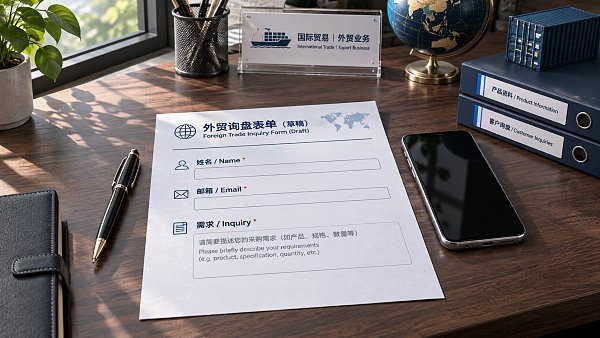
How can you reduce the number of fields without losing information sales needs?
Fewer fields are not always better. B2B inquiries for international trade often need to include the product, purchasing requirements, or target market so sales can respond effectively. But asking visitors to provide every purchasing detail on their first contact can increase the chance that they abandon the form. A practical question to ask is: Would not having this information affect the initial response? If not, you can make the field optional or ask for the information in a follow-up conversation.
For example, a standard product inquiry can initially collect a name, email address, and description of the requirements, with optional fields for the product model, quantity, or destination. An inquiry about custom equipment may need specifications or the intended application to help assess the requirements. In that case, explain the purpose beside the field and let users provide an approximate description if they are unsure.
Be especially cautious about asking for information that is sensitive or not readily available. A phone number, detailed address, purchasing budget, and company size may not all be suitable as required fields. If your business genuinely needs to speak with buyers by phone, explain why and give buyers who prefer email the option to be contacted that way. Also consider alternatives for file uploads: if visitors don’t have drawings available, can they describe their requirements in text first?
Field labels and prompts also affect form completion. Use language that the target market understands and avoid internal sales terminology. State format requirements near the input field, such as the accepted phone number format. Validation should help users complete the form, not make them guess repeatedly: if submission fails, identify the specific field and reason, and retain the information they have already entered.
Help visitors understand why they need to fill out the form and what happens next
Insufficient product information before the form can also reduce the likelihood of submission. Buyers usually need to determine whether a product meets their basic requirements before deciding whether to get in touch. For equipment or industrial products, first check whether the specification range, application conditions, images, and available documentation are clear enough. For custom services, explaining what requirements can be discussed is more helpful than simply displaying a “Contact Us” button.
Button copy should match visitors’ expectations. For example, if the button leads to a quote request, use wording that clearly indicates the intent to request a quote. If sales need to confirm specifications before providing a quote, you can explain this near the form. Don’t give users the impression that they will receive a price immediately after submitting if all they will get is a generic notification that you will contact them.
Place a privacy notice close to the form, explain that contact details will be used to respond to inquiries, and provide a link to the privacy policy. If your website serves different markets, handle personal information and marketing subscriptions according to your actual business practices and applicable requirements, and avoid combining inquiry submissions with marketing consent. After a successful submission, give users clear feedback. If you promise a response time, make sure it matches your team’s actual capacity.
Test the complete process on a mobile device
Checking the mobile experience means more than seeing whether the form fits on the screen. Use a phone to navigate from a product page to the form, scroll to it, fill in each field, trigger an error, and submit again. This is the best way to see the obstacles users encounter. In particular, check the following details:
- Is the inquiry form easy to find? Do floating buttons cover the main content, input fields, or Submit button?
- Are the input fields and buttons easy to tap? After the keyboard appears, are the current field and error messages still visible?
- Do fields such as email and phone number bring up the appropriate keyboard? Is it easy to select a country or region?
- Do CAPTCHA, file uploads, and dropdown menus work properly? Does the Submit button provide clear feedback when the network is slow?
- After an error, does the page go to the relevant field? After users make a correction, is the other information they entered retained?
When testing, use commonly used mobile browsers and cover the main language versions of the page. On multilingual websites, prompts may not be translated, button text may be too long, or error messages may still appear in the original language. These details all make the page harder to understand.
After making changes, don’t focus only on the number of submissions
Fix issues such as failed submissions, mobile layout problems, and missing notifications first, then address fields and copy. For each round of changes, focus on one main adjustment if possible—for example, changing the phone number field from required to optional—and observe the form completion rate on the same page and with similar traffic sources. Avoid changing too many things at once, which makes it difficult to identify the cause of any change.
If the number of submissions increases, also check whether the number of valid inquiries has increased accordingly: whether the email address is reachable, whether the inquiry is relevant to the product, and whether sales has enough information. If more submissions come in but many lack essential specifications, adjust the field prompts or add optional fields. If valid inquiries decrease, review whether you have relaxed conditions that are essential to the business. Make the form easier to complete while ensuring every submission enters a process that can be followed up.
Related Articles
 Low Inquiry Form Submission Rates on Your Export Website? Troubleshoot Everything from Form Fields to the Mobile Experience
 Getting Traffic but No Inquiries on Your B2B Website? Check Every Step from Product Pages to Forms
 Are AI SEO Ranking Guarantees Reliable? Understand the Terms Before Signing


Related Products
 Yiyingbao SaaS Intelligent Website Building and Marketing SystemYiyingbao SaaS Intelligent Website Building and Marketing System, AI-powered no-code website building, rapid creation of multilingual B2B international websites in 10 minutes, global server acceleration, AI-powered SEO optimization, helping businesses connect efficiently with global markets. The perfect integration of technology and operation makes building an international trade website remarkably simple
 AI+SEM Intelligent Advertising Marketing SystemAI+SEM drives intelligent ad creation, empowering full-funnel precision advertising marketing. The system automatically generates weekly/monthly reports, AI recommends keywords and target countries, monitors core metrics in real-time with intelligent alerts, and enables one-click high-conversion ad solutions to help quickly acquire customers and improve ROI.
 AI+SEO Dual-Engine System Optimization ServicesYiyingbao’s AI+SEO dual-engine optimization system helps foreign trade enterprises acquire high-quality organic traffic through AI-powered keyword research, content generation, and comprehensive technical optimization, significantly improving search rankings and conversion rates.
 AI+SNS Social Media Marketing SystemYingbao AI+SNS Social Media Marketing System - Precision social capture for the social media era. Supports one-click content synchronization across major platforms like Facebook and LinkedIn. AI intelligently rewrites posts for enhanced relevance. 24/7 AI customer service and user profiling analysis empower businesses to efficiently expand into global markets.
 AI+SEO营销解决方案易营宝AI+SEO营销解决方案,通过AI批量写作、智能生成TDK、精准关键词扩词等功能,全面优化网站SEO效果,提升流量与转化率。助力企业构建高效智能网站新生态。
 AI+SEM Advertising Marketing SolutionsAI+SEM Advertising Marketing Solution leverages AI technology to deeply empower SEM ad campaigns. It automatically generates weekly/monthly reports using AI, presenting account data across multiple dimensions for comprehensive insights into campaign performance and trends. The system precisely recommends keywords and target countries, intelligently generates high-conversion ad copy, and enables one-click activation of efficient campaign plans to help businesses rapidly acquire customers. Simultaneously, it monitors core metrics in real time, intelligently identifies abnormal fluctuations, and issues timely alerts to ensure stable, high-return advertising results.
 Domain Name ServicesEasyWin provides professional domain name services, including intelligent queries, one-stop registration, brand protection, and full lifecycle management, helping businesses build a digital brand image.
 EasyOperate B2C Cross-Border E-Commerce Platform & Independent WebsiteEasyStore B2C Cross-border E-commerce Independent Store is an intelligent website building and cross-border e-commerce integrated solution independently developed by EasyStore Information Technology (Beijing) Co., Ltd. The system is specially designed for small and medium-sized as well as large export enterprises, integrating 'website building, operation, marketing, advertising, and conversion' into one, helping enterprises quickly establish cross-border e-commerce independent stores to achieve brand globalization and global sales growth.
The platform supports multiple languages, multiple currencies, and multi-channel marketing, with built-in AI intelligent translation and SEO optimization systems, suitable for mainstream markets such as Southeast Asia, Europe and America, Latin America, and the Middle East, assisting Chinese manufacturing enterprises in efficiently deploying international e-commerce strategies. SSL证书易营宝提供专业SSL安全证书服务,包括单域名和泛域名证书,确保网站数据传输加密、身份验证和完整性保护,助力企业建立安全可信的在线业务环境。









