









- Which customer acquisition channels will be affected by cross-border marketing trends in 2026?Sep 06, 2026View details
- Which homogenization risks should be considered in an analysis of the AI-powered website building industry?Aug 30, 2026View details
- How Will AI Marketing Trends 2026 Change Advertising Budget AllocationAug 28, 2026View details
- Is the EV SSL certificate market shrinking or upgrading? How should companies assess certificate procurement?Aug 11, 2026View details
- Why the old AMP SEO 2020 practices no longer work and what has changed in current optimization prioritiesAug 02, 2026View details
- How to Choose Topics for an Industry News Section to Attract More Organic Search TrafficJul 29, 2026View details
How to Choose an Official Website System for Small and Medium-Sized Foreign Trade Enterprises
How Should Small and Medium-Sized Foreign Trade Companies Choose an Official Website System? Do Not Focus Only on Website Development Costs—Consider Whether It Can Sustain Customer Acquisition
Faced with rising customer acquisition costs and competition in overseas markets, many business owners ask: which foreign trade company website system is more suitable for small and medium-sized enterprises? The real challenge is not simply “building a website,” but whether, after launch, the website can be understood by overseas customers, indexed by search engines, receive advertising traffic, and enable sales staff to obtain more effective inquiries.
When building an English website for the first time, many companies are accustomed to choosing templates, domain names, and service providers based on the approach used for domestic corporate websites: the pages look impressive and include plenty of product images, but after six months there is almost no organic traffic, visits disappear as soon as advertising stops, and forms contain a large number of spam inquiries. The problem is usually not whether they have a website, but that the official website system was not built for overseas marketing scenarios from the outset.
For small and medium-sized enterprises with relatively limited budgets and teams, the choice of system should not focus on the number of features. Instead, priority should be given to whether it can support ongoing business adjustments. A foreign trade website is not a one-time deliverable; it is more like customer acquisition infrastructure that requires continuous content additions, page testing, and channel integration.
First, Clarify: Do You Need a Brand Showcase Website or a Sales and Lead Generation Website?
If a company primarily relies on existing customers, trade shows, and offline visits, its website serves as an endorsement. The focus will be on factory capabilities, certifications, production processes, core products, and contact information. Such websites can be relatively simple, but they cannot be rough, especially as the mobile experience, page loading speed, and basic English wording often directly affect a customer's initial assessment of a supplier.
If a company hopes to continuously acquire new customers through Google search, advertising, and social media content, the system must be selected according to the requirements of a marketing website. Product pages cannot consist only of product names and specification tables; they must also support content covering application scenarios, materials and processes, customization capabilities, procurement questions, delivery-time communication, and more. Landing pages should be configurable separately for different countries, product lines, and advertising campaigns.
The selection logic also differs between generating B2B inquiries and conducting B2C cross-border retail. The former places greater emphasis on product categories, inquiry forms, sample requests, file downloads, and lead assignment; the latter requires consideration of product specifications, inventory, shipping costs, payments, orders, and after-sales processes. Forcing these two types of requirements into the same page structure often results in customers being unable to find the key information and internal staff finding the site difficult to maintain.
When Small and Medium-Sized Enterprises Choose an Official Website System, Focus on These Five “Ongoing Costs”
A low website development quotation does not mean low long-term costs. What truly tends to slow down a project is that, after launch, every product page revision, additional language, or advertising landing page requires waiting for technical staff, or even being charged again on a per-page basis. The products, markets, and promotional strategies of small and medium-sized enterprises change more quickly, so whether the backend is easy to use directly determines whether the website will be updated over the long term.
It is also important to clarify the system's support for search optimization. A page being accessible does not mean it is suitable for SEO. At a minimum, it should allow convenient management of page titles, descriptions, product URLs, image descriptions, sitemaps, redirect rules, and content hierarchy. For factories with numerous product models and complex categories, standardized category and internal-link structures are more useful than stuffing many keywords onto the homepage.
Multilingual Does Not Mean a “Translation Button”: Page Priorities Vary by Market
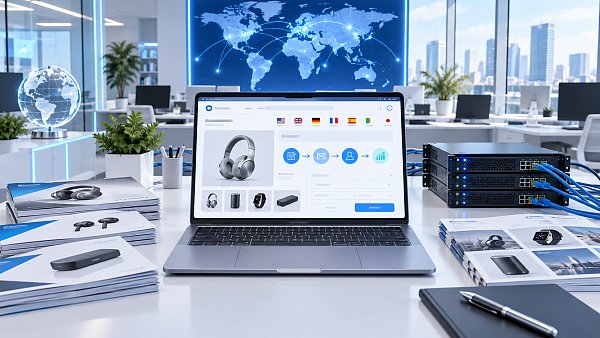
When planning a multilingual website, many companies first ask how many languages it can support. A more important question is whether each language has market-specific messaging. North American customers may pay more attention to application results, delivery responsiveness, and service commitments; European customers may examine materials, compliance information, or technical documentation more carefully in certain categories; and browsing habits and commonly used communication methods may also differ in the Middle East, Latin America, and Russian-speaking markets.
Therefore, there is no need to launch more than a dozen languages at once in the initial stage. For small and medium-sized foreign trade enterprises, a more prudent approach is usually to first identify core export markets and establish a solid English main website and key product pages; when a particular region already has stable inquiries, distributor deployment, or an advertising budget, the corresponding language version can then be expanded. The more languages there are, the greater the subsequent workload for content proofreading, page updates, and search maintenance.
There is also a frequently overlooked detail here: form fields should not be copied directly from Chinese corporate websites. Overseas procurement personnel are usually unwilling to complete overly long forms, and information genuinely needed by the business can be supplemented through follow-up emails or instant communication. The shorter the initial conversion path, the easier it is to reduce ineffective drop-offs; however, leaving only “name and email” makes it difficult for sales teams to qualify leads. Field selection should be based on average order value, product complexity, and sales cycle.
Do Not Treat SEO, Advertising, and the Official Website as Three Unrelated Matters
A common coordination gap among foreign trade companies is this: the website development team is responsible only for launch, the SEO team takes over and finds that the page structure is unsuitable for optimization, and the advertising team creates another batch of temporary landing pages. Page styles, product information, and inquiry entry points all differ, leaving customers with an inconsistent impression of the company after clicking through from an advertisement.
A more suitable official website system should enable a basic closed loop among the website, search optimization, advertising, and social media traffic generation. For example, high-converting search terms generated by advertising can inform product pages and content topics; technical articles accumulated through SEO can be used for social media distribution; and inquiry sources should be recorded to help the business determine which countries, categories, and pages are worth continued investment. Without a data closed loop, promotional decisions can easily be reduced to simply feeling that “the results are average.”
Yiyingbao Information Technology (Beijing) Co., Ltd. has long served foreign trade and overseas expansion scenarios. Its approach is not merely to provide a page editing tool, but to consider intelligent website building, multilingual websites, SEO, advertising, and overseas social media within the same business chain. Its proprietary cloud intelligent website-building system, cross-border e-commerce system, and AI marketing and AI+SEO/GEO optimization capabilities are suitable for evaluation by enterprises that need to gradually develop overseas digital marketing. For factories or trading companies without dedicated technical teams, the value of this integrated model lies in reducing communication losses among multiple suppliers; however, companies should still confirm content ownership, service scope, response mechanisms, and subsequent expansion costs before signing a contract.
Before Selection, Conduct a “Stress Test” Using Your Own Business
Rather than only reviewing demo websites, prepare several real tasks and ask the service provider to explain them on the spot: how long it takes to add a product with multiple specifications; how to create an independent landing page for the U.S. market; whether modifying English content will affect other language versions; whether form inquiries can be labeled by source; and how URL changes will be handled if the old website already has existing pages. A system that can clearly explain these issues is usually more valuable as a reference than a showcase of “many templates and attractive designs.”
There is no standard answer independent of business needs as to which foreign trade company website system is more suitable for small and medium-sized enterprises. Companies with a limited product range and inquiries as their core objective should prioritize content management, product presentation, and promotion tracking; brands with many SKUs that sell directly to consumers should assess e-commerce and order capabilities earlier; and companies planning to pursue long-term Google organic traffic should especially not accept a website that cannot be continuously updated or structurally adjusted.
When choosing a system, the most important risk to watch out for is making a decision solely to “rush the launch.” The real value of an official website often becomes gradually evident only three or six months after launch: whether content is still being updated, whether advertising can identify effective pages, and whether sales can distinguish inquiry sources. Only by considering these follow-up activities can a company select a foreign trade website system that will not quickly become a burden.
Related Articles


Related Products
 Yiyingbao SaaS Intelligent Website Building and Marketing SystemYiyingbao SaaS Intelligent Website Building and Marketing System, AI-powered no-code website building, rapid creation of multilingual B2B international websites in 10 minutes, global server acceleration, AI-powered SEO optimization, helping businesses connect efficiently with global markets. The perfect integration of technology and operation makes building an international trade website remarkably simple
 AI+SEM Intelligent Advertising Marketing SystemAI+SEM drives intelligent ad creation, empowering full-funnel precision advertising marketing. The system automatically generates weekly/monthly reports, AI recommends keywords and target countries, monitors core metrics in real-time with intelligent alerts, and enables one-click high-conversion ad solutions to help quickly acquire customers and improve ROI.
 AI+SEO Dual-Engine System Optimization ServicesYiyingbao’s AI+SEO dual-engine optimization system helps foreign trade enterprises acquire high-quality organic traffic through AI-powered keyword research, content generation, and comprehensive technical optimization, significantly improving search rankings and conversion rates.
 AI+SNS Social Media Marketing SystemYingbao AI+SNS Social Media Marketing System - Precision social capture for the social media era. Supports one-click content synchronization across major platforms like Facebook and LinkedIn. AI intelligently rewrites posts for enhanced relevance. 24/7 AI customer service and user profiling analysis empower businesses to efficiently expand into global markets.
 AI+SEO营销解决方案易营宝AI+SEO营销解决方案,通过AI批量写作、智能生成TDK、精准关键词扩词等功能,全面优化网站SEO效果,提升流量与转化率。助力企业构建高效智能网站新生态。
 AI+SEM Advertising Marketing SolutionsAI+SEM Advertising Marketing Solution leverages AI technology to deeply empower SEM ad campaigns. It automatically generates weekly/monthly reports using AI, presenting account data across multiple dimensions for comprehensive insights into campaign performance and trends. The system precisely recommends keywords and target countries, intelligently generates high-conversion ad copy, and enables one-click activation of efficient campaign plans to help businesses rapidly acquire customers. Simultaneously, it monitors core metrics in real time, intelligently identifies abnormal fluctuations, and issues timely alerts to ensure stable, high-return advertising results.
 Domain Name ServicesEasyWin provides professional domain name services, including intelligent queries, one-stop registration, brand protection, and full lifecycle management, helping businesses build a digital brand image.
 EasyOperate B2C Cross-Border E-Commerce Platform & Independent WebsiteEasyStore B2C Cross-border E-commerce Independent Store is an intelligent website building and cross-border e-commerce integrated solution independently developed by EasyStore Information Technology (Beijing) Co., Ltd. The system is specially designed for small and medium-sized as well as large export enterprises, integrating 'website building, operation, marketing, advertising, and conversion' into one, helping enterprises quickly establish cross-border e-commerce independent stores to achieve brand globalization and global sales growth.
The platform supports multiple languages, multiple currencies, and multi-channel marketing, with built-in AI intelligent translation and SEO optimization systems, suitable for mainstream markets such as Southeast Asia, Europe and America, Latin America, and the Middle East, assisting Chinese manufacturing enterprises in efficiently deploying international e-commerce strategies. SSL证书易营宝提供专业SSL安全证书服务,包括单域名和泛域名证书,确保网站数据传输加密、身份验证和完整性保护,助力企业建立安全可信的在线业务环境。









