









- Can the average annual growth rate reflect real opportunities in overseas markets?Oct 07, 2026View details
- Which customer acquisition channels will be affected by cross-border marketing trends in 2026?Sep 06, 2026View details
- Which homogenization risks should be considered in an analysis of the AI-powered website building industry?Aug 30, 2026View details
- How Will AI Marketing Trends 2026 Change Advertising Budget AllocationAug 28, 2026View details
- Is the EV SSL certificate market shrinking or upgrading? How should companies assess certificate procurement?Aug 11, 2026View details
- Why the old AMP SEO 2020 practices no longer work and what has changed in current optimization prioritiesAug 02, 2026View details
What accounts for differences in website translation and localization service pricing
The difference in website translation and localization service quotes lies not in the unit price itself, but in the delivery scope. Many quotes may seem to just "translate into another language," but the actual differences often stem from details like terminology consistency, page structure adaptation, image text processing, form field validation, currency and unit conversion, SEO tag rewriting, and post-launch maintenance frequency. On the surface, the cost per thousand words may be similar, but what truly drives the cost difference is whether the translation goes from "readable" to "usable, searchable, and convertible."
For the same website translation and localization service, a basic package typically only handles the main body text, translating paragraph by paragraph while preserving the original layout and images. This approach is suitable for pages with simple content and infrequent updates. However, when encountering product parameters, specifications, downloadable materials, or form instructions, issues like inconsistent units, ambiguous field meanings, or awkward button copy can arise. Another, higher-priced package usually includes page navigation, CTAs, footer legal notices, inquiry forms, FAQs, and chart descriptions within its scope, and also synchronizes title hierarchy and URL rules. The price difference lies in these "non-translation-text" parts.
The most commonly overlooked aspect during procurement is industry adaptation. Machinery, chemicals, medical, software, and cross-border retail each have different requirements for terminology and expression. For example, the same word "specification" might be closer to a parameter table on some pages, while on others it needs to be written as an application scope; "sample" might correspond to a trial, test run, or trial assembly in different businesses. If priced based on general translation, subsequent rework often costs more than the initial savings. Titles like Research on Comprehensive Budget Management in Administrative and Public Institutions, if mechanically translated, often lose their content attributes, making them less conducive to search and categorization when placed in a directory page. This is the practical difference between localization and ordinary translation.
SEO-related aspects also significantly impact the quote. If a website translation and localization service only changes the language without adjusting the keyword layout, the page may be readable but may not be correctly understood by search engines. Common treatments include rewriting title tags, controlling description length, retaining or replacing core keywords, checking H-tag hierarchy, handling multilingual URLs, setting hreflang, and avoiding duplicate content. The workload and risk here are higher than a simple "translate once" approach, especially when the original site has a chaotic structure and many page templates. The cost of manual review and technical coordination must be factored in.
Another cost comes from asset processing. Many websites are not purely text-based; English text on images, product parameter diagrams, flowcharts, video subtitles, downloadable PDFs, and pop-up prompts may all need to be changed. If only the body text is translated, the live page may have a mix of Chinese and English, inconsistent units, and conflicting button meanings. For websites with many image-text modules, quotes are usually tiered by page type: detail pages, category pages, landing pages, help centers, form pages, and download pages. The depth of processing varies, and so does the price.
The maintenance method also changes the total cost. One-time translation is suitable for static content, but once a website enters a continuous update phase, pricing shifts to monthly maintenance, batch updates, or hourly billing. A common misjudgment here is comparing only the initial production cost without factoring in subsequent new pages, product launches, temporary event page modifications, and terminology database maintenance. In reality, a stable localization project requires establishing a terminology list, style guide, and review process upfront to avoid repeatedly fixing the same type of errors later.
If you consider website translation and localization services together with integrated website + marketing services, the pricing logic adds another layer. The former is more focused on content delivery, while the latter handles website content, search visibility, ad landing pages, and social media promotional materials within the same context. This means the copy needs to be not just "correct," but also consider page flow and conversion paths. Titles, hero sections, buttons, form prompts, and trust signals must all be unified. The cost comes not just from word count, but from the coordination workload across pages and channels.
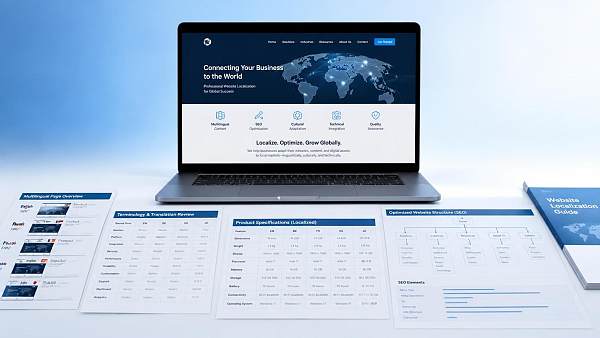
To determine if a quote is reasonable, you can directly ask a few specific questions: Which page types are included in the translation scope? Does it include images and PDFs? Does it handle SEO tags? Is a terminology list provided? How are revision rounds calculated? How are subsequent new additions charged? As long as these boundaries are clear, the price differences are easy to understand. Conversely, if a quote only gives a total price without specifying the deliverables, it's easy to end up with a gap between "translation is done" and "the site is ready to launch."
Often, a cheaper solution is not unusable, but its applicable conditions are narrower; a more expensive solution is not always worthwhile, but the key is whether the price difference corresponds to the page structure, industry terminology, search processing, and long-term maintenance you actually need. The budget for website translation and localization services ultimately buys not word count, but the ability for content to remain consistent, readable, searchable, and updatable in the target market.
Related Articles



Related Products
 Yiyingbao SaaS Intelligent Website Building and Marketing SystemYiyingbao SaaS Intelligent Website Building and Marketing System, AI-powered no-code website building, rapid creation of multilingual B2B international websites in 10 minutes, global server acceleration, AI-powered SEO optimization, helping businesses connect efficiently with global markets. The perfect integration of technology and operation makes building an international trade website remarkably simple
 AI+SEM Intelligent Advertising Marketing SystemAI+SEM drives intelligent ad creation, empowering full-funnel precision advertising marketing. The system automatically generates weekly/monthly reports, AI recommends keywords and target countries, monitors core metrics in real-time with intelligent alerts, and enables one-click high-conversion ad solutions to help quickly acquire customers and improve ROI.
 AI+SEO Dual-Engine System Optimization ServicesYiyingbao’s AI+SEO dual-engine optimization system helps foreign trade enterprises acquire high-quality organic traffic through AI-powered keyword research, content generation, and comprehensive technical optimization, significantly improving search rankings and conversion rates.
 AI+SNS Social Media Marketing SystemYingbao AI+SNS Social Media Marketing System - Precision social capture for the social media era. Supports one-click content synchronization across major platforms like Facebook and LinkedIn. AI intelligently rewrites posts for enhanced relevance. 24/7 AI customer service and user profiling analysis empower businesses to efficiently expand into global markets.
 AI+SEO营销解决方案易营宝AI+SEO营销解决方案,通过AI批量写作、智能生成TDK、精准关键词扩词等功能,全面优化网站SEO效果,提升流量与转化率。助力企业构建高效智能网站新生态。
 AI+SEM Advertising Marketing SolutionsAI+SEM Advertising Marketing Solution leverages AI technology to deeply empower SEM ad campaigns. It automatically generates weekly/monthly reports using AI, presenting account data across multiple dimensions for comprehensive insights into campaign performance and trends. The system precisely recommends keywords and target countries, intelligently generates high-conversion ad copy, and enables one-click activation of efficient campaign plans to help businesses rapidly acquire customers. Simultaneously, it monitors core metrics in real time, intelligently identifies abnormal fluctuations, and issues timely alerts to ensure stable, high-return advertising results.
 Domain Name ServicesEasyWin provides professional domain name services, including intelligent queries, one-stop registration, brand protection, and full lifecycle management, helping businesses build a digital brand image.
 EasyOperate B2C Cross-Border E-Commerce Platform & Independent WebsiteEasyStore B2C Cross-border E-commerce Independent Store is an intelligent website building and cross-border e-commerce integrated solution independently developed by EasyStore Information Technology (Beijing) Co., Ltd. The system is specially designed for small and medium-sized as well as large export enterprises, integrating 'website building, operation, marketing, advertising, and conversion' into one, helping enterprises quickly establish cross-border e-commerce independent stores to achieve brand globalization and global sales growth.
The platform supports multiple languages, multiple currencies, and multi-channel marketing, with built-in AI intelligent translation and SEO optimization systems, suitable for mainstream markets such as Southeast Asia, Europe and America, Latin America, and the Middle East, assisting Chinese manufacturing enterprises in efficiently deploying international e-commerce strategies. SSL证书易营宝提供专业SSL安全证书服务,包括单域名和泛域名证书,确保网站数据传输加密、身份验证和完整性保护,助力企业建立安全可信的在线业务环境。









