









- Can the average annual growth rate reflect real opportunities in overseas markets?Oct 07, 2026View details
- Which customer acquisition channels will be affected by cross-border marketing trends in 2026?Sep 06, 2026View details
- Which homogenization risks should be considered in an analysis of the AI-powered website building industry?Aug 30, 2026View details
- How Will AI Marketing Trends 2026 Change Advertising Budget AllocationAug 28, 2026View details
- Is the EV SSL certificate market shrinking or upgrading? How should companies assess certificate procurement?Aug 11, 2026View details
- Why the old AMP SEO 2020 practices no longer work and what has changed in current optimization prioritiesAug 02, 2026View details
Why Centralized Management Is Better for Multilingual Content
When multilingual content management is scattered across different websites, regional teams, or suppliers, what usually gets out of control first is not “translation,” but versioning. A glossary is updated in one place while product specifications remain unsynchronized; a page title is changed while the old language version still uses the previous wording; one country site goes live first while another continues using copy from the previous round. On the surface, these are merely textual differences, but in practice they split brand messaging, technical explanations, and marketing language into disconnected parts. When corrective action is needed, page structures, image captions, downloadable files, and redirect links often have to be checked at the same time, making the workload even greater than that of the initial publication.
The value of centralized maintenance is first reflected in the consistency of the content source. Multilingual content management is not simply moving Chinese sentence by sentence into English, French, or Spanish. Instead, the basic content should first be divided into reusable modules: titles, feature descriptions, specifications, notes, download filenames, button copy, and metadata. The benefit is that once the original content changes, the scope of impact can be tracked at the field level, rather than manually searching for differences across several independent pages. This division is particularly important for content-intensive pages such as technical documents, product detail pages, and solution pages, because an adjustment to one term often affects an entire group of pages.
When content is maintained separately, one common misconception is to interpret “localization” as “each market writes its own version.” Although this may appear flexible, it can cause the same product to have different specification formats, unit conversion methods, and even delivery scopes across different language versions. For example, for the same installation instructions, one version may emphasize wall load-bearing requirements while another omits the requirements for embedded components. Likewise, one after-sales service page may clearly specify the maintenance cycle, while another retains only a vague description. For projects requiring coordination across multiple sites, such differences directly increase the number of communication rounds and make it difficult for reviewers to determine which version is the one officially in effect.
Centralized maintenance does not mean that all languages must be processed word for word by the same person. Rather, it means fixing the relationship between the “master content” and the “translated content.” A common approach is to establish a unified terminology database, style guide, and field-mapping rules, and then divide the content into version-controlled segments. In this way, technical terms, material names, processing techniques, transportation conditions, installation limitations, and maintenance requirements can remain consistent. If a passage involves professional judgment, such as dimensional tolerances, interface compatibility, or ambient temperature and humidity requirements, it should not be freely rewritten on each language site. Instead, it should be checked against the source content and then distributed consistently.
From the perspective of integrated website and marketing services, centralized maintenance is also related to consistency between content and traffic entry points. Search page titles, landing page primary copy, advertising destination pages, download pages, and form prompts may appear to belong to different scenarios, but they actually share the same information foundation. If these elements are updated independently, keyword strategies, page promises, and user expectations can easily become disconnected. This is especially true for multilingual websites, where some pages perform three functions at once: presentation, discovery, and conversion. Any wording discrepancy may cause users to experience a gap in understanding when switching languages.
Image and attachment management should also be included within the scope of unified maintenance. Many content issues do not occur in the main text, but in image annotations, specification tables, PDF manuals, and video subtitles. For example, a model number may be changed in an image while remaining unchanged in the main text; a specification table may be updated while the download link still points to the old file; or a filename on one language site may use a locally customary expression, making search and archiving more difficult.
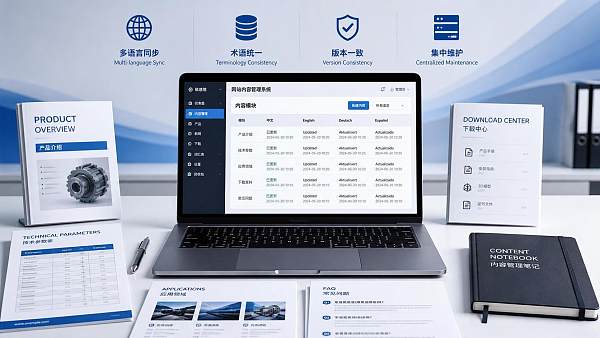
In practice, centralized maintenance is not about solving “who will translate,” but “who is responsible for the final publishable content.” This involves approval boundaries, field locking, change records, and rollback mechanisms. For pages that change frequently, it is best to distinguish between high-frequency and low-frequency fields. For example, campaign descriptions, delivery times, and contact information are suitable for independent maintenance, while core product descriptions, process explanations, and compliance notices should be subject to stricter version control. This reduces repetitive work while preventing local changes from accidentally damaging the structure of the entire page.
Another easily overlooked issue is semantic drift in multilingual content. When a Chinese sentence is excessively rewritten in English, “applicable when the conditions are met” may become “applicable by default,” “recommended value” may become “fixed value,” and “optional configuration” may become “standard configuration.” In ordinary promotional copy, such deviations may be merely a matter of style, but in delivery, maintenance, installation, or procurement instructions, they can become real execution discrepancies. Centralized maintenance combined with terminology controls can keep this type of drift within a reviewable range.
The value of structured maintenance is even more evident on pages that publish technical content externally. For example, if an explanation prepared around the delivery of an engineering project exists in both Chinese and English, the material names, specification units, acceptance conditions, and attachment numbers must correspond exactly. Content such as Analysis of Common Problems and Countermeasures in Engineering Settlement Audits, when embedded in a multilingual website, should follow the same rules: the title, summary, link copy, and contextual prompts must remain consistent, preventing pages in different languages from interpreting the same resource as different topics.
What centralized maintenance truly reduces is the cost of repeated checking at a later stage. The more content there is, the less it can rely on personal experience to remember which version was changed, which was not, where translated additions were made, and where the original text was revised. Turning multilingual content management into a unified maintenance process is essentially the establishment of a traceable, reviewable, and rollback-capable content chain. For pages operating across multiple sites, languages, and channels at the same time, this is closer to a sustainable way of working than temporary gap-filling.
Related Articles


Related Products
 Yiyingbao SaaS Intelligent Website Building and Marketing SystemYiyingbao SaaS Intelligent Website Building and Marketing System, AI-powered no-code website building, rapid creation of multilingual B2B international websites in 10 minutes, global server acceleration, AI-powered SEO optimization, helping businesses connect efficiently with global markets. The perfect integration of technology and operation makes building an international trade website remarkably simple
 AI+SEM Intelligent Advertising Marketing SystemAI+SEM drives intelligent ad creation, empowering full-funnel precision advertising marketing. The system automatically generates weekly/monthly reports, AI recommends keywords and target countries, monitors core metrics in real-time with intelligent alerts, and enables one-click high-conversion ad solutions to help quickly acquire customers and improve ROI.
 AI+SEO Dual-Engine System Optimization ServicesYiyingbao’s AI+SEO dual-engine optimization system helps foreign trade enterprises acquire high-quality organic traffic through AI-powered keyword research, content generation, and comprehensive technical optimization, significantly improving search rankings and conversion rates.
 AI+SNS Social Media Marketing SystemYingbao AI+SNS Social Media Marketing System - Precision social capture for the social media era. Supports one-click content synchronization across major platforms like Facebook and LinkedIn. AI intelligently rewrites posts for enhanced relevance. 24/7 AI customer service and user profiling analysis empower businesses to efficiently expand into global markets.
 AI+SEO营销解决方案易营宝AI+SEO营销解决方案,通过AI批量写作、智能生成TDK、精准关键词扩词等功能,全面优化网站SEO效果,提升流量与转化率。助力企业构建高效智能网站新生态。
 AI+SEM Advertising Marketing SolutionsAI+SEM Advertising Marketing Solution leverages AI technology to deeply empower SEM ad campaigns. It automatically generates weekly/monthly reports using AI, presenting account data across multiple dimensions for comprehensive insights into campaign performance and trends. The system precisely recommends keywords and target countries, intelligently generates high-conversion ad copy, and enables one-click activation of efficient campaign plans to help businesses rapidly acquire customers. Simultaneously, it monitors core metrics in real time, intelligently identifies abnormal fluctuations, and issues timely alerts to ensure stable, high-return advertising results.
 Domain Name ServicesEasyWin provides professional domain name services, including intelligent queries, one-stop registration, brand protection, and full lifecycle management, helping businesses build a digital brand image.
 EasyOperate B2C Cross-Border E-Commerce Platform & Independent WebsiteEasyStore B2C Cross-border E-commerce Independent Store is an intelligent website building and cross-border e-commerce integrated solution independently developed by EasyStore Information Technology (Beijing) Co., Ltd. The system is specially designed for small and medium-sized as well as large export enterprises, integrating 'website building, operation, marketing, advertising, and conversion' into one, helping enterprises quickly establish cross-border e-commerce independent stores to achieve brand globalization and global sales growth.
The platform supports multiple languages, multiple currencies, and multi-channel marketing, with built-in AI intelligent translation and SEO optimization systems, suitable for mainstream markets such as Southeast Asia, Europe and America, Latin America, and the Middle East, assisting Chinese manufacturing enterprises in efficiently deploying international e-commerce strategies. SSL证书易营宝提供专业SSL安全证书服务,包括单域名和泛域名证书,确保网站数据传输加密、身份验证和完整性保护,助力企业建立安全可信的在线业务环境。









