









- Why the old AMP SEO 2020 practices no longer work and what has changed in current optimization prioritiesAug 02, 2026View details
- How to Choose Topics for an Industry News Section to Attract More Organic Search TrafficJul 29, 2026View details
- Digital Marketing Shenzhen Market Insights: Why Are Companies Expanding Overseas Looking for Growth Teams in Shenzhen?Jul 31, 2026View details
- Can Zhejiang foreign trade independent websites still be developed today? Look at changes in traffic and lead generationJul 28, 2026View details
- What New Signals Are Emerging in Enterprise Services SaaS Marketing ReportsJul 27, 2026View details
- What Does a Global Traffic Ecosystem Service Provider Do? What Are the Differences from a Single Advertising AgencyJul 16, 2026View details
Is SEM Optimization Outsourcing Worth It? Should Companies Build Their Own Teams or Hand It Over to a Service Provider?
Is SEM Optimization Outsourcing Worth It? Don't Ask About the Price Yet—First Determine Whether It Can Be Managed
As traffic costs continue to rise, companies often struggle with whether to outsource or build their own optміzacion sem capabilities. Choosing the right model affects not only advertising efficiency, but also customer acquisition costs, team collaboration, and long-term growth potential.
Many managers start by asking, “Is outsourcing expensive?” However, the real difficulty of SEM often lies not within the advertising account itself, but in whether the business understanding behind the account can be effectively implemented. SEM optimization is not simply about adjusting bids for a few keywords or writing several ad copies. Essentially, it is a customer acquisition management mechanism centered on search traffic, covering keyword strategy, campaign structure, landing-page engagement, conversion tracking, data attribution, regional and language adaptation, and budget allocation. Who should manage it depends on whether the company has already mastered this mechanism itself.
For companies operating across regions, especially those engaged in international trade, cross-border e-commerce, or global brand expansion, optmizacions sem is often not an isolated activity. It usually operates together with multilingual websites, SEO, social media traffic acquisition, and brand-keyword protection. Advertising may appear to be traffic buying, but in practice it is also a way to validate markets, identify high-intent demand, and assess regional differences. Therefore, whether outsourcing is worthwhile cannot be measured solely by service fees. The key is whether it can shorten the trial-and-error cycle and reduce invalid clicks and low-quality inquiries.
First, Clarify a Common Misunderstanding: SEM Is Not Simply Managed Operations
Many companies understand SEM outsourcing as “finding someone to open an account, add funds, and run ads.” After several months of cooperation, however, they may find that although there are leads, the sales team considers their quality average. The problem may not lie in the advertising activities themselves, but in the fact that the company treats SEM as media buying rather than conversion-funnel optimization.
A mature SEM optimization service should answer at least four questions: What are customers searching for? Why do they click? After entering the page, will they continue reading? How can they ultimately be identified as qualified business opportunities? Service providers responsible only for the first two steps can usually generate spending; those capable of connecting the latter two steps are closer to the advertising partners companies genuinely need.
This is also why website capabilities and marketing capabilities should ideally not be completely separated. For companies expanding overseas, advertising-account performance is closely related to the website experience. Page loading speed, mobile structure, form length, localization of language, and the convenience of the inquiry path all directly affect conversion costs. For service models such as Yiyingbao, which integrate intelligent website building, SEO optimization, advertising, and social media marketing within one system, the value lies not merely in “providing several additional services,” but in reducing gaps between departments and suppliers so that advertising data can in turn drive page and content optimization.
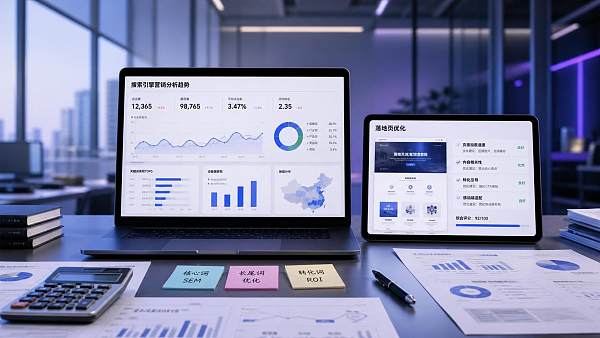
Which Companies Are Better Suited to Outsourcing, and Which Should Build In-House Capabilities?
Outsourcing is not a lower-tier option, and building an in-house team does not automatically mean greater professionalism. The key is to consider the company’s current stage.
If a company has just started running Google Ads or has recently entered a new market, it is usually more suitable to initially rely on a service provider. The reason is practical: in the early stage, the greatest cost is not the service fee, but the waste caused by choosing the wrong direction. Keyword match types, negative-keyword strategies, ad-group structuring, search habits in different countries, and the different inquiry logic of B2B and B2C all require accumulated experience. If a service provider also has website development, tracking, and multilingual content capabilities, it can bring the account to a measurable state more quickly, instead of having the company spend several months experimenting internally only to discover that the data is unusable.
However, if a company already has a stable advertising budget, clearly defined primary markets, a mature sales team, and the ability to continuously produce materials and content, the value of building an in-house team becomes increasingly apparent. Once SEM enters a more refined stage, many optimization activities depend heavily on internal information, such as changes in product margins, key market-development regions, sales feedback on different types of leads, quarterly promotional schedules, and customer lifetime value. External teams can see account data, while internal teams can more easily obtain real business data. The depth of information available to the two is different.
Another situation is easy to overlook: companies do not necessarily have to choose between “fully outsourced” and “fully in-house.” In fact, many effective models are hybrid. For example, the service provider may be responsible for strategy, account setup, and data tracking, while the internal team manages daily lead quality checks and the sales feedback loop. Alternatively, the company may have an internal operations manager, while an external provider offers multilingual advertising, creative testing, and technical support. For most companies, this is more stable than immediately building a complete team.
When Assessing Value, Don't Focus Only on ROI
ROI is certainly important, but focusing only on this metric during the selection stage can be misleading. In the early stages of advertising, conversion tracking may be incomplete, and the sales team may not be able to accurately send every lead back to the account. Using surface-level ROI as the sole criterion at this stage can easily lead to incorrect conclusions.
The following dimensions are generally more informative:
In other words, whether outsourcing is worthwhile depends not only on how much money is spent, but also on whether the service provider fills capabilities that the company previously lacked. If it only operates the account without improving advertising decisions and the data feedback loop, even a low service fee may not be worthwhile.
The Value of a Service Provider Often Lies in the “Invisible” Aspects
When companies choose to outsource, the easiest factors to compare are quotations and case studies; the hardest to compare is the methodology. Experienced service providers typically do not discuss only cost per click. Instead, they first ask about website structure, target countries, conversion actions, sales follow-up cycles, historical organic traffic, and brand-keyword search volume. This information determines whether the account should be divided by product line, region, or intent. It also determines whether advertising should be coordinated with SEO, content, and social media.
Take overseas expansion as an example. Many inquiry problems are not caused by “poor advertising,” but by the website’s lack of infrastructure suited to overseas search and conversion. Directly translated page language, a site structure that is unfavorable for indexing, overly long forms, and materials lacking trust-building information can all increase SEM customer acquisition costs. The advantage of an integrated “website + marketing services” model such as Yiyingbao is that it handles the front-end website, back-end advertising, and AI-driven optimization system within the same process. This is more suitable for companies that need to operate an overseas independent website over the long term, rather than simply seeking to launch advertising in the short term.
Some managers worry that outsourcing will cause them to lose control. This concern is not unfounded. However, the solution is not to reject outsourcing, but to clarify permissions, data, and objectives in advance. Account ownership, data access, conversion definitions, weekly-report standards, testing periods, negative-keyword rules, and landing-page modification permissions should all be clearly defined at the outset. Otherwise, it is easy to end up in a situation where “a great deal of work has been completed, but both parties have different understandings of the results.”
The Hidden Costs of Building an In-House Team Are Often Underestimated
Many companies believe that building an in-house team is more cost-effective. Although this may appear true on paper, the actual cost often involves much more than salaries. A team that can genuinely make SEM work typically needs not only an advertising specialist, but also people who understand analytics and page and content development, and who can establish stable cooperation with technical, design, and sales teams. Otherwise, a common situation arises: someone manages the account, but no one can modify the landing page, implement data tracking, feed lead quality information back, and ultimately the internal team can only keep working around the advertising dashboard.
For small and medium-sized companies, this organizational cost is often higher than the service fee. This is especially true when multiple languages, regions, and product lines are being developed simultaneously in international markets, where it is difficult for a single advertising specialist to handle both strategy and execution. In such cases, using an external team to establish standards and gradually bringing key capabilities in-house may better match the company’s operating pace.
This approach is not limited to marketing. Many management issues essentially follow the same principle: “first leverage external capabilities to build the framework, then deepen operations internally.” This is also common in management topics such as integration and operational optimization strategies for property companies following mergers and acquisitions: what truly determines the outcome is not the nominal organizational model, but whether a unified mechanism, clear processes, and traceable metrics have been established after integration. The logic behind choosing between SEM outsourcing and in-house development is actually quite similar.
How to Make the Decision: Focus on What the Company Currently Lacks
If the company’s greatest current gaps are methodology, trial-and-error experience, and overseas-market execution capabilities, outsourcing is generally more effective. If the main gaps are rapid responses to business changes and an in-depth understanding of high-quality leads, building in-house capabilities offers greater advantages. If both areas are lacking, it is best to first use external capabilities to establish the foundation and then gradually build internal control.
The questions can be made more specific: Does the company have clear conversion objectives? Does it have websites and pages suitable for advertising? Is it capable of continuously updating content and materials? Can sales provide feedback on the criteria for qualified leads? If these fundamentals are still incomplete, discussing whether to outsource or build in-house too early means skipping over the real issue.
SEM is not a role that can achieve long-term success through isolated techniques, nor is it a channel that can be scaled steadily simply by spending money. It is more like the most direct part of a company’s digital customer acquisition system—and the part most likely to expose problems. The decision about who should manage it should not be based only on who is cheaper, but on who can best connect traffic, pages, data, and sales. Once this criterion is established, the answer to whether optmizacions sem should be outsourced or built in-house will usually become much clearer.
Related Articles
Related Products
 Yiyingbao SaaS Intelligent Website Building and Marketing SystemYiyingbao SaaS Intelligent Website Building and Marketing System, AI-powered no-code website building, rapid creation of multilingual B2B international websites in 10 minutes, global server acceleration, AI-powered SEO optimization, helping businesses connect efficiently with global markets. The perfect integration of technology and operation makes building an international trade website remarkably simple
 AI+SEM Intelligent Advertising Marketing SystemAI+SEM drives intelligent ad creation, empowering full-funnel precision advertising marketing. The system automatically generates weekly/monthly reports, AI recommends keywords and target countries, monitors core metrics in real-time with intelligent alerts, and enables one-click high-conversion ad solutions to help quickly acquire customers and improve ROI.
 AI+SEO Dual-Engine System Optimization ServicesYiyingbao’s AI+SEO dual-engine optimization system helps foreign trade enterprises acquire high-quality organic traffic through AI-powered keyword research, content generation, and comprehensive technical optimization, significantly improving search rankings and conversion rates.
 AI+SNS Social Media Marketing SystemYingbao AI+SNS Social Media Marketing System - Precision social capture for the social media era. Supports one-click content synchronization across major platforms like Facebook and LinkedIn. AI intelligently rewrites posts for enhanced relevance. 24/7 AI customer service and user profiling analysis empower businesses to efficiently expand into global markets.
 AI+SEO营销解决方案易营宝AI+SEO营销解决方案,通过AI批量写作、智能生成TDK、精准关键词扩词等功能,全面优化网站SEO效果,提升流量与转化率。助力企业构建高效智能网站新生态。
 AI+SEM Advertising Marketing SolutionsAI+SEM Advertising Marketing Solution leverages AI technology to deeply empower SEM ad campaigns. It automatically generates weekly/monthly reports using AI, presenting account data across multiple dimensions for comprehensive insights into campaign performance and trends. The system precisely recommends keywords and target countries, intelligently generates high-conversion ad copy, and enables one-click activation of efficient campaign plans to help businesses rapidly acquire customers. Simultaneously, it monitors core metrics in real time, intelligently identifies abnormal fluctuations, and issues timely alerts to ensure stable, high-return advertising results.
 Domain Name ServicesEasyWin provides professional domain name services, including intelligent queries, one-stop registration, brand protection, and full lifecycle management, helping businesses build a digital brand image.
 EasyOperate B2C Cross-Border E-Commerce Platform & Independent WebsiteEasyStore B2C Cross-border E-commerce Independent Store is an intelligent website building and cross-border e-commerce integrated solution independently developed by EasyStore Information Technology (Beijing) Co., Ltd. The system is specially designed for small and medium-sized as well as large export enterprises, integrating 'website building, operation, marketing, advertising, and conversion' into one, helping enterprises quickly establish cross-border e-commerce independent stores to achieve brand globalization and global sales growth.
The platform supports multiple languages, multiple currencies, and multi-channel marketing, with built-in AI intelligent translation and SEO optimization systems, suitable for mainstream markets such as Southeast Asia, Europe and America, Latin America, and the Middle East, assisting Chinese manufacturing enterprises in efficiently deploying international e-commerce strategies. SSL证书易营宝提供专业SSL安全证书服务,包括单域名和泛域名证书,确保网站数据传输加密、身份验证和完整性保护,助力企业建立安全可信的在线业务环境。









