









- Can the average annual growth rate reflect real opportunities in overseas markets?Oct 07, 2026View details
- Which customer acquisition channels will be affected by cross-border marketing trends in 2026?Sep 06, 2026View details
- Which homogenization risks should be considered in an analysis of the AI-powered website building industry?Aug 30, 2026View details
- How Will AI Marketing Trends 2026 Change Advertising Budget AllocationAug 28, 2026View details
- Is the EV SSL certificate market shrinking or upgrading? How should companies assess certificate procurement?Aug 11, 2026View details
- Why the old AMP SEO 2020 practices no longer work and what has changed in current optimization prioritiesAug 02, 2026View details
Is It More Cost-Effective for Enterprises to Build Their Own Enterprise Website System or Use SaaS?
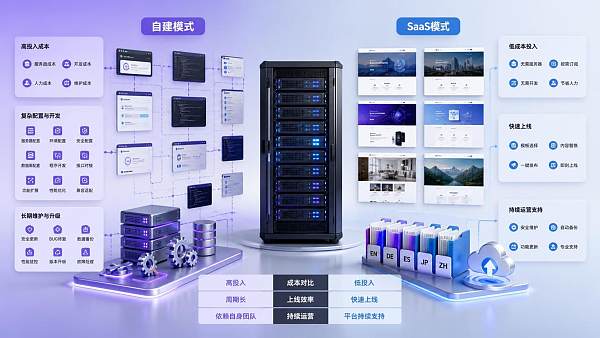
If an enterprise website building system is viewed simply as “creating a website,” the gap between self-build and SaaS is often underestimated. What truly creates a cost difference is usually not the homepage visual design or one-time development fee, but every subsequent redesign, each server capacity expansion, every form field adjustment, the launch of each language version, and the time required to troubleshoot search engine indexing issues. When discussing whether it is more cost-effective to self-build or use SaaS for an enterprise website building system, the focus should be on the total cost of ownership, delivery pace, and whether the marketing chain can continue to operate effectively.
The advantages of self-building are clear: the underlying system is controllable, business logic can be deeply customized according to internal processes, and the database structure, permission system, interface strategy, and deployment environment can all be determined independently. For special requirements, such as integrating with ERP, CRM, quotation systems, or warehouse management systems, or writing inquiry data directly into an internal review workflow, self-building is usually more capable of achieving seamless integration. The issue is that this “control” itself requires long-term maintenance by a technical team. Front-end framework upgrades, interface version compatibility, caching strategies, log monitoring, disaster recovery backups, CDN configuration, and certificate renewals will continuously consume budget and time.
The cost-effectiveness of SaaS usually does not lie in being “cheap,” but in converting a large amount of hidden engineering work into standardized capabilities in advance. Template systems, form components, page permissions, media asset management, multilingual switching, basic SEO fields, mobile adaptation, and version release rollback may not appear significant when developed individually in a self-built project, but they are often highly labor-intensive. For scenarios requiring rapid launch, frequent adjustments to page structure, and the simultaneous advancement of SEO and advertising landing pages, SaaS is usually more aligned with business needs.
Calculate Long-Term Costs Before Discussing One-Time Investment
Many budget comparisons focus only on the first year. Self-building may appear to involve a “large initial investment followed by stability,” but the actual situation is often the opposite. Once the system goes live, the truly costly stage begins: security patches need to be updated, databases require regular inspections, marketing campaigns need stress testing before launch, page redesigns may affect component compatibility, and new tracking requirements may impact front-end performance. If the website serves visitors from multiple regions, image compression strategies, node distribution, and static resource caching durations all require continuous optimization. As long as the website is responsible for customer acquisition, these tasks will not stop.
The cost structure of SaaS is easier to understand. Subscription fees, plugin fees, and charges for additional modules are usually stated clearly, while servers, basic operations and maintenance, system upgrades, and general vulnerability fixes are partly handled by the service provider. However, there is also a common misjudgment: if the business requires many unconventional processes, such as a complex quotation engine, deep product parameter interactions, or unique approval mechanisms, SaaS may save time initially but incur additional integration costs later due to limited expansion capabilities. Whether it is cost-effective depends not on the monthly fee alone, but on whether the business complexity and frequency of changes match the platform’s boundaries.
Behind Launch Speed Lies the Cost of Organizational Collaboration
The reasons enterprise projects are delayed are often not that code is written slowly, but that every stage requires waiting. Self-building usually involves multiple stages, including requirements analysis, prototype review, UI design, front-end and back-end development, integration testing, deployment acceptance, content migration, and permission activation. If any stage requires repeated revisions, the entire schedule will be extended. This is especially true for multilingual websites, where language pack management, URL structures, hreflang tags, and differences in form fields across regions may further expand the timeline.
When SaaS is used, many basic processes have already been standardized. Page modules can be combined through drag and drop, and the category structure can take shape more quickly, making it more suitable for launching and optimizing at the same time. For websites that need to coordinate SEO content publishing, advertising landing page testing, and traffic acquisition through overseas social media, delaying the launch by one week means losing not only working time, but also data accumulation and search engine crawling opportunities.
Marketing Capabilities Are Not Add-Ons; They Are Best Built in from the Website Development Stage
Many enterprises later discover that a website is not an isolated system. Whether pages support customized titles and descriptions, whether canonical tags can be configured independently, whether alt text can be conveniently added to images, whether page loading speed remains stable, whether lead sources can be tracked after form submissions, and whether advertising conversion codes can be easily deployed will all directly affect promotional efficiency. The question of whether self-building or SaaS is more cost-effective for an enterprise website building system becomes even more apparent at the marketing stage.
If a company chooses self-building but fails to incorporate SEO structures, tracking logic, content management, and advertising landing page testing capabilities into the initial design, it may later face a situation where “the website looks fine but is difficult to use.” For example, product detail page URLs may change frequently without setting up 301 redirects for old links. Alternatively, the front end may use heavy script rendering without properly handling above-the-fold output, affecting both crawling and loading performance. These issues are not difficult to fix, but they often arise after traffic investment has already begun, making the cost of correction higher.
If SaaS is designed specifically for marketing-oriented websites, it will often turn capabilities such as page templates, basic SEO settings, multilingual content management, form tracking, and advertising code installation into reusable modules. The real value here is not having “more features,” but eliminating the need to repeatedly queue marketing actions with developers. Tasks such as changing the order of landing page modules, replacing the copy on an inquiry button, adding an entry point for a regional subsite, or configuring indexing rules for a new campaign page should ideally be completed quickly at the content level.
Is Technical Control Worth the Long-Term Maintenance Cost?
The core reason self-building is often chosen is concern that data, interfaces, and functions may become restricted by the platform. This concern is not unfounded. If a project genuinely requires private deployment, fine-grained database control, integration with an internal identity authentication system, or compliance with strict audit requirements, the value of self-building will increase rapidly. Particularly in scenarios involving large product catalogs, complex pricing systems, and regional inventory synchronization, the freedom of the system architecture itself is part of the cost.
However, if the business model is still primarily focused on corporate website presentation, content-based customer acquisition, inquiry collection, multilingual operations, and advertising conversion, investing in self-building too early for requirements that “may become complex in the future” is often not cost-effective. Many systems do not fail because they lack capabilities, but because no one maintains the documentation over the long term, no one takes over the interfaces, and new teams cannot understand the historical code after the original developers leave. On the surface, the system belongs to the company, but in practice it depends on the memory of a few engineers. This type of control is not stable.
Content Migration, International Access, and Publishing Risks Often Surface Only Later
The aspect most easily overlooked during a website migration is data transfer. When redesigning a self-built website, it is necessary to handle old URL mapping, media file redirects, historical article categorization, form data export, retention of indexed old pages, and sitemap reconstruction. If the path planning is rushed, search engine performance may fluctuate in the short term. SaaS is not naturally risk-free either. Particularly when migrating from one system to another, it is still necessary to verify URL rules, field compatibility, and code injection locations, although the degree of standardization is generally higher.
International access is not as simple as “putting up a server.” The size of image resources, the number of JS scripts, font file calls, and regional availability of third-party plugins will all affect loading speed. If a self-building team has no long-term experience optimizing overseas access, it may repeatedly conduct trial and error with details such as DNS resolution, cache expiration, and cross-region resource loading. SaaS with a mature global access architecture can eliminate considerable underlying technical work, but it is still necessary to confirm whether form delivery, email notifications, verification codes, and human-machine verification functions remain stable in different regions.
Suitable Scenarios for Self-Building Are Usually Specific
When a website is not merely a content and inquiry center but part of a business system, self-building is generally more reasonable. For example, online product selection, real-time quotations, order approvals, distributor permissions, after-sales service tickets, equipment parameter downloads, and internal master data may all need to be integrated into the same system. Alternatively, the page may only serve as an entry point, while the core value lies in the closed-loop back-end processes. In such cases, the website building system is no longer simply a marketing tool. No matter how convenient SaaS is, it may still be unable to support critical processes.
Conversely, as long as the website’s primary tasks remain presentation, indexing, customer acquisition, conversion support, and continuous updates, SaaS is more likely to generate a positive return on investment. This is especially true when pages require frequent modifications, categories will continue to expand, the content team needs to publish independently, and multilingual versions need to be managed simultaneously. A standardized platform is often more practical than developing everything from scratch.
What Really Determines Cost-Effectiveness Is Not the Technical Approach Itself
Whether an enterprise website building system should be self-built or use SaaS ultimately depends on three factors: whether requirements are stable, whether the company has continuous maintenance capabilities, and whether the website undertakes long-term marketing tasks. If requirements are stable and processes are complex, self-building has a stronger foundation. If requirements change rapidly, launch deadlines are tight, and marketing integration is extensive, SaaS usually reduces total costs. Do not compare only development fees and annual fees; also include redesign frequency, publishing efficiency, content operations, SEO maintenance, interface adjustments, global access, and fault handling in the calculation.
If a more detailed approach is required, one practical option is to leave the parts that “must be privately deployed and deeply customized” to self-building, while placing high-frequency modules such as website content, campaign pages, multilingual sections, and SEO landing pages within a mature SaaS system. Website building and marketing modules with AI capabilities are also more suitable for areas that require rapid trial and error and continuous iteration, rather than undergoing heavy development first and waiting for business validation. Calculated this way, whether the solution is cost-effective is often clearer than treating it as a single-choice question.
Related Articles


Related Products
 Yiyingbao SaaS Intelligent Website Building and Marketing SystemYiyingbao SaaS Intelligent Website Building and Marketing System, AI-powered no-code website building, rapid creation of multilingual B2B international websites in 10 minutes, global server acceleration, AI-powered SEO optimization, helping businesses connect efficiently with global markets. The perfect integration of technology and operation makes building an international trade website remarkably simple
 AI+SEM Intelligent Advertising Marketing SystemAI+SEM drives intelligent ad creation, empowering full-funnel precision advertising marketing. The system automatically generates weekly/monthly reports, AI recommends keywords and target countries, monitors core metrics in real-time with intelligent alerts, and enables one-click high-conversion ad solutions to help quickly acquire customers and improve ROI.
 AI+SEO Dual-Engine System Optimization ServicesYiyingbao’s AI+SEO dual-engine optimization system helps foreign trade enterprises acquire high-quality organic traffic through AI-powered keyword research, content generation, and comprehensive technical optimization, significantly improving search rankings and conversion rates.
 AI+SNS Social Media Marketing SystemYingbao AI+SNS Social Media Marketing System - Precision social capture for the social media era. Supports one-click content synchronization across major platforms like Facebook and LinkedIn. AI intelligently rewrites posts for enhanced relevance. 24/7 AI customer service and user profiling analysis empower businesses to efficiently expand into global markets.
 AI+SEO营销解决方案易营宝AI+SEO营销解决方案,通过AI批量写作、智能生成TDK、精准关键词扩词等功能,全面优化网站SEO效果,提升流量与转化率。助力企业构建高效智能网站新生态。
 AI+SEM Advertising Marketing SolutionsAI+SEM Advertising Marketing Solution leverages AI technology to deeply empower SEM ad campaigns. It automatically generates weekly/monthly reports using AI, presenting account data across multiple dimensions for comprehensive insights into campaign performance and trends. The system precisely recommends keywords and target countries, intelligently generates high-conversion ad copy, and enables one-click activation of efficient campaign plans to help businesses rapidly acquire customers. Simultaneously, it monitors core metrics in real time, intelligently identifies abnormal fluctuations, and issues timely alerts to ensure stable, high-return advertising results.
 Domain Name ServicesEasyWin provides professional domain name services, including intelligent queries, one-stop registration, brand protection, and full lifecycle management, helping businesses build a digital brand image.
 EasyOperate B2C Cross-Border E-Commerce Platform & Independent WebsiteEasyStore B2C Cross-border E-commerce Independent Store is an intelligent website building and cross-border e-commerce integrated solution independently developed by EasyStore Information Technology (Beijing) Co., Ltd. The system is specially designed for small and medium-sized as well as large export enterprises, integrating 'website building, operation, marketing, advertising, and conversion' into one, helping enterprises quickly establish cross-border e-commerce independent stores to achieve brand globalization and global sales growth.
The platform supports multiple languages, multiple currencies, and multi-channel marketing, with built-in AI intelligent translation and SEO optimization systems, suitable for mainstream markets such as Southeast Asia, Europe and America, Latin America, and the Middle East, assisting Chinese manufacturing enterprises in efficiently deploying international e-commerce strategies. SSL证书易营宝提供专业SSL安全证书服务,包括单域名和泛域名证书,确保网站数据传输加密、身份验证和完整性保护,助力企业建立安全可信的在线业务环境。









