









- Can the average annual growth rate reflect real opportunities in overseas markets?Oct 07, 2026View details
- Which customer acquisition channels will be affected by cross-border marketing trends in 2026?Sep 06, 2026View details
- Which homogenization risks should be considered in an analysis of the AI-powered website building industry?Aug 30, 2026View details
- How Will AI Marketing Trends 2026 Change Advertising Budget AllocationAug 28, 2026View details
- Is the EV SSL certificate market shrinking or upgrading? How should companies assess certificate procurement?Aug 11, 2026View details
- Why the old AMP SEO 2020 practices no longer work and what has changed in current optimization prioritiesAug 02, 2026View details
Which Is Better for Customer Acquisition: an Independent Building Materials Export Website or Alibaba.com?
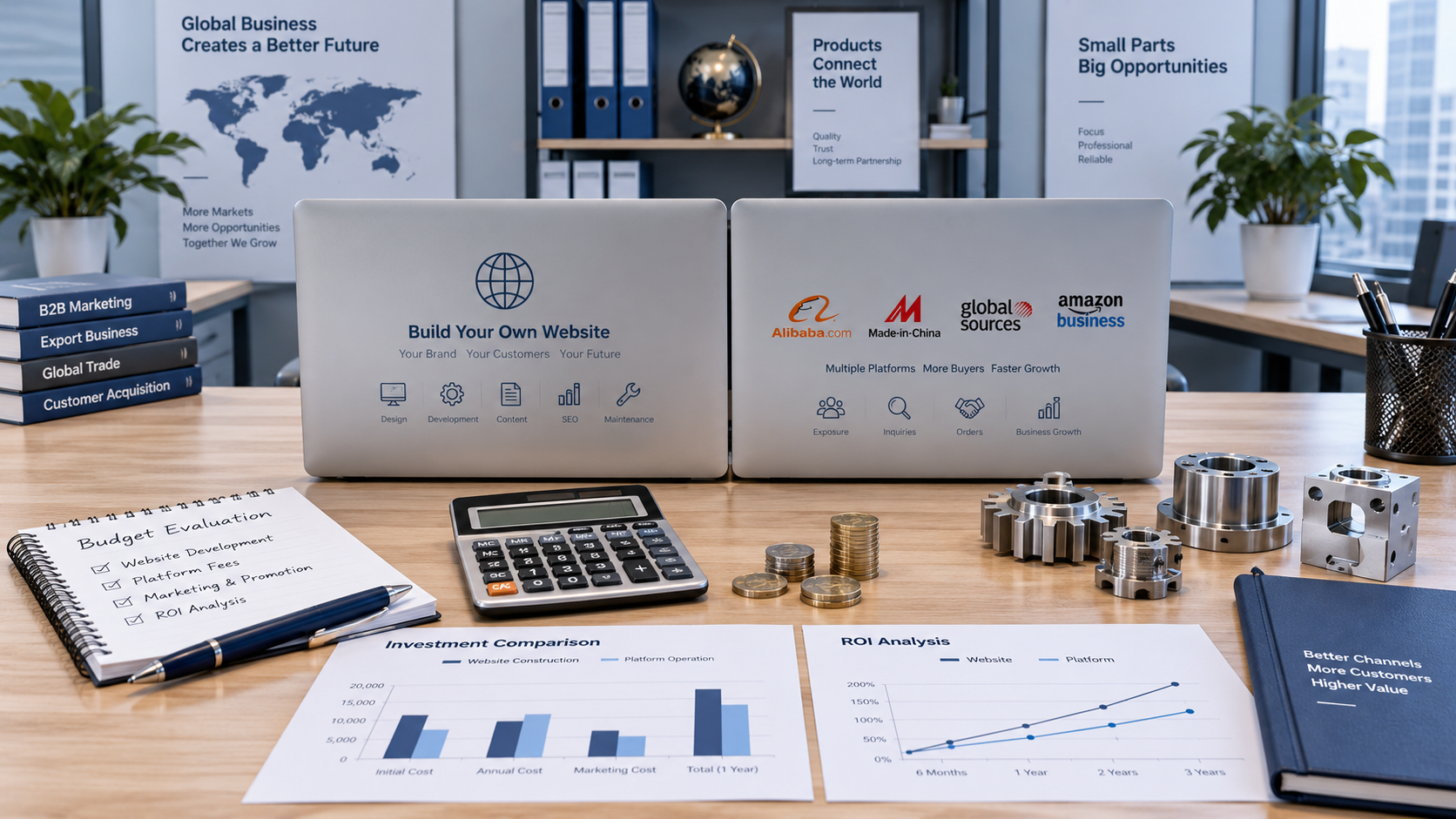
Whether to choose an independent website or Alibaba.com for building materials exports depends on current customer acquisition goals, product complexity, sales cycles, and overseas market strategy. Alibaba.com is suitable for quickly testing product categories within existing platform traffic and capturing procurement demand from active searches; an independent website is better suited to building brand equity, demonstrating technical capabilities, and directing traffic from search, advertising, social media, and other channels into a proprietary inquiry system. For building materials exports, the two are not simply substitutes for one another. The key is whether budget allocation aligns with the actual path to conversion.
If the main products have clear specifications, a high degree of standardization, and can be sold through conventional quotations—such as common hardware accessories, decorative panels, basic sanitary ware accessories, or general-purpose tools—a platform store can usually gain exposure more quickly. Buyers can directly filter suppliers by category, price range, minimum order quantity, and lead time. At the initial stage, the focus should be on strengthening the main images, attributes, quotation tiers, minimum order quantities, and response speed.
However, building materials transactions often involve more than simply “placing an order based on pictures.” Stone texture batches, tile water absorption and abrasion resistance grades, wall thickness of door and window profiles, fire performance of insulation materials, pressure resistance parameters of pipes, tolerances for customized dimensions, packaging methods, and container loading plans can all affect inquiry quality. The more a product depends on technical confirmation, sample approval, project drawings, or installation conditions, the more apparent the value of an independent website as an information carrier becomes.
First, consider where leads come from and where they will ultimately be verified
Alibaba.com’s advantage lies in the concentration of existing purchasing demand. Buyers enter the platform with clear product categories in mind, and suppliers can compete for visibility through categories, keywords, and on-platform promotion. It is suitable for verifying whether a particular SKU can generate sustained inquiries and for supplementing initial lead sources when entering a new market. However, similar product pages are displayed side by side, with price, lead time, and response speed often placed prominently, which can easily shift communication back toward price comparison.
An independent website does not come with immediate traffic and requires traffic generation through organic search, Google Ads, industry content, overseas social media, email outreach, or post-exhibition visits. Investment and traffic growth require more planning, but visitor paths, page content, form fields, and remarketing data can be managed independently. For building materials that require explanations of material composition, manufacturing processes, customization scope, project cases, and delivery procedures, an independent website can organize fragmented materials into a continuous trust-building journey.
For example, a page for exterior wall decorative materials should not contain only renderings and model numbers. More useful information includes applicable climate conditions, substrate requirements, weight per square meter, edge finishing details, reference wind pressure resistance range, color batch management, maintenance recommendations, and how sea freight packaging reduces the risk of damage. On an independent website, such content can be developed separately by product series, application scenario, and country language; platform product detail pages are better suited to highlighting core selling points and guiding further communication.

Building material categories determine channel priorities
When deciding between an independent website and Alibaba.com for building materials exports, first distinguish whether products are “directly comparable” or “require solution confirmation.” The former usually have fixed parameters, frequent repeat purchases, and relatively clear purchase quantities and standard lead times, allowing platforms to capture search traffic more effectively. The latter often involve engineering projects, regional standards, spatial dimensions, installation team capabilities, and transportation constraints. Since multiple rounds of communication are required before closing a deal, an independent website is more suitable as an information hub and an inquiry qualification entry point.
- Standardized auxiliary materials and general accessories: Platform exposure can be used first to obtain market feedback, while retaining independent website product pages to receive branded keyword, model keyword, and advertising traffic.
- Customized doors and windows, integrated bathroom systems, and metal curtain wall components: Priority should be given to building an independent website that can display system parameters, detail drawings, color options, and project processes. Forms can include fields for dimensions, quantity, port of destination, drawing uploads, and other information to reduce back-and-forth communication caused by missing key details.
- Heavy, fragile, or container-loading-dependent products: Regardless of the customer acquisition channel, packaging, loading methods, trade terms, and unloading conditions at the destination port should be clarified as early as possible. Quoting a low price without verifying logistics conditions alone creates a high likelihood of subsequent disputes.
Customer acquisition costs should not be assessed solely by the price of initial inquiries
Platform investment is generally easier to associate with on-platform impressions, clicks, and inquiries, but this does not mean that every lead has equal value. Among building materials inquiries, those containing only a product name without specifications, quantity, project stage, or port of destination are often difficult to quote quickly. Qualified inquiries, sample requests, drawing discussions, formal quotations, and order sources in sales records should be tracked separately to avoid judging channel performance by total inquiry volume alone.
The cost structure of an independent website is more dispersed, including content production, page development, organic search optimization, advertising landing pages, and ongoing operations. Its return should likewise not be measured solely by the number of monthly form submissions. A page built around “fire rating + application scenario + country language” may continue to generate search traffic over a long period; visitors may also gradually develop purchase intent by downloading catalogs, viewing installation instructions, or returning to product pages. The prerequisite is that there are no fundamental issues with website loading, mobile display, form delivery, and inquiry assignment.
A common misjudgment is turning an independent website into a corporate brochure: product categories are unclear, specification documents can only be sent after a lead is confirmed, language versions are directly machine-translated, and inquiry forms contain only name and email fields. Such websites are difficult to support advertising campaigns and cannot help sales teams assess demand. Another misjudgment is treating a platform as a fully proprietary customer asset, when store rules, traffic placement, and the competitive environment for similar products can all affect lead stability.
Page content should support quotation and delivery coordination
Content preparation for a building materials export website should not be completed solely by marketing personnel. Product, technical, foreign trade, logistics, and after-sales materials need to be aligned before launch. Parameter units on product pages should be standardized, and conversions between imperial and metric units need to be reviewed; names for the same model should remain consistent across catalogs, quotations, and the website; for products involving installation, applicable substrates, fastener requirements, and common limitations should be explained rather than merely displaying the finished result.
For multilingual markets, prioritize translating high-value pages rather than duplicating all sections at once. Focus areas also vary by market: some pay greater attention to weather resistance and maintenance, while others focus more on lead times, container loading quantities, or the feasibility of local installation. Advertising landing pages can be designed around a single application scenario to avoid directing visitors to an overly broad homepage.
A more prudent approach is often to define priorities rather than distribute resources evenly. When standard product demand needs to be verified quickly, the platform can serve as a front-end customer acquisition channel, while technical documentation, brand information, and project-oriented pages are hosted on the independent website; once products have established stable models, core markets, and a content foundation, the proportion of independent website investment in search and advertising can be increased. Reviewing qualified inquiry quality, quotation progress, customer acquisition costs, and repeat purchase sources at regular intervals allows channel allocation to remain appropriate as products and markets evolve.
Related Articles
 On a Limited Budget, Which Is Better for Generating Export Leads: an Independent Website or a Third-Party Platform?
 How effective is 易营宝's TikTok lead generation for overseas markets? How can you assess lead quality?
 How Can an Enterprise Self-Service Website Building System Support Multi-Department Permission Management?


Related Products
 Yiyingbao SaaS Intelligent Website Building and Marketing SystemYiyingbao SaaS Intelligent Website Building and Marketing System, AI-powered no-code website building, rapid creation of multilingual B2B international websites in 10 minutes, global server acceleration, AI-powered SEO optimization, helping businesses connect efficiently with global markets. The perfect integration of technology and operation makes building an international trade website remarkably simple
 AI+SEM Intelligent Advertising Marketing SystemAI+SEM drives intelligent ad creation, empowering full-funnel precision advertising marketing. The system automatically generates weekly/monthly reports, AI recommends keywords and target countries, monitors core metrics in real-time with intelligent alerts, and enables one-click high-conversion ad solutions to help quickly acquire customers and improve ROI.
 AI+SEO Dual-Engine System Optimization ServicesYiyingbao’s AI+SEO dual-engine optimization system helps foreign trade enterprises acquire high-quality organic traffic through AI-powered keyword research, content generation, and comprehensive technical optimization, significantly improving search rankings and conversion rates.
 AI+SNS Social Media Marketing SystemYingbao AI+SNS Social Media Marketing System - Precision social capture for the social media era. Supports one-click content synchronization across major platforms like Facebook and LinkedIn. AI intelligently rewrites posts for enhanced relevance. 24/7 AI customer service and user profiling analysis empower businesses to efficiently expand into global markets.
 AI+SEO营销解决方案易营宝AI+SEO营销解决方案,通过AI批量写作、智能生成TDK、精准关键词扩词等功能,全面优化网站SEO效果,提升流量与转化率。助力企业构建高效智能网站新生态。
 AI+SEM Advertising Marketing SolutionsAI+SEM Advertising Marketing Solution leverages AI technology to deeply empower SEM ad campaigns. It automatically generates weekly/monthly reports using AI, presenting account data across multiple dimensions for comprehensive insights into campaign performance and trends. The system precisely recommends keywords and target countries, intelligently generates high-conversion ad copy, and enables one-click activation of efficient campaign plans to help businesses rapidly acquire customers. Simultaneously, it monitors core metrics in real time, intelligently identifies abnormal fluctuations, and issues timely alerts to ensure stable, high-return advertising results.
 Domain Name ServicesEasyWin provides professional domain name services, including intelligent queries, one-stop registration, brand protection, and full lifecycle management, helping businesses build a digital brand image.
 EasyOperate B2C Cross-Border E-Commerce Platform & Independent WebsiteEasyStore B2C Cross-border E-commerce Independent Store is an intelligent website building and cross-border e-commerce integrated solution independently developed by EasyStore Information Technology (Beijing) Co., Ltd. The system is specially designed for small and medium-sized as well as large export enterprises, integrating 'website building, operation, marketing, advertising, and conversion' into one, helping enterprises quickly establish cross-border e-commerce independent stores to achieve brand globalization and global sales growth.
The platform supports multiple languages, multiple currencies, and multi-channel marketing, with built-in AI intelligent translation and SEO optimization systems, suitable for mainstream markets such as Southeast Asia, Europe and America, Latin America, and the Middle East, assisting Chinese manufacturing enterprises in efficiently deploying international e-commerce strategies. SSL证书易营宝提供专业SSL安全证书服务,包括单域名和泛域名证书,确保网站数据传输加密、身份验证和完整性保护,助力企业建立安全可信的在线业务环境。









