









- Which customer acquisition channels will be affected by cross-border marketing trends in 2026?Sep 06, 2026View details
- Which homogenization risks should be considered in an analysis of the AI-powered website building industry?Aug 30, 2026View details
- How Will AI Marketing Trends 2026 Change Advertising Budget AllocationAug 28, 2026View details
- Is the EV SSL certificate market shrinking or upgrading? How should companies assess certificate procurement?Aug 11, 2026View details
- Why the old AMP SEO 2020 practices no longer work and what has changed in current optimization prioritiesAug 02, 2026View details
- How to Choose Topics for an Industry News Section to Attract More Organic Search TrafficJul 29, 2026View details
Which delivery and attribution metrics should be confirmed before procuring digital marketing services for export business
When procuring digital marketing services for foreign trade, the items listed in a quotation—“website development, SEO, advertising, social media operations, and inquiry growth”—do not in themselves constitute deliverables that can be accepted. The most common mistake buyers make is treating the scope of services as delivery results: the website has gone live, the advertising account has been opened, and the monthly report has been sent, yet it remains unclear where traffic comes from, whether inquiries are valid, whether the sales team can follow up, and which investments generate business opportunities.
Whether a service package is worth procuring depends first on whether the supplier can break down “what will be done” into verifiable deliverables and define “what results will be generated” using metrics mutually agreed upon by both parties. For companies targeting B2B inquiries, the most important factor is usually not a single traffic volume or number of form submissions, but whether a continuous data chain can be established from website fundamentals and customer acquisition channels to lead quality.
Define delivery boundaries clearly first to avoid treating launch as completion
Integrated website and marketing services often span multiple stages. If a contract merely states “build an English website,” “perform Google optimization,” or “manage advertising campaigns,” gaps in responsibility can easily arise during execution: who provides page content, how product materials are translated, whether conversion forms are integrated with the CRM, who iterates advertising landing pages, and who records leads lost because sales did not follow up in time. All of these may become disputes in the later stages of the project.
Procurement documents should divide deliverables into three levels. The first level consists of verifiable assets, including domain names, website source files or platform account permissions, multilingual page lists, product detail pages, landing pages, advertising accounts, analytics tools, and tag management permissions. The second level consists of reviewable process outputs, such as keyword and market research, page structure plans, content plans, campaign structures, search term reports, and optimization records. Only the third level consists of business metrics, such as qualified visits, conversions, leads, and opportunities.
Account and data permissions, in particular, should not be treated as minor details. The registered entity, administrator permissions, handover method, and post-termination handling rules should be clearly defined for the website backend, domain name, advertising accounts, analytics tools, pixels, and conversion events. Otherwise, even if marketing data has been accumulated, the company may be unable to fully inherit historical accounts, audience data, and optimization records.
For manufacturing companies, it is also necessary to confirm whether website development deliverables cover actual customer acquisition scenarios. For example, do complex products require parameter downloads, sample requests, RFQ forms, or solution pages categorized by industry? Do different country markets require separate language pages and contact details? Can quotation requests include fields such as model number, quantity, and destination? Only when these requirements are included in the page and feature list will subsequent “conversion rate optimization” have clearly defined targets.
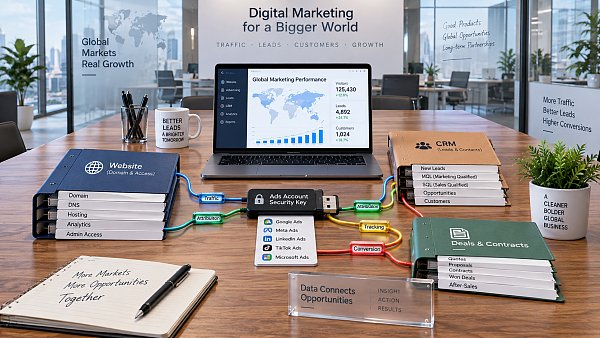
Traffic metrics can be reviewed, but should not end with traffic metrics
Visits generated by organic search, advertising, and social media do not carry equal value. If buyers only require “increased exposure” or “more visitors,” service providers can easily concentrate budgets on low-threshold traffic, while such visits may not come from regions, industries, or job roles with purchasing intent.
A more reasonable approach is to agree on traffic quality metrics at project kickoff. Different businesses may select different combinations: the share of visits from target countries or regions, visits to core product pages, time spent and engagement on key pages, document downloads, email or WhatsApp clicks, form submissions, and online consultation requests. For advertising channels, the relationships among search terms, audiences, creatives, landing pages, and conversion events should also be retained to identify exactly which needs the budget is being spent on.
SEO services in particular need to distinguish between “ranking delivery” and “content delivery that can generate business.” High rankings for certain keywords do not automatically mean inquiries will be obtained. During procurement, suppliers can be asked to explain: how core terms are grouped by product, application, region, and purchasing stage; which pages serve information searches and which pages serve explicit purchasing needs; and how content updates, technical fixes, backlinks, or digital PR work are recorded. For organic growth with a longer cycle, phased checkpoints should also be established, such as indexing status, visibility of key pages, organic traffic to target pages, and conversion paths, rather than waiting until the end of the contract term to review a single overall result.
“Number of inquiries” must be upgraded to a verifiable opportunity definition
A form submission does not equal a qualified inquiry. Spam, job-seeking messages, individual retail requests, and messages without clear product needs can all inflate lead volume without helping buyers assess the value of the service. Before signing the contract, both parties should jointly define lead scoring rules and agree on who will complete the assessment and within what timeframe.
For B2B businesses with high average order values and long decision cycles, “monthly sales revenue” should not be set as the service provider's sole performance metric. Transactions are also affected by pricing, delivery time, certifications, samples, sales response, and the customer's internal procurement process. However, this does not mean marketing results cannot be measured. A more practical requirement is for the service provider to provide traceable channel data, while the company's sales team feeds back lead statuses according to established rules, enabling both parties to assess the volume of qualified leads and opportunities contributed by each channel.
If the company also undertakes ESG communications, supply chain transparency presentation, or compliance documentation for overseas customers, website content and marketing pages should also be incorporated into the same conversion design. Such content should not be created solely as press releases; it may be presented through white papers, capability statements, or downloadable materials to address specific procurement needs, such as themed content like An Analysis of Implementation Paths for ESG to Support the Development of New Quality Productive Forces in Enterprises, provided that its audience, landing page, and subsequent follow-up actions have all been clearly defined.
Attribution rules should be established before campaigns launch, not explained during review
Common attribution disputes in foreign trade digital marketing services typically arise when customers submit their information only after multiple touchpoints: they first discover the brand through search, then click on a remarketing advertisement, and finally visit the website directly to submit a form. Without rules determined in advance, SEO, advertising, social media, and sales teams may all claim contribution to the same lead.
Buyers should confirm at least four matters: first, whether first-touch, last-touch, assisted-touch, or multi-touch attribution will serve as the primary management framework; second, when advertising platform data, website analytics data, and CRM data differ, which data source will be used as the basis for business decisions; third, how cross-device, cross-domain, multilingual websites, and third-party forms will be tracked; and fourth, whether privacy consent, Cookie settings, and data retention will affect tracking completeness.
In practice, two perspectives can be retained simultaneously: use last-click conversions to assess the direct customer acquisition efficiency of current campaigns, and use first-touch or assisted touchpoints to assess the contribution of brand content, SEO, and social media to long-term customer acquisition. This approach neither credits all budget results to the final click nor uses difficult-to-verify “brand impact” to conceal channel efficiency issues.
Turn monthly reports into a decision-making review mechanism
The value of a monthly report does not lie in listing impressions, clicks, and rankings, but in enabling procurement and business leaders to make next-step decisions. The report should answer several specific questions: which countries, product pages, and channels generated new qualified leads during the period; which campaigns or pages generated low-quality leads; what adjustments were made to budgets, content, and landing pages; what hypotheses will be tested in the next period; and which issues require the company to supplement product materials, pricing strategies, or sales response.
Before signing the contract, buyers can request a sample report or dashboard structure, focusing on whether it can drill down from channels to pages, keywords, ad groups, and lead statuses. If a report can only display total traffic, total inquiries, and generalized recommendations, it will usually be difficult to support subsequent budget adjustments.
Procuring foreign trade digital marketing services is essentially procuring the capability for continuous customer acquisition and continuous evaluation. The delivery list determines whether the project can be implemented, lead scoring determines whether results are credible, and attribution rules determine whether budgets can be optimized. By establishing these three elements in advance in the contract, kickoff meeting, and data dashboard, the supplier's capabilities and the boundaries of the company's own cooperation will become clear.
Related Articles



Related Products
 Yiyingbao SaaS Intelligent Website Building and Marketing SystemYiyingbao SaaS Intelligent Website Building and Marketing System, AI-powered no-code website building, rapid creation of multilingual B2B international websites in 10 minutes, global server acceleration, AI-powered SEO optimization, helping businesses connect efficiently with global markets. The perfect integration of technology and operation makes building an international trade website remarkably simple
 AI+SEM Intelligent Advertising Marketing SystemAI+SEM drives intelligent ad creation, empowering full-funnel precision advertising marketing. The system automatically generates weekly/monthly reports, AI recommends keywords and target countries, monitors core metrics in real-time with intelligent alerts, and enables one-click high-conversion ad solutions to help quickly acquire customers and improve ROI.
 AI+SEO Dual-Engine System Optimization ServicesYiyingbao’s AI+SEO dual-engine optimization system helps foreign trade enterprises acquire high-quality organic traffic through AI-powered keyword research, content generation, and comprehensive technical optimization, significantly improving search rankings and conversion rates.
 AI+SNS Social Media Marketing SystemYingbao AI+SNS Social Media Marketing System - Precision social capture for the social media era. Supports one-click content synchronization across major platforms like Facebook and LinkedIn. AI intelligently rewrites posts for enhanced relevance. 24/7 AI customer service and user profiling analysis empower businesses to efficiently expand into global markets.
 AI+SEO营销解决方案易营宝AI+SEO营销解决方案,通过AI批量写作、智能生成TDK、精准关键词扩词等功能,全面优化网站SEO效果,提升流量与转化率。助力企业构建高效智能网站新生态。
 AI+SEM Advertising Marketing SolutionsAI+SEM Advertising Marketing Solution leverages AI technology to deeply empower SEM ad campaigns. It automatically generates weekly/monthly reports using AI, presenting account data across multiple dimensions for comprehensive insights into campaign performance and trends. The system precisely recommends keywords and target countries, intelligently generates high-conversion ad copy, and enables one-click activation of efficient campaign plans to help businesses rapidly acquire customers. Simultaneously, it monitors core metrics in real time, intelligently identifies abnormal fluctuations, and issues timely alerts to ensure stable, high-return advertising results.
 Domain Name ServicesEasyWin provides professional domain name services, including intelligent queries, one-stop registration, brand protection, and full lifecycle management, helping businesses build a digital brand image.
 EasyOperate B2C Cross-Border E-Commerce Platform & Independent WebsiteEasyStore B2C Cross-border E-commerce Independent Store is an intelligent website building and cross-border e-commerce integrated solution independently developed by EasyStore Information Technology (Beijing) Co., Ltd. The system is specially designed for small and medium-sized as well as large export enterprises, integrating 'website building, operation, marketing, advertising, and conversion' into one, helping enterprises quickly establish cross-border e-commerce independent stores to achieve brand globalization and global sales growth.
The platform supports multiple languages, multiple currencies, and multi-channel marketing, with built-in AI intelligent translation and SEO optimization systems, suitable for mainstream markets such as Southeast Asia, Europe and America, Latin America, and the Middle East, assisting Chinese manufacturing enterprises in efficiently deploying international e-commerce strategies. SSL证书易营宝提供专业SSL安全证书服务,包括单域名和泛域名证书,确保网站数据传输加密、身份验证和完整性保护,助力企业建立安全可信的在线业务环境。









