









- Can the average annual growth rate reflect real opportunities in overseas markets?Oct 07, 2026View details
- Which customer acquisition channels will be affected by cross-border marketing trends in 2026?Sep 06, 2026View details
- Which homogenization risks should be considered in an analysis of the AI-powered website building industry?Aug 30, 2026View details
- How Will AI Marketing Trends 2026 Change Advertising Budget AllocationAug 28, 2026View details
- Is the EV SSL certificate market shrinking or upgrading? How should companies assess certificate procurement?Aug 11, 2026View details
- Why the old AMP SEO 2020 practices no longer work and what has changed in current optimization prioritiesAug 02, 2026View details
How to Build a LinkedIn Company Page for Consistent B2B Inquiry Generation
Whether a LinkedIn Company Page can generate B2B inquiries usually does not depend on how “complete” the page looks, but on whether visitors can quickly confirm three things: who you serve, what problems you solve, and how they should contact you next. The page is only an entry point for trust; content, employee account engagement, website landing pages, and sales follow-up together form the lead-generation pathway.
If a Company Page only displays brand slogans, office environments, and generic product introductions, it will be difficult to convert followers into qualified business opportunities, even if it accumulates an audience. A more suitable B2B approach is to first identify target customers and priority markets, then design the page as a professional window that supports both “initial understanding” and “further inquiries.”
First, identify the type of decision-makers your page should attract
Do not rush to upload a cover image before building the page. First, clearly define the basic profile of your target customers: their industry, company size, primary regions, job roles, and the issues they are dealing with. For example, when manufacturers target overseas buyers, procurement managers typically focus on lead times, quality control, certification capabilities, and customization scope; when software service providers target operations managers, customers are more concerned with integration methods, deployment cycles, and usage results.
This information will directly determine the description, featured content, and destination pages of the LinkedIn Company Page. A common mistake is to put all products and all markets into one introduction. As a result, the information may seem comprehensive, but no visitor can tell whether it is relevant to them. If the business has multiple core offerings, the page can state its core positioning and use different content series and landing pages to support different product lines, rather than turning the introduction into a product catalog.
Page information should support trust assessment rather than fill every field
Basic information such as the company name, Logo, industry category, and company size should remain consistent, especially with the brand name and contact details on the official website and employee profiles. Overseas prospects often verify a company's identity across multiple touchpoints. Inconsistencies in the brand name, website URL, or email domain can easily create barriers to communication.
The “About” section should use clear business language: the first paragraph explains who you serve and your core business; the second describes verifiable capability boundaries, such as product types, service regions, delivery models, or cooperation methods; and the final section provides a clear contact action. Avoid stacking terms such as “high quality,” “professional team,” and “leading solutions” that lack a basis for evaluation. Rather than saying “we provide quality services,” it is better to state actual cooperation conditions, such as “support for small-batch trial orders, drawing-based customization, or multilingual pre-sales communication.”
The cover image should not contain only a slogan. A more suitable approach is to use visuals of products, production, project outcomes, or application scenarios, supplemented with a small amount of text describing the main business direction and website address. Images serve a quick-recognition function; detailed selling points should still be placed in the main content and destination pages.
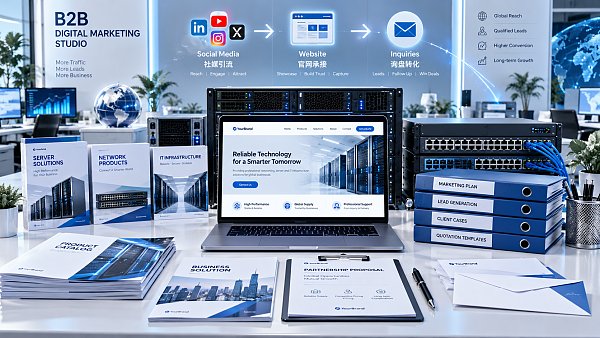
Connect your LinkedIn Company Page with your independent website to create a trackable inquiry path
Most users on social platforms are still in the research and comparison stage and will not submit a purchasing request immediately after seeing a post. Therefore, external links on the page should not all direct users to the website homepage. Linking to the relevant product page, industry solution page, case study page, or inquiry page based on different content topics can reduce the effort visitors need to spend searching for further information.
At a minimum, the landing page should allow customers to find the product range, key specifications or service process, trust-building materials, a contact form, and other contact channels. For complex equipment, customized services, or project-based businesses, the form does not need to be overly long, but it should retain information that enables initial sales qualification, such as procurement region, requirement category, estimated quantity, or project stage. Forms requesting only a name and email address may generate more submissions, but they shift substantial screening work to follow-up personnel.
The website domain is the foundation of this pathway. Companies should use a stable, easily recognizable brand domain and maintain consistency across LinkedIn, corporate email, and the official website. When multiple markets or brand protection are involved, domain services can be used to centrally manage registration, DNS configuration, and renewal reminders, reducing the risk of broken links, inaccessible websites, or brand variants being registered by others. The focus here is not on registering more domains, but on ensuring that the primary domain used publicly remains stable over the long term and redirects correctly to the relevant pages.
Do not make content revolve around company self-description
To continuously acquire B2B inquiries, page content needs to help customers make a specific assessment. Content suitable for long-term operations can generally be divided into three categories:
- Procurement decision-making content: Explain how to select materials, compare processes, evaluate suppliers, and plan lead times, helping customers understand decision criteria.
- Capability validation content: Showcase product details, testing processes, production stages, packaging methods, the team's professional perspectives, or how common issues are handled. The key is to demonstrate how capabilities are applied in specific work.
- Market and application content: Focus on a particular industry, region, or application scenario to explain product suitability conditions and common limitations, attracting audiences whose needs are more closely aligned.
Product promotion can be published, but it is not advisable for every post to directly ask visitors to “request a quote now.” For visitors who have not yet established trust, providing useful information first and then placing relevant pages or communication entry points at the end is generally more aligned with the B2B decision-making cycle. Content language should also match priority markets. When targeting markets with multiple languages, there is no need to put every language into one post; content can be published separately by region and topic, while ensuring linked pages have corresponding language versions.
Employee account participation is necessary for a Company Page to gain genuine engagement
A Company Page is suitable for building up brand content, but relationship building on LinkedIn often takes place between personal accounts. The profiles of sales staff, technical personnel, project managers, or executives should be linked to the Company Page, with clear job descriptions and consistent professionalism in profile photos, experience, and contact details.
After company content is published, relevant employees can add perspectives based on their respective responsibilities, rather than simply reposting with “please like.” For example, technical personnel can explain the applicable conditions of a process, sales personnel can address common questions in the procurement process, and managers can discuss market trends. Such engagement can both expand content reach and show prospects that the company has knowledgeable professionals they can communicate with.
What should be avoided is replacing relationship building with mass connection requests, templated direct messages, or excessive sales promotion. Even if these methods generate visits in the short term, they can easily attract unsuitable contacts and may even negatively affect the account experience. A more effective approach is to build connections around clearly defined industries and job roles, then conduct targeted communication after the other party has viewed content, engaged with it, or shown relevant needs.
Review performance based on “funnel quality” rather than “number of posts”
After operating the page for a period of time, do not look only at follower and like counts. More valuable metrics include: which topics drive page visits, which content generates website clicks, whether visitors come from target regions and industries, and whether form submissions lead to effective sales follow-up. If readership is high but there are no website clicks, the content may be disconnected from the next action; if there are many clicks but inquiry quality is low, check whether the landing page promise is too broad, form qualification is insufficient, or traffic sources have deviated from target customers.
First, establish a workable minimum closed loop
There is no need to wait until all content is ready before going live. Completing the basic Company Page information, one website page that can capture demand, three to five pieces of content focused on procurement questions, and assigning a clear person responsible for inquiry handling are already sufficient conditions for testing. Then, gradually adjust topics, links, and communication methods based on traffic sources and inquiry quality.
Yiyingbao provides services including intelligent website building, multilingual website development, SEO, social media operations, and advertising placement, making it suitable for companies that need to connect LinkedIn traffic, overseas independent websites, and subsequent marketing activities into an integrated system. For B2B lead generation, the value of a Company Page does not lie in how lively it appears, but in whether every visit can lead potential customers toward clearer business assessment and a communication entry point.
Related Articles


Related Products
 Yiyingbao SaaS Intelligent Website Building and Marketing SystemYiyingbao SaaS Intelligent Website Building and Marketing System, AI-powered no-code website building, rapid creation of multilingual B2B international websites in 10 minutes, global server acceleration, AI-powered SEO optimization, helping businesses connect efficiently with global markets. The perfect integration of technology and operation makes building an international trade website remarkably simple
 AI+SEM Intelligent Advertising Marketing SystemAI+SEM drives intelligent ad creation, empowering full-funnel precision advertising marketing. The system automatically generates weekly/monthly reports, AI recommends keywords and target countries, monitors core metrics in real-time with intelligent alerts, and enables one-click high-conversion ad solutions to help quickly acquire customers and improve ROI.
 AI+SEO Dual-Engine System Optimization ServicesYiyingbao’s AI+SEO dual-engine optimization system helps foreign trade enterprises acquire high-quality organic traffic through AI-powered keyword research, content generation, and comprehensive technical optimization, significantly improving search rankings and conversion rates.
 AI+SNS Social Media Marketing SystemYingbao AI+SNS Social Media Marketing System - Precision social capture for the social media era. Supports one-click content synchronization across major platforms like Facebook and LinkedIn. AI intelligently rewrites posts for enhanced relevance. 24/7 AI customer service and user profiling analysis empower businesses to efficiently expand into global markets.
 AI+SEO营销解决方案易营宝AI+SEO营销解决方案,通过AI批量写作、智能生成TDK、精准关键词扩词等功能,全面优化网站SEO效果,提升流量与转化率。助力企业构建高效智能网站新生态。
 AI+SEM Advertising Marketing SolutionsAI+SEM Advertising Marketing Solution leverages AI technology to deeply empower SEM ad campaigns. It automatically generates weekly/monthly reports using AI, presenting account data across multiple dimensions for comprehensive insights into campaign performance and trends. The system precisely recommends keywords and target countries, intelligently generates high-conversion ad copy, and enables one-click activation of efficient campaign plans to help businesses rapidly acquire customers. Simultaneously, it monitors core metrics in real time, intelligently identifies abnormal fluctuations, and issues timely alerts to ensure stable, high-return advertising results.
 Domain Name ServicesEasyWin provides professional domain name services, including intelligent queries, one-stop registration, brand protection, and full lifecycle management, helping businesses build a digital brand image.
 EasyOperate B2C Cross-Border E-Commerce Platform & Independent WebsiteEasyStore B2C Cross-border E-commerce Independent Store is an intelligent website building and cross-border e-commerce integrated solution independently developed by EasyStore Information Technology (Beijing) Co., Ltd. The system is specially designed for small and medium-sized as well as large export enterprises, integrating 'website building, operation, marketing, advertising, and conversion' into one, helping enterprises quickly establish cross-border e-commerce independent stores to achieve brand globalization and global sales growth.
The platform supports multiple languages, multiple currencies, and multi-channel marketing, with built-in AI intelligent translation and SEO optimization systems, suitable for mainstream markets such as Southeast Asia, Europe and America, Latin America, and the Middle East, assisting Chinese manufacturing enterprises in efficiently deploying international e-commerce strategies. SSL证书易营宝提供专业SSL安全证书服务,包括单域名和泛域名证书,确保网站数据传输加密、身份验证和完整性保护,助力企业建立安全可信的在线业务环境。









