









- 21st Century Business Herald: AI and CTV Become Core Growth Engines for Digital Marketing in Overseas MarketsNov 18, 2026View details
- China Presents 25 Cooperation Outcomes in Areas Including Cross-Border E-Commerce During APECNov 18, 2026View details
- AI Products Drive Hong Kong Exports Up 64.9% in September, Fastest Growth in Over 40 YearsNov 17, 2026View details
- National Bureau of Statistics: Foreign trade grew rapidly in October, providing stable support for global tradeNov 17, 2026View details
- The U.S. has ended the $800 de minimis exemption for non-postal shipments; express courier packages must be formally declared.Nov 16, 2026View details
- ASEAN Signs Digital Economy Framework Agreement, Moving Toward Harmonized Cross-Border E-Commerce RulesNov 15, 2026View details
How can you avoid duplicate content when distributing it across multiple social media platforms?
A product introduction may seem easy to repurpose: post it on LinkedIn, then copy it to Facebook, Instagram, and short-video platforms. It may save time, but the results may fall short. The text may be too long for one platform, the visuals may not suit another, and users may lose interest after seeing the same content repeatedly. Distributing content across multiple social media platforms does not mean starting from scratch each time. The key is to keep the core message consistent while adapting the content to different audiences and contexts.
First, distinguish between “consistent information” and “repetitive content”
Businesses need a consistent brand voice. Key information such as product names, specifications, applications, pricing terms, and contact details should be based on verified information and should not be casually rewritten just to make each post different. What needs to change is how the information is presented: the question the opening addresses, the type of media used, the level of detail provided, and the action you want users to take.
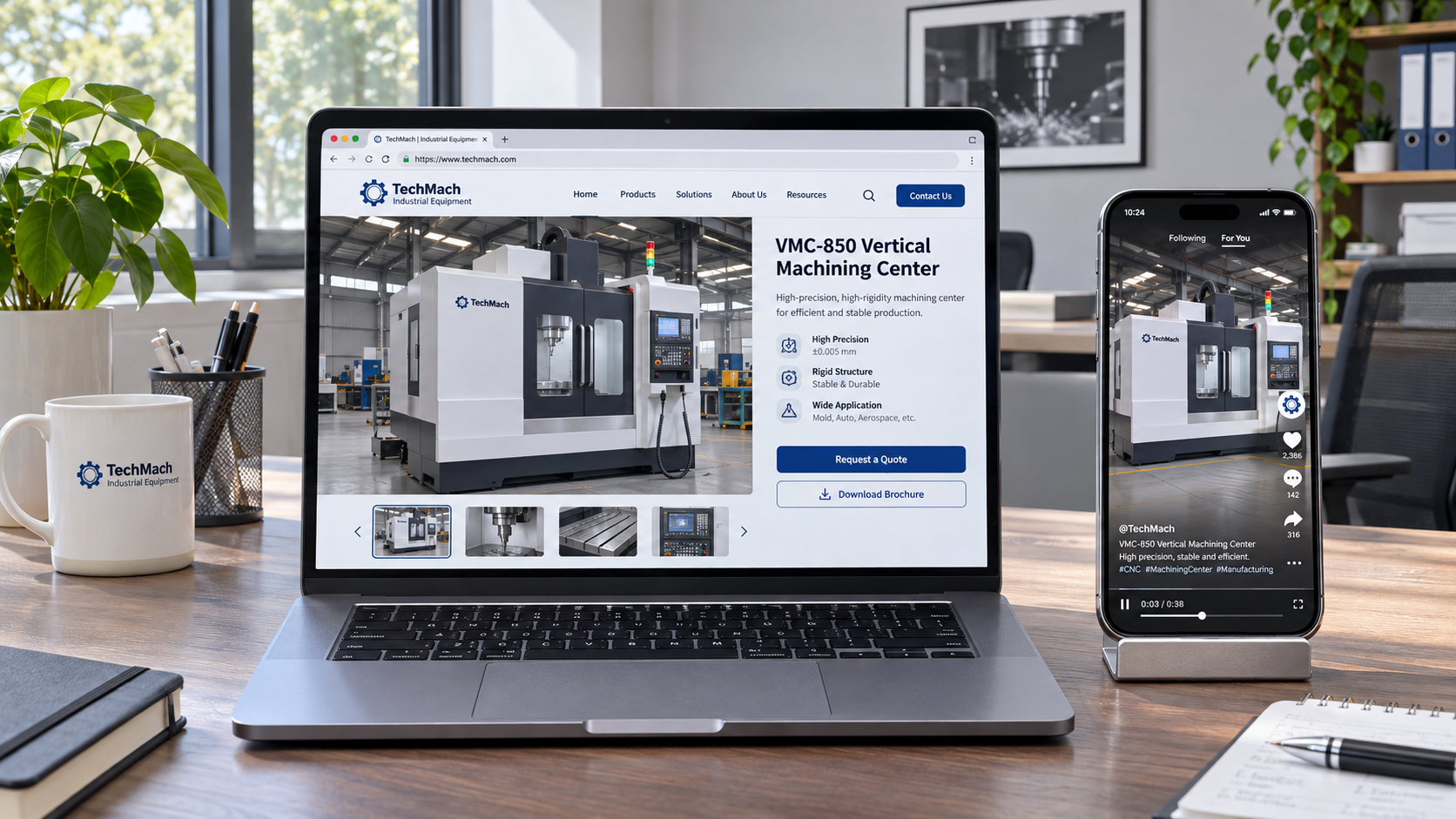
For example, the same industrial equipment can be used to discuss selection considerations that matter to buyers on LinkedIn, show the equipment in use on Facebook, present structural details through images or short videos on Instagram, and provide full specifications on the product page of your website. The topic stays the same, but each platform gives users a different reason to engage.
Copying content directly does not necessarily result in a platform penalty, but it may not match users’ browsing habits and makes it difficult to assess which messaging works best. To determine whether content is repetitive, look beyond how similar the wording is and consider whether users receive the same value when they encounter it on different channels.
Turn one set of source materials into versions for different platforms
Before distributing content, consider preparing a “master draft” that brings together the topic, target audience, key selling points, facts approved for public use, source materials, and target link. The master draft is the factual reference—not a long article to be published as is. Then break it down according to each platform’s purpose:
- LinkedIn: Focus on business challenges. This platform is suitable for reaching procurement professionals, industry practitioners, or potential partners. Build your post around product selection, application experience, or common misconceptions. You could open with a specific question, offer a way to think through the issue, and then direct readers to more detailed information.
- Facebook: Emphasize context and conversation. Use on-site photos, frequently asked customer questions, or a brief demonstration to describe when and how the product is useful. Ending with an easy-to-answer question is more likely to start a conversation than bluntly asking people to like the post.
- Instagram: Let the visuals explain first. Use a carousel or short video to show details, how the product is used, or the steps in a process. Use the text to add information that the visuals cannot convey. The cover should quickly tell users what the post is about, rather than simply display the company logo.
- YouTube and other video channels: Provide a complete demonstration. Create step-by-step videos about installation, operation, or maintenance. Make the title and description clear about the intended audience and what the video covers. Shorter clips can direct viewers to the full video.
These are suggestions for preparing an initial version of your content, not fixed rules. Before publishing, also confirm which platforms are used in your target market, who already follows your accounts, and the current format and linking requirements of each platform.

How can you adapt the same topic without making it feel repetitive?
Suppose an export-oriented factory is preparing to explain “how to choose packaging equipment.” First, establish the shared facts: the types of products the equipment can handle, the key selection criteria, and which specifications need to be confirmed with the company. Then develop the content in different ways:
- Industry perspective: Open on LinkedIn with “What should you consider beyond capacity when choosing equipment?” Discuss material characteristics, shop-floor space, and ongoing maintenance, and include a link to a selection guide.
- Visual, scenario-based post: On Facebook, show the equipment handling different packaging stages. Briefly explain the relevant applications and invite users to share their packaging needs.
- Visual breakdown: On Instagram, use a carousel to present several key components and explain what each one does. Cover just one point per image, and use the caption to direct users to your profile for more information.
- Demonstration video: Film the equipment running and show how to operate it, including any necessary safety information. Cut a short clip from the full video to answer one specific question.
This is not about mechanically splitting a long article into several parts. Instead, choose a complete, focused subtopic for each platform. Even if the same prospective customer sees multiple versions, each can offer a different benefit, such as selection advice, application visuals, or operating information. When creating content, ensure that the equipment’s performance, application conditions, and demonstration footage accurately reflect reality.
Set up a simple workflow to keep revisions organized
When several people manage accounts, repetitive content often results not from a lack of writing skills but from a lack of shared records. You can manage topics in a spreadsheet, with one row for each content topic and fields for platform, audience, format, owner, publication date, asset version, target link, and review status. After publishing, add the live link so colleagues can see what is already online.
A single planning session does not need to cover too many topics. Start with an article for your website, a product-related question, or a genuine demonstration. Confirm which user questions it can answer, then decide which platforms are worth using. There is no need to force content without suitable visuals into a video, or dress up an opinion as an industry conclusion when it lacks supporting business information.
AI tools can help generate headlines, distill key points, and revise initial drafts, but people should still check terminology, specifications, tone, and links before publishing. For multilingual content, pay particular attention to units, dates, industry terminology, and local expression. Do not simply translate the Chinese version sentence by sentence. Claims about product performance or results should be based on information the company can verify.
Can publishing at different times solve the repetition problem?
Spacing out posts can help with scheduling and may reduce the likelihood of the same users seeing identical information repeatedly in a short period. But it is no substitute for adapting the content. Publishing the same image and copy a few days apart still gives users the same content. A more reliable approach is to distinguish the angles first, then schedule posts based on asset readiness and account data.
Also avoid going to the other extreme and turning each platform’s content into a completely unrelated story just to make it different. When users visit your website from social media, they should be able to find the product, guide, or inquiry form mentioned in the post—not land on a homepage and have to search again. Use distinct tracking links for different platforms and check that landing pages open correctly on mobile devices.
Which metrics should you use to make adjustments after publishing?
Do not compare likes alone. Content aimed at B2B buyers may attract valuable product-page visits or inquiries even if it receives little engagement. Depending on your goals, monitor signals such as:
- Content appeal: Review views, video watch metrics, and engagement to assess whether the opening, cover, or topic encourages the target audience to stop and pay attention.
- Traffic quality: Use tracking links and website analytics tools to see how much traffic each platform brings and whether users continue to browse relevant pages.
- Business actions: Track form submissions, qualified inquiries, or other defined conversions, and check which post and landing page brought users to your site.
When comparing results, try to use similar time periods and account for differences in audience size, content format, and whether paid promotion was used. If a particular version performs poorly, try changing the cover or opening first and then observe the results. Avoid changing every element at once, or it will be difficult to identify the cause.
For businesses managing an international website alongside multiple social media accounts, website content, link tracking, and social media assets need to be managed in coordination. Yi Ying Bao offers related services, including intelligent website building, SEO, and overseas social media operations, which can be used to plan the process from content presentation to website follow-up. Whatever tools you use, the quality of distribution still comes down to one thing: give each platform content that is worthwhile in its own right, while guiding users toward a clear and credible next step.
Related Articles
 How can you avoid duplicate content when distributing it across multiple social media platforms?
 What Types of Traffic Can Social Media Marketing Bring to a Cross-Border Independent Website?
 How to Track the Sources of Inquiries to Your Website from Overseas Social Media


Related Products
 Yiyingbao SaaS Intelligent Website Building and Marketing SystemYiyingbao SaaS Intelligent Website Building and Marketing System, AI-powered no-code website building, rapid creation of multilingual B2B international websites in 10 minutes, global server acceleration, AI-powered SEO optimization, helping businesses connect efficiently with global markets. The perfect integration of technology and operation makes building an international trade website remarkably simple
 AI+SEM Intelligent Advertising Marketing SystemAI+SEM drives intelligent ad creation, empowering full-funnel precision advertising marketing. The system automatically generates weekly/monthly reports, AI recommends keywords and target countries, monitors core metrics in real-time with intelligent alerts, and enables one-click high-conversion ad solutions to help quickly acquire customers and improve ROI.
 AI+SEO Dual-Engine System Optimization ServicesYiyingbao’s AI+SEO dual-engine optimization system helps foreign trade enterprises acquire high-quality organic traffic through AI-powered keyword research, content generation, and comprehensive technical optimization, significantly improving search rankings and conversion rates.
 AI+SNS Social Media Marketing SystemYingbao AI+SNS Social Media Marketing System - Precision social capture for the social media era. Supports one-click content synchronization across major platforms like Facebook and LinkedIn. AI intelligently rewrites posts for enhanced relevance. 24/7 AI customer service and user profiling analysis empower businesses to efficiently expand into global markets.
 AI+SEO营销解决方案易营宝AI+SEO营销解决方案,通过AI批量写作、智能生成TDK、精准关键词扩词等功能,全面优化网站SEO效果,提升流量与转化率。助力企业构建高效智能网站新生态。
 AI+SEM Advertising Marketing SolutionsAI+SEM Advertising Marketing Solution leverages AI technology to deeply empower SEM ad campaigns. It automatically generates weekly/monthly reports using AI, presenting account data across multiple dimensions for comprehensive insights into campaign performance and trends. The system precisely recommends keywords and target countries, intelligently generates high-conversion ad copy, and enables one-click activation of efficient campaign plans to help businesses rapidly acquire customers. Simultaneously, it monitors core metrics in real time, intelligently identifies abnormal fluctuations, and issues timely alerts to ensure stable, high-return advertising results.
 Domain Name ServicesEasyWin provides professional domain name services, including intelligent queries, one-stop registration, brand protection, and full lifecycle management, helping businesses build a digital brand image.
 EasyOperate B2C Cross-Border E-Commerce Platform & Independent WebsiteEasyStore B2C Cross-border E-commerce Independent Store is an intelligent website building and cross-border e-commerce integrated solution independently developed by EasyStore Information Technology (Beijing) Co., Ltd. The system is specially designed for small and medium-sized as well as large export enterprises, integrating 'website building, operation, marketing, advertising, and conversion' into one, helping enterprises quickly establish cross-border e-commerce independent stores to achieve brand globalization and global sales growth.
The platform supports multiple languages, multiple currencies, and multi-channel marketing, with built-in AI intelligent translation and SEO optimization systems, suitable for mainstream markets such as Southeast Asia, Europe and America, Latin America, and the Middle East, assisting Chinese manufacturing enterprises in efficiently deploying international e-commerce strategies. SSL证书易营宝提供专业SSL安全证书服务,包括单域名和泛域名证书,确保网站数据传输加密、身份验证和完整性保护,助力企业建立安全可信的在线业务环境。









