









- Which customer acquisition channels will be affected by cross-border marketing trends in 2026?Sep 06, 2026View details
- Which homogenization risks should be considered in an analysis of the AI-powered website building industry?Aug 30, 2026View details
- How Will AI Marketing Trends 2026 Change Advertising Budget AllocationAug 28, 2026View details
- Is the EV SSL certificate market shrinking or upgrading? How should companies assess certificate procurement?Aug 11, 2026View details
- Why the old AMP SEO 2020 practices no longer work and what has changed in current optimization prioritiesAug 02, 2026View details
- How to Choose Topics for an Industry News Section to Attract More Organic Search TrafficJul 29, 2026View details
How to Allocate Content Frequency for Overseas Social Media Account Operations
When managing overseas social media accounts, what many teams struggle with first is not “what to post,” but “how often to post.” Some worry that posting too little means no one will see their content, so they try to increase the frequency as much as possible. Others are afraid of disturbing users and only publish scattered content over long periods. As a result, the account may look busy, but engagement remains unstable and the content schedule becomes increasingly disorganized.
In an overseas social media account management strategy, content frequency is neither better when it is higher nor necessarily safer when it is lower. The real challenge is that different platforms, audiences, and stages have different tolerances for update frequency. If the schedule is not properly planned at the beginning, content gaps, fluctuations in account authority, disorganized team schedules, and even wasted traffic that could otherwise generate conversions may occur later.
Before deciding how many posts to publish each day, first determine the account’s current stage
Many people immediately ask about a fixed posting frequency, but it is more important to first understand what stage the account is in. For a new account, the focus is on building a presence and showing the platform that it is being updated consistently. An account with an established follower base needs more stable output and topic expansion. If the account is primarily responsible for lead generation, its frequency must also take the lead conversion journey into consideration rather than focusing solely on exposure.
A practical way to make this assessment is as follows: if you are still testing your audience, topics, and communication style, do not set the frequency too high at the beginning. Start with a relatively stable schedule and observe which types of content are more likely to attract views, saves, and comments before gradually increasing the frequency. Conversely, if the account has already identified several types of effective content, the frequency can be expanded around those content types instead of starting from scratch every time.
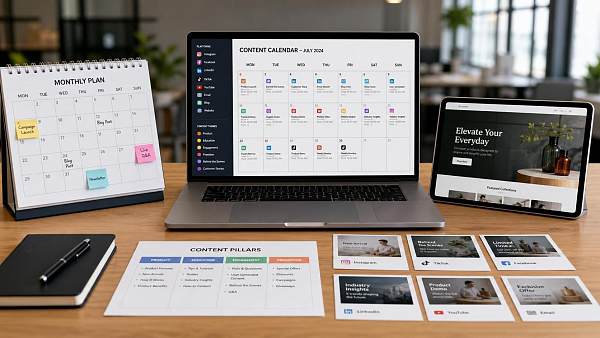
Breaking down content frequency is more useful than simply counting total posts
The key to an overseas social media account management strategy is not only posting consistently, but also allocating content frequency appropriately. Many teams schedule all content together, causing informational, branding, and conversion-oriented content to compete with one another. In the end, none of these categories is updated consistently enough. A more reasonable approach is to first divide content according to its purpose and then arrange an update schedule for each category.
For example, routine content helps maintain activity and is suitable for lightweight updates. Professional content builds trust and can be published less frequently, but each post should be more comprehensive. Interactive content is used to respond to comments, questions, and industry trends, so it is suitable for intermittent publication. Conversion-oriented content should not be published too frequently, as excessive promotion can easily cause audience fatigue. Once content is separated in this way, you will find that “frequency” is no longer just a number, but a combination of different schedules.
Common allocation approaches
If resources are limited, you can first ensure that the primary platform is updated consistently and then use other platforms for supporting distribution. Content on the primary platform should remain continuous, while supporting platforms can adapt or repurpose the same topic into different formats. This avoids adding too much extra work. For many foreign trade companies, manufacturing factories, and cross-border sellers, this approach is more practical than creating content from scratch for every platform.
If you are managing a multilingual website, overseas social media, and advertising campaigns at the same time, content frequency should also align with the overall marketing schedule. If social media content is published too quickly but the website landing page is not ready, users may experience a disconnect after clicking through. If the website is updated frequently while social media remains inactive for a long time, the account may also appear inactive. It is best to coordinate the content schedule with page updates, campaign milestones, and advertising creatives.
Three signals can help you determine whether your posting frequency is appropriate
First, evaluate the quality of engagement rather than looking only at the number of likes. If you are posting more frequently but receiving increasingly superficial comments, your content may be exhausting the audience’s attention. Second, consider whether the team can execute the schedule consistently. Many plans look excellent on paper but become disorganized after only two weeks; this type of schedule is usually unsuitable for long-term operations. Third, assess whether the content is sufficiently differentiated. If every post is more or less the same, even a high posting frequency will only result in repetitive exposure.
For some accounts, the problem is not that they post too little, but that their content lacks hierarchy. Today it is a product image, and tomorrow it is another product image. Today it is an industry opinion, and tomorrow it is still a vague introduction. Over time, users may no longer understand what you are trying to communicate. When frequency is allocated properly, the content should feel varied while the overall direction of the account remains consistent.
A more reliable approach is to define “content buckets” first and then schedule the publishing time
You can divide content into several fixed categories according to its purpose, such as industry insights, product applications, frequently asked customer questions, brand updates, and short-video clips. Then arrange the update frequency based on the characteristics of each platform: visually oriented platforms can publish lightweight content more frequently, while platforms focused on in-depth communication are better suited to a lower frequency and higher quality per post. The advantage of this approach is that the team will not need to find topics at the last minute just to meet a posting quota.
If you are developing an overseas social media account management strategy, you can also use AI website-building, SEO optimization, and overseas marketing tools such as Yiyingbao to synchronize social media content with content on your independent website. For example, social media can be responsible for attracting traffic and reaching audiences, while the website can provide information and capture inquiries. The social media schedule can be organized around new website pages, topical content, and landing-page campaigns, making the overall marketing process more coordinated.
In practice, it is recommended to first break down a month’s themes into weekly plans and then divide them into daily publishing tasks. Do not focus only on “what to post today”; also consider whether the week contains sufficient thematic depth. Frequent updates without sufficient substance will usually only make operations increasingly exhausting.
These situations indicate that it is time to adjust your posting frequency
If any of the following situations continue for a period of time, it is usually time to reallocate your content frequency: engagement declines increasingly quickly after content is published; similar questions begin to appear repeatedly in the comments; the team starts extensively reusing old content in order to meet the update schedule; or a particular platform clearly consumes too much effort without generating corresponding engagement or leads.
At this point, do not rush to increase your investment. First return to the content structure itself. Remove unnecessary pressure to publish daily and reserve your efforts for content that can genuinely support the account. For many overseas social media accounts, consistency is more important than density, and continuity is more important than short-term bursts. Only with an appropriate frequency allocation can an account more easily establish a manageable operating rhythm.
If a simple rule of thumb is needed, first ensure that the schedule can be maintained over the long term before pursuing a higher frequency; first make the content well-structured before considering large-scale publishing. The essence of allocating content frequency in an overseas social media account management strategy is not to “post more,” but to ensure that every publication appears at the right time and in the right context.
Related Articles



Related Products
 Yiyingbao SaaS Intelligent Website Building and Marketing SystemYiyingbao SaaS Intelligent Website Building and Marketing System, AI-powered no-code website building, rapid creation of multilingual B2B international websites in 10 minutes, global server acceleration, AI-powered SEO optimization, helping businesses connect efficiently with global markets. The perfect integration of technology and operation makes building an international trade website remarkably simple
 AI+SEM Intelligent Advertising Marketing SystemAI+SEM drives intelligent ad creation, empowering full-funnel precision advertising marketing. The system automatically generates weekly/monthly reports, AI recommends keywords and target countries, monitors core metrics in real-time with intelligent alerts, and enables one-click high-conversion ad solutions to help quickly acquire customers and improve ROI.
 AI+SEO Dual-Engine System Optimization ServicesYiyingbao’s AI+SEO dual-engine optimization system helps foreign trade enterprises acquire high-quality organic traffic through AI-powered keyword research, content generation, and comprehensive technical optimization, significantly improving search rankings and conversion rates.
 AI+SNS Social Media Marketing SystemYingbao AI+SNS Social Media Marketing System - Precision social capture for the social media era. Supports one-click content synchronization across major platforms like Facebook and LinkedIn. AI intelligently rewrites posts for enhanced relevance. 24/7 AI customer service and user profiling analysis empower businesses to efficiently expand into global markets.
 AI+SEO营销解决方案易营宝AI+SEO营销解决方案,通过AI批量写作、智能生成TDK、精准关键词扩词等功能,全面优化网站SEO效果,提升流量与转化率。助力企业构建高效智能网站新生态。
 AI+SEM Advertising Marketing SolutionsAI+SEM Advertising Marketing Solution leverages AI technology to deeply empower SEM ad campaigns. It automatically generates weekly/monthly reports using AI, presenting account data across multiple dimensions for comprehensive insights into campaign performance and trends. The system precisely recommends keywords and target countries, intelligently generates high-conversion ad copy, and enables one-click activation of efficient campaign plans to help businesses rapidly acquire customers. Simultaneously, it monitors core metrics in real time, intelligently identifies abnormal fluctuations, and issues timely alerts to ensure stable, high-return advertising results.
 Domain Name ServicesEasyWin provides professional domain name services, including intelligent queries, one-stop registration, brand protection, and full lifecycle management, helping businesses build a digital brand image.
 EasyOperate B2C Cross-Border E-Commerce Platform & Independent WebsiteEasyStore B2C Cross-border E-commerce Independent Store is an intelligent website building and cross-border e-commerce integrated solution independently developed by EasyStore Information Technology (Beijing) Co., Ltd. The system is specially designed for small and medium-sized as well as large export enterprises, integrating 'website building, operation, marketing, advertising, and conversion' into one, helping enterprises quickly establish cross-border e-commerce independent stores to achieve brand globalization and global sales growth.
The platform supports multiple languages, multiple currencies, and multi-channel marketing, with built-in AI intelligent translation and SEO optimization systems, suitable for mainstream markets such as Southeast Asia, Europe and America, Latin America, and the Middle East, assisting Chinese manufacturing enterprises in efficiently deploying international e-commerce strategies. SSL证书易营宝提供专业SSL安全证书服务,包括单域名和泛域名证书,确保网站数据传输加密、身份验证和完整性保护,助力企业建立安全可信的在线业务环境。









