









- Which customer acquisition channels will be affected by cross-border marketing trends in 2026?Sep 06, 2026View details
- Which homogenization risks should be considered in an analysis of the AI-powered website building industry?Aug 30, 2026View details
- How Will AI Marketing Trends 2026 Change Advertising Budget AllocationAug 28, 2026View details
- Is the EV SSL certificate market shrinking or upgrading? How should companies assess certificate procurement?Aug 11, 2026View details
- Why the old AMP SEO 2020 practices no longer work and what has changed in current optimization prioritiesAug 02, 2026View details
- How to Choose Topics for an Industry News Section to Attract More Organic Search TrafficJul 29, 2026View details
No Engagement on Facebook Posts? Where Is the Content Rhythm Going Wrong?
Why Do Facebook Posts Get No Engagement? Where Is the Problem with Your Content Rhythm?
When Facebook posts receive little engagement, many teams instinctively assume that the “content is not good enough,” so they work overtime to develop more topics, rush to produce graphics, and chase trending topics. However, anyone with real experience in overseas social media knows that low engagement is often not a problem of content volume, but of an incorrect publishing rhythm. Publishing time, update frequency, content type, the growth stage of the page, and even the sales team’s follow-up capabilities all affect whether a post can ultimately be seen and whether users can be effectively engaged.
For companies providing integrated website and marketing services in particular, Facebook operations are rarely an isolated activity. They are connected with independent website inquiries, advertising remarketing, brand awareness, and off-site traffic acquisition. For platform-based service providers such as Yiyingbao, which cover intelligent website building, SEO optimization, advertising, and overseas social media operations, actual projects make one issue easier to identify: the problem is not simply that “posts receive no response,” but that the publishing rhythm is not aligned with traffic sources and the customer decision-making cycle.
One of the most common mistakes occurs among B2B foreign trade companies. A page may publish only two or three posts per week, with content consisting mainly of product images, factory photos, and holiday greetings. There is no obvious error on the surface, but such accounts face low-frequency decisions, lengthy procurement processes, and audiences across multiple time zones. If content is updated too infrequently, it becomes difficult for the platform to continuously recognize the page’s activity. If the content is too repetitive, users have no reason to stay, comment, or share even when they see it. Many manufacturing companies treat Facebook as an online exhibition showroom, but showroom logic is different from social media logic. At a trade show, customers are willing to ask questions because they have already walked to your booth. On social media, users must first be stopped by the content before they may take action.
What really needs to be adjusted here is not simply “post a little more,” but to divide content into different tasks. Some content is responsible for building professional credibility, some for generating light interaction, and some for bringing users back to the website. For example, for a factory account, production details, delivery milestones, before-and-after application comparisons, and common selection mistakes are usually more likely to encourage users to stop than simple product posters. This is because such content is closer to the questions customers care about before making an inquiry, rather than information the company simply wants to communicate.
Not Every Industry Is Suited to the Same Posting Frequency
The rhythm for cross-border e-commerce is completely different from that for B2B lead generation. Cross-border retail pages typically rely on more frequent exposure testing, have shorter campaign cycles, and experience faster content depreciation, so content can be updated more intensively. For a B2B page, however, publishing three or four product posts in a single day may not increase engagement. Instead, it may disperse the already limited organic reach. Many companies treat “daily posting” as a standard practice, but the result is not a stronger content system; the page increasingly resembles a content warehouse.
In actual execution, it is more effective to assess three conditions before blindly creating a content calendar:
Many teams are not actually incapable of creating content; they simply have not clearly understood the stage their account is in. Low engagement is normal during the early stage of a new page. At this point, a consistent rhythm and clear positioning are more important, so that the platform understands who you are, what you talk about, and whom you want to attract. If an established page has already accumulated a certain number of followers, the problem is often not whether to post, but that the content is too repetitive. Followers already know what you are going to say and therefore are unwilling to click again.
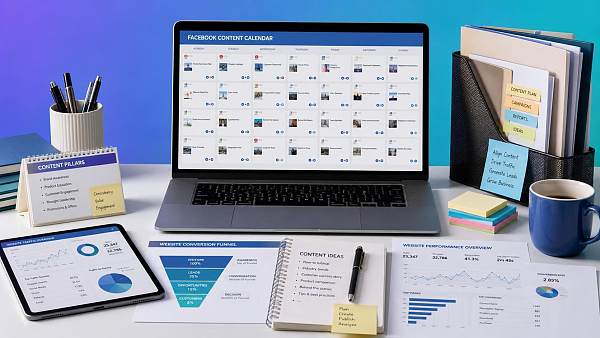
Posting Time Is Not Based on Mysticism, but You Cannot Focus on Just One Best Time Slot
Many companies search everywhere for the “best time to post on Facebook,” hoping to find a universal answer. This approach is highly problematic. Customers in North America, distributors in Southeast Asia, procurement managers in Europe, and distribution channels in the Middle East have significantly different online behaviors. Even within the manufacturing industry, decision-makers and users may not belong to the same type of account at all. Some people browse updates during their commute or lunch break, while others handle industry information after work. If you mechanically pursue the so-called golden hour, you may overlook the actual active windows that have already formed on your own page.
A more practical approach is to observe different regions and content types separately. Engagement peaks may vary for short videos, text-and-image posts, customer-site footage, and technical Q&A content. Some accounts perform more consistently when publishing educational content in the evening because users have time to read it through. Other accounts may receive more likes from industry professionals when they publish application-scenario images during the day. As Facebook operations mature, success is not about who works harder, but who can better match “content format” with “the amount of information users can accept at that moment.”
This is especially evident in multilingual markets. Yiyingbao serves markets across North America, Europe, Southeast Asia, Japan and South Korea, the Middle East, and Latin America. In actual operations, a common situation is that the same type of product content performs only moderately on an English-language page but is more likely to generate comments or direct messages on a local-language page. The reason may not necessarily be a translation issue; it may also be that users in different markets have different preferences for information density and communication styles. A sense of rhythm is not only about what time to post, but also what to post, what tone to use, and how often to repeat the same topic.
Low Engagement May Sometimes Result from Poor Content Task Allocation
Some pages appear to update frequently, but all their content does the same thing: sell products. The problem is that every time users see the content, they must immediately decide whether they are interested, whether to buy, and whether to inquire. The decision threshold is too high. Engagement on social platforms does not always occur with direct sales content. On the contrary, the content that consistently generates comments is often content that reduces users’ comprehension costs, such as explanations of common misconceptions, demonstrations of process differences, or breakdowns of frequently asked customer questions.
This is actually consistent with website content strategy. SEO professionals know that different pages serve different search intents; the same applies to social media content. Brand introductions, product specifications, solutions, and case studies should not all be forced into the same type of post. It is often more effective to break down the core content of a website into formats suitable for social media communication. For example, the viewpoint of a professional article can first be introduced through a question on social media, followed by guidance to more in-depth content on the website. Some companies even turn topics that originally focus on back-office management or financial decisions into business-management content to reach business owners. Content such as A Brief Discussion of Problems and Countermeasures in Corporate Tax Planning, when placed in an appropriate business context, may attract audiences who are more sensitive to operational efficiency rather than being limited to traffic for a single product.
This type of integrated content has one prerequisite: it must match the audience’s role. If your Facebook page targets operations managers at cross-border sellers, website growth, advertising costs, tax compliance, and the return structure of an independent website may all be business topics they care about. However, if your audience mainly consists of end consumers, similar content may be off target. Sometimes, declining engagement is not caused by a poor topic itself, but by a mismatch between the topic and the page’s positioning.
Do Not Focus Only on Post Metrics; Assess the Website and the Subsequent Conversion Path Together
When implementing integrated website and marketing service projects, an easily overlooked reality is that some posts may appear to have average engagement but generate high-quality website traffic, while others may receive many likes but bring low-quality traffic. Focusing only on surface-level comments and likes can lead to an incorrect adjustment of the publishing rhythm. The truly valuable indicators for Facebook operations include not only post-level data, but also time spent after the click-through, page browsing depth, form completion, and even whether the inquiry content becomes more specific.
This is also why many companies feel that they are “busy but achieving no results” when managing social media independently. Social media publishing, website landing pages, form design, SEO content development, and advertising remarketing should originally form a complete chain. For service models such as Yiyingbao’s, which coordinate AI intelligent website building, SEO/GEO optimization, and overseas social media, the value lies not only in offering more comprehensive tools, but also in placing the question of whether content generates engagement within the entire lead-generation process. Whether posting frequency should be increased should not be decided by guesswork based solely on the social media dashboard. Instead, companies should assess whether the website can receive and convert the traffic, whether leads can be identified, and whether there is a mechanism for subsequent secondary engagement.
If a page has been receiving little engagement for a long time, do not rush to overturn the team’s strategy or immediately blame the algorithm. Review the content from the past month and focus on four points: whether the publishing time matches the target market; whether the content has remained focused on the company talking only about itself; whether different types of posts are performing different tasks; and whether the traffic generated after publishing is being captured by the website and sales activities. After these four points are clarified, decide whether to change the content, adjust the frequency, or revise the entire operating process. Many so-called “no engagement” problems are ultimately not caused by a lack of creativity, but by a rhythm that is not grounded in real business needs.
Related Articles



Related Products
 Yiyingbao SaaS Intelligent Website Building and Marketing SystemYiyingbao SaaS Intelligent Website Building and Marketing System, AI-powered no-code website building, rapid creation of multilingual B2B international websites in 10 minutes, global server acceleration, AI-powered SEO optimization, helping businesses connect efficiently with global markets. The perfect integration of technology and operation makes building an international trade website remarkably simple
 AI+SEM Intelligent Advertising Marketing SystemAI+SEM drives intelligent ad creation, empowering full-funnel precision advertising marketing. The system automatically generates weekly/monthly reports, AI recommends keywords and target countries, monitors core metrics in real-time with intelligent alerts, and enables one-click high-conversion ad solutions to help quickly acquire customers and improve ROI.
 AI+SEO Dual-Engine System Optimization ServicesYiyingbao’s AI+SEO dual-engine optimization system helps foreign trade enterprises acquire high-quality organic traffic through AI-powered keyword research, content generation, and comprehensive technical optimization, significantly improving search rankings and conversion rates.
 AI+SNS Social Media Marketing SystemYingbao AI+SNS Social Media Marketing System - Precision social capture for the social media era. Supports one-click content synchronization across major platforms like Facebook and LinkedIn. AI intelligently rewrites posts for enhanced relevance. 24/7 AI customer service and user profiling analysis empower businesses to efficiently expand into global markets.
 AI+SEO营销解决方案易营宝AI+SEO营销解决方案,通过AI批量写作、智能生成TDK、精准关键词扩词等功能,全面优化网站SEO效果,提升流量与转化率。助力企业构建高效智能网站新生态。
 AI+SEM Advertising Marketing SolutionsAI+SEM Advertising Marketing Solution leverages AI technology to deeply empower SEM ad campaigns. It automatically generates weekly/monthly reports using AI, presenting account data across multiple dimensions for comprehensive insights into campaign performance and trends. The system precisely recommends keywords and target countries, intelligently generates high-conversion ad copy, and enables one-click activation of efficient campaign plans to help businesses rapidly acquire customers. Simultaneously, it monitors core metrics in real time, intelligently identifies abnormal fluctuations, and issues timely alerts to ensure stable, high-return advertising results.
 Domain Name ServicesEasyWin provides professional domain name services, including intelligent queries, one-stop registration, brand protection, and full lifecycle management, helping businesses build a digital brand image.
 EasyOperate B2C Cross-Border E-Commerce Platform & Independent WebsiteEasyStore B2C Cross-border E-commerce Independent Store is an intelligent website building and cross-border e-commerce integrated solution independently developed by EasyStore Information Technology (Beijing) Co., Ltd. The system is specially designed for small and medium-sized as well as large export enterprises, integrating 'website building, operation, marketing, advertising, and conversion' into one, helping enterprises quickly establish cross-border e-commerce independent stores to achieve brand globalization and global sales growth.
The platform supports multiple languages, multiple currencies, and multi-channel marketing, with built-in AI intelligent translation and SEO optimization systems, suitable for mainstream markets such as Southeast Asia, Europe and America, Latin America, and the Middle East, assisting Chinese manufacturing enterprises in efficiently deploying international e-commerce strategies. SSL证书易营宝提供专业SSL安全证书服务,包括单域名和泛域名证书,确保网站数据传输加密、身份验证和完整性保护,助力企业建立安全可信的在线业务环境。









