









- Which customer acquisition channels will be affected by cross-border marketing trends in 2026?Sep 06, 2026View details
- Which homogenization risks should be considered in an analysis of the AI-powered website building industry?Aug 30, 2026View details
- How Will AI Marketing Trends 2026 Change Advertising Budget AllocationAug 28, 2026View details
- Is the EV SSL certificate market shrinking or upgrading? How should companies assess certificate procurement?Aug 11, 2026View details
- Why the old AMP SEO 2020 practices no longer work and what has changed in current optimization prioritiesAug 02, 2026View details
- How to Choose Topics for an Industry News Section to Attract More Organic Search TrafficJul 29, 2026View details
How Can Facebook Content Management Improve Engagement Rates?
In an environment where social media traffic is becoming increasingly fragmented, simply maintaining a regular posting schedule is far from enough for businesses that want to gain stable exposure and customers through Facebook. What truly creates a competitive difference is not how much content is published, but whether the business has mastered effective Facebook content operation methods for increasing engagement, encouraging users to stay, comment, share, and even send direct messages or inquiries.
For foreign trade enterprises, brands expanding overseas, and cross-border marketing managers, engagement rate is more than a surface-level metric. It directly affects the efficiency of secondary content distribution, the speed at which brand trust is built, and the conversion costs of subsequent advertising and private-domain customer retention. This article will start from users' actual concerns and break down the core ideas and practical methods for increasing engagement.
Why do many businesses publish plenty of Facebook content but receive little engagement?
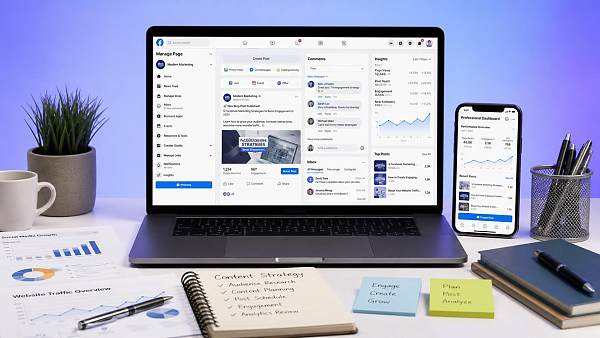
The most common problem many businesses face when managing Facebook is not a lack of content, but content that has not been designed from the user's perspective. Brands focus only on introducing products, promotions, and company strengths while overlooking why users should like, comment on, or share the content. As a result, the content naturally lacks motivation for engagement.
Another common reason is treating Facebook as an information bulletin board rather than a setting for building relationships. Users on the platform are more willing to respond to content with emotion, opinions, and a sense of participation than to one-way product introductions. The more content resembles an advertisement, the lower engagement tends to be.
Some teams value content but lack a well-planned publishing rhythm. Inconsistent publishing times, disorganized content categories, and inconsistent visual styles make it difficult for an account to build lasting recognition. A low engagement rate does not necessarily mean that the product lacks appeal; in many cases, the content mechanism has simply not been properly established.
Businesses should focus not on individual viral posts, but on the business value behind engagement rate
For business managers, judging whether Facebook content operations are effective cannot rely solely on whether a particular post received many likes. More importantly, they should examine whether engagement generates greater organic reach, lower customer acquisition costs, and stronger brand trust. This is the true value of content operations.
Content with a high engagement rate is generally more likely to be recommended by the platform, allowing brands to gain greater exposure without continuously increasing their budgets. Especially for businesses expanding overseas, more stable organic engagement means lower audience education costs for subsequent advertising and higher overall marketing efficiency.
At the same time, comments and sharing behavior are visible signals of user intent. If a certain type of content receives more comments, it indicates that users care more about it; if a certain type of content is more likely to be shared, its value is more transmissible. These insights can guide social media operations while also helping optimize website content, advertising materials, and sales messaging.
To increase engagement, businesses should first adjust their content topics
To increase engagement, the first step is not to rush into copy optimization, but to revise the content topics. Truly effective topics often focus on decision-making issues that concern users, such as how to choose a product, avoid common pitfalls, improve efficiency, or determine whether a supplier is reliable, rather than simply discussing what the brand wants to say.
For foreign trade and cross-border industry accounts, four types of content can be prioritized. The first is experience- and advice-based content that helps users solve business problems; the second is case- and results-based content that builds trust through actual outcomes; the third is trend-focused content that establishes a professional image; and the fourth is interactive question-based content that directly encourages users to express their opinions.
If a business serves B2B customers, it can also produce more decision-support content, such as common purchasing mistakes, cost comparisons between different solutions, and factors affecting delivery times. This type of content is more likely to prompt target customers to leave comments because it addresses the judgment challenges they face in actual business operations.
If you want users to like and comment, how content is expressed matters more than what is posted
Even with the same topic, different ways of expressing it can produce very different engagement results. Many businesses receive no response not because the topic is wrong, but because the writing is too much like promotional material. On Facebook, users are more willing to engage with information that is authentic, direct, and grounded in real situations than with standardized corporate language.
When increasing engagement, businesses can prioritize three types of expression. The first is an opening framed as a question, using a familiar business scenario to create identification; the second is an opinion-led approach that clearly states a position and encourages agreement or discussion; and the third is a comparative presentation that clarifies differences before and after, stimulating users to share their views.
The end of the copy should not simply mechanically say, 'Feel free to contact us.' A more effective approach is to give users a low-barrier action, such as 'Do you care more about price or delivery time?' or 'What is the most common problem you are facing right now?' The more specific the engagement prompt, the higher the comment rate usually is.
Increasing engagement is not just a copywriting technique; it also requires a stable content structure
Many accounts have unstable engagement performance because their content has not been organized into consistent categories and publishing rhythms. They may post a product today, news tomorrow, and a holiday poster the day after, making it difficult for users to develop a habit of following the account. In the long term, a stable structure is more effective at increasing overall engagement than occasional inspiration.
Businesses can establish a fixed content matrix for their Facebook pages, such as sharing industry insights every Monday, customer cases every Wednesday, and interactive Q&A content every Friday. This arrangement has two benefits: it makes it easier for the team to produce content consistently and helps users develop expectations, increasing the likelihood of returning and engaging.
For teams with limited resources, content does not need to be overly complex, but responsibilities must be clearly defined. Which content is responsible for building expertise, which content is intended to stimulate discussion, and which content is designed to support conversion should all be planned in advance. Only then can increased engagement move beyond occasional results.
Publishing times, engagement responses, and comment management directly affect subsequent distribution
Many people focus all their attention on what happens before content is published while overlooking operational actions after publication. In fact, the initial engagement speed of Facebook content affects how the platform evaluates its performance. If a post receives comments and responses within a short time after publication, it will generally have an advantage in subsequent organic distribution.
Therefore, businesses should prioritize testing publishing times. When targeting different markets, users in North America, Europe, and Southeast Asia have significantly different active hours, so posts should not be scheduled solely according to domestic working hours. A/B testing based on the time zones and historical data of target regions is often more effective than relying on assumptions.
Comment management is also essential. When users leave comments, engagement can easily stop if the brand does not respond for a long time. If the brand responds quickly and continues the conversation by asking follow-up questions, providing additional information, or expressing thanks, comment threads will become deeper and content momentum will be more likely to continue.
Which data should be monitored to determine whether increased engagement is truly effective?
Engagement rate cannot be evaluated solely by the number of likes. Meaningful monitoring should also include comment rate, share rate, save intent, direct-message conversions, and link clicks. Different engagement actions represent different levels of user intent, and their underlying business value varies significantly.
If one type of content receives many likes but few comments and clicks, it is likely serving primarily as lightweight exposure content. If comments and direct messages increase significantly, it indicates that the content is more effective at triggering action among target customers. When applying methods for increasing engagement through Facebook content operations, businesses must distinguish between surface-level popularity and real conversion.
Furthermore, it is recommended that businesses analyze social media engagement data together with website visits, inquiry sources, and advertising audience performance. Only in this way can they determine whether increased engagement is truly driving business growth rather than remaining merely 'good-looking data' within the platform. For management teams, this approach offers greater decision-making value.
For businesses expanding overseas, the key to increasing engagement is coordination between content, websites, advertising, and brand storytelling
Facebook operations have limited impact when carried out in isolation. After becoming interested on social media, users typically continue to view the website, landing pages, or other brand social media content. If the information across these channels is inconsistent, the page experience is poor, or the value proposition is unclear, initial engagement will also have difficulty converting into inquiries and sales.
Therefore, businesses are better served by incorporating Facebook content operations into an integrated overseas marketing system. Content builds attention and trust, the website captures search traffic and supports conversion, advertising amplifies high-performing materials, and SEO and GEO continuously attract users with active search intent. Only through coordination among these elements can businesses achieve a higher return on investment.
For an integrated platform such as 易营宝, which provides AI-powered website building, multilingual website development, Google SEO optimization, Facebook advertising marketing, and overseas social media operations, the value lies in helping businesses connect content engagement, website conversion, traffic acquisition, and customer conversion, rather than leaving social media operations at the level of isolated execution.
Conclusion: Truly effective engagement growth comes from making content more relevant to user decisions
Returning to the key question—how can Facebook content operations increase engagement? The answer is not to post more, make content look more like advertising, or simply chase trending topics. Instead, businesses should design topics, messaging, publishing rhythms, and engagement mechanisms around the genuine concerns of target customers, giving every piece of content a reason for users to respond.
For businesses, worthwhile methods for increasing engagement through Facebook content operations should meet three conditions at the same time: users are willing to participate, the platform is willing to distribute the content, and the business can support conversion. Only when all three conditions are met does increased engagement have real significance and become a long-term asset for brand growth in overseas markets.
Related Articles



Related Products
 Yiyingbao SaaS Intelligent Website Building and Marketing SystemYiyingbao SaaS Intelligent Website Building and Marketing System, AI-powered no-code website building, rapid creation of multilingual B2B international websites in 10 minutes, global server acceleration, AI-powered SEO optimization, helping businesses connect efficiently with global markets. The perfect integration of technology and operation makes building an international trade website remarkably simple
 AI+SEM Intelligent Advertising Marketing SystemAI+SEM drives intelligent ad creation, empowering full-funnel precision advertising marketing. The system automatically generates weekly/monthly reports, AI recommends keywords and target countries, monitors core metrics in real-time with intelligent alerts, and enables one-click high-conversion ad solutions to help quickly acquire customers and improve ROI.
 AI+SEO Dual-Engine System Optimization ServicesYiyingbao’s AI+SEO dual-engine optimization system helps foreign trade enterprises acquire high-quality organic traffic through AI-powered keyword research, content generation, and comprehensive technical optimization, significantly improving search rankings and conversion rates.
 AI+SNS Social Media Marketing SystemYingbao AI+SNS Social Media Marketing System - Precision social capture for the social media era. Supports one-click content synchronization across major platforms like Facebook and LinkedIn. AI intelligently rewrites posts for enhanced relevance. 24/7 AI customer service and user profiling analysis empower businesses to efficiently expand into global markets.
 AI+SEO营销解决方案易营宝AI+SEO营销解决方案,通过AI批量写作、智能生成TDK、精准关键词扩词等功能,全面优化网站SEO效果,提升流量与转化率。助力企业构建高效智能网站新生态。
 AI+SEM Advertising Marketing SolutionsAI+SEM Advertising Marketing Solution leverages AI technology to deeply empower SEM ad campaigns. It automatically generates weekly/monthly reports using AI, presenting account data across multiple dimensions for comprehensive insights into campaign performance and trends. The system precisely recommends keywords and target countries, intelligently generates high-conversion ad copy, and enables one-click activation of efficient campaign plans to help businesses rapidly acquire customers. Simultaneously, it monitors core metrics in real time, intelligently identifies abnormal fluctuations, and issues timely alerts to ensure stable, high-return advertising results.
 Domain Name ServicesEasyWin provides professional domain name services, including intelligent queries, one-stop registration, brand protection, and full lifecycle management, helping businesses build a digital brand image.
 EasyOperate B2C Cross-Border E-Commerce Platform & Independent WebsiteEasyStore B2C Cross-border E-commerce Independent Store is an intelligent website building and cross-border e-commerce integrated solution independently developed by EasyStore Information Technology (Beijing) Co., Ltd. The system is specially designed for small and medium-sized as well as large export enterprises, integrating 'website building, operation, marketing, advertising, and conversion' into one, helping enterprises quickly establish cross-border e-commerce independent stores to achieve brand globalization and global sales growth.
The platform supports multiple languages, multiple currencies, and multi-channel marketing, with built-in AI intelligent translation and SEO optimization systems, suitable for mainstream markets such as Southeast Asia, Europe and America, Latin America, and the Middle East, assisting Chinese manufacturing enterprises in efficiently deploying international e-commerce strategies. SSL证书易营宝提供专业SSL安全证书服务,包括单域名和泛域名证书,确保网站数据传输加密、身份验证和完整性保护,助力企业建立安全可信的在线业务环境。









