









- Which customer acquisition channels will be affected by cross-border marketing trends in 2026?Sep 06, 2026View details
- Which homogenization risks should be considered in an analysis of the AI-powered website building industry?Aug 30, 2026View details
- How Will AI Marketing Trends 2026 Change Advertising Budget AllocationAug 28, 2026View details
- Is the EV SSL certificate market shrinking or upgrading? How should companies assess certificate procurement?Aug 11, 2026View details
- Why the old AMP SEO 2020 practices no longer work and what has changed in current optimization prioritiesAug 02, 2026View details
- How to Choose Topics for an Industry News Section to Attract More Organic Search TrafficJul 29, 2026View details
Why Does Conversion Decrease After Translating a Marketing Page?
When entering overseas markets, many companies regard “website content translation” as a relatively standardized task: translate Chinese pages into English, Japanese, or German, and the pages can then be used by local customers. In practice, the results are often the opposite—traffic may remain stable, but the bounce rate increases, inquiries decrease, advertising landing pages perform worse, and even previously effective marketing pages may experience a significant decline in conversion after translation.
This type of issue is particularly important in business evaluations because it directly affects two judgments: first, whether the investment in multilingual content is actually generating returns; and second, whether poor page performance is caused by the channel, the product, or a deviation in the page localization itself. In many cases, the problem is not whether the language is correct, but whether the persuasion mechanism has been preserved.
A marketing page is not merely an information page. It is responsible for persuading visitors, qualifying them, and prompting action. If the original wording is simply transferred into another language without simultaneously adapting to the audience’s psychology, trust signals, value priorities, and conversion path, the page may appear to have been translated successfully while actually losing its ability to generate conversions.
Why does a translated page seem more “understandable” but no longer “convert”?
One of the most common misjudgments in business evaluations is equating translation quality with page quality. Fluent language does not necessarily mean that a page is effective. The core purpose of a marketing page is not to express everything completely, but to reduce decision-making friction.
The reason an original page may convert effectively in a Chinese-language environment is often that it relies on a set of implicit assumptions: customers are familiar with industry terminology, understand the company’s communication style, accept common forms of promises, and know how to initiate communication. After translation, these assumptions may no longer apply.
For example, expressions commonly found on Chinese pages, such as “direct from the manufacturer,” “quality guaranteed,” “welcome to visit our factory,” “customization supported,” and “fast quotation,” sound natural in the domestic context. In overseas markets, however, customers are more concerned with delivery stability, certifications, minimum order quantities, after-sales responsibilities, sample procedures, compliance risks, and response times. A literal translation may not be wrong, but the user’s perception changes—from a “reliable supplier” to a “generic sales page.”
This is why many companies experience the following situation: SEO indexing remains normal and advertising click-through rates are not low, yet marketing page conversion declines. The point at which users are actually lost is not before they enter the page, but within the first few seconds after entry, when they decide whether the company is worth continuing to evaluate.
A decline in conversion is usually not a single translation problem, but four localization problems
In practice, when marketing pages perform worse after translation, the problems usually fall into four categories.
The value proposition remains in the same order, but the customer’s decision-making order has changed
Chinese pages often follow the sequence of “company strengths—product introduction—service advantages—contact and consultation.” This logic may not be effective for overseas purchasers or partners. They often look at suitability first, credibility second, and only then decide whether to make contact.
If the beginning of the page is still dominated by a lengthy company introduction instead of directly answering “What problem can you solve for me?”, “What scenarios is it suitable for?”, and “How are you different from other suppliers?”, users can easily leave within the first few screens. It is not necessarily that they are uninterested; the page simply has not addressed their decision-making needs in the right order.
Trust signals have been translated literally but not reconstructed
The foundation of marketing page conversion is trust. Different markets have very different triggers for trust. Some companies directly translate statements such as “more than ten years of experience,” “serving customers worldwide,” and “reliable quality” and place them on the page, believing that these statements demonstrate their capabilities. In many markets, however, such expressions provide little distinctive information.
Effective trust signals are usually more specific: countries served, industry certifications, delivery performance, authorized partner brands, application cases, after-sales mechanisms, compliance statements, privacy policies, registered company address, telephone number, and local communication methods. Without these details, the page may look like “translated introductory material” rather than “a verifiable business entity.”
The CTA has been translated, but the barrier to action has been increased
Many marketing pages use generic button copy such as “Consult Now,” “Contact Us,” and “Get a Quote.” These are retained after translation without further adaptation. However, users in different markets have different levels of willingness to submit their information. If the page has not answered key questions in advance, users will not be willing to provide their details immediately.
This is especially true in B2B scenarios. Customers often want to know first: Do you support small-batch orders? How long is the delivery time? Can you provide customization? Do you have certifications? Can you provide samples? If these questions have not been basically answered before the CTA, placing the button earlier may make it feel more like pressure than guidance.
The page language has been localized, but the purchasing context has not
This problem is common on multilingual websites. The page text has been translated into the target language, but the currency, units of measurement, contact details, case-study regions, downloadable materials, time-zone information, and even form fields still use the original settings. Users immediately sense that the page is “for everyone” rather than “designed for my market.”
At the conversion level, this sense of inconsistency has a significant impact. Customers are not only evaluating the product; they are also evaluating whether friction in the subsequent cooperation process will be too high.
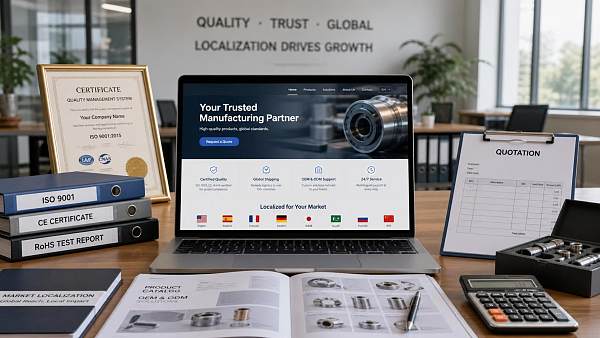
In business evaluations, do not look only at translation costs; consider whether the conversion path has been disrupted
When evaluating a multilingual page project, many companies focus on the translation cost per page, launch speed, and number of languages. What they should really examine is whether the translation has caused an originally effective conversion structure to fail.
A marketing page typically consists of five stages: receiving traffic, matching needs, building trust, eliminating concerns, and triggering action. If any one of these stages breaks after translation, the overall page conversion rate will decline significantly.
Therefore, when determining whether a multilingual marketing page is worth continued investment, companies should not look only at whether the page has been completed. They should also examine whether the following business metrics have changed:
- Has the time spent on the page become shorter?
- Has the click-through rate in key areas declined?
- Have both the form arrival rate and submission rate fallen?
- Has the performance gap between advertising traffic and organic traffic widened?
- Are conversion differences among visitors from different countries abnormal?
- Has inquiry quality declined, rather than just inquiry volume?
If traffic alone has decreased, the problem may lie in advertising or rankings. If the traffic structure has not deteriorated significantly but conversion has suddenly declined, page localization should become a priority for investigation.
Which pages are most likely to “look normal but fail in practice” after translation?
Not all pages depend equally on localization. The pages with the highest risk are usually those responsible for generating conversions.
Advertising landing pages, for example, are particularly vulnerable. Users who click on an advertisement already have clear expectations, so if the value proposition on the landing page does not match those expectations, they will leave very quickly. Product and solution pages are next. These pages need to provide both professional explanations and commercial persuasion, and literal translation can easily turn them into pages that are “complete in information but unclear in focus.”
The homepage comes next. Many companies treat the homepage as the multilingual “front door,” but it is often also the page where trust is evaluated most intensively. If the company introduction, manufacturing capabilities, delivery commitments, qualifications, and contact details are not combined in a localized way, the homepage will directly affect the credibility of the entire website.
By comparison, news, blog articles, and basic FAQ pages generally have less impact on conversion even if their translations are somewhat formal or written. This means that when the budget is limited, translation resources should not be distributed evenly. High-conversion pages should be corrected first.
The truly effective solution is not to translate again, but to rebuild the page’s decision-making logic
When companies discover that marketing page conversion has declined after translation, the most common remedy is to find another translator to polish the copy. However, if the problem lies in the page logic, this type of repair often has limited effect.
A more effective approach is to reassess the page as a sales communication interface for the target market.
First, confirm which type of visitor the page serves: unfamiliar traffic encountering the brand for the first time, or comparison-oriented traffic that already has purchasing intent; visitors arriving through search, or visitors arriving through advertising; distributors, end buyers, or partners. Different types of traffic involve different levels of decision-making, so the page structure should also differ.
Then determine whether the content accomplishes three key tasks: enabling users to quickly confirm relevance, convincing them that you have the ability to deliver, and encouraging them to take the next step. Many multilingual pages are ineffective because they try to discuss the company, products, vision, and services all at once, with the result that none of these points truly aligns with the visitor’s current decision-making stage.
In practical implementation, companies usually need to adjust more than just the copy, including:
- Whether the headline above the fold directly responds to the needs of the target market;
- Whether case studies should be replaced with industry scenarios that are more familiar in the target region;
- Whether key information such as certifications, delivery times, MOQ, and after-sales service is presented earlier;
- Whether there are too many form fields;
- Whether the CTA matches the user’s stage—for example, “Download the Specification Sheet” or “Get a Sample Solution” is often more likely to trigger an initial conversion than “Request a Quote Now”;
- Whether the mobile reading and submission process is smooth.
Do not overlook a practical reality: different markets have different tolerance levels for “marketing language”
This is also a factor frequently underestimated in business evaluations. Some markets are naturally wary of strong sales language, especially in high-value B2B scenarios with long decision cycles. Excessive adjectives, exaggerated promises, dense button placement, and repeated claims of being “leading,” “top-tier,” or “the best” not only fail to improve conversion but may also weaken the sense of professionalism.
Many Chinese marketing pages perform well in the domestic environment because users are already familiar with this type of expression. In overseas markets, however, customers are more receptive to evidence-based communication than emotionally driven communication. The more a page resembles a stack of sales pitches, the more likely it is to be regarded as unreliable.
Therefore, website content translation is not about copying the emotions of the original text. It requires determining which forms of persuasion the target market is more willing to accept: data, case studies, certifications, process transparency, or service response commitments. A marketing page can and should market, but its marketing approach must be localized.
How should companies decide whether to continue optimizing or rebuild the page?
If page traffic remains acceptable, branded searches are stable, and users can enter core sections, but form submissions and qualified inquiries have declined, continued optimization is usually worthwhile. This indicates that demand exists and that the main problems lie in the messaging and the user journey.
If visitors from the target market spend very little time on the page, the bounce rate is extremely high, multiple entry pages perform poorly, and users are unwilling even to continue basic browsing, the page positioning itself may not suit the current market. In this case, the benefits of making minor adjustments are limited, and rebuilding the page based on the target country or customer type is more appropriate.
For business evaluators, the most important question is not whether the “translation quality is good,” but whether the current multilingual page can still perform its customer-acquisition role. This determines whether the budget should be directed toward copy optimization, structural reconstruction, stronger trust signals, or a complete rebuilding of the landing-page system.
A decline in conversion after marketing page translation does not mean that a multilingual strategy is ineffective. More often, companies have mistaken “translation completed” for “localization completed.” From a business-results perspective, a truly effective multilingual page must address language comprehension, trust building, and action conversion at the same time. Completing only the first means that the page can be understood; completing all three gives the page a real chance of being chosen.
Related Articles


Related Products
 Yiyingbao SaaS Intelligent Website Building and Marketing SystemYiyingbao SaaS Intelligent Website Building and Marketing System, AI-powered no-code website building, rapid creation of multilingual B2B international websites in 10 minutes, global server acceleration, AI-powered SEO optimization, helping businesses connect efficiently with global markets. The perfect integration of technology and operation makes building an international trade website remarkably simple
 AI+SEM Intelligent Advertising Marketing SystemAI+SEM drives intelligent ad creation, empowering full-funnel precision advertising marketing. The system automatically generates weekly/monthly reports, AI recommends keywords and target countries, monitors core metrics in real-time with intelligent alerts, and enables one-click high-conversion ad solutions to help quickly acquire customers and improve ROI.
 AI+SEO Dual-Engine System Optimization ServicesYiyingbao’s AI+SEO dual-engine optimization system helps foreign trade enterprises acquire high-quality organic traffic through AI-powered keyword research, content generation, and comprehensive technical optimization, significantly improving search rankings and conversion rates.
 AI+SNS Social Media Marketing SystemYingbao AI+SNS Social Media Marketing System - Precision social capture for the social media era. Supports one-click content synchronization across major platforms like Facebook and LinkedIn. AI intelligently rewrites posts for enhanced relevance. 24/7 AI customer service and user profiling analysis empower businesses to efficiently expand into global markets.
 AI+SEO营销解决方案易营宝AI+SEO营销解决方案,通过AI批量写作、智能生成TDK、精准关键词扩词等功能,全面优化网站SEO效果,提升流量与转化率。助力企业构建高效智能网站新生态。
 AI+SEM Advertising Marketing SolutionsAI+SEM Advertising Marketing Solution leverages AI technology to deeply empower SEM ad campaigns. It automatically generates weekly/monthly reports using AI, presenting account data across multiple dimensions for comprehensive insights into campaign performance and trends. The system precisely recommends keywords and target countries, intelligently generates high-conversion ad copy, and enables one-click activation of efficient campaign plans to help businesses rapidly acquire customers. Simultaneously, it monitors core metrics in real time, intelligently identifies abnormal fluctuations, and issues timely alerts to ensure stable, high-return advertising results.
 Domain Name ServicesEasyWin provides professional domain name services, including intelligent queries, one-stop registration, brand protection, and full lifecycle management, helping businesses build a digital brand image.
 EasyOperate B2C Cross-Border E-Commerce Platform & Independent WebsiteEasyStore B2C Cross-border E-commerce Independent Store is an intelligent website building and cross-border e-commerce integrated solution independently developed by EasyStore Information Technology (Beijing) Co., Ltd. The system is specially designed for small and medium-sized as well as large export enterprises, integrating 'website building, operation, marketing, advertising, and conversion' into one, helping enterprises quickly establish cross-border e-commerce independent stores to achieve brand globalization and global sales growth.
The platform supports multiple languages, multiple currencies, and multi-channel marketing, with built-in AI intelligent translation and SEO optimization systems, suitable for mainstream markets such as Southeast Asia, Europe and America, Latin America, and the Middle East, assisting Chinese manufacturing enterprises in efficiently deploying international e-commerce strategies. SSL证书易营宝提供专业SSL安全证书服务,包括单域名和泛域名证书,确保网站数据传输加密、身份验证和完整性保护,助力企业建立安全可信的在线业务环境。









