









- CBP Finalizes Electronic Rail Export Manifest Rule, Effective October 26, 2026Oct 26, 2026View details
- Amazon’s 2026 peak season surcharge takes effect on October 25Oct 26, 2026View details
- AI Is Eating SaaS: Three Real-World Cases in One AfternoonOct 25, 2026View details
- Exiger CEO: The SaaS Apocalypse Is Real, but It Means Something DifferentOct 25, 2026View details
- Hengqin Cooperation Zone Shares Cross-Border E-Commerce Developments, Focusing on Macao-Hengqin Collaboration and International MarketsOct 24, 2026View details
- A Shenyang study highlights the development of the “cross-border e-commerce + industrial cluster” modelOct 24, 2026View details
How Can a Hardware Fastener Website Ensure Multilingual Field Synchronization?
How can a foreign trade website for hardware fasteners ensure synchronization of multilingual fields? The key is not to translate Chinese pages sentence by sentence into English, German, or Spanish, but to first unify the source of product data, field rules, and review responsibilities. Once information such as specifications, materials, surface treatment, standard numbers, and packaging methods differs across language pages, customers may easily question the factory’s professionalism, and inquiries may stall at the parameter confirmation stage.
Multilingual issues for fastener products are far more complex than those for ordinary corporate websites. A page for a bolt, nut, or washer often includes fields such as dimensions, threads, strength grades, applicable standards, coatings, weight, carton quantity, and applicable industries. Some content can be translated, while some must remain unchanged; some parameters need to be presented according to target-market conventions, while other descriptions must remain consistent with drawings and test reports. The truly effective approach is to turn “translation work” into a manageable data synchronization process.
How can a foreign trade website for hardware fasteners ensure synchronization of multilingual fields?
Here is a direct answer: establish a unified product field database, manage specifications and attributes through a single master data source, and let language pages call the corresponding fields, with errors controlled through required-field validation, change notifications, and pre-publication reviews. The focus is not to make all languages completely identical, but to ensure that the core facts of the same product remain consistent across different language sites.
For example, the M8×30 dimension, DIN 933 standard, 8.8 strength grade, and zinc-plated surface treatment are technical fields that cannot be changed arbitrarily. The English page may use “Zinc Plated,” while the German page may use wording appropriate to local conventions, but one page cannot state zinc plated while another states Dacromet, nor can an 8.8 grade be incorrectly entered as 10.9.
First distinguish between “technical fields” and “marketing fields”
When building multilingual websites, one of the most common mistakes companies make is maintaining all content in a single rich-text editor. When products are updated, staff first revise the Chinese page and then search through each language page for the corresponding paragraph. This may seem manageable when there are few products, but once the number of SKUs increases, missed updates become almost unavoidable.
It is recommended to start with field attributes and divide content into two categories.
- Technical fields: Product name, model, dimensions, thread specification, material, strength grade, standard number, surface treatment, tolerance, weight, packaging quantity, drawings, and certificates. These fields should be entered in a structured format, with units, formats, and selectable values defined.
- Marketing fields: Product selling points, application scenarios, lead-time descriptions, customization capabilities, FAQs, and industry solutions. This content may be rephrased for different languages and markets and should not be required to match word for word.
This distinction is highly practical. Technical fields prioritize “single source, accuracy, and traceability,” while marketing fields prioritize “localization, ease of understanding, and alignment with search habits.” Managing both together often results in English pages with correct parameters but awkward wording, or natural copy that omits key specifications.
Taking “Stainless Steel Bolt” as an example, an English title can include “Hex Bolt” or “Threaded Bolt” according to search habits, but the material grade, diameter range, standard, and surface condition must be output from the unified field database. SEO titles can be optimized, but product facts cannot be freely altered.

The field database should start with product master data, not language pages
A sustainably maintained hardware fastener website will usually first establish a product master table. Each product is assigned a unique product ID, and all language versions are linked to the same ID. This way, when product information is updated, the system knows which English, Russian, and Arabic pages require synchronized review instead of relying on human memory.
Field naming must also be unified. For example, do not mix different terms such as “surface treatment,” “coating,” and “Surface” across products; “standard” and “material standard” should also be separated. If field definitions are unclear, even after translation tools or website-building systems are integrated, the confusion will only be replicated across more pages.
In actual configuration, the following information can be set as mandatory: product model, size range, material, standard, surface treatment, minimum order quantity, packaging method, and inquiry entry point. For fields involving safety performance or purchasing decisions, such as strength grade, salt spray requirements, and certification information, it is recommended to add a secondary review rather than allowing content staff to publish them alone.
Translation is not synchronization: units and standards are the high-risk areas
Many sites appear to have completed translation of their multilingual pages, but problems only emerge during overseas procurement communication. The reason is usually not misspelled words, but rather that units, standards, and technical terminology have not been handled according to market rules.
For example, customers in Europe and the United States may be accustomed to imperial specifications, European customers may focus more on DIN, ISO, or EN systems, and some markets may search for both metric dimensions and imperial expressions. A website does not need to overload every page with standard numbers to accommodate all users, but it must clearly state which specifications the product actually supports, which standard prevails, and whether customization according to drawings is available.
There is a principle here: retain the original technical data in the primary unit, then convert it at the display layer according to target-market requirements. Do not let staff manually convert millimeters to inches and directly hard-code them into pages. Manual conversion is not only prone to errors; it also makes page-by-page review difficult after original specifications change. Where conversion precision is involved, technical personnel should confirm the rules and apply them consistently across the entire site.
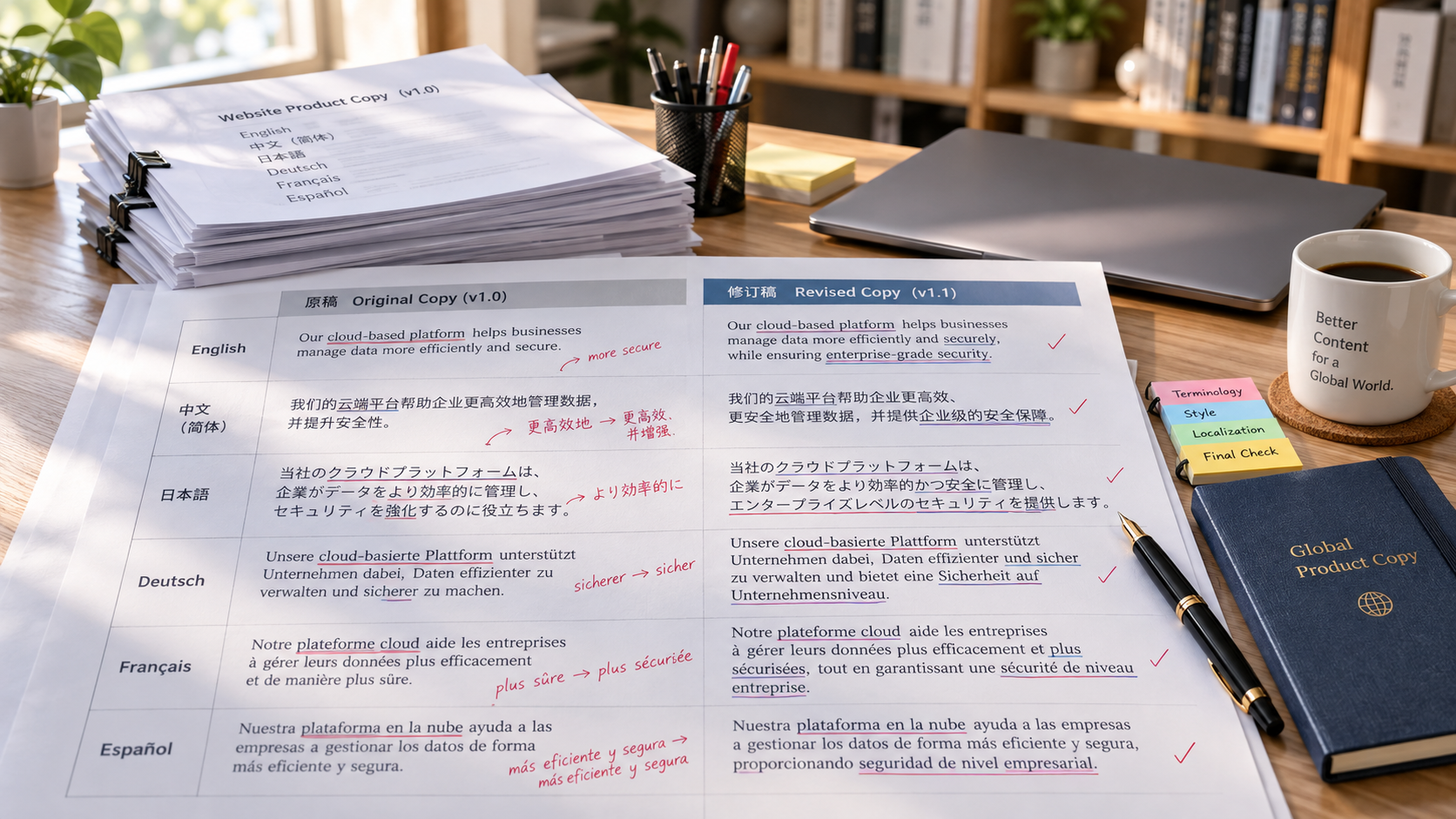
Terminology also requires a glossary. For example, “self-tapping screw,” “machine screw,” and “thread rolling screw” are not interchangeable at will; “galvanized” and “zinc plated” may also lead to differences in understanding in different purchasing contexts. Common terminology, prohibited translations, and standard-number retention rules should form reusable language guidelines rather than being decided ad hoc for each translation.
Make “modified but untranslated” a visible status
The greatest concern in field synchronization is not failing to create multilingual content, but having Chinese data already updated while other language pages still display older versions. The solution is not complicated, but it must be reflected in the system workflow.
When a product master field changes, the corresponding language versions should automatically be marked as “Pending Synchronization” or “Pending Review.” Before review is completed, pages may continue displaying old content or publishing may be restricted according to the company’s risk requirements; however, the backend must clearly show which languages and fields were modified, by whom, and which items have not yet been processed.
In particular, the following changes should not be considered complete after updating only one language page:
- Discontinuation, replacement, or specification-range adjustment of a model;
- Changes to key attributes such as material, strength grade, and surface treatment;
- Adjustments to commercial information such as packaging quantity, minimum order quantity, and lead time;
- Updates to drawings, test reports, and certification documents;
- Changes to page URLs, product categories, and SEO titles.
The final item is often overlooked. Multilingual SEO is not limited to translating body text; page titles, descriptions, image alt text, breadcrumbs, filter options, and structured product attributes must also maintain corresponding relationships. If the URL of an English product page has been changed but language switching still leads to the old link, both search engine indexing and user experience will be affected.
Before publishing, focus on checking these types of pages
It is not recommended to rely on manually reading all language content for every update, as this is costly and has limited effectiveness. A more suitable approach is to first screen with rules and then conduct sample reviews.
Rule-based checks can identify issues such as empty required fields, abnormal numeric formats, missing units, incomplete language-page coverage, unlinked images, and inconsistent standard numbers. Manual reviews should prioritize products with high inquiry volume, advertising landing pages, language pages for key countries, and products that have recently undergone technical changes.
When checking, do not only verify whether the page “displays normally.” It is best to use a product checklist to compare the Chinese master data and language pages side by side, focusing on product model, dimensions, material, standard, surface treatment, document links, and the product identifier in the inquiry form. If a customer submits an inquiry through a German page and the sales team cannot accurately identify the corresponding SKU, even an attractive frontend will still result in lost communication efficiency.
Which companies need systematic synchronization management most?
Factories with few product models, only one English site, and long-term stable parameters can initially use standardized field tables plus manual review, with no need to make the process overly complex from the beginning. However, once there are multi-country language sites, frequent expansion of product lines, shared distributor materials and official website content, or simultaneous needs for Google SEO, advertising landing pages, and cross-border stores, a website-building system that supports structured product management should be adopted as early as possible.
The AI-powered website building and multilingual website development services provided by Yiyingbao are suitable for companies that need to advance product information, page management, and overseas marketing activities within the same system. When selecting a platform, the focus should be on whether it supports unified product field management, language-version linking, modification status tracking, SEO metadata maintenance, and permission-based reviews, rather than simply whether it can generate pages in multiple languages with one click.
Frequently Asked Questions
Can machine translation solve multilingual field synchronization?
It cannot solve it independently. Machine translation can improve the efficiency of first drafts for marketing copy, but it cannot replace product master data management. Models, standards, units, material grades, and strength grades should be controlled through rule-based fields, combined with professional terminology review.
Must product names be exactly the same across different language pages?
Not necessarily. Names can be adjusted according to local purchasing habits and search terms, but the model, key specifications, and product classification must remain consistent. Name localization does not mean technical information can change.
If one product has multiple specifications, should multiple pages be created?
It depends on the purchasing path. If specification differences affect application, standards, or search demand, separate pages are clearer; if they are only standard size variations, a specification table can be used for unified presentation. Regardless of the approach used, specification data should come from the same field database.
Returning to the original question, how can a foreign trade website for hardware fasteners ensure synchronization of multilingual fields? The most reliable answer remains this: first manage product data clearly, then carry out language localization and marketing expansion. Once you establish a unified field database, define terminology rules, record change statuses, and set publication reviews, multilingual pages can truly become assets for acquiring overseas inquiries rather than a group of difficult-to-maintain translated pages.
Related Articles
 Can I learn to use a multilingual content management system without a technical background?
 How can you evaluate a provider’s translation editing capabilities for AI-powered multilingual website services?
 Building a Website for the Russian-Speaking Market: Is Translating the Website Enough?

Related Products
 Yiyingbao SaaS Intelligent Website Building and Marketing SystemYiyingbao SaaS Intelligent Website Building and Marketing System, AI-powered no-code website building, rapid creation of multilingual B2B international websites in 10 minutes, global server acceleration, AI-powered SEO optimization, helping businesses connect efficiently with global markets. The perfect integration of technology and operation makes building an international trade website remarkably simple
 AI+SEM Intelligent Advertising Marketing SystemAI+SEM drives intelligent ad creation, empowering full-funnel precision advertising marketing. The system automatically generates weekly/monthly reports, AI recommends keywords and target countries, monitors core metrics in real-time with intelligent alerts, and enables one-click high-conversion ad solutions to help quickly acquire customers and improve ROI.
 AI+SEO Dual-Engine System Optimization ServicesYiyingbao’s AI+SEO dual-engine optimization system helps foreign trade enterprises acquire high-quality organic traffic through AI-powered keyword research, content generation, and comprehensive technical optimization, significantly improving search rankings and conversion rates.
 AI+SNS Social Media Marketing SystemYingbao AI+SNS Social Media Marketing System - Precision social capture for the social media era. Supports one-click content synchronization across major platforms like Facebook and LinkedIn. AI intelligently rewrites posts for enhanced relevance. 24/7 AI customer service and user profiling analysis empower businesses to efficiently expand into global markets.
 AI+SEO营销解决方案易营宝AI+SEO营销解决方案,通过AI批量写作、智能生成TDK、精准关键词扩词等功能,全面优化网站SEO效果,提升流量与转化率。助力企业构建高效智能网站新生态。
 AI+SEM Advertising Marketing SolutionsAI+SEM Advertising Marketing Solution leverages AI technology to deeply empower SEM ad campaigns. It automatically generates weekly/monthly reports using AI, presenting account data across multiple dimensions for comprehensive insights into campaign performance and trends. The system precisely recommends keywords and target countries, intelligently generates high-conversion ad copy, and enables one-click activation of efficient campaign plans to help businesses rapidly acquire customers. Simultaneously, it monitors core metrics in real time, intelligently identifies abnormal fluctuations, and issues timely alerts to ensure stable, high-return advertising results.
 Domain Name ServicesEasyWin provides professional domain name services, including intelligent queries, one-stop registration, brand protection, and full lifecycle management, helping businesses build a digital brand image.
 EasyOperate B2C Cross-Border E-Commerce Platform & Independent WebsiteEasyStore B2C Cross-border E-commerce Independent Store is an intelligent website building and cross-border e-commerce integrated solution independently developed by EasyStore Information Technology (Beijing) Co., Ltd. The system is specially designed for small and medium-sized as well as large export enterprises, integrating 'website building, operation, marketing, advertising, and conversion' into one, helping enterprises quickly establish cross-border e-commerce independent stores to achieve brand globalization and global sales growth.
The platform supports multiple languages, multiple currencies, and multi-channel marketing, with built-in AI intelligent translation and SEO optimization systems, suitable for mainstream markets such as Southeast Asia, Europe and America, Latin America, and the Middle East, assisting Chinese manufacturing enterprises in efficiently deploying international e-commerce strategies. SSL证书易营宝提供专业SSL安全证书服务,包括单域名和泛域名证书,确保网站数据传输加密、身份验证和完整性保护,助力企业建立安全可信的在线业务环境。









