









- CBP Finalizes Electronic Rail Export Manifest Rule, Effective October 26, 2026Oct 26, 2026View details
- Amazon’s 2026 peak season surcharge takes effect on October 25Oct 26, 2026View details
- AI Is Eating SaaS: Three Real-World Cases in One AfternoonOct 25, 2026View details
- Exiger CEO: The SaaS Apocalypse Is Real, but It Means Something DifferentOct 25, 2026View details
- Hengqin Cooperation Zone Shares Cross-Border E-Commerce Developments, Focusing on Macao-Hengqin Collaboration and International MarketsOct 24, 2026View details
- A Shenyang study highlights the development of the “cross-border e-commerce + industrial cluster” modelOct 24, 2026View details
How can foreign trade websites in the packaging industry reduce technical maintenance workload?
The maintenance burden of a foreign trade website in the packaging industry often comes not from a single redesign, but from continuously changing product information. Categories such as cartons, color boxes, flexible packaging bags, labels, and cushioning inserts involve numerous parameters, while materials, basis weight, dimensions, printing processes, surface treatments, minimum order quantities, and lead times are often adjusted according to orders. If adding products, updating language versions, or launching inquiry pages always depends on development schedules, marketing content updates can easily lag behind, and the technical team may remain caught up in fragmented fixes for a long time.
How can packaging industry foreign trade websites reduce the maintenance workload of technical teams? First, separate frequent content changes from underlying technical changes. Product descriptions, specification tables, application scenarios, downloadable materials, and FAQs should be managed in a unified backend; server configuration, template code, plugin updates, tracking scripts, and similar items should have clear publishing permissions and rules. Mixing these two types of work is what causes a simple parameter update to require code changes, page testing, and republishing.
Organize product data before creating pages
Packaging product pages have a high degree of repetition, but their fields are not entirely the same. Corrugated cartons may emphasize flute type, edge crush strength, load-bearing method, and packing dimensions; laminated flexible packaging needs to specify film structure, barrier properties, sealing method, food-contact suitability, and whether it is supplied as rollstock or bags. If this information is written only in free text, later changes can easily result in inconsistencies between English parameters and PDF materials, different translations for the same material name, or outdated lead times remaining on old pages.
A more maintenance-efficient approach is to first establish a product field library and divide reusable information into structured fields, such as product category, substrate, thickness range, printing method, surface finish, customizable size range, applicable products, packaging format, sample status, and information required for inquiries. Pages can use these fields to generate specification sections, so content staff only need to maintain the data source rather than repeatedly adjust page layouts. For technical specifications that have not yet been confirmed, conditional wording such as “can be confirmed according to requirements” should be retained to avoid entering parameters that cannot be consistently fulfilled merely to fill the page.
- Establish a Chinese-English terminology table for material names, such as PET, PE, BOPP, kraft paper, and corrugated board, to reduce the use of multiple translations across different pages.
- Standardize display rules for dimensions, thickness, and weight units. Where necessary, provide millimeters, microns, basis weight, or imperial conversions at the same time, but keep the data source consistent.
- Enter “optional features” and “standard configurations” separately. Processes such as lamination, hot stamping, spot UV, tear notches, and hanging holes should not be stated by default as available for all products.
Although this step may appear to focus on content management, it can substantially reduce technical rework. Once fields are stable, creating a similar new product usually only requires selecting a template, completing the information, and uploading assets; the page structure does not need to be redeveloped.
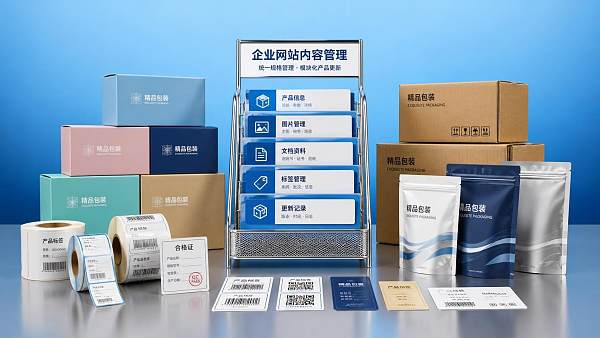
Use modular templates to control the scope of redesigns
A common maintenance risk on foreign trade websites is that each product page is created by copying and assembling content from different people. While this enables fast launches in the short term, any later adjustment to inquiry forms, mobile image ratios, structured data, or privacy notices requires checking pages one by one. Packaging websites are particularly prone to this issue because the number of product pages grows quickly and many pages differ only in dimensions or application descriptions.
Pages can be divided into a small number of combinable modules: above-the-fold product overview, materials and processes, specifications, application industries, customization process, quality control information, downloads, inquiry form, and related products. Each module should have fixed data inputs and display logic. For example, the download module automatically hides when there are no test reports or drawings; when no clear minimum order quantity is available, the page does not display a fabricated number; if a product category is not suitable for showing transportation testing information, that section is not loaded.
The number of templates should not be excessive either. Setting up a limited number of templates by product form is generally easier to maintain than designing one separately for each series. Visual variations can be achieved through hero images, process images, colors, and content order, without creating independent code for every packaging type. Mobile display should be handled consistently at the template level: specification tables can scroll horizontally or be converted into grouped information, overly long product names can wrap automatically, and inquiry buttons can remain in a stable position, preventing content updates from disrupting the layout.
Set publishing boundaries for multilingual content
Multilingual pages in the packaging industry involve more than translating titles. Material terminology, production processes, transportation conditions, and compliance statements may all vary by market. Directly machine-translating Chinese pages and publishing them simultaneously may appear to reduce maintenance work, but in reality it only postpones proofreading, correction, and search indexing issues.
A more reliable process is to first define the fields and templates for the primary-language pages, then send reusable fields into translation tasks. Product models, numerical units, file numbers, and image annotations should be retrieved from a unified data source whenever possible, avoiding manual rewriting in every language. For terms that can easily cause misunderstanding, such as “recyclable,” “food-grade,” “biodegradable,” and “moisture-proof,” the decision to display them must be based on the actual material, sales region, and available documentation; when complete evidence is unavailable, use more cautious wording and avoid copying it in bulk across the website.
Language versions can have separate publishing statuses: draft, pending review, published, and pending update. When core product data changes, the system should be able to flag affected language pages instead of allowing outdated translations to remain on the live site. This way, the technical team does not need to be involved in every translation adjustment, and the content owner can identify which versions have not yet been synchronized.
Integrate SEO maintenance into daily editing tasks
Many websites treat SEO as a dedicated task after launch, resulting in another batch of pages requiring completion whenever a product is added. A more practical approach is to preset necessary items in the editing interface: page title, description, main heading, image alt text, canonical link, index status, and product structured data fields. Before publishing content, only a small number of key items need to be checked, without logging into multiple tools or modifying template code.
For packaging products, search-focused pages should not merely stack generic terms such as “custom packaging” and “printing packaging.” Page content should be built around actual purchasing intent, such as material combinations, printing results, items being packaged, size customization, moisture-resistance or barrier requirements, and packing and transportation methods. Similar pages need clear differentiation: one page may discuss the zipper and laminated structure of stand-up pouches, while another discusses filling and sealing requirements for spout pouches, avoiding large volumes of duplicate content created by simply replacing product names.
When products are discontinued or series are adjusted, maintenance rules are equally important. Temporarily out-of-stock products do not need to have their pages deleted immediately; when a product is permanently discontinued and has a replacement model, an explanation can be retained and users can be directed to related products; where no suitable replacement content exists, then evaluate whether an appropriate status should be returned. Arbitrarily deleting pages that have already been indexed may cause external links to fail and increase subsequent investigation work.
Reduce the accumulation of plugins and temporary scripts
Technical maintenance is often slowed down by plugins, pop-ups, analytics code, and marketing tags. Every added function brings compatibility, loading speed, privacy notice, and upgrade risks. Common functions for packaging foreign trade websites, such as inquiries, file downloads, online chat, and form tracking, should preferably be configured within existing system capabilities; when external tools are genuinely required, clearly define their owner, purpose, pages where they load, and conditions for deactivation.
Do not allow advertising tracking code to be repeatedly pasted by editors of different pages. It should be managed centrally in a unified location, with production and test environments distinguished. Before launch, checking form submission, file downloads, language switching, and the mobile above-the-fold area is sufficient; a full-site regression test is not necessary for every copy adjustment. Updates involving templates, form fields, payments, or privacy settings should be verified on a test page before publication.
A reduced maintenance workload does not mean that a website remains unupdated for a long time; it means that most updates can be completed through clear data, templates, and approval rules. Technical resources should be reserved for matters that truly affect stability, speed, and security, rather than repeatedly handling fragmented requests for product parameters, image replacements, and multilingual copy.
Related Articles
 Can content automatically generated by a website builder be published directly?
 Can AI assist with website optimization, and which recommendations need human verification?
 How can you verify the factual accuracy of AI-assisted product content?


Related Products
 Yiyingbao SaaS Intelligent Website Building and Marketing SystemYiyingbao SaaS Intelligent Website Building and Marketing System, AI-powered no-code website building, rapid creation of multilingual B2B international websites in 10 minutes, global server acceleration, AI-powered SEO optimization, helping businesses connect efficiently with global markets. The perfect integration of technology and operation makes building an international trade website remarkably simple
 AI+SEM Intelligent Advertising Marketing SystemAI+SEM drives intelligent ad creation, empowering full-funnel precision advertising marketing. The system automatically generates weekly/monthly reports, AI recommends keywords and target countries, monitors core metrics in real-time with intelligent alerts, and enables one-click high-conversion ad solutions to help quickly acquire customers and improve ROI.
 AI+SEO Dual-Engine System Optimization ServicesYiyingbao’s AI+SEO dual-engine optimization system helps foreign trade enterprises acquire high-quality organic traffic through AI-powered keyword research, content generation, and comprehensive technical optimization, significantly improving search rankings and conversion rates.
 AI+SNS Social Media Marketing SystemYingbao AI+SNS Social Media Marketing System - Precision social capture for the social media era. Supports one-click content synchronization across major platforms like Facebook and LinkedIn. AI intelligently rewrites posts for enhanced relevance. 24/7 AI customer service and user profiling analysis empower businesses to efficiently expand into global markets.
 AI+SEO营销解决方案易营宝AI+SEO营销解决方案,通过AI批量写作、智能生成TDK、精准关键词扩词等功能,全面优化网站SEO效果,提升流量与转化率。助力企业构建高效智能网站新生态。
 AI+SEM Advertising Marketing SolutionsAI+SEM Advertising Marketing Solution leverages AI technology to deeply empower SEM ad campaigns. It automatically generates weekly/monthly reports using AI, presenting account data across multiple dimensions for comprehensive insights into campaign performance and trends. The system precisely recommends keywords and target countries, intelligently generates high-conversion ad copy, and enables one-click activation of efficient campaign plans to help businesses rapidly acquire customers. Simultaneously, it monitors core metrics in real time, intelligently identifies abnormal fluctuations, and issues timely alerts to ensure stable, high-return advertising results.
 Domain Name ServicesEasyWin provides professional domain name services, including intelligent queries, one-stop registration, brand protection, and full lifecycle management, helping businesses build a digital brand image.
 EasyOperate B2C Cross-Border E-Commerce Platform & Independent WebsiteEasyStore B2C Cross-border E-commerce Independent Store is an intelligent website building and cross-border e-commerce integrated solution independently developed by EasyStore Information Technology (Beijing) Co., Ltd. The system is specially designed for small and medium-sized as well as large export enterprises, integrating 'website building, operation, marketing, advertising, and conversion' into one, helping enterprises quickly establish cross-border e-commerce independent stores to achieve brand globalization and global sales growth.
The platform supports multiple languages, multiple currencies, and multi-channel marketing, with built-in AI intelligent translation and SEO optimization systems, suitable for mainstream markets such as Southeast Asia, Europe and America, Latin America, and the Middle East, assisting Chinese manufacturing enterprises in efficiently deploying international e-commerce strategies. SSL证书易营宝提供专业SSL安全证书服务,包括单域名和泛域名证书,确保网站数据传输加密、身份验证和完整性保护,助力企业建立安全可信的在线业务环境。









