









- Which customer acquisition channels will be affected by cross-border marketing trends in 2026?Sep 06, 2026View details
- Which homogenization risks should be considered in an analysis of the AI-powered website building industry?Aug 30, 2026View details
- How Will AI Marketing Trends 2026 Change Advertising Budget AllocationAug 28, 2026View details
- Is the EV SSL certificate market shrinking or upgrading? How should companies assess certificate procurement?Aug 11, 2026View details
- Why the old AMP SEO 2020 practices no longer work and what has changed in current optimization prioritiesAug 02, 2026View details
- How to Choose Topics for an Industry News Section to Attract More Organic Search TrafficJul 29, 2026View details
Should an International SEO Multilingual Website Start with Architecture or Content?
For International SEO and Multilingual Websites, Should You Build the Structure or Create the Content First?
When carrying out international SEO optimization, should a multilingual website be structured first or should the content be created first? This question is frequently raised at project kickoff meetings, and the people asking it are usually not operations staff, but business owners, heads of international trade, and marketing managers. What they really care about is not the technical sequence itself, but when the website will be indexed, when it will start generating inquiries, and whether making the wrong decision at the beginning will lead to redesigns, ranking losses, translation rework, or even conflicts between advertising and SEO traffic systems.
If only one conclusion can be given, most corporate websites targeting overseas markets—especially multilingual websites intended for long-term organic search growth—should generally have their structure clearly defined before entering systematic content development. However, “first” does not mean that all page frameworks must be completed and every technical detail frozen before any content work begins. It means first stabilizing the structural framework that affects indexing, index allocation, relationships between language versions, and future scalability, and then introducing content according to priority.
This distinction may not be so obvious for a single-language website, but once English, Spanish, French, German, Russian, Arabic, or Southeast Asian languages are involved, the situation is completely different. A multilingual corporate website is not simply a matter of translating Chinese pages into other languages. At its core, it is an organizational project involving multiple markets, search environments, and conversion paths.
Why Many Projects Go Off Track from the Start
A common misjudgment is to treat “the speed of publishing content” as “the speed of launching SEO.” Writing content first may seem faster, and as the number of pages increases, the team may feel that the project is progressing significantly. However, if language directories, URL rules, the relationship between countries and languages, site navigation levels, and product classification methods have not yet been determined, the more content is created, the higher the rework cost becomes. This situation is particularly common on websites for international trade and manufacturing companies: company introductions, product details, news, and case studies are translated and published all at once in the early stage, only for the team to discover two months later, when international SEO optimization begins, that the English and other language sites are mixed at the same level, product categories are organized according to Chinese business logic rather than overseas buyers’ search habits, and blog directories and product directories are competing with each other for indexing access points. The website can ultimately only be adjusted a second time.
This rework is not merely a matter of development workload. More importantly, search engines may already have begun identifying the old URLs, old structure, and relationships between old pages. Each change means that redirects, canonical tags, sitemaps, and internal-link authority must all be handled again. If the work is done carefully, part of the accumulated value can be preserved; if it is done roughly, the content production and external-link resources invested in the early stage will be diluted.
What Does the “Structure” That Comes First Actually Mean?
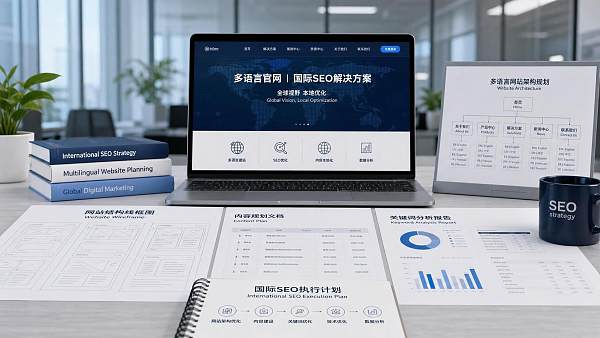
The structure referred to here is not merely the front-end layout, nor is it simply the column tree in technical development. For a multilingual corporate website, four things genuinely need to be determined first: how languages and regions will be divided, how content types will be layered, at which level conversion entry points will be placed, and whether the structure can support the addition of new markets in the future.
Here is a practical example of the difference. For a B2B international trade inquiry website, product pages, industry solution pages, application pages, technical support pages, and case study pages serve different search intents. When a buyer searches for a product model, the landing page should be completely different from the one used when searching for “how to solve a particular problem in a particular process.” If this distinction is not made during the structural phase, the content team can usually only keep making product pages longer, attempting to cover specifications, industries, applications, FAQs, and service commitments at the same time. The result is a heavy page with an unfocused topic.
Similarly, for a B2C cross-border independent website, many companies begin by creating product details and campaign pages because they appear closest to conversion. However, if the relationships between directory rules, filtering logic, brand-term pages, and category-term pages have not been clarified first, a large number of similar pages may emerge later. This affects crawling efficiency and disperses internal authority. Such websites are not prohibited from publishing content first; rather, large-scale content deployment should not take place without an information architecture.
When Can Content Come First?
Not every project must strictly follow the sequence of “structure first, content second.” If a company already has a mature main-site structure, plans to add only a small number of language versions, and has stable core product lines and clearly defined page types, content can be introduced in advance and should even be developed in parallel. For these projects, the greatest risk lies not in the structure but in localization quality.
For example, if an English website has been operating for many years and the company is preparing to expand into Spanish- and German-speaking markets, while the page templates, URL standards, technical foundation, and conversion paths can all be reused, the factors that most often affect performance are whether keywords have been reworked according to local search habits, whether the titles and body copy avoid literal-translation phrasing, and whether contact details and trust information match the reading habits of local visitors. If a large amount of time is still spent redrawing the site structure at this stage, the overall pace may actually be slowed down.
There is one prerequisite, however: the existing site structure must already be adequate. Many companies believe that they “already have a website,” when in fact they only have a site capable of displaying information, not necessarily one suitable for supporting multilingual SEO. Excessively deep navigation, ambiguous section names, redundant mobile loading, and repetitive page components may be manageable in a single-market environment, but once replicated in a multilingual environment, these problems will be magnified several times over.
For Manufacturing and International Trade Companies, Structure Often Comes First
Based on practical experience with integrated website and marketing service projects, international trade companies and manufacturing plants are the most likely to underestimate the importance of structure. The reason is simple: these companies often have complex product systems, numerous specifications, and a wide range of application industries. The same product may also be described differently in the search markets of different countries. Internally, Chinese companies may classify products by workshop, process, series, or material, while overseas buyers may search by application, problem type, industry standard, or procurement stage.
If the focus is placed only on content production from the beginning, the resulting pages often reflect “what the company wants to say” rather than “how customers search.” Building the structure first is essentially the first round of market mapping: identifying which pages serve brand awareness, which pages serve category searches, which pages address long-tail questions, which pages are suitable as landing pages for advertising traffic, which content should retain a consistent template across different language sites, and which content must be rewritten through separate localization.
This is also why many companies later choose to manage website development, SEO optimization, and advertising within one coordinated system. A corporate website is not an isolated collection of pages, but an integrated combination of traffic entry points, content assets, and conversion paths. For an AI-driven intelligent website-building and overseas marketing platform such as Yiyingbao, the value lies not only in creating the website, but also in keeping the underlying website-building system aligned with subsequent SEO, advertising, and social media distribution. For a multilingual corporate website, this consistency is more important than speed at any single point.
What You Really Need to Prioritize Is Not Which Comes First, but Which Batch Comes First
The most practical approach during project implementation is usually not to choose between the two, but to divide structure and content according to priority. First define the core markets, core languages, and core page types; launch with the smallest viable structure; and then expand gradually. This avoids delaying launch in pursuit of an overly comprehensive system while also preventing rushed content accumulation from blocking future development.
A relatively sound sequence is often as follows:
- First define language directories, URL rules, page templates, and navigation levels;
- At the same time, complete keyword research for core countries and create a list of the first batch of landing pages;
- Prioritize the launch of the homepage, core product pages, key industry pages, and contact and conversion pages;
- Then add blogs, knowledge content, case studies, and long-tail topic pages.
The advantage of this approach is that search engines can first identify a clear structure, while the business team can quickly obtain a batch of pages that are genuinely suitable for advertising, indexing, and handling inquiries. Whether the next step is long-term Google SEO optimization or traffic generation through Google Ads and social media, the project will not need to repeatedly return to the drawing board because the website foundation is unstable.
Several Decision Points That Are Easily Overlooked in Practice
First, look at the number of languages, not merely the amount of translation. A project involving three languages and one involving ten languages require completely different organizational approaches. As the number of languages increases, ongoing maintenance, version synchronization, and update frequency become operational issues rather than merely website-building issues. If the structure is unclear, changing a single product specification later may affect multiple language sites.
Second, assess whether the content sources are stable. Some companies have complete product materials and mature English collateral, making them suitable for entering content production quickly. Other companies have even their Chinese materials scattered across sales documents, brochures, and sales staff chat records. In such cases, creating content prematurely often results in many pages with incomplete information and limited SEO or conversion value.
Third, consider whether advertising will be added later. If the website also needs to support Google Ads, Facebook Ads, or short-video traffic acquisition, its page structure cannot be designed solely around SEO logic. Advertising landing pages emphasize short conversion paths and minimal distractions, while SEO pages generally require more comprehensive information coverage. These two types of pages can share some underlying modules, but they should not be completely combined into one format.
Fourth, assess whether the team has the capacity for ongoing maintenance. International SEO optimization is not a one-time deliverable. Especially after a multilingual website goes live, content iteration, technical inspections, page expansion, and reviews of search performance all need to keep pace. Teams without sustained operational capabilities should simplify the structure and focus on the primary market from the beginning, rather than launching too many languages and sections at once.
The Sequence Ultimately Depends on the Growth Objective
If the goal is to launch a website quickly, start running advertisements quickly, and validate the market quickly, the company can adopt a “light structure + core content first” approach and get the minimum number of essential pages up and running. If the goal is to turn a multilingual corporate website into a long-term customer acquisition asset, especially one capable of consistently generating organic traffic across North America, Europe, Southeast Asia, and other regions, the structure must come before large-scale content production.
In other words, the decision to build the structure first or create the content first should not be based on preference, but on the role the website is expected to play in the future. A website intended merely for presentation and a foundation intended to support global search growth have completely different requirements. The former prioritizes speed of launch, while the latter prioritizes scalability, indexability, and reusability.
For most companies that are serious about developing overseas markets, the more reliable answer remains: build the structural foundation of the multilingual corporate website correctly first, and then allow content to grow continuously around the target markets. This approach may be half a step slower at the beginning, but it often prevents many unnecessary detours later. What truly requires urgency is not publishing a few more pieces of content today, but ensuring that six months from now the website can still expand, rank, and generate conversions.
Related Articles


Related Products
 Yiyingbao SaaS Intelligent Website Building and Marketing SystemYiyingbao SaaS Intelligent Website Building and Marketing System, AI-powered no-code website building, rapid creation of multilingual B2B international websites in 10 minutes, global server acceleration, AI-powered SEO optimization, helping businesses connect efficiently with global markets. The perfect integration of technology and operation makes building an international trade website remarkably simple
 AI+SEM Intelligent Advertising Marketing SystemAI+SEM drives intelligent ad creation, empowering full-funnel precision advertising marketing. The system automatically generates weekly/monthly reports, AI recommends keywords and target countries, monitors core metrics in real-time with intelligent alerts, and enables one-click high-conversion ad solutions to help quickly acquire customers and improve ROI.
 AI+SEO Dual-Engine System Optimization ServicesYiyingbao’s AI+SEO dual-engine optimization system helps foreign trade enterprises acquire high-quality organic traffic through AI-powered keyword research, content generation, and comprehensive technical optimization, significantly improving search rankings and conversion rates.
 AI+SNS Social Media Marketing SystemYingbao AI+SNS Social Media Marketing System - Precision social capture for the social media era. Supports one-click content synchronization across major platforms like Facebook and LinkedIn. AI intelligently rewrites posts for enhanced relevance. 24/7 AI customer service and user profiling analysis empower businesses to efficiently expand into global markets.
 AI+SEO营销解决方案易营宝AI+SEO营销解决方案,通过AI批量写作、智能生成TDK、精准关键词扩词等功能,全面优化网站SEO效果,提升流量与转化率。助力企业构建高效智能网站新生态。
 AI+SEM Advertising Marketing SolutionsAI+SEM Advertising Marketing Solution leverages AI technology to deeply empower SEM ad campaigns. It automatically generates weekly/monthly reports using AI, presenting account data across multiple dimensions for comprehensive insights into campaign performance and trends. The system precisely recommends keywords and target countries, intelligently generates high-conversion ad copy, and enables one-click activation of efficient campaign plans to help businesses rapidly acquire customers. Simultaneously, it monitors core metrics in real time, intelligently identifies abnormal fluctuations, and issues timely alerts to ensure stable, high-return advertising results.
 Domain Name ServicesEasyWin provides professional domain name services, including intelligent queries, one-stop registration, brand protection, and full lifecycle management, helping businesses build a digital brand image.
 EasyOperate B2C Cross-Border E-Commerce Platform & Independent WebsiteEasyStore B2C Cross-border E-commerce Independent Store is an intelligent website building and cross-border e-commerce integrated solution independently developed by EasyStore Information Technology (Beijing) Co., Ltd. The system is specially designed for small and medium-sized as well as large export enterprises, integrating 'website building, operation, marketing, advertising, and conversion' into one, helping enterprises quickly establish cross-border e-commerce independent stores to achieve brand globalization and global sales growth.
The platform supports multiple languages, multiple currencies, and multi-channel marketing, with built-in AI intelligent translation and SEO optimization systems, suitable for mainstream markets such as Southeast Asia, Europe and America, Latin America, and the Middle East, assisting Chinese manufacturing enterprises in efficiently deploying international e-commerce strategies. SSL证书易营宝提供专业SSL安全证书服务,包括单域名和泛域名证书,确保网站数据传输加密、身份验证和完整性保护,助力企业建立安全可信的在线业务环境。









