









- Ministry of Commerce: Online retail sales grew 4.4% in the first three quarters, while cross-border e-commerce maintained relatively rapid growthOct 29, 2026View details
- CCTV reports: AI-powered smart hardware is expanding overseas at a faster pace, with orders for some best-selling products booked through next yearOct 29, 2026View details
- Alphabet Q3 Earnings: Google Search Advertising Revenue Rises 10.5% to $82 BillionOct 29, 2026View details
- AliExpress Announces New Service Rules for Russia, Linked to Wildberries Product IntegrationOct 28, 2026View details
- Black Friday Preparations Enter the Final Sprint Week as Cross-Border E-Commerce Platforms Roll Out Their PlansOct 28, 2026View details
- CBP Finalizes Electronic Rail Export Manifest Rule, Effective October 26, 2026Oct 26, 2026View details
Technical Architecture for International Website Development: How Multilingual Content, Regions, and SEO Work Together
Define Site Boundaries Before Deciding on the Number of Languages
The challenge of international website development usually lies not in whether pages can switch languages, but in whether search engines, users, and content teams recognize “the same website” as a consistent system. During technical evaluation, the first thing to confirm is not how many languages will be launched, but which countries or regions the company intends to serve, and whether independent product, pricing, delivery, compliance, and conversion paths exist among these markets.
For example, when English pages target buyers in the United States, the United Kingdom, and Southeast Asia, if product specifications, certification descriptions, inquiry contacts, and delivery commitments are largely consistent, a single main English site can be used initially, with page content and traffic data then used to determine whether regional versions should be separated. Conversely, if the German market requires an independent privacy policy, units of measurement, product materials, and local contacts, language switching alone is often insufficient to support conversion and compliance. An independent regional version should be established at the information architecture level.
This decision directly affects URLs, content models, SEO annotations, backend permissions, and subsequent publishing processes. If the architecture is defined too broadly from the start, common issues later include different markets being forced to share unsuitable pages, new language launches requiring the entire site to be duplicated, and editorial teams having to repeat the same operation across multiple pages to modify a single product parameter.
URL Structure Determines Whether Regions and Languages Can Be Properly Managed
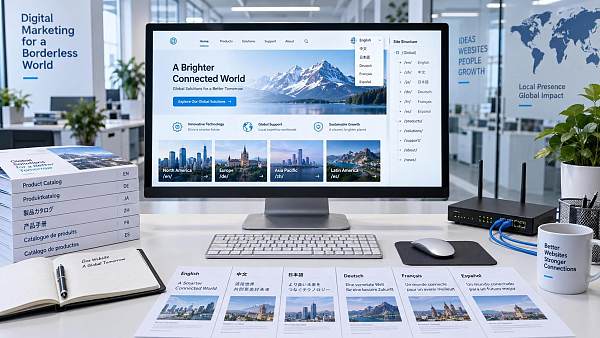
Multilingual and multi-regional websites need each version that can be searched, shared, and measured to have a stable address. Common approaches include country-code top-level domains, subdomains, and directory structures. No single structure is inherently suitable for every business.
- Country-code top-level domains: for example, using the corresponding domain for a single country. Their regional signals are clear and they are suitable for businesses with local teams, independent brand strategies, or long-term market investment, but domain, content, and authority management become more fragmented.
- Subdomains: for example, creating separate site entry points by country or language. They are suitable when the technical environment, business entity, or operations team genuinely needs to be isolated, but the responsibility for content and link building for each subsite must be clearly defined.
- Directory structures: for example, dividing paths by language or region under the main domain. They are easier to maintain for most B2B companies in an expansion phase, as templates, components, and content assets can be reused, while analytics and permission systems are more centralized.
Technical evaluation should not focus only on whether “subdirectories are supported.” More importantly, languages and regions should be built as independent content dimensions. A product page should at least distinguish between source content, translated content, localized fields, sale availability, and SEO metadata. If the backend only provides an option to “copy a page and then translate it,” version drift can easily occur as new markets are added: the Chinese source page may have updated certification materials, while the Spanish or Arabic page still retains the old version.
A more reliable data relationship is usually “content entity + language version + market version.” Product models, image assets, and basic technical parameters can serve as shared entities; while copy, units, download materials, contacts, tax notices, and call-to-action buttons can be overridden by language or region. This avoids making every market a completely independent website while retaining the level of control needed for business localization.
hreflang Resolves Version Relationships, Not Content Localization
The hreflang tag most frequently mentioned in international SEO is used to tell search engines which URLs are language and regional alternative versions of the same or similar content. Its purpose is to help search results present more suitable pages to users in different languages and regions, rather than enabling any translated page to automatically rank.
Three conditions should be checked during deployment. First, tags must use accessible, indexable final canonical URLs and must not point to redirect pages, pages restricted by robots, or addresses with test parameters. Second, references between pages should form a closed loop: when the English U.S. version points to the German Germany version, the German Germany version should also point back to the English U.S. version and include its own version. Third, language and region codes must comply with standards; language codes and region codes cannot be written arbitrarily.
For pages differentiated only by language, language identifiers can be used; for pages in the same language serving different countries, a “language-region” combination should be used. A default version can be set for users without a clearly matching version, but the default page must not become a substitute for content in all markets. If content for the French market, the French Canadian market, and a general French page is highly similar, it is still necessary to first determine whether there are genuinely independent service differences before deciding whether to separate them, avoiding the creation of large numbers of low-value duplicate pages merely for tag completeness.
Canonicalization, Redirects, and Indexing Rules Must Be Designed Together
Multilingual SEO mistakes often occur when page logic conflicts. A URL may have a canonical pointing to the main English page while declaring itself as a French alternative page; or after users enter a German page from search results, IP detection forcibly redirects them to the English homepage. The former weakens the independent indexing signal of regional pages, while the latter affects search engine crawling and causes cross-border buyers to lose control over the page language.
Canonicalization principles should be clear: for language or regional versions with genuinely independent content, the canonical should generally point to itself; when the same page generates multiple addresses due to filter parameters, tracking parameters, or duplicate paths, canonical should then be used to consolidate them to the main URL. Automatic redirects can be used to recommend a language, but a prominent and persistently available language-switching entry must be retained and visitors must not be prevented from staying on their selected version.
It is also necessary to check whether the sitemap includes all indexable versions, whether HTTP status codes are correct, and whether pagination and internal search pages are unintentionally indexed. For sites with heavy JavaScript rendering, the technical team should ensure that key body content, titles, links, language annotations, and product structured data are available in the initial HTML or through reliable server-side rendering. Relying entirely on browser-side scripts to load core information increases crawling and troubleshooting costs.
The Translation Process Determines Whether SEO Pages Have Business Value
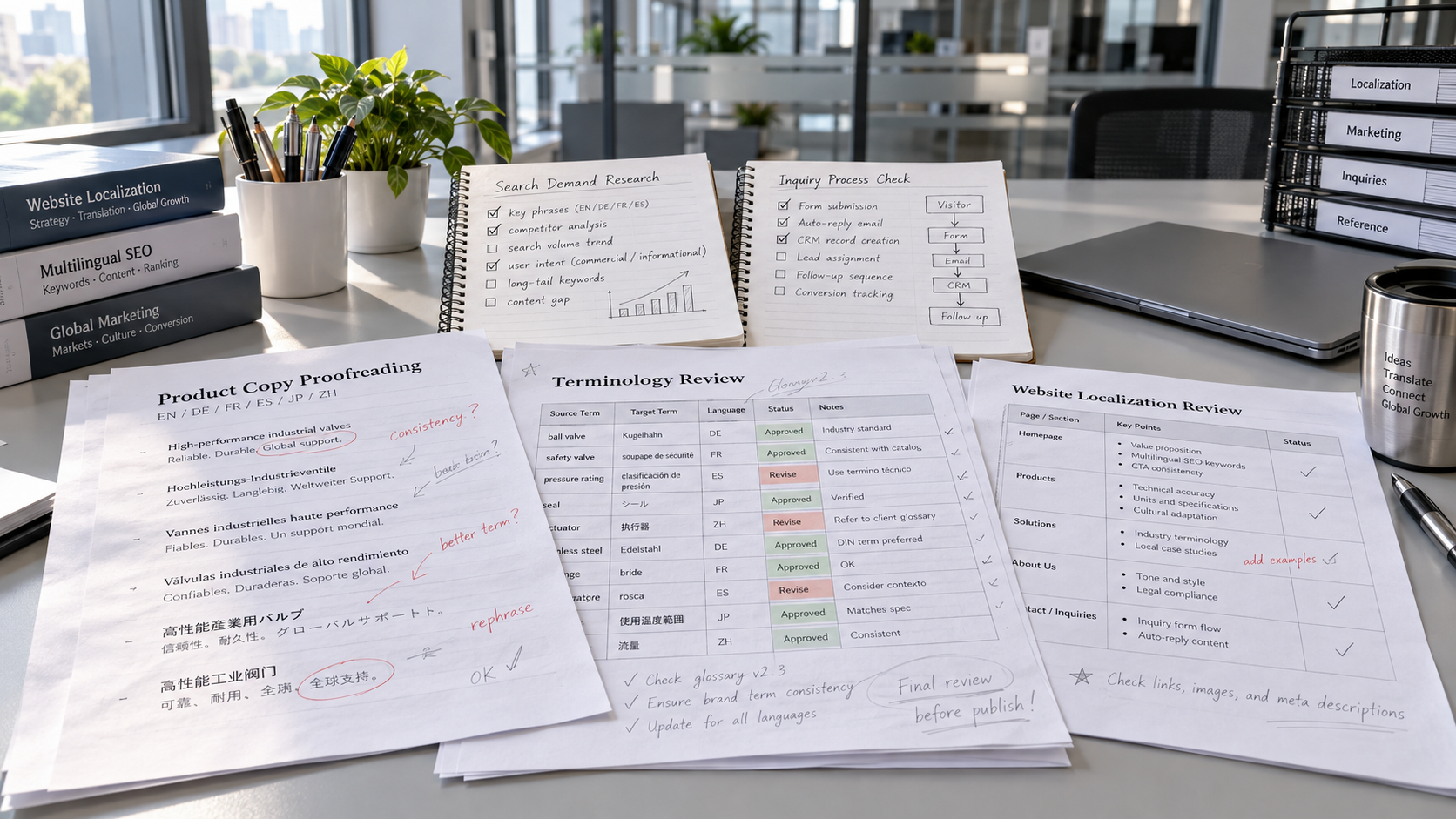
Machine translation can accelerate first-draft production, but it cannot replace localized editing. Product names, application terminology, certification wording, dimensional units, and inquiry language on B2B websites often have a greater impact on trust assessment than general marketing copy. Translating Chinese pages sentence by sentence into English and then copying them into other languages can easily result in inconsistent terminology, unnatural search expressions, or commitments that exceed actual local service capabilities.
Fields suitable for inclusion in the content workflow include page titles, descriptions, body text, image alt text, file download names, form prompts, currencies and units, internal link anchor text, and frequently asked questions for different markets. Technically, these fields should be independently maintainable by language version, with source content relationships and review status retained. Otherwise, even if editors complete the body translation, they may overlook search snippets, image information, or form terms.
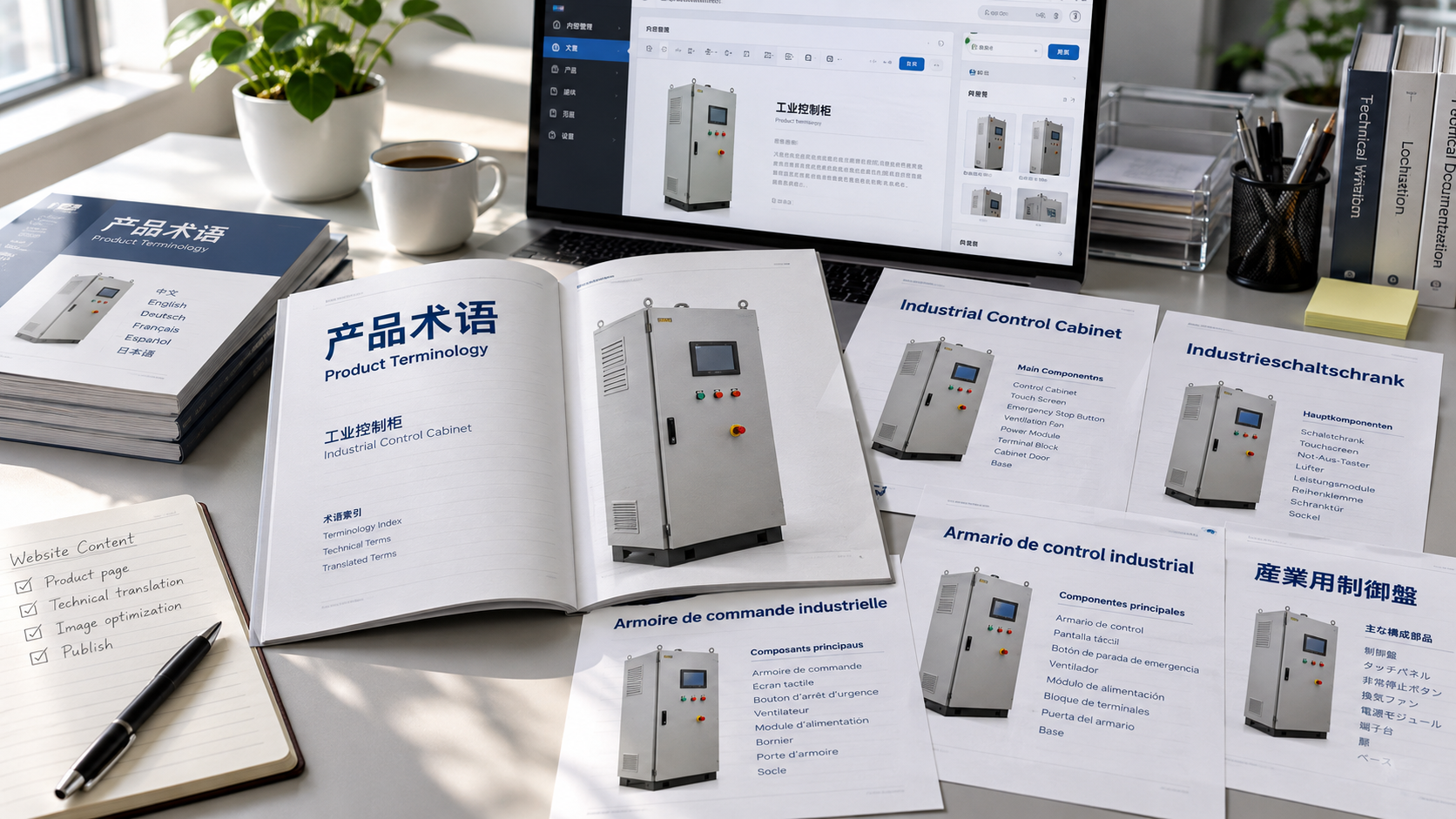
For manufacturing companies whose product information is frequently updated, it is recommended to distinguish between fields that “must be synchronized” and fields that “allow local adjustment.” Models, key parameters, and safety instructions should generally have a change synchronization mechanism; market cases, promotional selling points, and inquiry paths can be maintained by regional teams. When evaluating a website-building system, this process should be demonstrated rather than merely reviewing the front-end language-switching effect.
Four Types of Coordination Should Be Verified Before Launch
Ultimately, the technical value of international website development is reflected in whether expansion can remain controllable. When only two or three languages are initially created, manually copying pages may seem sufficient; as product lines increase, regional rules diverge, and SEO pages continue to accumulate, differences in content models and version governance will quickly become magnified. Only by treating languages, regions, indexing, and content maintenance as one architectural issue can new markets be launched without having to rebuild the website.
Related Articles
 How Can Brands Going Global Assess a Multilingual Website Provider’s Localization Capabilities?
 How to Validate RTL Layouts for Arabic Website Development Services in Shanghai
 How Can You Keep Product Terminology Consistent Across Multilingual Website Translations?

Related Products
 Yiyingbao SaaS Intelligent Website Building and Marketing SystemYiyingbao SaaS Intelligent Website Building and Marketing System, AI-powered no-code website building, rapid creation of multilingual B2B international websites in 10 minutes, global server acceleration, AI-powered SEO optimization, helping businesses connect efficiently with global markets. The perfect integration of technology and operation makes building an international trade website remarkably simple
 AI+SEM Intelligent Advertising Marketing SystemAI+SEM drives intelligent ad creation, empowering full-funnel precision advertising marketing. The system automatically generates weekly/monthly reports, AI recommends keywords and target countries, monitors core metrics in real-time with intelligent alerts, and enables one-click high-conversion ad solutions to help quickly acquire customers and improve ROI.
 AI+SEO Dual-Engine System Optimization ServicesYiyingbao’s AI+SEO dual-engine optimization system helps foreign trade enterprises acquire high-quality organic traffic through AI-powered keyword research, content generation, and comprehensive technical optimization, significantly improving search rankings and conversion rates.
 AI+SNS Social Media Marketing SystemYingbao AI+SNS Social Media Marketing System - Precision social capture for the social media era. Supports one-click content synchronization across major platforms like Facebook and LinkedIn. AI intelligently rewrites posts for enhanced relevance. 24/7 AI customer service and user profiling analysis empower businesses to efficiently expand into global markets.
 AI+SEO营销解决方案易营宝AI+SEO营销解决方案,通过AI批量写作、智能生成TDK、精准关键词扩词等功能,全面优化网站SEO效果,提升流量与转化率。助力企业构建高效智能网站新生态。
 AI+SEM Advertising Marketing SolutionsAI+SEM Advertising Marketing Solution leverages AI technology to deeply empower SEM ad campaigns. It automatically generates weekly/monthly reports using AI, presenting account data across multiple dimensions for comprehensive insights into campaign performance and trends. The system precisely recommends keywords and target countries, intelligently generates high-conversion ad copy, and enables one-click activation of efficient campaign plans to help businesses rapidly acquire customers. Simultaneously, it monitors core metrics in real time, intelligently identifies abnormal fluctuations, and issues timely alerts to ensure stable, high-return advertising results.
 Domain Name ServicesEasyWin provides professional domain name services, including intelligent queries, one-stop registration, brand protection, and full lifecycle management, helping businesses build a digital brand image.
 EasyOperate B2C Cross-Border E-Commerce Platform & Independent WebsiteEasyStore B2C Cross-border E-commerce Independent Store is an intelligent website building and cross-border e-commerce integrated solution independently developed by EasyStore Information Technology (Beijing) Co., Ltd. The system is specially designed for small and medium-sized as well as large export enterprises, integrating 'website building, operation, marketing, advertising, and conversion' into one, helping enterprises quickly establish cross-border e-commerce independent stores to achieve brand globalization and global sales growth.
The platform supports multiple languages, multiple currencies, and multi-channel marketing, with built-in AI intelligent translation and SEO optimization systems, suitable for mainstream markets such as Southeast Asia, Europe and America, Latin America, and the Middle East, assisting Chinese manufacturing enterprises in efficiently deploying international e-commerce strategies. SSL证书易营宝提供专业SSL安全证书服务,包括单域名和泛域名证书,确保网站数据传输加密、身份验证和完整性保护,助力企业建立安全可信的在线业务环境。









