









- Ministry of Commerce: Online retail sales grew 4.4% in the first three quarters, while cross-border e-commerce maintained relatively rapid growthOct 29, 2026View details
- CCTV reports: AI-powered smart hardware is expanding overseas at a faster pace, with orders for some best-selling products booked through next yearOct 29, 2026View details
- Alphabet Q3 Earnings: Google Search Advertising Revenue Rises 10.5% to $82 BillionOct 29, 2026View details
- AliExpress Announces New Service Rules for Russia, Linked to Wildberries Product IntegrationOct 28, 2026View details
- Black Friday Preparations Enter the Final Sprint Week as Cross-Border E-Commerce Platforms Roll Out Their PlansOct 28, 2026View details
- CBP Finalizes Electronic Rail Export Manifest Rule, Effective October 26, 2026Oct 26, 2026View details
How can foreign trade digital marketing solutions connect lead generation, inquiry nurturing, and deal tracking
Customers in overseas markets do not complete a purchase after a single click. Especially for foreign trade companies with high average order values and long decision-making cycles, customers may first search for solutions on Google, learn about suppliers through LinkedIn weeks later, then return to the website to download materials and submit an inquiry, with sales ultimately advancing the order at an offline trade show or through a video meeting. If these touchpoints are disconnected, companies see only the appearance of “traffic but few conversions.”
The real value of a foreign trade digital marketing solution is not simply building a website, running an advertising campaign, or managing several social media accounts separately. It is about connecting customer acquisition, identification, nurturing, sales follow-up, and deal review into a manageable growth process. For business decision-makers, the key is not how broadly channels are deployed, but whether every marketing investment can answer three questions: Where do customers come from? Why do they stay? Do they ultimately convert?
Shifting from “Traffic Thinking” to “Customer Journey Thinking”
Many foreign trade teams encounter similar situations: SEO brings organic visits, Google Ads generates clicks, and social media content occasionally receives engagement, yet the sales department still considers lead quality unstable. The issue is often not that a particular channel has completely failed, but that the channels are not coordinated around the same customer journey.
For B2B manufacturing companies, for example, purchasers may initially search for product models, industry standards, or application solutions rather than a company name. At this stage, the website needs to meet search demand by providing clear product pages, technical specifications, application scenarios, and credible company information. When customers move into the comparison stage, they pay more attention to lead times, customization capabilities, certifications, service responsiveness, and partnership risks. At this point, case studies, FAQs, downloadable catalogs, and email follow-up become significantly more important. At the inquiry and negotiation stage, advertising attribution, form sources, communication records, and quotation feedback determine whether sales can advance the opportunity in a targeted manner.
Therefore, foreign trade marketing should not focus only on “traffic volume” or “number of inquiries.” Traffic reflects exposure, and inquiries reflect initial interest, while qualified opportunities, sample requests, quotation response rates, and sales cycles are closer to actual business results.
The First Link: Making an Independent Website an Identifiable Customer Acquisition Entry Point
An overseas independent website is the central destination for digital marketing, but many company websites still function merely as electronic brochures: their homepages are information-dense, product pages lack keyword planning, inquiry entry points are difficult to find, and multilingual pages are simply machine-translated. Visitors find it difficult to quickly determine whether “this supplier is right for me.” Even when such websites attract traffic, visitors are likely to leave within seconds.
A website-building strategy better suited to overseas business should consider both “being found” and “being trusted.” Website architecture needs to align with product lines, target industries, and search habits in different regions. In addition to displaying specifications, product pages should explain application value, available configurations, delivery methods, and common questions. When targeting markets such as Europe and North America, the Middle East, and Latin America, multilingual content must also take into account units, language conventions, and local purchasing priorities.
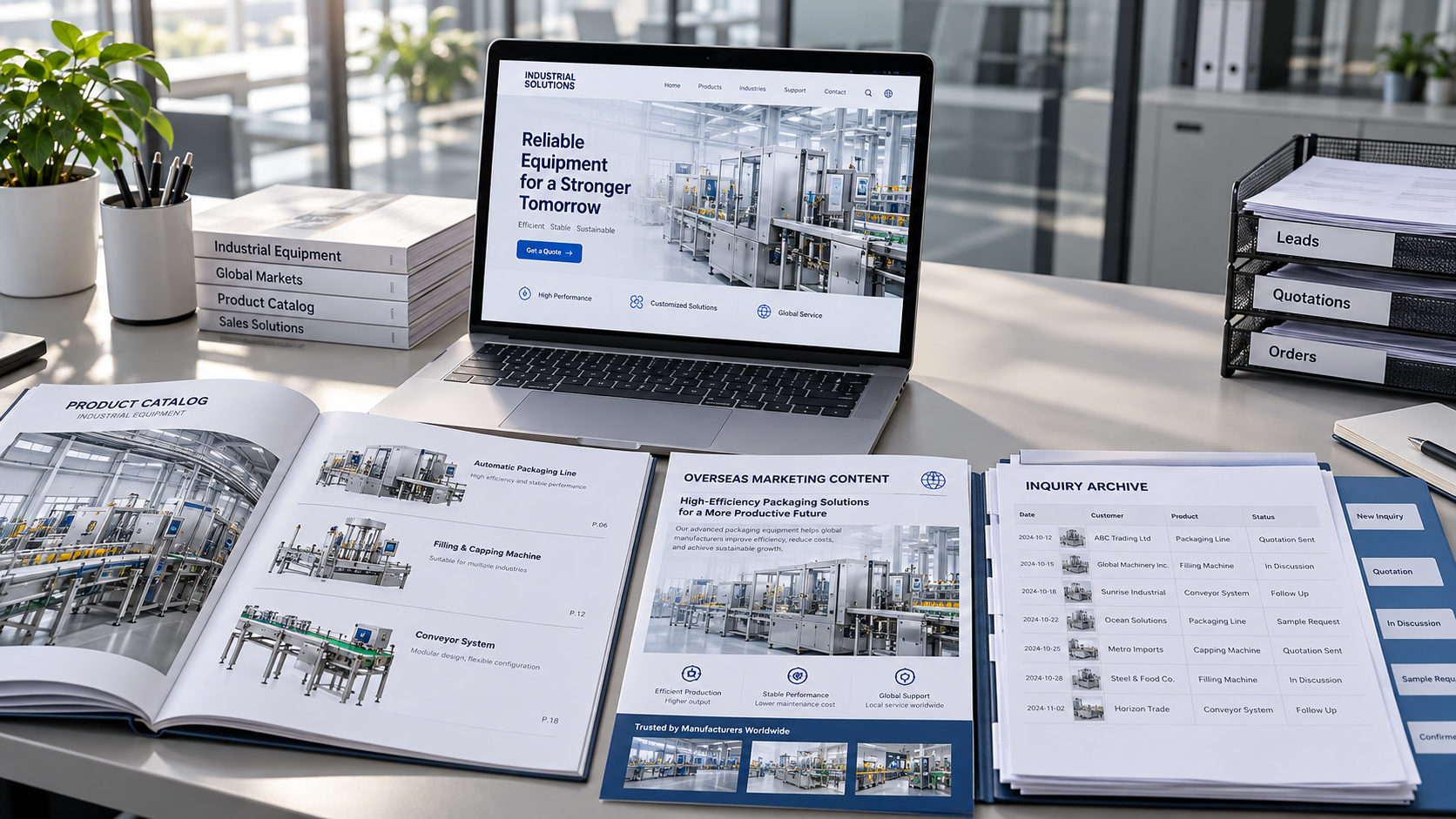
Based on AI-driven enterprise SaaS intelligent website building and overseas marketing services, EasyMarketing covers scenarios including multilingual corporate websites, B2B marketing websites, cross-border online stores, and advertising landing pages. For companies, website building is no longer merely about launching a page; it also creates unified touchpoints for SEO indexing, advertising traffic reception, social media traffic generation, and subsequent data tracking. This enables teams to identify whether visitors from different sources arrive through organic search, advertising, social media content, or remarketing outreach.

The Second Link: An Inquiry Is Not the End—Nurturing Determines Lead Value
The quality of overseas inquiries naturally varies. Some prospects have a clear purchasing plan and only need to select a supplier; others are still collecting information; still others simply download materials and have no plans to launch a project in the short term. If sales uses the same follow-up approach for every inquiry, it not only consumes manpower but may also miss prospects that are not yet mature but have high potential.
An effective nurturing mechanism typically starts with lead segmentation. Companies can establish an initial assessment based on signals such as source channel, pages visited, submitted information, country, company type, whether a catalog was downloaded, and repeat visits. Visitors who search for “custom packaging supplier” and view customization pages should clearly enter a different follow-up cadence from visitors who only browse the homepage.
For customers who are not yet ready to purchase, continuously providing valuable information is more useful than frequently urging them for an inquiry. For example, provide technical buyers with selection guides, process comparisons, and quality control explanations; provide procurement managers with content on lead-time management, supply chain coordination, and cooperation processes. Email automation, remarketing ads, LinkedIn content, and one-to-one sales communication can work together to ensure the brand remains visible when the customer’s decision window truly opens.
During this process, companies must not overlook the risk boundaries inherent in trade itself. Customer background, payment terms, contract clauses, and fulfillment milestones may all affect the actual quality of an order. When designing lead qualification and sales processes, teams can refer to Research on Risk Management and Prevention for International Trade Enterprises and assess market-based customer acquisition and transaction risk control on the same business map.
The Third Link: Conversion Tracking Must Move Beyond the Blind Spot of “Form Data”
Many companies can track the number of form submissions but cannot determine which leads move into quotation, sampling, repeat purchase, or loss stages. This can lead to a common misjudgment: a channel with many inquiries is considered a high-quality channel, but if those inquiries do not enter the sales funnel over the long term, their actual contribution may be limited.
The core of conversion tracking is connecting marketing-side data with sales-side outcomes. At a minimum, companies are advised to consistently record lead source, first contact time, products of interest, person in charge, follow-up status, quotation outcome, estimated amount, and reasons for lost deals. There is no need to pursue a complex system from the outset, but marketing and sales must use relatively consistent fields and definitions.
For example, Google Ads should not optimize only for the “form submission” action; it can also be assessed using deeper events such as qualified inquiries, meeting bookings, or quotation opportunities. SEO content should not focus only on keyword rankings but also observe which product pages consistently generate high-quality traffic. Social media operations should not pursue likes alone; they should examine whether they generate branded searches, website return visits, and identifiable business opportunities.
A Practical Collaborative Approach to Foreign Trade Digital Marketing
When implementing a foreign trade digital marketing solution, companies may first select one priority market, one core product line, and one primary conversion path for validation. After defining the target customer profile, build corresponding landing pages and content assets; then use SEO, Google Ads, Facebook ads, or overseas social media to reach audiences at different stages; finally, use a unified data dashboard and sales feedback to calibrate the direction.
There are two details that are easily overlooked. First, advertising and SEO should not replace one another. Advertising is suitable for quickly testing markets, product keywords, and landing pages, while SEO accumulates long-term search assets. When the two share keyword insights and page strategies, efficiency is often higher. Second, AI tools can improve the efficiency of content production, campaign optimization, and data organization, but they cannot replace a company’s judgment of product capabilities, target customers, and commercial risks. Truly competitive content must still come from an understanding of industry scenarios.
EasyMarketing incorporates cloud-based intelligent website building, AI advertising marketing, AI+SEO/GEO optimization, and overseas social media promotion into one service perspective, making it suitable for companies expanding overseas that seek to reduce the coordination costs of working with multiple suppliers. For brands entering AI search and generative answer scenarios, GEO, or Generative Engine Optimization, is also worth planning in advance: enabling product information, professional content, and brand signals to be understood and cited more clearly, rather than competing for position only in traditional search results.
Assess Solution Effectiveness by the Closed Loop, Not Isolated Promises
When selecting services or planning internal projects, decision-makers can return to several practical questions: Can the website expand according to markets and product lines? Can every channel be traced back to its lead source? Are sales teams willing to use and provide feedback on lead status? Are content, advertising, and the website centered on the same target customers? When the market changes, can the team adjust quickly based on data?
When these questions have clear answers, marketing is no longer an expense that is difficult to explain. It gradually becomes a growth system that can be reviewed and optimized. Overseas customers may still have long decision-making cycles, but companies can at least see where they emerge, how they move closer, and at which stage a more appropriate response is needed.
Related Articles
 Which fields should you include in an inquiry form on a marketing-focused export website?
 With a limited budget, which channels should be prioritized for overseas promotion?
 How to Choose a Digital Marketing Solution for Expanding Your Brand Overseas


Related Products
 Yiyingbao SaaS Intelligent Website Building and Marketing SystemYiyingbao SaaS Intelligent Website Building and Marketing System, AI-powered no-code website building, rapid creation of multilingual B2B international websites in 10 minutes, global server acceleration, AI-powered SEO optimization, helping businesses connect efficiently with global markets. The perfect integration of technology and operation makes building an international trade website remarkably simple
 AI+SEM Intelligent Advertising Marketing SystemAI+SEM drives intelligent ad creation, empowering full-funnel precision advertising marketing. The system automatically generates weekly/monthly reports, AI recommends keywords and target countries, monitors core metrics in real-time with intelligent alerts, and enables one-click high-conversion ad solutions to help quickly acquire customers and improve ROI.
 AI+SEO Dual-Engine System Optimization ServicesYiyingbao’s AI+SEO dual-engine optimization system helps foreign trade enterprises acquire high-quality organic traffic through AI-powered keyword research, content generation, and comprehensive technical optimization, significantly improving search rankings and conversion rates.
 AI+SNS Social Media Marketing SystemYingbao AI+SNS Social Media Marketing System - Precision social capture for the social media era. Supports one-click content synchronization across major platforms like Facebook and LinkedIn. AI intelligently rewrites posts for enhanced relevance. 24/7 AI customer service and user profiling analysis empower businesses to efficiently expand into global markets.
 AI+SEO营销解决方案易营宝AI+SEO营销解决方案,通过AI批量写作、智能生成TDK、精准关键词扩词等功能,全面优化网站SEO效果,提升流量与转化率。助力企业构建高效智能网站新生态。
 AI+SEM Advertising Marketing SolutionsAI+SEM Advertising Marketing Solution leverages AI technology to deeply empower SEM ad campaigns. It automatically generates weekly/monthly reports using AI, presenting account data across multiple dimensions for comprehensive insights into campaign performance and trends. The system precisely recommends keywords and target countries, intelligently generates high-conversion ad copy, and enables one-click activation of efficient campaign plans to help businesses rapidly acquire customers. Simultaneously, it monitors core metrics in real time, intelligently identifies abnormal fluctuations, and issues timely alerts to ensure stable, high-return advertising results.
 Domain Name ServicesEasyWin provides professional domain name services, including intelligent queries, one-stop registration, brand protection, and full lifecycle management, helping businesses build a digital brand image.
 EasyOperate B2C Cross-Border E-Commerce Platform & Independent WebsiteEasyStore B2C Cross-border E-commerce Independent Store is an intelligent website building and cross-border e-commerce integrated solution independently developed by EasyStore Information Technology (Beijing) Co., Ltd. The system is specially designed for small and medium-sized as well as large export enterprises, integrating 'website building, operation, marketing, advertising, and conversion' into one, helping enterprises quickly establish cross-border e-commerce independent stores to achieve brand globalization and global sales growth.
The platform supports multiple languages, multiple currencies, and multi-channel marketing, with built-in AI intelligent translation and SEO optimization systems, suitable for mainstream markets such as Southeast Asia, Europe and America, Latin America, and the Middle East, assisting Chinese manufacturing enterprises in efficiently deploying international e-commerce strategies. SSL证书易营宝提供专业SSL安全证书服务,包括单域名和泛域名证书,确保网站数据传输加密、身份验证和完整性保护,助力企业建立安全可信的在线业务环境。









