









- Which customer acquisition channels will be affected by cross-border marketing trends in 2026?Sep 06, 2026View details
- Which homogenization risks should be considered in an analysis of the AI-powered website building industry?Aug 30, 2026View details
- How Will AI Marketing Trends 2026 Change Advertising Budget AllocationAug 28, 2026View details
- Is the EV SSL certificate market shrinking or upgrading? How should companies assess certificate procurement?Aug 11, 2026View details
- Why the old AMP SEO 2020 practices no longer work and what has changed in current optimization prioritiesAug 02, 2026View details
- How to Choose Topics for an Industry News Section to Attract More Organic Search TrafficJul 29, 2026View details
How Can French Website Translation Avoid Literal Translation That Hurts Conversions?
How Can French Website Translation Avoid Literal Translation That Hurts Conversion?
For the French market, French website translation is far more than replacing Chinese or English sentence by sentence with French. For B2B projects involving industrial equipment, components, engineering services, and similar offerings, procurement professionals often assess whether a supplier is professional, whether the information is reliable, and whether communication costs are manageable through the website first. If a page reads like machine translation, visitors may question whether the company is adequately prepared for the local market, even if the product specifications themselves are correct, and consequently decide not to submit an inquiry.
The losses caused by literal translation usually extend beyond grammar. It can make product categories difficult to understand, make technical advantages seem vague, make inquiry button wording overly abrupt, and create ambiguity around sensitive information such as delivery, warranty, and certification. Project leaders need to incorporate translation into the overall process of website planning, content review, and marketing campaigns, rather than treating it as a last-minute language task before the website goes live.
Why Literal Translation Makes French Visitors Stop but Not Continue Exploring
Chinese business communication often emphasizes “strength,” “quality,” and “one-stop solutions,” while English pages also commonly use concise, impactful marketing terms. However, when translated directly into French, such wording often appears generic or even unnatural. French B2B visitors need to quickly find specific evidence on the page: the operating conditions for which the equipment is suitable, material grades, available configurations, scope of delivery, after-sales response methods, and whether technical documentation can be requested. Rather than repeatedly translating “high-quality solutions,” it is better to clearly explain what process problems the product addresses, how key components are configured, and which conditions need to be confirmed before quotation.
Another common issue is terminology mismatch. The same Chinese term may refer to an equipment name, a functional module, or a process operation in different industry segments; in French, it may require a more precise technical term, or even the retention of an internationally recognized abbreviation with additional explanation. Especially where pressure, flow rate, dimensions, tolerances, electrical specifications, surface treatment, and test conditions are involved, translators who do not understand the source materials can easily translate a “capability description” as a “commitment,” or an “option” as a “standard configuration.” This can create risks for sales communication and subsequent fulfillment.
Another hidden loss comes from forms of address and tone. Pages intended for professional purchasers or engineers should not be overly conversational, nor should they copy the dense, exclamatory style often found on Chinese websites. French content needs to remain polite, clear, and appropriately formal; when a page asks users to download materials, schedule a discussion, or submit requirements, the call to action should explain what they can obtain rather than simply stating a vague “Contact Us Now.”
Determine “Who Is Reading” Before Deciding “How to Translate”
The homepage, product pages, technical documentation pages, and advertising landing pages of a French website should not use the same translation approach. The homepage is intended to establish positioning and trust, product pages need to answer product selection questions, document download pages need to reduce barriers to obtaining information, and advertising landing pages must remain consistent with search terms and advertising promises. If a single corporate introduction is distributed evenly across every page, the content may be linguistically correct but still fail to support the user's next decision.
In practice, a content-priority list can be prepared before the project begins: which pages serve as organic search entry points, which receive advertising traffic, which materials must be verified by the technical team, and which statements must not be altered without authorization. Product models, units, drawing numbers, test conditions, and certification descriptions should be based on source files confirmed by the company; brand propositions, selling-point headlines, application scenarios, and form prompts, on the other hand, require localized adaptation. Mixing these two types of content in the same translation workflow is usually where errors are most likely to occur.
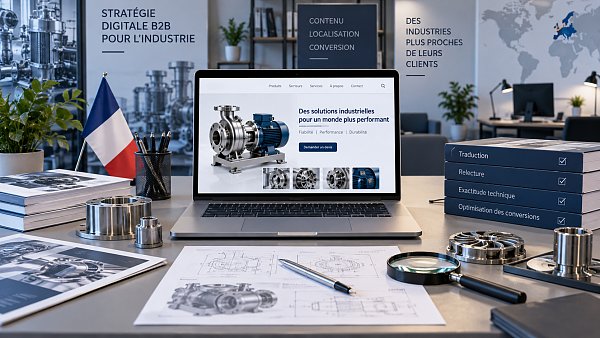
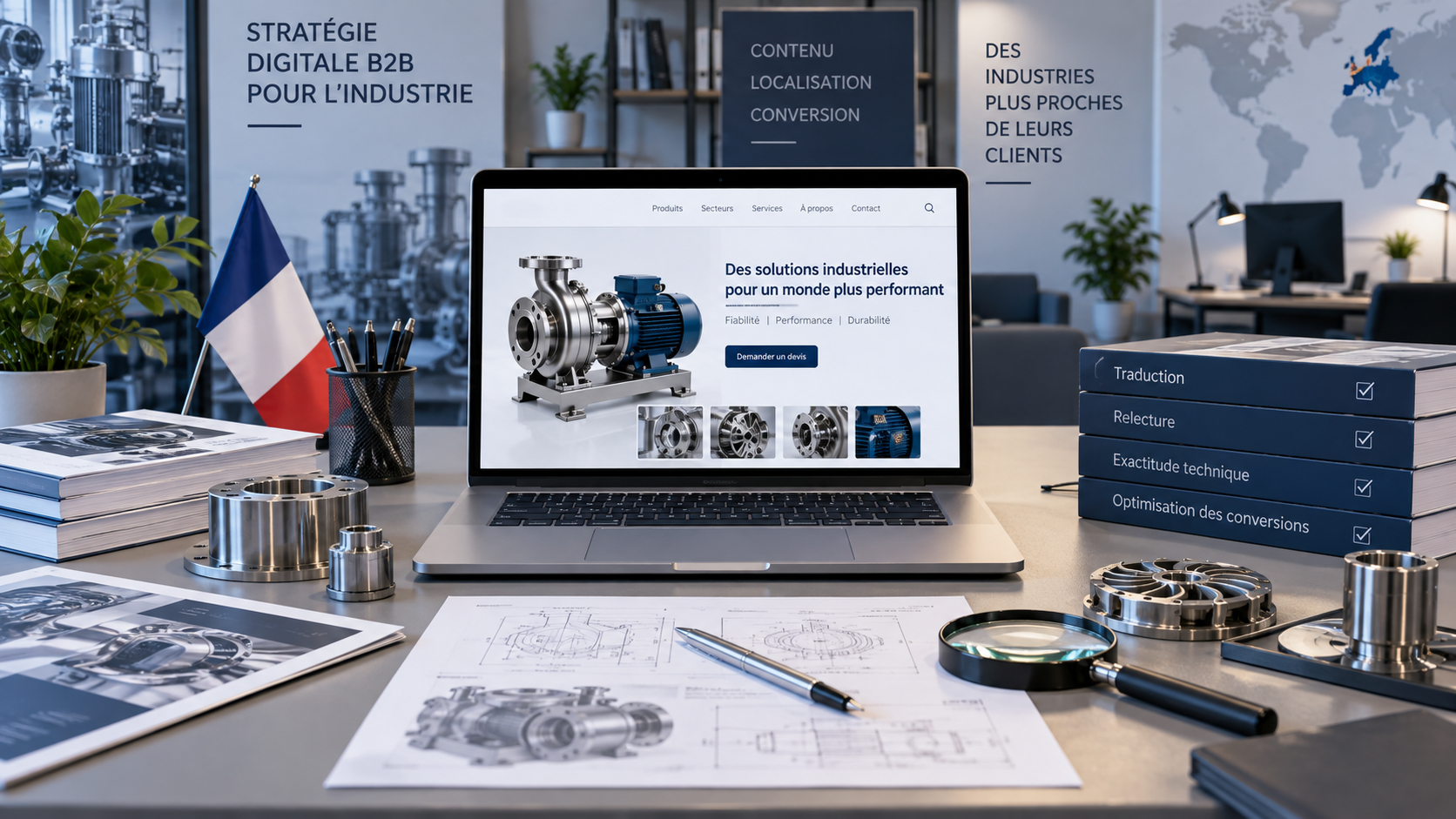
Make Translation Serve Technical Communication, Search, and Inquiries at the Same Time
French content suitable for a website should undergo at least three levels of review. The first is accuracy: whether terminology, figures, units, models, and delivery boundaries are consistent with the original materials. The second is readability: whether French visitors can understand the sentences without relying on a Chinese-language context, and whether headings genuinely summarize the page content. Only the third level is conversion: after reading, whether visitors know that they can request a catalog, send drawings, confirm configurations, or schedule a technical discussion.
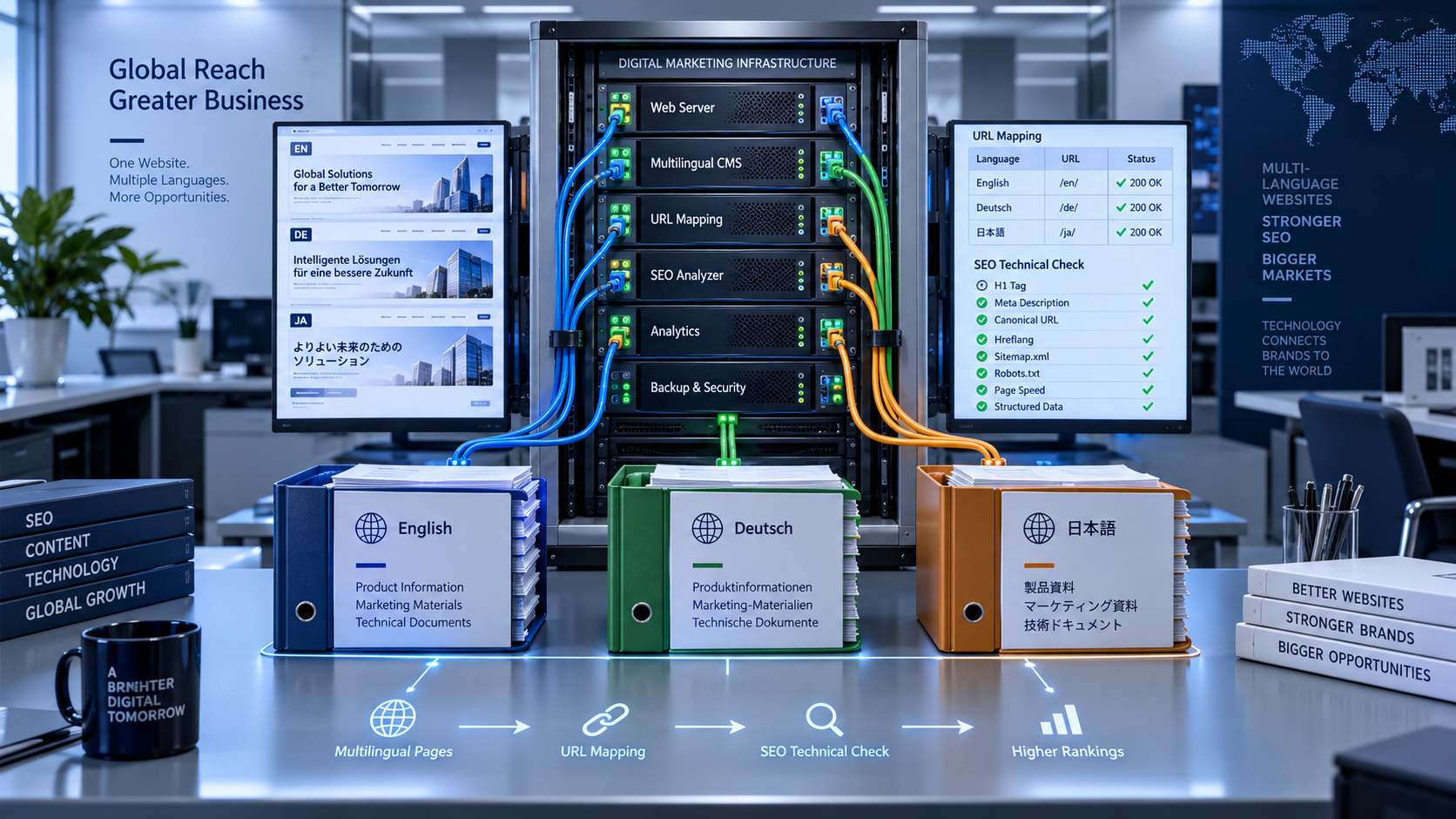
Search-related work should not be left until later either. Chinese keywords are often internal company terminology and may not be the terms French users search for. Page topics, category names, product attributes, and FAQs need to be organized around product terms, application terms, and problem-related terms likely to be used locally, rather than repeatedly placing one core term in headings and body text. For longer procurement decision cycles, building a content path around “application scenarios—available parameters—access to documentation—contact entry points” is usually more useful than simply stacking product names.
Forms themselves also merit separate review. Chinese websites often require visitors to provide a large amount of information at once. For an initial-contact page in the French market, only essential fields such as name, company, email address, and a brief description of requirements may be retained first, with technical parameters supplemented through subsequent communication. Wording for privacy notices, document subscriptions, and marketing consent should align with actual handling practices; where local compliance requirements are involved, companies are advised to confirm them based on their own business and professional advice rather than reusing templates from websites in other languages.
Four Often Overlooked Aspects of Project Management
First, translating directly while the source text is still unstable. When Chinese drafts are being revised frequently, multilingual pages can easily develop issues such as unsynchronized parameters and remnants of older versions. A more reliable approach is to first finalize core product materials and the terminology glossary, then process marketing copy in batches.
Second, reviewing only the language and not the page. French sentence length, punctuation conventions, and information order differ from Chinese. Once placed into a fixed layout, this can result in truncated buttons, unbalanced headline wrapping, or difficult-to-read parameter tables. Translation acceptance should be completed in the actual page environment rather than by confirming text paragraph by paragraph in a document alone.
Third, treating machine translation as the final deliverable. Artificial intelligence can be used for initial drafts, terminology consistency checks, and more efficient content updates, but technical statements, commercial commitments, and customer-facing action copy still require human review. In particular, when restrictive claims such as “guaranteed,” “compliant,” “certified,” or “minimum” appear on a page, they must be verified against factual evidence.
Fourth, failing to observe feedback after the website goes live. Search terms, time spent on pages, form completion rates, and questions received by the sales team can be used to identify expressions that have not been understood. If visitors repeatedly ask about information already stated on the page, it may not mean that customers have failed to read carefully; the headings, terminology, or information hierarchy may simply not communicate the answer clearly enough.
Integrate French Content Back into the Complete Overseas Lead-Generation Journey
French website translation should not be separated from website development, SEO, and advertising campaigns. Users arriving through organic search, advertising clicks, and social media referrals do not have exactly the same concerns, but all ultimately need to verify information on the website. Accurate content, clear page paths, and accessible inquiry channels are essential to prevent front-end lead-generation budgets from being consumed by inappropriate language expression.
Since its establishment in 2013, Yiyingbao Information Technology (Beijing) Co., Ltd. has continuously provided services related to intelligent website development, overseas marketing, and multilingual websites. Its artificial intelligence- and big data-based capabilities in website development, SEO, advertising, and social media are well suited to coordinated implementation from a unified project perspective: reserving multilingual content structures during the website development stage and adjusting pages based on actual search and inquiry feedback during the promotion stage, thereby avoiding reactive fixes after translation is completed. For companies with complex product lines and frequent updates, this integration can reduce loss of version control more effectively than a one-time translation.
Before entering the French market, it is recommended to validate the process with a set of core pages: select the homepage, one key product page, one application page, and one inquiry page, then complete terminology confirmation, page proofreading, and testing of the actual lead path. Once the language style, documentation boundaries, and review mechanism are running smoothly, expand to the complete product catalog. This approach may not be the fastest, but it can reveal the real disconnects between literal translation, layout, and conversion at an earlier stage.
Related Articles

Related Products
 Yiyingbao SaaS Intelligent Website Building and Marketing SystemYiyingbao SaaS Intelligent Website Building and Marketing System, AI-powered no-code website building, rapid creation of multilingual B2B international websites in 10 minutes, global server acceleration, AI-powered SEO optimization, helping businesses connect efficiently with global markets. The perfect integration of technology and operation makes building an international trade website remarkably simple
 AI+SEM Intelligent Advertising Marketing SystemAI+SEM drives intelligent ad creation, empowering full-funnel precision advertising marketing. The system automatically generates weekly/monthly reports, AI recommends keywords and target countries, monitors core metrics in real-time with intelligent alerts, and enables one-click high-conversion ad solutions to help quickly acquire customers and improve ROI.
 AI+SEO Dual-Engine System Optimization ServicesYiyingbao’s AI+SEO dual-engine optimization system helps foreign trade enterprises acquire high-quality organic traffic through AI-powered keyword research, content generation, and comprehensive technical optimization, significantly improving search rankings and conversion rates.
 AI+SNS Social Media Marketing SystemYingbao AI+SNS Social Media Marketing System - Precision social capture for the social media era. Supports one-click content synchronization across major platforms like Facebook and LinkedIn. AI intelligently rewrites posts for enhanced relevance. 24/7 AI customer service and user profiling analysis empower businesses to efficiently expand into global markets.
 AI+SEO营销解决方案易营宝AI+SEO营销解决方案,通过AI批量写作、智能生成TDK、精准关键词扩词等功能,全面优化网站SEO效果,提升流量与转化率。助力企业构建高效智能网站新生态。
 AI+SEM Advertising Marketing SolutionsAI+SEM Advertising Marketing Solution leverages AI technology to deeply empower SEM ad campaigns. It automatically generates weekly/monthly reports using AI, presenting account data across multiple dimensions for comprehensive insights into campaign performance and trends. The system precisely recommends keywords and target countries, intelligently generates high-conversion ad copy, and enables one-click activation of efficient campaign plans to help businesses rapidly acquire customers. Simultaneously, it monitors core metrics in real time, intelligently identifies abnormal fluctuations, and issues timely alerts to ensure stable, high-return advertising results.
 Domain Name ServicesEasyWin provides professional domain name services, including intelligent queries, one-stop registration, brand protection, and full lifecycle management, helping businesses build a digital brand image.
 EasyOperate B2C Cross-Border E-Commerce Platform & Independent WebsiteEasyStore B2C Cross-border E-commerce Independent Store is an intelligent website building and cross-border e-commerce integrated solution independently developed by EasyStore Information Technology (Beijing) Co., Ltd. The system is specially designed for small and medium-sized as well as large export enterprises, integrating 'website building, operation, marketing, advertising, and conversion' into one, helping enterprises quickly establish cross-border e-commerce independent stores to achieve brand globalization and global sales growth.
The platform supports multiple languages, multiple currencies, and multi-channel marketing, with built-in AI intelligent translation and SEO optimization systems, suitable for mainstream markets such as Southeast Asia, Europe and America, Latin America, and the Middle East, assisting Chinese manufacturing enterprises in efficiently deploying international e-commerce strategies. SSL证书易营宝提供专业SSL安全证书服务,包括单域名和泛域名证书,确保网站数据传输加密、身份验证和完整性保护,助力企业建立安全可信的在线业务环境。









