









- Which customer acquisition channels will be affected by cross-border marketing trends in 2026?Sep 06, 2026View details
- Which homogenization risks should be considered in an analysis of the AI-powered website building industry?Aug 30, 2026View details
- How Will AI Marketing Trends 2026 Change Advertising Budget AllocationAug 28, 2026View details
- Is the EV SSL certificate market shrinking or upgrading? How should companies assess certificate procurement?Aug 11, 2026View details
- Why the old AMP SEO 2020 practices no longer work and what has changed in current optimization prioritiesAug 02, 2026View details
- How to Choose Topics for an Industry News Section to Attract More Organic Search TrafficJul 29, 2026View details
How can multilingual content production efficiency be improved for global growth?
How Can You Improve Multilingual Content Production Efficiency for Global Growth?
Amid the challenges of operating across multiple markets, improving the efficiency of multilingual content production for global growth has become critical for businesses to achieve precise reach, rapid lead generation, and sustained conversions. For frontline operations teams, the real question is not “how to translate a few more articles,” but how to continuously produce content that can be published, indexed, and converted without compromising accuracy, brand consistency, or search performance.
Users searching for this topic typically want a practical approach: how to reduce repetitive tasks, avoid expression errors caused by machine translation, adapt pages in different languages to local search habits, and incorporate website, SEO, advertising, and social media content into one collaborative workflow. The key insight is that improving multilingual efficiency depends on a content system, rather than simply adding more translation tools.
Break Down Content Tasks First to Avoid Using the Same Production Process for All Content
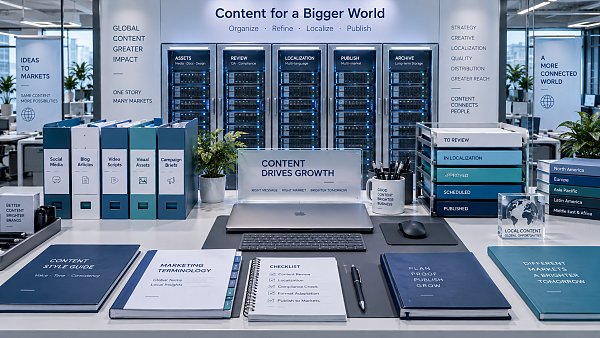
Low multilingual content production efficiency is often caused by handling product pages, blog articles, ad copy, social media posts, and inquiry emails in the same way. In fact, these types of content differ in update frequency, accuracy requirements, search objectives, and conversion paths, so a tiered mechanism should be established based on content type.
For example, factual content such as product specifications, certification information, and delivery lead times should be managed through standardized content fields and a centralized information database, with multilingual page updates driven by source data. This reduces manual copying and version errors while ensuring that the basic information seen in different markets remains consistent.
Case studies, industry insights, and brand stories, on the other hand, are expressive content and cannot be translated directly in bulk. Operators should first identify the target market’s reader concerns, commonly used search terms, and calls to action, then complete publication through AI-generated drafts, human proofreading, and localized adaptation to prevent content from sounding rigid or detached from the context.
Ad headlines, above-the-fold landing page content, and short social media posts are high-frequency testing content, making them better suited to modular templates. By breaking down selling points, audiences, regions, offers, and call-to-action buttons into replaceable fields, teams can quickly generate versions for multiple markets and continuously iterate based on click-through rates, time on page, and conversion rates.
Build a Content Asset Library for “One Content Source, Reuse Across Multiple Markets”
The first step in improving multilingual content production efficiency for global growth is not purchasing more tools, but organizing the company’s existing content assets. Many teams repeatedly consult product departments, sales departments, or technical staff because information is scattered across chat records, spreadsheets, old websites, and personal computers, making it difficult to access reliably.
It is recommended to consolidate frequently used information into a structured content library, including brand terminology, product names, technical specifications, target industries, application scenarios, FAQs, customer cases, and compliance statements. Each item should indicate its source, person responsible, applicable market, and most recent update date to prevent outdated information from being repeatedly used by AI or editors.
Among these, a terminology database is especially important. Once company names, models, technical terms, certification abbreviations, and core selling points appear in multiple translations, this not only weakens brand professionalism but may also dilute page keyword weight. Operators should define standard wording, prohibited expressions, and necessary explanations for each key language.
On AI-driven website-building and overseas marketing platforms such as Yiyingbao, content assets can be managed collaboratively with multilingual website pages, SEO fields, and marketing materials. After source content is updated, teams can locate affected pages more quickly instead of manually checking each site and language one by one, substantially reducing routine maintenance costs.
Use AI for First Drafts and Humans for Localization and Quality Control
AI is well suited for repetitive tasks such as outline generation, initial translation, headline rewriting, meta description writing, FAQ expansion, and content summarization, but it should not be treated as an automated tool that produces content ready for direct publication. Content aimed at B2B buyers, technical decision-makers, or regional consumers in particular still requires human verification to ensure that the wording fits the local context.
A practical workflow is to have operators first provide the page objective, target country, core keywords, audience profile, and conversion action, and then have AI generate a first draft that meets the structural requirements. Content produced this way is closer to business needs and avoids being linguistically fluent while lacking search intent and conversion focus.
During human proofreading, four types of issues should be checked first: whether technical specifications are accurate, whether keywords match how local users search, whether currencies, units, and dates are localized, and whether calls to action align with target market conventions. For sensitive industries such as healthcare, finance, and chemicals, compliance and legal wording reviews should also be added.
Do not equate “localization” with replacing one language with another. “Request a quote” in English-speaking markets, more direct communication styles in Latin American markets, and the greater emphasis on service explanations in Japanese and Korean markets can all affect page conversion. The goal of content production efficiency is to create effective versions faster, not simply to complete literal translations faster.
Configure Keywords Around Search Intent Rather Than Directly Translating Chinese Terms
A common multilingual SEO mistake is to first determine Chinese keywords and then translate them word for word into pages for each language. Buyers in different countries may use different product names, specification expressions, or problem descriptions; if these differences are ignored, pages may struggle to gain effective organic traffic even when their content is complete.
Operators should create a keyword mapping table for each market, containing at least core terms, application terms, problem terms, specification terms, and competitor alternative terms. In the case of industrial equipment, for example, users may search for the equipment name, but they may also search for “what materials is it suitable for,” “how to resolve a certain fault,” or “how to choose a supplier.”
After keywords are determined, the page type should then be decided. Core commercial terms should primarily correspond to product pages, category pages, or service pages; long-tail questions are suitable for blog, FAQ, and case study pages; advertising terms need to match dedicated landing pages. This avoids directing all traffic to the homepage and improves the match between pages and search demand.
At the same time, titles, descriptions, URLs, and image alt text should be completed separately for pages in different languages, with the correct language and regional associations configured. If a multilingual website-building system can centrally manage these SEO fields, it can reduce omissions and help search engines understand the relationships among language versions.
Create a Traceable Closed Loop for Review, Publication, and Data Feedback
After content production speed increases, new risks often emerge during the review and publication stages: translations are not reviewed, products are updated while old pages remain online, ad copy is inconsistent with website selling points, or multiple markets modify the same content at the same time. Addressing these issues requires clearly defined statuses, responsible parties, and version rules.
The workflow can be set up in six stages: “requirement confirmation, AI first draft, professional proofreading, SEO review, page publication, and data review.” Each stage does not need complex approval procedures, but it should be clear who is responsible for moving it forward and which content requires confirmation from product, legal, or local market personnel, preventing tasks from remaining only at the communication stage.
After publication, do not only count the quantity of content. More meaningful metrics include target keyword rankings, organic traffic, time on page, form submission rates, inquiry quality, and advertising landing page conversion rates. Poor data performance does not necessarily indicate a language issue; it may also result from page intent, the order of selling points, or insufficient trust information.
High-value pages can be reviewed once a month, while pages with frequently updated products should have content expiration reminders in place. Only by identifying high-converting topics through data and then reusing effective structures across more languages and regions can content teams shift from reactive translation to proactively driving global customer acquisition.
Different Business Scenarios Require Different Efficiency Priorities
B2B foreign trade companies should prioritize the standardization of product information, consistency of technical terminology, and localization of inquiry pages. Industries with longer procurement cycles need to build trust through product pages, case studies, certification explanations, and technical articles, rather than relying solely on short promotional copy.
B2C cross-border sellers should focus more on rapid iteration of product details, review content, promotional campaigns, and social media assets. Different markets have different concerns regarding sizing, logistics, returns and exchanges, and payment methods, so the content system needs to support frequent updates and stay synchronized with store inventory, campaigns, and advertising schedules.
For brands that deploy SEO, Google Ads, and overseas social media at the same time, it is recommended to use one core landing page as the content hub, then break it down into search snippets, ad headlines, short-video scripts, and social media posts. This maintains consistency in selling points while reducing the time required to create content from scratch for each channel.
Conclusion: The Essence of Efficiency Is Enabling Content to Serve Growth Faster
Improving multilingual content production efficiency for global growth is not simply about pursuing faster translation, but about establishing a complete mechanism of “standardized content assets, AI-assisted generation, localized human review, precise SEO adaptation, and continuous data review.” Only when processes can be reused will efficiency no longer depend on the experience of individual team members.
For hands-on operators, the highest-priority tasks are to first organize frequently used content, standardize terminology and fields, and then select a platform that connects website building, SEO, and marketing scenarios. Only when every piece of multilingual content is accurate, searchable, and capable of conversion can it truly support a company’s continued expansion into global markets.
Related Articles


Related Products
 Yiyingbao SaaS Intelligent Website Building and Marketing SystemYiyingbao SaaS Intelligent Website Building and Marketing System, AI-powered no-code website building, rapid creation of multilingual B2B international websites in 10 minutes, global server acceleration, AI-powered SEO optimization, helping businesses connect efficiently with global markets. The perfect integration of technology and operation makes building an international trade website remarkably simple
 AI+SEM Intelligent Advertising Marketing SystemAI+SEM drives intelligent ad creation, empowering full-funnel precision advertising marketing. The system automatically generates weekly/monthly reports, AI recommends keywords and target countries, monitors core metrics in real-time with intelligent alerts, and enables one-click high-conversion ad solutions to help quickly acquire customers and improve ROI.
 AI+SEO Dual-Engine System Optimization ServicesYiyingbao’s AI+SEO dual-engine optimization system helps foreign trade enterprises acquire high-quality organic traffic through AI-powered keyword research, content generation, and comprehensive technical optimization, significantly improving search rankings and conversion rates.
 AI+SNS Social Media Marketing SystemYingbao AI+SNS Social Media Marketing System - Precision social capture for the social media era. Supports one-click content synchronization across major platforms like Facebook and LinkedIn. AI intelligently rewrites posts for enhanced relevance. 24/7 AI customer service and user profiling analysis empower businesses to efficiently expand into global markets.
 AI+SEO营销解决方案易营宝AI+SEO营销解决方案,通过AI批量写作、智能生成TDK、精准关键词扩词等功能,全面优化网站SEO效果,提升流量与转化率。助力企业构建高效智能网站新生态。
 AI+SEM Advertising Marketing SolutionsAI+SEM Advertising Marketing Solution leverages AI technology to deeply empower SEM ad campaigns. It automatically generates weekly/monthly reports using AI, presenting account data across multiple dimensions for comprehensive insights into campaign performance and trends. The system precisely recommends keywords and target countries, intelligently generates high-conversion ad copy, and enables one-click activation of efficient campaign plans to help businesses rapidly acquire customers. Simultaneously, it monitors core metrics in real time, intelligently identifies abnormal fluctuations, and issues timely alerts to ensure stable, high-return advertising results.
 Domain Name ServicesEasyWin provides professional domain name services, including intelligent queries, one-stop registration, brand protection, and full lifecycle management, helping businesses build a digital brand image.
 EasyOperate B2C Cross-Border E-Commerce Platform & Independent WebsiteEasyStore B2C Cross-border E-commerce Independent Store is an intelligent website building and cross-border e-commerce integrated solution independently developed by EasyStore Information Technology (Beijing) Co., Ltd. The system is specially designed for small and medium-sized as well as large export enterprises, integrating 'website building, operation, marketing, advertising, and conversion' into one, helping enterprises quickly establish cross-border e-commerce independent stores to achieve brand globalization and global sales growth.
The platform supports multiple languages, multiple currencies, and multi-channel marketing, with built-in AI intelligent translation and SEO optimization systems, suitable for mainstream markets such as Southeast Asia, Europe and America, Latin America, and the Middle East, assisting Chinese manufacturing enterprises in efficiently deploying international e-commerce strategies. SSL证书易营宝提供专业SSL安全证书服务,包括单域名和泛域名证书,确保网站数据传输加密、身份验证和完整性保护,助力企业建立安全可信的在线业务环境。









