









- How to Choose Topics for an Industry News Section to Attract More Organic Search TrafficJul 29, 2026View details
- Can Zhejiang foreign trade independent websites still be developed today? Look at changes in traffic and lead generationJul 28, 2026View details
- What New Signals Are Emerging in Enterprise Services SaaS Marketing ReportsJul 27, 2026View details
- What Does a Global Traffic Ecosystem Service Provider Do? What Are the Differences from a Single Advertising AgencyJul 16, 2026View details
- What should you focus on in the latest enterprise SaaS report? From renewal rates and delivery costs to overseas growth opportunitiesJul 12, 2026View details
- What signals are worth paying attention to in a cross-border marketing trend report? B2B companies should look at these 6 signalsJul 11, 2026View details
How to Build a Framework for Multilingual Content Management and Global Websites
Multilingual Content Management for Global Websites: The Challenge Has Never Been “Adding More Languages”
Multilingual content management for global websites may appear to be a translation project, but in practice it is much closer to an information architecture project. The most common mistake in technical evaluations is to equate “supporting language switching” with “having global website capabilities.” The former only solves page display, while the latter must also address content models, site structures, permission workflows, search engine indexing, local market differences, and version consistency during ongoing operations. If the framework is designed incorrectly from the beginning, the cost will multiply with every additional language, country site, or product line.
From a technical perspective, the core issue is not whether a certain plugin can translate pages, but whether the system manages “language” as an independent dimension. Content on a global website is not always mapped one-to-one: some markets only require copy adjustments, while others need changes to pricing, case studies, qualification statements, form fields, or even navigation structures. In other words, multilingual content management is not about copying a Chinese website into English, Japanese, and German versions. It is about enabling the same underlying site to reliably support shared content and regional differences in parallel.
Look at the Framework Before Looking at Translation
A website framework suitable for global business should generally answer three questions first: At what granularity is content managed? How are languages decoupled from sites? Who controls the publishing workflow? Many projects lose control at a later stage not because the pages cannot be built, but because the content granularity is too coarse. For example, using an entire page as the smallest management unit may enable quick short-term deployment, but once product specifications, FAQs, downloadable materials, and case study excerpts need to be reused, the same information becomes scattered across multiple language sites, with each version being edited independently and gradually drifting apart. During a technical evaluation, it is more important to determine whether the system supports structured content, separating products, industry solutions, articles, forms, SEO fields, and media assets into reusable objects rather than treating pages as the only assets.
The next layer concerns the relationship between languages and sites. Three common approaches are used in the industry: adding language directories under one main site, dividing regional sites by subdomain, and deploying independent sites by country. There is no absolute best option; the decision depends on specific factors. If a company emphasizes unified branding and centralized SEO assets, a directory structure is often easier to manage. If different regions have independent operating teams, different compliance requirements, or completely different promotional schedules, subdomains or independent sites provide greater flexibility in assigning permissions. The problem is that many systems appear to support all three approaches, while their underlying logic is still based on “site duplication.” Once duplication is adopted, content synchronization, template upgrades, and permission inheritance all become cumbersome, and technical debt quickly becomes visible.
This is why companies are placing increasing emphasis on whether their website-building systems natively support multilingual, multisite, and unified back-office collaboration when developing overseas websites, cross-border e-commerce stores, or multi-region brand sites. For an integrated platform focused on intelligent website building and overseas marketing, the real value is not simply the ability to “generate multilingual pages,” but the ability to handle website building, SEO field management, advertising landing page production, and content distribution through the same mechanism. Otherwise, the front end may appear unified while the back end is actually assembled from multiple tools, causing ongoing maintenance to become increasingly inconsistent.
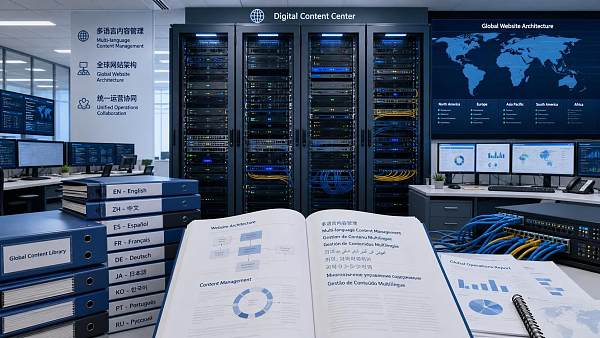
During Technical Evaluation, Focus on at Least These Structural Points
The first is master content data. Can information such as product names, specifications, case study summaries, industry tags, and downloadable materials be maintained at a single source and then mapped by language to different pages? Without a master data layer, content teams are forced to enter the same information repeatedly in pages, while translation teams cannot determine which content has changed.
The second is the boundaries of localization fields. A truly mature system does not assume that every field must be translated. Brand names, model numbers, certification abbreviations, and certain technical specifications often need to remain consistent across languages, while titles, summaries, button text, form prompts, and SEO descriptions require localization. If a platform does not support field-level control and can only translate entire pages, both content accuracy and efficiency will be affected.
The third is version control and workflow. After a multilingual website goes live, the most difficult issue is usually not the initial launch, but how other languages follow up after the original content is updated. During evaluation, check whether the system can mark a status such as “original content changed, translation pending update,” and whether it supports role-based collaboration, with editors, reviewers, translators, and regional operators handling different stages. If the permission model is too broad, the common result is that everyone edits pages in the back office, leaving no one able to clearly identify who changed what, which language is behind, or which regional content has not been reviewed.
The fourth is that SEO is not an auxiliary function. If multilingual management for a global site does not take search engine rules into account, traffic can be lost directly to technical details. At a minimum, determine whether each language version has an independently indexable URL, whether canonical links can be configured, whether language-region targeting relationships can be managed, and whether titles, descriptions, structured information, and redirect rules can be configured separately for different languages. A page being technically visible does not mean that search engines can correctly understand the relationships among the sites.
Many Projects Fail Not Because of Functionality, but Because of Boundary Decisions
A common misconception is to “launch with machine translation first and optimize later.” This may work for a one-time campaign landing page, but it is not a reliable approach for a global website operated over the long term. The issue is not only language quality. Machine-translated content also affects URL naming, page topic focus, internal-link anchor text, and conversion-oriented messaging. If the content model, keyword mapping, and regional differences are not accounted for at the outset, later corrections will often involve more than revising a few pieces of copy; the entire page relationship structure may need to be rebuilt.
Another misconception is treating “multilingual” and “multiregional” as the same thing. An English-language site does not automatically cover every English-speaking market. North America, the United Kingdom, and parts of Southeast Asia may differ significantly in wording preferences, delivery commitments, form fields, and case study preferences. If a website is built only by language without retaining a regional layer, limitations will arise later in regional advertising, landing page segmentation, and lead attribution.
There is also the situation in which companies focus heavily on consistent front-end visuals while underestimating the difficulty of back-office collaboration. In practice, the part of a global site most likely to lose control is not the homepage, but the editorial process after the content volume expands: which languages go live first when a new product launches, which markets are delayed, which country pages must be updated simultaneously when a qualification document expires, and whether advertising landing pages and official product pages use the same content source. These are content governance issues, not design issues. If the necessary mechanisms are not reserved when the framework is built, the team can only rely on spreadsheets and manual reminders, creating significant risk.
How to Determine Whether a Solution Really Works
To evaluate multilingual content management for global websites, you can verify the solution by asking the following questions:
If the answers to these questions are vague, the solution is often more focused on the presentation layer than on the content management layer. For technical evaluators, the real warning sign is that “everything appears possible in the demo environment,” but once questions are raised about multilingual content synchronization, permission review, search indexing, and regional operations, the system boundaries immediately become unclear.
Industry practice shows that an increasing number of companies are considering website-building systems, SEO capabilities, advertising landing page production, and AI-assisted content together on a unified platform. The reason is practical: global business is not a one-time launch project, but a system for continuous growth. Platforms such as 易营宝, which cover AI-powered website building, multilingual websites, cross-border e-commerce stores, Google SEO, advertising, and GEO optimization, provide value closer to that of “unified digital growth infrastructure” than that of a simple page editor. Whether a platform is suitable still needs to be determined by returning to the structural questions above.
If a more industry-realistic understanding of “multilingual content management for global websites” is needed, its essence is the standardized governance of global content assets: enabling headquarters to maintain a unified brand and technical foundation while allowing regional markets to make necessary adjustments based on language, compliance, and lead-generation needs. When the framework is built correctly, entering a new market is simply an extension. When it is not, every expansion will expose old problems again. During technical evaluation, do not be misled by surface-level metrics such as “how many languages are supported.” What truly determines long-term results is whether content structure, collaboration mechanisms, and search friendliness are incorporated into the same design from the beginning.
Related Articles
Related Products
 Yiyingbao SaaS Intelligent Website Building and Marketing SystemYiyingbao SaaS Intelligent Website Building and Marketing System, AI-powered no-code website building, rapid creation of multilingual B2B international websites in 10 minutes, global server acceleration, AI-powered SEO optimization, helping businesses connect efficiently with global markets. The perfect integration of technology and operation makes building an international trade website remarkably simple
 AI+SEM Intelligent Advertising Marketing SystemAI+SEM drives intelligent ad creation, empowering full-funnel precision advertising marketing. The system automatically generates weekly/monthly reports, AI recommends keywords and target countries, monitors core metrics in real-time with intelligent alerts, and enables one-click high-conversion ad solutions to help quickly acquire customers and improve ROI.
 AI+SEO Dual-Engine System Optimization ServicesYiyingbao’s AI+SEO dual-engine optimization system helps foreign trade enterprises acquire high-quality organic traffic through AI-powered keyword research, content generation, and comprehensive technical optimization, significantly improving search rankings and conversion rates.
 AI+SNS Social Media Marketing SystemYingbao AI+SNS Social Media Marketing System - Precision social capture for the social media era. Supports one-click content synchronization across major platforms like Facebook and LinkedIn. AI intelligently rewrites posts for enhanced relevance. 24/7 AI customer service and user profiling analysis empower businesses to efficiently expand into global markets.
 AI+SEO营销解决方案易营宝AI+SEO营销解决方案,通过AI批量写作、智能生成TDK、精准关键词扩词等功能,全面优化网站SEO效果,提升流量与转化率。助力企业构建高效智能网站新生态。
 AI+SEM Advertising Marketing SolutionsAI+SEM Advertising Marketing Solution leverages AI technology to deeply empower SEM ad campaigns. It automatically generates weekly/monthly reports using AI, presenting account data across multiple dimensions for comprehensive insights into campaign performance and trends. The system precisely recommends keywords and target countries, intelligently generates high-conversion ad copy, and enables one-click activation of efficient campaign plans to help businesses rapidly acquire customers. Simultaneously, it monitors core metrics in real time, intelligently identifies abnormal fluctuations, and issues timely alerts to ensure stable, high-return advertising results.
 Domain Name ServicesEasyWin provides professional domain name services, including intelligent queries, one-stop registration, brand protection, and full lifecycle management, helping businesses build a digital brand image.
 EasyOperate B2C Cross-Border E-Commerce Platform & Independent WebsiteEasyStore B2C Cross-border E-commerce Independent Store is an intelligent website building and cross-border e-commerce integrated solution independently developed by EasyStore Information Technology (Beijing) Co., Ltd. The system is specially designed for small and medium-sized as well as large export enterprises, integrating 'website building, operation, marketing, advertising, and conversion' into one, helping enterprises quickly establish cross-border e-commerce independent stores to achieve brand globalization and global sales growth.
The platform supports multiple languages, multiple currencies, and multi-channel marketing, with built-in AI intelligent translation and SEO optimization systems, suitable for mainstream markets such as Southeast Asia, Europe and America, Latin America, and the Middle East, assisting Chinese manufacturing enterprises in efficiently deploying international e-commerce strategies. SSL证书易营宝提供专业SSL安全证书服务,包括单域名和泛域名证书,确保网站数据传输加密、身份验证和完整性保护,助力企业建立安全可信的在线业务环境。









