









- Which customer acquisition channels will be affected by cross-border marketing trends in 2026?Sep 06, 2026View details
- Which homogenization risks should be considered in an analysis of the AI-powered website building industry?Aug 30, 2026View details
- How Will AI Marketing Trends 2026 Change Advertising Budget AllocationAug 28, 2026View details
- Is the EV SSL certificate market shrinking or upgrading? How should companies assess certificate procurement?Aug 11, 2026View details
- Why the old AMP SEO 2020 practices no longer work and what has changed in current optimization prioritiesAug 02, 2026View details
- How to Choose Topics for an Industry News Section to Attract More Organic Search TrafficJul 29, 2026View details
How to Choose Languages, Domains, and Page Hierarchy for a Multilingual B2B Website
How to Choose Languages, Domains, and Page Hierarchy for Multilingual B2B Website Development
The challenge of multilingual B2B website development usually lies not in whether Chinese content can be translated into multiple languages, but in whether a company considers languages, markets, product lines, and lead-generation paths within a single architecture. For technical evaluators, a seemingly simple request to “add Spanish pages” often affects domain strategy, content management, search engine indexing, inquiry allocation, permission control, and the future cost of adding country-specific sites.
If a website is initially built only for presentation purposes, companies often find, when they later begin running ads, developing organic search, or entering new regions, that pages duplicate one another, language versions cannot be operated independently, and URL rules are difficult to adjust. A truly sustainable global website should first answer three questions: What languages do target customers use to search, which markets does the company intend to operate in for the long term, and does each market require independent content and conversion strategies?
Language Selection Is Not the Same as a List of Countries
Language priorities should be determined by orders, inquiries, and search behavior, rather than by the assumption that broader coverage is always better. English is generally suitable as a global base language, but it cannot replace local-language pages. German buyers may be able to read English, yet they still search for product specifications, certification documents, and suppliers in German; likewise, Spanish content for Latin American markets may not be suitable if it directly adopts business expressions used in Spain.
A more prudent approach is to divide languages into three tiers: the first tier consists of core markets with stable existing business or clear promotional budgets; the second tier consists of potential markets that already generate inquiries but still need to validate their conversion potential; the third tier retains only language entry points or a limited number of basic pages, avoiding the large-scale rollout of low-quality content all at once. Languages such as Russian, Arabic, Japanese, and Korean also involve character display, line-break rules, form fields, and reading habits, and cannot simply be regarded as “one more translation package.”
Translation quality should likewise be allocated according to page value. The homepage, core category pages, key product pages, application pages, and inquiry pages are best reviewed in the context of the industry; news, general information, or long-tail pages can improve efficiency with intelligent tools based on human review. For specialized manufacturing industries, the translations of models, materials, processes, testing items, and lead times particularly need to be consistent. Otherwise, inconsistent terminology seen by buyers across different pages will directly affect their assessment of supply capability.
Domain Architecture Determines Future Operational Boundaries
Common architectures include country- or language-specific top-level domains, subdomains, and subdirectories. There is no absolute best or worst option; the key lies in the degree of market independence and the team's maintenance capabilities. If a country has an independent team, independent quotation system, local warehousing, or compliance-content requirements, using a separate country domain makes it easier to establish clear regional site boundaries; however, it also means that each site must independently build up content, external references, and operational resources.
For most B2B companies still in the overseas market validation stage, a primary domain with language subdirectories is often easier to manage, for example, structuring URLs by language rather than arbitrarily splitting them by country. This allows content in different languages to remain under the same brand assets and facilitates unified maintenance of product data, forms, and inquiry rules. The prerequisite is that the system can correctly handle the relationships between language versions, avoiding forced redirects from Chinese pages to English pages or repeated crawling by search engines of highly similar pages.
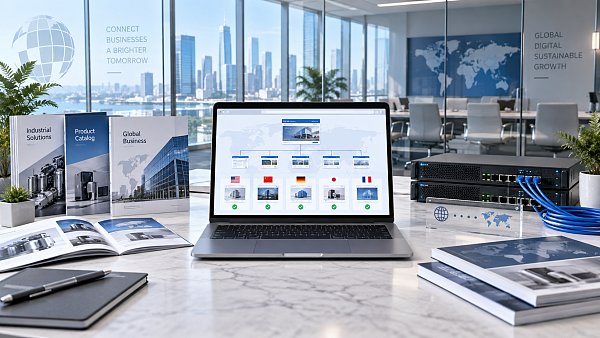
Page Hierarchy Should Serve Purchasing Decisions Rather Than Copying a Chinese Website Directory
Many companies' overseas websites retain the structure of their domestic official websites: company profile, product center, news center, and contact us. Such a hierarchy can present the company, but it may not necessarily address the decision-making path of overseas buyers. B2B visitors often first confirm whether products are suitable, then review application industries, technical capabilities, quality control, delivery terms, and contact information. Therefore, page structure is better organized around “product category—sub-product—application or industry—capability evidence—conversion entry point.”
The product hierarchy should not be too deep. If users need to click four or five times consecutively from the homepage to reach a specific product, both mobile access and search crawling become inefficient. Core products can generally be kept within two to three levels of access, while breadcrumb navigation, related products, and application pages can establish horizontal links. For products with significant specification differences, separate pages are more conducive to explanation than putting dozens of models onto one page. If variations involve only color, packaging, or minor size changes, however, it should be carefully assessed whether separate pages are necessary, in order to avoid creating repetitive pages with thin content.
Language versions should not be mechanically matched one to one either. Some markets focus on minimum order quantities and lead times, while others place greater importance on certifications, installation guidance, or after-sales service networks. Basic product information can be shared, but above-the-fold selling points, case materials, form fields, downloadable resources, and calls to action should allow localized configuration. This is similar to how companies need first to clarify the scope of application and decision-making entities when studying complex issues; for example, when reading specialized materials such as Research on Tax Planning Issues for Power Grid Enterprises, conclusions cannot be applied directly without considering industry conditions. Website architecture is the same: general templates can only provide a starting point and cannot replace market judgment.
Technical Evaluation Should Treat “Operational Usability” as a Hard Criterion
When selecting a solution, in addition to visual design and the initial website development cycle, companies should verify whether the backend supports language-level content management, form routing for different markets, batch page updates, tiered permissions, and version rollback. Once product parameters are adjusted, can multiple language sites be updated simultaneously? Can an agent in a particular region view only leads from that region? Can advertising landing pages be built independently without affecting the main site structure? These questions often determine whether subsequent operations will repeatedly depend on developers.
Basic technical items should also be confirmed: whether pages support mobile responsiveness; whether multilingual URLs are stable and customizable; whether sitemaps, redirects, structured data, and image alt text can be maintained; whether traffic analytics can distinguish between organic search, advertising, social media, and different language versions; and whether forms have anti-spam mechanisms and the necessary privacy notice configurations. Compliance requirements vary across countries and industries. Where data collection, Cookie notices, or content disclosures are involved, they should be handled in accordance with actual local business circumstances and legal advice.
Website Development and Lead Generation Cannot Be Split into Two Separate Projects
Launching a website is only the starting point of the international marketing journey. If the website development team does not understand keyword strategy, advertising landing-page requirements, and social-media traffic-generation paths, it is often necessary later to rebuild sections, add pages, or reimplement tracking. Conversely, if the marketing team does not understand site hierarchy and product data sources, it can easily direct traffic to pages with insufficient information.
Yiyingbao Information Technology (Beijing) Co., Ltd. has continuously served global digital marketing scenarios since 2013, considering intelligent website development, SEO optimization, advertising, social media operations, and AI search visibility optimization within the same business chain. For companies targeting North America, Europe, Southeast Asia, Japan and South Korea, the Middle East, Russian-speaking regions, Latin America, and Africa, its cloud-based intelligent website development and marketing system can be used to centrally manage multilingual official websites, B2B inquiry pages, cross-border online stores, and regional advertising landing pages. When evaluating this type of integrated solution, the focus should not be solely on the number of features, but on whether website data, content updates, lead sources, and subsequent promotion can truly be connected.
Ultimately, languages, domains, and page hierarchy are not three isolated choices. First identify priority markets, then determine the degree of business independence, and finally ensure that the page structure supports the search and decision-making paths of local buyers. This is usually more reliable than pursuing “coverage in more than a dozen languages” from the outset. Before launch, it is advisable to conduct a complete test using a real product: enter through a search result, review specifications, submit an inquiry, assign the lead, and then return to the backend to track its source. Only when this process works end to end does the website have a foundation for continued expansion.
Related Articles
 What are the fundamental differences between B2B website translation and B2C website translation?
 Website Localization Is More Than Translation: What Else Should Be Adjusted Before Entering a New Market?
 How Can Multilingual Website Translation Avoid Machine Translation Distortion and Brand Messaging Inconsistencies


Related Products
 Yiyingbao SaaS Intelligent Website Building and Marketing SystemYiyingbao SaaS Intelligent Website Building and Marketing System, AI-powered no-code website building, rapid creation of multilingual B2B international websites in 10 minutes, global server acceleration, AI-powered SEO optimization, helping businesses connect efficiently with global markets. The perfect integration of technology and operation makes building an international trade website remarkably simple
 AI+SEM Intelligent Advertising Marketing SystemAI+SEM drives intelligent ad creation, empowering full-funnel precision advertising marketing. The system automatically generates weekly/monthly reports, AI recommends keywords and target countries, monitors core metrics in real-time with intelligent alerts, and enables one-click high-conversion ad solutions to help quickly acquire customers and improve ROI.
 AI+SEO Dual-Engine System Optimization ServicesYiyingbao’s AI+SEO dual-engine optimization system helps foreign trade enterprises acquire high-quality organic traffic through AI-powered keyword research, content generation, and comprehensive technical optimization, significantly improving search rankings and conversion rates.
 AI+SNS Social Media Marketing SystemYingbao AI+SNS Social Media Marketing System - Precision social capture for the social media era. Supports one-click content synchronization across major platforms like Facebook and LinkedIn. AI intelligently rewrites posts for enhanced relevance. 24/7 AI customer service and user profiling analysis empower businesses to efficiently expand into global markets.
 AI+SEO营销解决方案易营宝AI+SEO营销解决方案,通过AI批量写作、智能生成TDK、精准关键词扩词等功能,全面优化网站SEO效果,提升流量与转化率。助力企业构建高效智能网站新生态。
 AI+SEM Advertising Marketing SolutionsAI+SEM Advertising Marketing Solution leverages AI technology to deeply empower SEM ad campaigns. It automatically generates weekly/monthly reports using AI, presenting account data across multiple dimensions for comprehensive insights into campaign performance and trends. The system precisely recommends keywords and target countries, intelligently generates high-conversion ad copy, and enables one-click activation of efficient campaign plans to help businesses rapidly acquire customers. Simultaneously, it monitors core metrics in real time, intelligently identifies abnormal fluctuations, and issues timely alerts to ensure stable, high-return advertising results.
 Domain Name ServicesEasyWin provides professional domain name services, including intelligent queries, one-stop registration, brand protection, and full lifecycle management, helping businesses build a digital brand image.
 EasyOperate B2C Cross-Border E-Commerce Platform & Independent WebsiteEasyStore B2C Cross-border E-commerce Independent Store is an intelligent website building and cross-border e-commerce integrated solution independently developed by EasyStore Information Technology (Beijing) Co., Ltd. The system is specially designed for small and medium-sized as well as large export enterprises, integrating 'website building, operation, marketing, advertising, and conversion' into one, helping enterprises quickly establish cross-border e-commerce independent stores to achieve brand globalization and global sales growth.
The platform supports multiple languages, multiple currencies, and multi-channel marketing, with built-in AI intelligent translation and SEO optimization systems, suitable for mainstream markets such as Southeast Asia, Europe and America, Latin America, and the Middle East, assisting Chinese manufacturing enterprises in efficiently deploying international e-commerce strategies. SSL证书易营宝提供专业SSL安全证书服务,包括单域名和泛域名证书,确保网站数据传输加密、身份验证和完整性保护,助力企业建立安全可信的在线业务环境。









