









- Which customer acquisition channels will be affected by cross-border marketing trends in 2026?Sep 06, 2026View details
- Which homogenization risks should be considered in an analysis of the AI-powered website building industry?Aug 30, 2026View details
- How Will AI Marketing Trends 2026 Change Advertising Budget AllocationAug 28, 2026View details
- Is the EV SSL certificate market shrinking or upgrading? How should companies assess certificate procurement?Aug 11, 2026View details
- Why the old AMP SEO 2020 practices no longer work and what has changed in current optimization prioritiesAug 02, 2026View details
- How to Choose Topics for an Industry News Section to Attract More Organic Search TrafficJul 29, 2026View details
What should be noted in the development and optimization of an Arabic website? Layout direction, fonts, and local search habits
Arabic website development and optimization: start with the underlying layout.
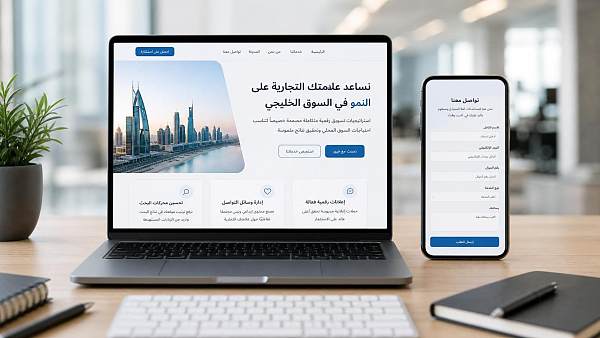
For Arabic website development and optimization, the primary issue isn't translation, but rather page structure. Arabic is read from right to left, abbreviated as RTL. If the direction is wrong, subsequent design, interaction, and SEO will all suffer.
Many companies, when launching Arabic websites, only change the text without altering the code structure. The result is often disorganized navigation, misaligned forms, incorrectly reversed button icons, and a significantly worse mobile reading experience.
In practice, developing and optimizing an Arabic website is more like a complete localization overhaul. During the technical assessment, it's recommended to first check three fundamental aspects: documentation direction, component compatibility, and content rendering logic.
The root node of the page should explicitly declare the direction attribute. A common practice is to set the language and direction simultaneously when switching HTML language versions, so that navigation, carousels, breadcrumbs, pop-ups, and input boxes all enter RTL mode together.
- The root node supports bidirectional switching between RTL and LTR.
- The component library has orientation adaptability.
- Icons, arrows, and page breaks rotate synchronously.
- Rules for retaining readability of numbers, phone numbers, and email addresses
If these underlying capabilities are lacking, subsequent investments in content and promotion after Arabic website development and optimization will struggle to yield stable results. More obvious signs include high bounce rates, short dwell times, and low inquiry form completion rates.
Font compatibility determines display quality and conversion rate
In Arabic website development and optimization, fonts are often underestimated. Arabic letters have ligature characteristics and complex glyph variations. If the wrong font is chosen, titles will appear weak, body text will look cramped, and the brand's professionalism will be directly diminished.
From a technical standpoint, two things need attention. First, does the font fully support the Arabic character set? Second, are the browser and system fallback fonts consistent? Otherwise, the page display will differ significantly across different devices.
It is recommended to prioritize mature and stable Arabic web fonts, and to set up a clear fallback mechanism. Avoid using too many different fonts for titles, navigation, body text, and buttons, as this will disrupt the visual rhythm.
Arabic text typically requires more space in line height and word spacing. Especially on mobile devices, if the same parameters as the English website are used, the content will appear cramped, scanning efficiency will decrease, and users will find it more difficult to quickly find the core information.
- The recommended line height for the main text is slightly higher than that of the Chinese and English websites.
- Avoid using overly bold titles to prevent the connected text from becoming a blurry mess.
- Leave more space for button text to avoid line breaks and distortion.
- The tests focused on Android devices and common browsers in the Middle East.
Recent changes indicate that Arabic website development and optimization is no longer simply about "displaying correctly." Search traffic creates the initial impression. Stable fonts and clear information are crucial for converting visits into inquiries.
The layout should extend to components and forms.
The real challenge in developing and optimizing Arabic websites often lies not in the homepage, but in the detailed pages. Product details, filters, inquiry forms, checkout processes, and article pages are the areas most likely to expose RTL adaptation issues.
For example, form labels are on the right, but the input cursor defaults to starting from the left; another example is when prices, dates, numbers, and units are mixed up, the order is disordered. Once a user hesitates, the conversion path will be lengthened.
Therefore, Arabic website development and optimization must incorporate typography rules into component specifications, rather than relying on front-end developers to patch each page individually. For the technical team, this means creating reusable RTL styles and test cases.
- Navigation, sidebar, and breadcrumbs are all laid out from right to left.
- Carousels, pagination, and step-by-step displays are rearranged according to the reading direction.
- Uniform rules for form prompts, error messages, and placeholder text
- Mixed content allows for separate definition of how numbers and symbols are displayed.
This also means that testing cannot rely solely on visual screenshots. It's also necessary to verify keyboard input, cursor movement, copy and paste, search suggestions, and form submission results. Otherwise, even if the page looks normal, it will still frequently encounter errors in actual use.
Local search habits can influence keyword placement.
Arabic website development and optimization ultimately come down to search visibility. Middle Eastern users' search habits don't entirely mirror those of the English market. Directly translated keywords often have limited search volume, and converted terms may not match actual needs.
When doing SEO, it's important to pay attention to formal expressions, commonly used regional expressions, and purchase-oriented keywords. Arabic-speaking countries have a wide reach, and different regions have varying preferences for industry-specific, service-related, and brand-related keywords.
If Arabic website development and optimization only focuses on page display without simultaneously optimizing titles, descriptions, category structure, and internal linking strategies, search engine indexing may be normal, but ranking competitiveness is usually insufficient.
A more prudent approach is to design the technical architecture and keyword strategy together. Page URLs, title tags, body text semantics, Q&A modules, and product parameter areas should all serve local search intent.
- Expanding long-tail keywords around core keywords
- Adjusting column names to suit local customs
- Product page supplements application scenarios and procurement information.
- The content page now includes frequently asked questions and solutions.
This approach is even more valuable for integrated website and marketing projects. This is because Arabic website development and optimization not only affect organic traffic but also the quality score of ad landing pages and subsequent remarketing performance.
Mobile performance is just as important as other criteria.
Mobile access is generally more prevalent in the Middle Eastern market, so Arabic website development and optimization must prioritize mobile devices. Many issues that are acceptable on desktop are significantly amplified on mobile, especially menus, forms, and font loading.
If the Arabic font file is too large, the initial page load time will be slower. If large images, animations, and multiple third-party scripts are added on top, the page's usability time will be extended, and users will leave before they even see the core content.
Therefore, performance must be included in the acceptance testing of Arabic website development and optimization. This includes font subsets, image compression, caching strategies, script lazy loading, and prioritizing the rendering of critical content, all of which directly impact SEO and conversion rates.
For companies aiming for long-term operations in the Middle Eastern market, mobile experience isn't a bonus, but a fundamental requirement. The more robust the Arabic website development and optimization, the lower the subsequent traffic acquisition costs will typically be.
How to establish a feasible acceptance checklist
To assess whether a project has truly completed Arabic website development and optimization, the evaluation can be broken down into four layers: code layer, presentation layer, search layer, and conversion layer. This approach will be more accurate than simply looking at the page itself.
At the code level, consider direction switching, component compatibility, and structural semantics. At the presentation level, consider fonts, layout, icons, forms, and consistency across multiple platforms. At the search level, consider indexes, tags, internal links, and keyword placement. At the conversion level, consider the smoothness of the inquiry path.
These types of projects are better suited to be collaboratively managed by teams specializing in website building, SEO, content creation, and advertising. EasyCreative has long served multilingual websites and overseas marketing scenarios, and its core approach is to integrate website adaptation, search engine optimization, and growth/conversion into a single system.
In summary, optimizing Arabic websites involves more than just reversing the direction and font display. What truly determines the outcome is whether technical specifications, local search habits, mobile performance, and conversion paths can all be effectively integrated.
When businesses prepare to enter the Middle Eastern market, they should first ensure their Arabic website development and optimization are done correctly before scaling up traffic; this makes their investment more certain. This is also a crucial step for multilingual websites to move from simply "going live" to "growing successfully."
Related Articles
Related Products
 Yiyingbao SaaS Intelligent Website Building and Marketing SystemYiyingbao SaaS Intelligent Website Building and Marketing System, AI-powered no-code website building, rapid creation of multilingual B2B international websites in 10 minutes, global server acceleration, AI-powered SEO optimization, helping businesses connect efficiently with global markets. The perfect integration of technology and operation makes building an international trade website remarkably simple
 AI+SEM Intelligent Advertising Marketing SystemAI+SEM drives intelligent ad creation, empowering full-funnel precision advertising marketing. The system automatically generates weekly/monthly reports, AI recommends keywords and target countries, monitors core metrics in real-time with intelligent alerts, and enables one-click high-conversion ad solutions to help quickly acquire customers and improve ROI.
 AI+SEO Dual-Engine System Optimization ServicesYiyingbao’s AI+SEO dual-engine optimization system helps foreign trade enterprises acquire high-quality organic traffic through AI-powered keyword research, content generation, and comprehensive technical optimization, significantly improving search rankings and conversion rates.
 AI+SNS Social Media Marketing SystemYingbao AI+SNS Social Media Marketing System - Precision social capture for the social media era. Supports one-click content synchronization across major platforms like Facebook and LinkedIn. AI intelligently rewrites posts for enhanced relevance. 24/7 AI customer service and user profiling analysis empower businesses to efficiently expand into global markets.
 AI+SEO营销解决方案易营宝AI+SEO营销解决方案,通过AI批量写作、智能生成TDK、精准关键词扩词等功能,全面优化网站SEO效果,提升流量与转化率。助力企业构建高效智能网站新生态。
 AI+SEM Advertising Marketing SolutionsAI+SEM Advertising Marketing Solution leverages AI technology to deeply empower SEM ad campaigns. It automatically generates weekly/monthly reports using AI, presenting account data across multiple dimensions for comprehensive insights into campaign performance and trends. The system precisely recommends keywords and target countries, intelligently generates high-conversion ad copy, and enables one-click activation of efficient campaign plans to help businesses rapidly acquire customers. Simultaneously, it monitors core metrics in real time, intelligently identifies abnormal fluctuations, and issues timely alerts to ensure stable, high-return advertising results.
 Domain Name ServicesEasyWin provides professional domain name services, including intelligent queries, one-stop registration, brand protection, and full lifecycle management, helping businesses build a digital brand image.
 EasyOperate B2C Cross-Border E-Commerce Platform & Independent WebsiteEasyStore B2C Cross-border E-commerce Independent Store is an intelligent website building and cross-border e-commerce integrated solution independently developed by EasyStore Information Technology (Beijing) Co., Ltd. The system is specially designed for small and medium-sized as well as large export enterprises, integrating 'website building, operation, marketing, advertising, and conversion' into one, helping enterprises quickly establish cross-border e-commerce independent stores to achieve brand globalization and global sales growth.
The platform supports multiple languages, multiple currencies, and multi-channel marketing, with built-in AI intelligent translation and SEO optimization systems, suitable for mainstream markets such as Southeast Asia, Europe and America, Latin America, and the Middle East, assisting Chinese manufacturing enterprises in efficiently deploying international e-commerce strategies. SSL证书易营宝提供专业SSL安全证书服务,包括单域名和泛域名证书,确保网站数据传输加密、身份验证和完整性保护,助力企业建立安全可信的在线业务环境。









